
Introduction
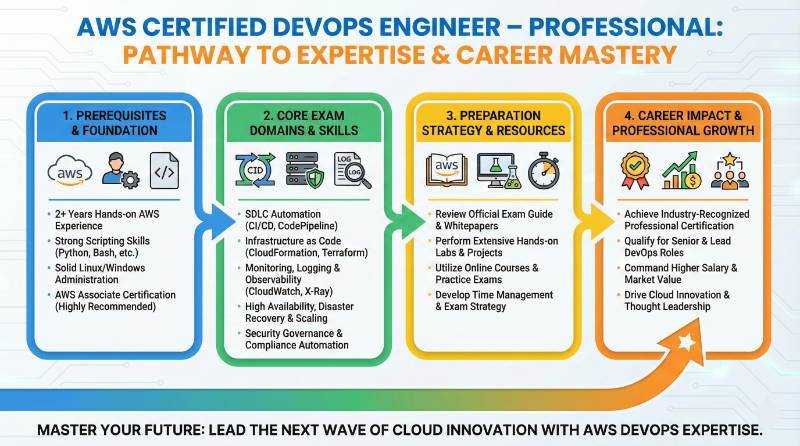
Modern engineering teams face a relentless pressure — ship software faster, keep systems reliable, and never let security or costs spiral out of control. The AWS DevOps Engineer – Professional certification is built for engineers and managers who want to master this balance on AWS, proving they can design, automate, and operate production-grade cloud systems end-to-end.
Whether you are a software engineer in India looking to level up, a platform engineer scaling delivery pipelines, or an engineering manager leading cloud transformation, this guide covers everything you need — skills, exam prep, career paths, learning roadmaps, and next steps — all in one place.
What Exactly is AWS DevOps Engineer – Professional?
AWS Certified DevOps Engineer – Professional is an advanced-level certification that validates your technical expertise in provisioning, operating, and managing distributed application systems on AWS.
It is designed for engineers who perform a DevOps role and goes well beyond basic cloud knowledge — it proves you can implement continuous delivery systems, automate security and compliance controls, define monitoring and logging frameworks, and build systems that are highly available, scalable, and self-healing on AWS.
Why Should You Care About This Certification?
- It separates engineers who build and run production systems from those who only write code.
- It strengthens your credibility when discussing architecture, reliability, and automation with senior stakeholders.
- For managers, it gives you the technical depth to lead cloud teams, evaluate toolchain choices, and make informed delivery decisions.
- It consistently ranks among the top certifications that software engineers pursue for career advancement.
Exam at a Glance
| Detail | Info |
|---|---|
| Full name | AWS Certified DevOps Engineer – Professional (DOP-C02) |
| Difficulty | Advanced / Professional |
| Exam duration | 180 minutes |
| Number of questions | 75 |
| Question format | Multiple choice and multiple response |
| Core domains | SDLC automation, IaC, resilient systems, monitoring, incident response, security |
| Recommended training | DevOpsSchool |
| Official certification URL | AWS DevOps Engineer – Professional |
Deep Dive: AWS DevOps Engineer – Professional
What It Is
AWS DevOps Engineer – Professional certifies that you can design, build, and manage automated production environments on AWS at scale.
It goes beyond basic cloud knowledge — you are expected to know how pipelines break, how infrastructure drifts, and how to fix both without touching servers manually.
It is the gold standard for cloud DevOps professionals working on real, high-stakes AWS environments.
Who Should Take It
- DevOps Engineers who manage CI/CD, deployments, and environments on AWS daily
- SRE and Platform Engineers responsible for production reliability and internal tooling automation
- Senior Software Developers ready to expand into DevOps, SRE, or platform responsibilities
- Cloud Engineers handling enterprise-scale, multi-account AWS architectures
- Engineering Managers who want hands-on technical credibility to guide cloud transformation initiatives
Skills You Will Walk Away With
- Designing end-to-end CI/CD pipelines using AWS-native developer tools
- Writing and managing Infrastructure as Code using CloudFormation and CDK
- Setting up centralized logging, distributed tracing, dashboards, and intelligent alerting
- Architecting fault-tolerant, self-healing systems with automated recovery mechanisms
- Embedding security guardrails, encryption, and compliance checks directly into delivery pipelines
- Building and operating multi-account, multi-region AWS environments
- Creating incident runbooks and auto-remediation workflows that reduce mean time to recovery
Real-World Projects You Should Be Able to Do
- Set up a full CI/CD pipeline with stage gates, automated testing, canary or blue/green deployments, and instant rollback for AWS microservices
- Provision entire environments — networking, compute, storage, databases, and observability stack — using Infrastructure as Code, repeatable across accounts
- Build a centralized observability platform with automated Lambda-based self-healing triggered by CloudWatch alarms
- Harden delivery pipelines with IAM least-privilege roles, AWS Config rules, and automated compliance reports
- Implement resource tagging policies, budget alerts, and scheduled automation for cost optimization across cloud environments
Preparation Plan
7–14 days — For engineers actively working on AWS
- Go through the official exam guide domain-by-domain and map each area to your current project experience
- Take one full-length practice exam on day one to find your weak spots
- Focus remaining days entirely on those gaps with targeted labs and AWS documentation
30 days — For engineers with some AWS and DevOps exposure
- Week 1: Revisit core AWS services through a DevOps and operations lens — EC2, ECS/EKS, Lambda, VPC, IAM, CloudWatch, CloudTrail, S3
- Week 2: Build hands-on labs covering CI/CD workflows, IaC templates, and logging/alerting setups
- Week 3: Work through scenario-based questions, AWS architecture whitepapers, and reference architectures
- Week 4: Sit for multiple practice exams, analyse every wrong answer, and do a light revision
60 days — For engineers building up DevOps knowledge
- Month 1: Strengthen Linux, Git, scripting, containers, and AWS fundamentals at an associate level before touching professional topics
- Month 2: Deep-dive into advanced areas — multi-account design, security automation, complex CI/CD, and large-scale observability
- Final 2 weeks: Full mock exams, thorough error analysis, and concise revision notes
Common Mistakes to Avoid
- Treating this like a multiple-choice theory test instead of a scenario-driven architecture exam
- Focusing only on pipelines while underestimating monitoring, incident response, and cost optimization questions
- Weak preparation on IAM boundaries, service control policies, and compliance automation
- Skipping multi-account and cross-region architecture concepts entirely
- Watching videos without doing any hands-on labs or building real pipelines
- Not practising timed full-length mock exams before the actual exam
Best Next Certification After This
- Same track — Certified DevOps Architect to move from engineering to architecture and governance
- Cross-track — DevSecOps Certified Professional to embed security deeply into cloud and DevOps workflows
- Leadership — Certified DevOps Manager for professionals stepping into team leadership, transformation programs, and strategic delivery roles
Choose Your Path: 6 Career Learning Paths
1. DevOps Path
Begin with foundational DevOps certifications and move into role-specific programs like Certified DevOps Engineer and AWS DevOps Engineer – Professional. Graduate into architecture and leadership with Certified DevOps Architect and Certified DevOps Manager.
2. DevSecOps Path
Use AWS DevOps Engineer – Professional as your technical foundation. Then pursue DevSecOps Certified Professional to shift security left — embedding it into pipelines, code reviews, and cloud architectures from day one.
3. SRE Path
AWS DevOps Engineer – Professional gives you deep automation, monitoring, and incident management skills. Build on this with SRE-specific training covering error budgets, SLOs, chaos engineering, and production reliability at scale.
4. AIOps / MLOps Path
Start with cloud automation and observability from AWS DevOps Engineer – Professional. Then move into AIOps to learn intelligent alerting, automated anomaly detection, and MLOps to manage model deployment pipelines at production scale.
5. DataOps Path
Apply DevOps automation principles to data pipelines, quality testing, and data platform deployments. Combining AWS DevOps Engineer – Professional with DataOps-focused training makes you invaluable in data-driven cloud engineering environments.
6. FinOps Path
Pair your AWS DevOps automation expertise with cloud financial management skills. FinOps-focused training helps you build cost-aware architectures, optimize cloud spend, and bridge the gap between engineering and finance teams.
Role → Recommended Certifications
| Role | Recommended Path |
|---|---|
| DevOps Engineer | Certified DevOps Professional → Certified DevOps Engineer → AWS DevOps Engineer – Professional → Certified DevOps Architect |
| SRE | Certified DevOps Professional → AWS DevOps Engineer – Professional → SRE-focused certifications and training |
| Platform Engineer | Certified DevOps Engineer → AWS DevOps Engineer – Professional → Certified DevOps Architect |
| Cloud Engineer | AWS associate-level certifications → AWS DevOps Engineer – Professional → Cloud architect-level programs |
| Security Engineer | DevSecOps Certified Professional → AWS DevOps Engineer – Professional → Advanced security certifications |
| Data Engineer | Certified DevOps Professional → DataOps training → AWS and data engineering certifications |
| FinOps Practitioner | Cloud foundation → FinOps-focused programs → AWS DevOps Engineer – Professional for technical depth |
| Engineering Manager | Certified DevOps Professional → AWS DevOps Engineer – Professional → Certified DevOps Architect → Certified DevOps Manager |
Top Training cum Certification Institutions
DevOpsSchool
DevOpsSchool is one of India’s most trusted platforms for AWS DevOps Engineer – Professional preparation, offering instructor-led training with 100+ labs, real-time project scenarios, and a detailed interview preparation kit.
They support the full career ecosystem — DevOps, DevSecOps, SRE, AIOps, DataOps, and FinOps — making them the go-to platform for engineers planning long-term multi-domain growth.
Their combination of structured curriculum and mentorship-driven delivery helps both freshers and experienced engineers crack the professional-level exam with confidence.
Cotocus
Cotocus specializes in enterprise-grade training that aligns DevOps and cloud programs closely with real organizational delivery environments and project constraints.
Their training helps engineering teams adopt DevOps and AWS practices at scale, blending exam preparation with organization-specific scenarios and toolchain workflows.
This makes Cotocus a strong partner for companies driving AWS cloud transformation across large teams.
Scmgalaxy
Scmgalaxy is a practitioner-driven platform built around source code management, CI/CD tooling, and foundational DevOps skills with strong community roots.
Engineers who want deep, practical coverage of version control systems, build automation tools, and DevOps implementation patterns will find Scmgalaxy highly relevant before attempting the professional exam.
Their tutorials and resources are widely referenced among DevOps practitioners across India and beyond.
BestDevOps
BestDevOps is a central discovery hub that aggregates training resources, course comparisons, community content, and certification guidance across the DevOps landscape.
Engineers preparing for AWS DevOps Engineer – Professional can use it to explore multiple preparation paths, compare study materials, and stay current on evolving industry practices.
It is especially useful early in your preparation journey when deciding which structured program to commit to.
devsecopsschool.com
DevsecopsSchool focuses entirely on DevSecOps, helping engineers embed security practices — secure coding, automated scanning, policy-as-code, and threat modelling — into every DevOps pipeline stage.
Pairing AWS DevOps Engineer – Professional with this platform’s programs creates a highly sought-after profile for secure cloud roles in banking, fintech, healthcare, and government sectors.
It is the logical next step for AWS DevOps engineers who want to specialize in cloud security and compliance engineering.
sreschool.com
SREschool is dedicated exclusively to Site Reliability Engineering, teaching production observability, SLO design, error budget management, and systematic incident response at scale.
It extends AWS DevOps Engineer – Professional skills into the SRE domain, shifting the focus from delivery pipelines to production system reliability and resilience.
Engineers who want to move into SRE roles at product companies or large-scale platforms will find this combination highly powerful.
aiopsschool.com
AIOpsschool focuses on intelligent operations, teaching how machine learning algorithms, anomaly detection, and AI-driven automation can replace manual monitoring and triage in complex cloud environments.
DevOps and SRE professionals with AWS DevOps foundations can use this platform to move into AIOps and intelligent incident management roles that are increasingly in demand.
It is the right step for engineers who want to lead the next wave of AI-assisted operations on cloud-native platforms.
dataopsschool.com
DataOpsschool applies DevOps principles — automation, testing, continuous delivery — specifically to data pipelines, analytics platforms, and data governance workflows.
Combined with AWS DevOps Engineer – Professional, it prepares engineers to build, operate, and govern large-scale data infrastructure where delivery speed and data quality must coexist.
Data engineers, analytics engineers, and platform engineers managing data-heavy AWS environments will find this combination especially impactful.
finopsschool.com
FinOpsschool bridges the gap between cloud engineering and financial management, teaching cost optimization frameworks, cloud budgeting, resource governance, and value attribution strategies.
Engineers and managers who combine AWS DevOps expertise with FinOps skills become uniquely capable of leading cost-efficient cloud programs that deliver measurable business value.
As cloud budgets grow, this combination of technical and financial fluency is becoming a genuine differentiator in the job market.
Next Certifications After AWS DevOps Engineer – Professional
1. Same Track — Go Deeper into DevOps
Certified DevOps Architect (CDA) — Design enterprise-wide DevOps architectures, governance models, toolchain strategies, and multi-team delivery patterns.
2. Cross-Track — Add a Specialist Dimension
- DevSecOps Certified Professional (DSOCP) — Shift security left and build secure delivery pipelines from the ground up.
- SRE or DataOps certifications — For engineers moving into reliability engineering or data platform roles.
3. Leadership Track — Step Into Strategy
Certified DevOps Manager — Learn how to scale DevOps programs across large organizations, manage engineering roadmaps, and drive cultural transformation.
FAQs
Q1. How hard is the AWS DevOps Engineer – Professional exam?
It is genuinely challenging because every question presents a realistic AWS scenario requiring you to apply knowledge, not just recall it.
Consistent hands-on practice and real project experience make a significant difference in how approachable the exam feels.
Q2. How much time do I need to prepare?
Experienced AWS practitioners typically need 2–4 weeks of focused preparation.
Engineers newer to advanced AWS topics should budget 1–2 months to cover both the knowledge gaps and hands-on practice.
Q3. Is an AWS associate certification mandatory before this?
No, it is not mandatory — but it is strongly advisable.
Associate-level knowledge of AWS services gives you the foundation needed to tackle professional-level scenario questions with confidence.
Q4. Is this useful for software engineers who are not DevOps specialists?
Absolutely. Software engineers who understand how their code gets deployed, monitored, and recovered in production become far more valuable to their teams.
This certification accelerates that transition from developer to full-cycle engineer.
Q5. What AWS services are critical for the exam?
You must know CodePipeline, CodeBuild, CodeDeploy, CodeCommit, CloudFormation, CDK, ECS/EKS, Lambda, CloudWatch, CloudTrail, Systems Manager, Config, GuardDuty, and IAM in depth.
Q6. Can this help me move into SRE or DevSecOps roles?
Yes. The exam builds the observability, incident management, and automation skills that are foundational to SRE roles.
Adding DevSecOps Certified Professional on top makes you a strong candidate for secure engineering and reliability roles.
Q7. Is DevOpsSchool a reliable place to prepare for this exam?
DevOpsSchool offers a structured, lab-heavy program with real-time project scenarios and interview preparation, making it one of the most practical preparation options available.
Their focus on hands-on learning aligns well with the scenario-driven nature of the actual exam.
Q8. What is the salary impact of this certification?
Cloud and DevOps professional certifications are consistently linked to senior-level roles and higher compensation bands globally.
The real financial impact accelerates when the certification is backed by visible project outcomes — migrations, reliability improvements, or significant cost savings.
Q9. Can I take this exam from home in India?
Yes, AWS provides online proctored testing through Pearson VUE and PSI, both fully accessible from India.
Q10. How does this certification help engineering managers?
It gives managers the technical depth to evaluate architecture proposals, guide toolchain decisions, and coach engineers on AWS DevOps best practices with credibility.
It also strengthens their ability to communicate complex cloud delivery concepts to non-technical business stakeholders.
Q11. How often does AWS update the exam?
AWS reviews and updates certification exams periodically to keep pace with new services, changing best practices, and industry evolution.
Always check the latest official exam guide before beginning your preparation to ensure your study plan is current.
Q12. What is the smartest study strategy for this exam?
Build a mini AWS project that touches CI/CD, IaC, monitoring, security, and incident response together — then study the exam guide to fill remaining gaps, complete 200+ practice questions, and take at least two full timed mock exams.
Conclusion
AWS DevOps Engineer – Professional is more than a certification — it is a statement that you can own the full delivery and operations lifecycle on AWS with confidence and precision.
Whether you are an engineer looking to level up, an SRE building resilient platforms, or a manager driving cloud transformation, this credential gives you the skills, credibility, and career momentum to grow in the direction you choose — DevSecOps, SRE, AIOps, DataOps, FinOps, or leadership.
