
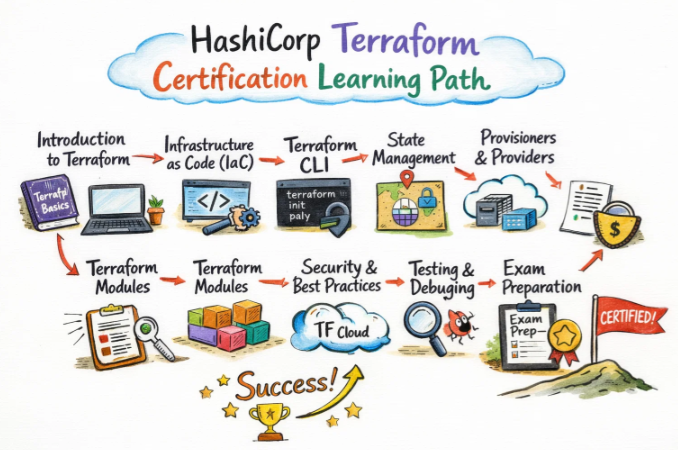
Introduction
Most modern teams now run on one or more clouds, with dozens or hundreds of resources per environment. Doing all of this by hand in a web console is slow, risky, and hard to track. HashiCorp Terraform solves this by letting you manage infrastructure as code, and the HashiCorp Certified: Terraform Associate certification proves you know how to use it in a professional way.
This guide is written for working engineers and managers in India and around the world. It explains Hashicorp Terraform training & certification in simple language: what the certification is, who should consider it, what skills you will gain, how to prepare in different time windows, and how it fits into careers in DevOps, DevSecOps, SRE, AIOps/MLOps, DataOps, and FinOps.
What Is Hashicorp Terraform Training & Certification?
Terraform is an Infrastructure as Code (IaC) tool from HashiCorp. You write configuration files that describe your infrastructure, then use Terraform commands to create, change, and destroy those resources in a controlled, repeatable way. The Hashicorp Terraform Training & Certification certification checks that you understand these core ideas and can work with Terraform on real projects.
Key facts about the Terraform Associate exam (current pattern):
- Associate‑level certification focused on Terraform 1.x and Terraform Cloud / HCP basics.
- Multiple‑choice and multiple‑select questions.
- Time‑limited online exam with remote proctoring.
- Focus on concepts, workflows, and best practices rather than deep coding.
Typical topics include:
- What Infrastructure as Code is and why teams use it.
- Terraform workflow:
init,plan,apply,destroy. - HashiCorp Configuration Language (HCL): resources, variables, outputs, data sources.
- Providers, backends, and state management.
- Modules, input/output variables, and code reuse.
- Terraform Cloud / HCP features at a basic level.
Who Should Take Terraform Training & Certification?
Terraform certification suits many roles that touch cloud infrastructure. It is especially useful for:
- DevOps Engineers and SREs who manage environments for many applications.
- Platform and Cloud Engineers who handle multi‑cloud or hybrid setups.
- Software Engineers who often provision or adjust infrastructure for their services.
- Engineering Managers and Architects who want a solid IaC foundation to guide their teams.
Good starting skills:
- Basic knowledge of at least one cloud provider (AWS, Azure, GCP, etc.).
- Comfort with the command line and Git.
- Basic understanding of infrastructure pieces like compute, network, storage, and IAM.
Terraform Certification Table
| Track | Level | Who it’s for | Prerequisites (recommended) | Skills covered (summary) | Recommended order |
|---|---|---|---|---|---|
| Hashicorp Terraform training & certification (Terraform Associate) | Associate | DevOps, SRE, cloud, platform engineers, developers | Basic cloud concepts, CLI + Git, some Terraform hands‑on practice | IaC basics, Terraform workflow, HCL syntax, providers, variables, outputs, state, modules, workspaces, Terraform Cloud basics | First Terraform / IaC certification |
| Advanced Terraform / infrastructure automation (reference) | Professional | Senior Terraform, platform, and cloud engineers | Terraform Associate + strong real‑world use | Complex modules, large‑scale state management, collaboration patterns, advanced workflows | After Associate and multiple real projects |
| HashiCorp Vault training & certification (reference) | Associate | Security, DevSecOps, platform engineers | Cloud basics + interest in secrets and security | Secrets management, encryption, access control, basic Terraform + Vault integration | Cross‑track after or alongside Terraform Associate |
In this guide, we treat the Associate‑level Terraform certification as the main focus.
Hashicorp Terraform Training & Certification
What it is
The Hashicorp Terraform training & certification path prepares you for the Terraform Associate exam and for real‑life Terraform work. It teaches you how to define infrastructure in code, run the Terraform workflow correctly, structure configurations with modules, and manage state safely.
Who should take it
- People in DevOps or SRE roles who want repeatable environments.
- Cloud and Platform Engineers who build shared platforms.
- Developers who frequently set up infrastructure for their services.
- Managers and architects planning Infrastructure as Code adoption in their teams.
Skills you’ll gain
- Understand and explain Infrastructure as Code and Terraform’s role.
- Use Terraform CLI:
init,validate,plan,apply,destroy. - Write basic and intermediate HCL: resources, variables, outputs, data sources, locals.
- Configure providers and remote backends for state storage.
- Split infrastructure into reusable modules with clear inputs and outputs.
- Use workspaces and basic Terraform Cloud or HCP features for team use.
Real‑world projects you should be able to do after it
- Build a Terraform configuration for a small application stack: network, compute, security groups, and storage.
- Create separate dev/test/prod environments using variables and workspaces without copy‑pasting code.
- Develop and publish simple modules that your team can reuse in multiple repositories.
- Move state from local files to a shared remote backend with locking.
- Integrate Terraform into a CI/CD pipeline so plans and applies happen in a controlled, auditable way.
Preparation Plan
7–14 Days – Fast Track
Use this plan if you already use Terraform in your day‑to‑day work.
- Days 1–2: Read the official exam objectives and mark topics you rarely use (for example, complex types, functions, Terraform Cloud features).
- Days 3–6: Do focused hands‑on labs only on weak areas; keep each lab small and targeted.
- Days 7–10: Take 2–3 full practice exams under time pressure and review every mistake in detail.
- Remaining days: Light revision of commands, common HCL patterns, and edge‑case questions.
30 Days – Working Professional
Use this if you have some Terraform experience but not daily usage.
- Week 1:
- Learn or review IaC concepts and Terraform basics.
- Install Terraform, set up a provider, and manage a single resource end‑to‑end.
- Week 2:
- Explore HCL: variables, outputs, data sources, expressions, and functions.
- Build a small environment with multiple resources and practice
planvsapply.
- Week 3:
- Learn modules, version constraints, and remote state backends.
- Create at least one local module and one that mimics a registry module.
- Week 4:
- Work with workspaces and basic Terraform Cloud / HCP concepts.
- Take practice exams and focus on any topics where you still feel shaky.
60 Days – Deep‑Dive
Use this if you are new to both cloud and Terraform.
- Weeks 1–2: Learn basic cloud (compute, network, storage, IAM) and create resources manually. Then reproduce the same with Terraform.
- Weeks 3–4: Go through all Terraform topics: workflow, HCL, providers, state, modules, Terraform Cloud basics, using lots of small labs.
- Weeks 5–6: Build a “mini‑production” setup using modules and remote state, then spend the final weeks on timed practice tests and addressing weak areas.
Common Mistakes
- Memorising commands without doing enough real Terraform labs.
- Ignoring state internals, remote backends, and locking until the last minute.
- Skipping modules and writing everything in one big file.
- Not reading the latest exam objectives and missing new topics.
- Going to the exam without practising under time limits.
Best Next Certification After Terraform Associate
After you complete Hashicorp Terraform training & certification, you can move in different directions:
- Same track (IaC depth): advanced Terraform/infrastructure automation certifications, focusing on large‑scale modules, collaboration, and operations.
- Cross‑track (cloud depth): cloud architect or developer certifications (AWS, Azure, GCP) so you combine strong IaC with deep cloud design skills.
- Leadership: architecture or platform‑leadership programs that emphasise multi‑cloud strategy, governance, and team practices, with Terraform as your IaC anchor.
You can map each of these to specific popular certifications when you publish the blog.
Choose Your Path: 6 Learning Paths
DevOps path
Terraform becomes your default tool for provisioning and updating infrastructure. You pair it with CI/CD and configuration management, so the full path from code commit to running app and infrastructure is automated and repeatable.
DevSecOps path
In this path, you use Terraform to codify security: network rules, IAM, logging, encryption, and baseline controls. You also add policy‑as‑code tools and checks in your pipelines so insecure Terraform changes are caught early.
SRE path
As an SRE, Terraform lets you treat infrastructure as part of reliability engineering. You fix issues by editing code and applying changes, not by making temporary manual adjustments, and you link Terraform changes with SLOs and incident post‑mortems.
AIOps/MLOps path
Terraform provisions the infrastructure for data and machine learning systems: clusters, storage, networks, and supporting services. You combine Terraform with MLOps tools so model training and serving environments can be created, updated, and destroyed in a controlled way.
DataOps path
Complex data platforms depend on many cloud services. Terraform helps you describe these dependencies as code so environments are consistent, versioned, and auditable. DataOps practices then focus on pipeline logic and data quality on top of a stable platform.
FinOps path
Terraform gives visibility into what infrastructure exists and how it changes. With FinOps skills, you use tagging, module defaults, and review processes to align Terraform code with cost, budget, and governance goals.
Role → Recommended Certifications
| Role | Recommended certification flow (with Terraform Associate) |
|---|---|
| DevOps Engineer | Cloud basics → Terraform Associate → cloud DevOps/architect certification |
| SRE | Cloud basics → Terraform Associate → SRE/observability and reliability training |
| Platform Engineer | Cloud + containers → Terraform Associate → Kubernetes / platform architect certifications |
| Cloud Engineer | Cloud associate cert → Terraform Associate → cloud solutions architect |
| Security Engineer | Security fundamentals → Terraform Associate → DevSecOps / Vault / cloud security certs |
| Data Engineer | Data platform basics → Terraform Associate → data/analytics or cloud data certifications |
| FinOps Practitioner | Cloud basics → Terraform Associate → FinOps / cost and governance programs |
| Engineering Manager | Cloud concepts → Terraform Associate → architecture and platform‑leadership tracks |
Top Training Partners for Terraform Training & Certification
DevOpsSchool
DevOpsSchool runs a focused Hashicorp Terraform training & certification course for the Terraform Associate exam. It mixes theory with hands‑on labs and exam‑style questions, and is structured for busy professionals who want to gain both certification and practical skills.
Cotocus
Cotocus offers structured paths where Terraform is learned alongside Kubernetes, cloud provider certifications, and automation tools. This is helpful if you want Terraform to be part of a broader, multi‑month progression into senior DevOps or platform roles.
Scmgalaxy
Scmgalaxy emphasises real‑world DevOps scenarios. Its Terraform content shows how to plug Terraform into CI/CD, team workflows, and environment management so you learn how to use Terraform in day‑to‑day work, not only for the exam.
BestDevOps
BestDevOps curates DevOps and cloud‑native content, including Terraform training, and encourages learners to combine Terraform with containers, Kubernetes, and observability. This makes it easier to position Terraform Associate as one piece of a complete DevOps skill stack.
devsecopsschool.com
devsecopsschool.com focuses on DevSecOps. It helps you combine Terraform with security ideas like policy‑as‑code, secure defaults, and compliance checks, which is useful for using Terraform in regulated or high‑risk environments.
sreschool.com
sreschool.com trains engineers in SRE practices. When combined with Terraform training, it helps you design infrastructure that supports reliability targets, and manage changes through code that is linked to incidents and SLOs.
aiopsschool.com
aiopsschool.com specialises in AIOps and automated operations. Terraform skills pair well with this, allowing you to take insights from monitoring and feed them back into controlled infrastructure changes.
dataopsschool.com
dataopsschool.com is focused on DataOps and analytics platforms. With Terraform Associate skills, you can codify the infrastructure for data lakes, pipelines, and analytics services, while DataOps training focuses on data flow and quality.
finopsschool.com
finopsschool.com teaches FinOps and cloud cost optimisation. When you combine this with Terraform, you can link cost to specific Terraform modules, tags, and changes, and help teams keep infrastructure both reliable and cost‑effective.
FAQs – Hashicorp Terraform Training & Certification
- Is the Terraform Associate exam very difficult?
It is not extremely hard, but it does expect you to understand the Terraform workflow, configuration language, state, and modules well. With regular practice, most engineers can pass it. - How long does it normally take to prepare?
Many working professionals need about 3–8 weeks, depending on their cloud background and how many hours they can study each week. - Do I need cloud experience before learning Terraform?
Yes, at least basic cloud knowledge is important so you know what resources you are managing, like instances, networks, and storage. - Is Terraform Associate a good first DevOps certification?
Yes, if you already know some cloud basics. It gives you a strong Infrastructure as Code foundation that works well with later Kubernetes or cloud architect certifications. - Do I need to know programming to pass this exam?
You do not need heavy programming skills, but you must be comfortable writing and reading HCL and working with variables and simple expressions. - How does Terraform certification help my career?
Terraform is widely used in DevOps, SRE, and platform roles. The certification shows that you can manage infrastructure using modern IaC practices instead of ad‑hoc manual changes. - Is Terraform still useful when each cloud has its own IaC tool?
Yes. Terraform is provider‑neutral, so you can use the same language and workflow across multiple clouds and services. - Can Terraform certification support remote job opportunities?
It can. Many remote DevOps and cloud positions list Terraform as a key skill, so having certification helps you stand out. - Does the Terraform Associate certification expire?
Yes, it is valid only for a limited period (typically two years). After that you need to pass an updated exam to stay certified. - Can I pass with self‑study, or do I need a course?
Self‑study is possible if you are disciplined and do enough labs and practice questions. A structured course can save time and give you clearer guidance if your schedule is busy. - What order should I follow Terraform and other certifications in?
A simple path is: cloud fundamentals → Terraform Associate → Kubernetes or cloud architect cert → advanced DevOps or security certifications depending on your role. - How does Terraform Associate compare to other popular certifications?
Many popular certifications focus on cloud services or development. Terraform Associate focuses on infrastructure automation, which complements those credentials and is highly valued in platform and DevOps teams.
Conclusion
The Hashicorp Terraform training & certification path is one of the most effective ways to move from manual cloud work to Infrastructure as Code. It helps you speak a common language for infrastructure, use a clear workflow for changes, and encode best practices into reusable modules instead of one‑off scripts.
For engineers and managers in India and globally, Terraform certification fits smoothly into longer journeys in DevOps, DevSecOps, SRE, AIOps/MLOps, DataOps, and FinOps. When you combine it with cloud provider and architecture‑oriented certifications, you build a career profile based on repeatable, auditable, and cost‑aware infrastructure—exactly what modern organisations look for.
