
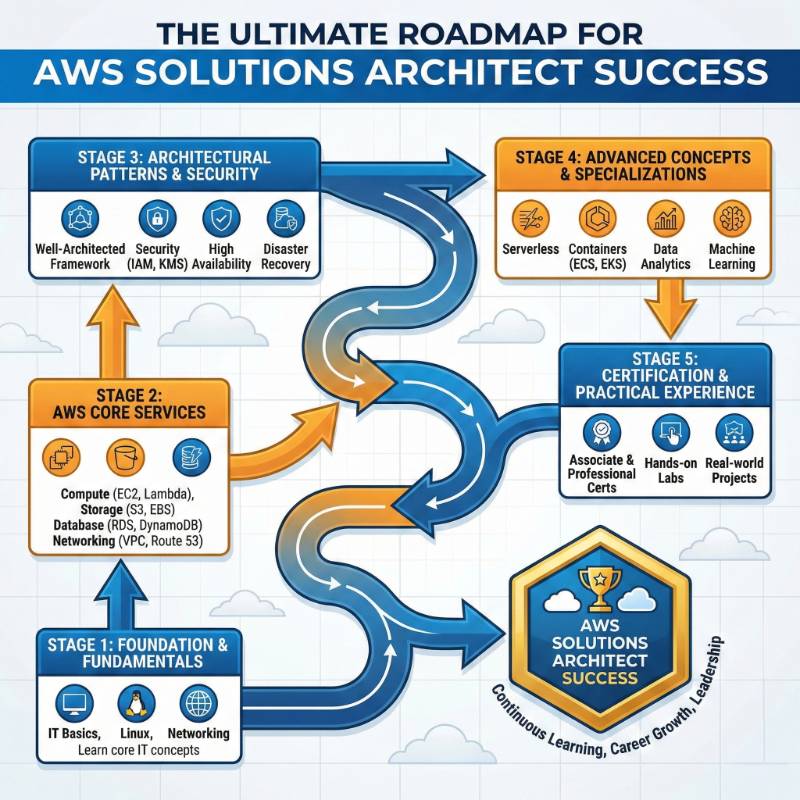
Introduction
The tech world is changing fast. A few years ago, it was enough to know how to write code or manage a single server. Today, businesses want engineers who can see the whole picture. They want professionals who can design systems that are secure, fast, and don’t cost a fortune to run. This is where the AWS Certified Solutions Architect – Associate (SAA-C03) comes in.
I have spent many years building and fixing large-scale systems. If there is one thing I have learned, it is that certifications are not just about the paper. They are about the mental shift. This guide is written for software engineers and managers in India and across the globe who want to stop being “just a coder” and start being a “system designer.”
AWS Certification Track: A Clear Overview
Before you start, you need to see the big picture. AWS has many certifications, but you don’t need all of them. Here is how they look.
Table: AWS Certification Roadmap
| Track | Level | Who it’s for | Prerequisites | Skills Covered | Recommended Order |
| Foundational | Beginner | Non-tech/Newbies | None | Cloud Basics, Billing | 1st |
| Architect | Associate | Engineers/Managers | None | VPC, S3, EC2, RDS | 2nd |
| Operations | Associate | SysAdmins | Basic AWS | Monitoring, Patching | 3rd (Optional) |
| Developer | Associate | Devs/Coders | Basic AWS | Serverless, SDKs, CI/CD | 3rd (Optional) |
| Architect | Professional | Sr. Architects | Associate Cert | Complex Design, Migrations | 4th |
| DevOps | Professional | DevOps/SREs | Associate Cert | Automation, Governance | 4th |
| Security | Specialty | Security Pros | Associate Cert | IAM, Encryption, Audit | 5th |
Deep Dive: AWS Certified Solutions Architect – Associate
What it is
This certification is the most popular cloud credential in the world. It proves that you know how to use AWS services to build a system that works well. It focuses on the Well-Architected Framework, which is a set of rules for building good cloud systems.
Who should take it
- Software Engineers who want to know where their code actually lives.
- Project Managers who need to talk to clients about technical costs and security.
- System Admins who want to move away from old data centers to the modern cloud.
- Freshers who want a strong start in the IT industry.
Skills you’ll gain
- Networking: How to build a private cloud (VPC) and connect it safely to the internet.
- Storage: Choosing between S3 (files), EBS (disks), and EFS (shared files).
- Databases: Deciding when to use SQL (RDS) versus NoSQL (DynamoDB).
- High Availability: Using Load Balancers and Auto-Scaling so your app never goes down.
- Security: Using IAM to make sure only the right people can touch your data.
Real-world projects you should be able to do after it
- Hosting a Website: Set up a secure website that scales automatically when more users visit.
- Data Backup: Build a system that automatically backs up company data to another part of the world.
- Cost Saving: Move a expensive, always-on server to a “Serverless” Lambda function to save money.
- Content Delivery: Use CloudFront to make sure your website opens fast for users in India, the US, or Europe.
Preparation Plan
7–14 Days (Fast-track, revision style)
Best if you already use AWS and want structured coverage.
- Day 1–2: Core AWS overview + IAM fundamentals
- Day 3–4: VPC basics (subnets, routes, NAT, SG/NACL)
- Day 5–6: Compute (EC2, scaling), storage (S3/EBS/EFS)
- Day 7–8: Databases (RDS basics, DynamoDB basics)
- Day 9–10: HA/DR patterns + monitoring basics
- Day 11–12: Cost basics + Well-Architected thinking
- Day 13–14: Practice tests + review weak areas
30 Days (Best for most working professionals)
- Week 1: Identity + networking foundations
- Week 2: Compute + storage (hands-on labs)
- Week 3: Databases + HA/DR + monitoring
- Week 4: Architecture review + practice exams + revision notes
60 Days (Deep learning + project confidence)
Best for beginners or people switching roles.
- Month 1: Learn services + do labs
- Month 2: Build 2–3 mini-projects + heavy exam practice + review mistakes
This approach gives you real confidence, not just exam readiness.
Common Mistakes
- Only Reading, No Doing: You cannot pass this exam just by reading books. You must log in to the AWS console and click the buttons.
- Ignoring the Names: AWS has many services with similar names (like ECS and EKS). Pay attention to the small differences.
- Skipping the FAQs: Most exam questions come from the “Frequently Asked Questions” pages of services like S3 and VPC.
- Time Management: The exam is long. People often spend too much time on one hard question and run out of time at the end.
Best next certification after this
If you like designing systems, go for AWS Certified Solutions Architect – Professional. If you like automation and coding, go for AWS Certified DevOps Engineer – Professional.
Choose Your Path: 6 Specialized Learning Tracks
Cloud is a big world. Once you have the Associate cert, you should pick a specialty.
1. DevOps Path
This is about speed. You learn how to use tools like Jenkins, Terraform, and AWS CodePipeline. The goal is to make sure code moves from a developer’s brain to a live website as fast as possible without breaking anything.
2. DevSecOps Path
This is DevOps with a focus on safety. You learn how to check for security bugs automatically. You ensure that hackers cannot get in, and that security is part of the build process, not an afterthought.
3. SRE (Site Reliability Engineering) Path
SREs are like doctors for websites. They focus on making sure things stay up and running. You will learn about monitoring, logging, and how to fix things automatically when they break at 3 AM.
4. AIOps / MLOps Path
This is for the data lovers. You use AI to manage the cloud. You also learn how to build “pipelines” for Machine Learning models using AWS SageMaker so they can handle millions of users.
5. DataOps Path
Data is the most valuable thing a company has. This path teaches you how to move huge amounts of data around safely. You will work with tools like AWS Glue, Redshift, and Athena to turn raw data into useful reports.
6. FinOps Path
Cloud can be very expensive if you are not careful. FinOps is about managing the bill. You learn how to use “Reserved Instances” and “Savings Plans” to keep the finance team happy while the engineers get the power they need.
Role → Recommended Certifications Mapping
| Your Goal Role | Certifications to Take |
| DevOps Engineer | SAA-Associate → SysOps Associate → DevOps Professional |
| SRE | SAA-Associate → Developer Associate → Security Specialty |
| Platform Engineer | SAA-Associate → DevOps Professional → CKA (Kubernetes) |
| Cloud Engineer | Cloud Practitioner → SAA-Associate → SysOps Associate |
| Security Engineer | SAA-Associate → Security Specialty → CISSP |
| Data Engineer | SAA-Associate → Data Engineer Associate → Database Specialty |
| FinOps Practitioner | Cloud Practitioner → SAA-Associate → FinOps Certified |
| Engineering Manager | Cloud Practitioner → SAA-Associate |
Next Certifications to Take
After you finish the Associate level, here are your three best moves:
- Same Track: AWS Solutions Architect – Professional. This is for those who want to be the “lead” architect for big companies.
- Cross-Track: Certified Kubernetes Administrator (CKA). Most AWS apps now run on Kubernetes. Knowing both AWS and K8s makes you very valuable.
- Leadership: Certified Information Security Manager (CISM). If you want to move into management and focus on strategy and risk.
Top Institutions for Training and Certifications
Choosing where to learn is as important as what you learn. These institutions are known for helping professionals clear the AWS SAA-C03 exam.
- DevOpsSchool:
This is a top-rated school that focuses on hands-on learning. They don’t just teach the theory; they give you real projects to work on so you can feel confident in your skills. Their mentors are experts who help you understand how tools work in the real world. - Cotocus:
They provide very focused and high-quality training for senior IT roles. If you are looking for a deep dive into cloud architecture with small batch sizes and personal attention, this is a great choice for working professionals. - Scmgalaxy:
A famous community and training center for everything related to DevOps and Cloud. They have a massive library of resources and focus on the practical side of configuration management and cloud design. - BestDevOps:
They offer streamlined courses that are easy to follow. This is perfect for busy engineers who want to learn the most important things quickly without getting lost in too much technical jargon. - devsecopsschool.com:
If your main interest is security, this is the place to go. They specialize in teaching you how to build secure cloud systems and how to pass the security-focused parts of the AWS exams. - sreschool.com:
This school is at the cutting edge. They teach you how to use AI and automation to manage your AWS infrastructure, which is a very high-paying skill right now. - dataopsschool.com:
Best for anyone working with Big Data. They provide detailed training on AWS data services and how to manage large-scale data pipelines efficiently. - finopsschool.com:
They focus on the money side of the cloud. You will learn how to track costs, optimize spending, and make sure your company is getting the most value out of AWS.
Frequently Asked Questions (FAQs)
1. Is the AWS Solutions Architect Associate exam hard?
It is a medium-level exam. It is harder than the Cloud Practitioner but easier than the Professional exams. If you study for 30-45 days, you should be fine.
2. Do I need to be a coder to pass?
No. You don’t need to write code like Python or C++, but you do need to understand how applications work and how they talk to databases.
3. Is there a lot of math in the exam?
Hardly any. You might need to do very simple math to calculate storage costs or network CIDR blocks, but nothing complex.
4. How much does the exam cost?
The exam fee is usually $150 USD. Always check the official site for regional pricing in India.
5. How long does the certificate last?
It is valid for 3 years. After that, you can take a higher-level exam to stay certified.
6. Can I take the exam in Hindi?
No, the main exams are in English, but the language is kept simple so non-native speakers can understand it easily.
7. Should I take the Cloud Practitioner exam first?
If you are totally new to IT, yes. If you have been working in IT for a year or two, you can skip it and go straight to the Solutions Architect Associate.
8. What is the passing score?
You need 720 out of 1000. Some questions are harder than others, so focus on the core services like VPC and S3.
9. Can a manager benefit from this cert?
Yes. It helps managers understand what their team is doing and how to estimate the budget for new projects.
10. Do I get a digital badge?
Yes, you get a badge you can put on LinkedIn. It is a great way to get noticed by recruiters.
11. What if I fail the first time?
Don’t worry. You can take it again after 14 days. Many great architects didn’t pass on their first try!
12. Will this help me get a higher salary?
In most cases, yes. Certified architects usually earn significantly more than non-certified peers because they can take on more responsibility.
FAQs on AWS Certified Solutions Architect – Associate
1) Is AWS SAA hard for beginners?
It’s manageable if you learn step-by-step and do hands-on labs. Beginners struggle mostly with networking (VPC) and IAM, so spend extra time there.
2) How long does it take to prepare?
Common ranges are 30–60 days for most working engineers. A 7–14 day plan works only if you already use AWS regularly.
3) Do I need coding skills?
Basic coding helps but is not required. You mainly need architecture thinking, service knowledge, and scenario-based decision making.
4) What are the most important topics to master?
VPC basics, IAM, high availability patterns, storage choices, and database selection are the most common scoring areas.
5) Is hands-on required or can I just read?
Hands-on is strongly recommended. Many exam questions test real understanding of architecture scenarios that reading alone often doesn’t build.
6) What kind of job roles benefit most from AWS SAA?
Cloud Engineer, Platform Engineer, DevOps Engineer, SRE, and Software Engineers who work on AWS-based systems benefit immediately.
7) What are common reasons people fail?
Rushing practice exams, weak VPC fundamentals, and misunderstanding “best answer” trade-offs are the most common reasons.
8) Is this certification valuable outside India too?
Yes. AWS is global, and architecture thinking transfers across companies and countries.
Conclusion
The AWS Certified Solutions Architect – Associate is more than just a title. It is a journey that changes how you think about technology. Instead of seeing a single server, you will see a global network. Instead of seeing a cost, you will see an investment in reliability.
Whether you are in a small startup or a global giant, these skills are your ticket to the next level of your career. Start small, be consistent, and don’t be afraid to make mistakes in your labs. That is where the real learning happens.
