
Introduction
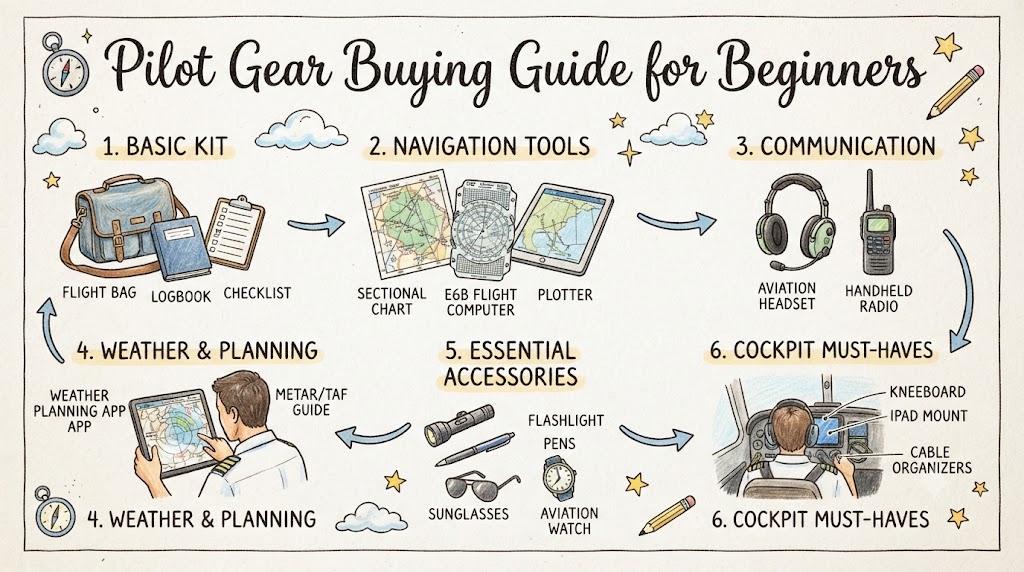
Starting flight training is exciting, but buying pilot equipment can quickly become confusing. Aviation stores offer expensive headsets, advanced tablets, large flight bags, electronic logbooks, navigation tools and many accessories that may look essential.
In reality, beginner pilots do not need to purchase everything immediately.
The best approach is to start with equipment required by your flight school, instructor and aviation authority. You can then add better or more specialised gear as your training progresses.
Good pilot equipment should improve communication, organisation, comfort and safety. It should not create distractions or place unnecessary pressure on your training budget.
This Pilotsdeal.com guide explains which pilot gear beginners should buy first, what features matter and which purchases can usually wait.
Ask Your Flight School Before Buying Anything
Every training organisation has different aircraft, procedures and equipment policies.
Before shopping, ask your instructor:
- Which headset connection does the aircraft use?
- Are headsets available for rent?
- Is a paper or electronic logbook required?
- Are tablets permitted during training?
- Which navigation application is used?
- Does the school provide charts and checklists?
- Is a kneeboard recommended?
- Which flight computer is used in ground classes?
- Are uniforms or specific shoes required?
- Are personal handheld radios permitted?
This conversation can prevent you from buying incompatible or unnecessary equipment.
Students training under DGCA rules should also understand their personal recordkeeping responsibilities. Indian aircraft rules require licensed flight crew members to maintain a personal logbook in the form prescribed by the Director-General.
Essential Pilot Gear for Beginners
Most student pilots can begin with a relatively small collection of useful items:
- Aviation headset
- Pilot logbook
- Flight bag
- Kneeboard
- Pens and pencils
- Checklists and study material
- Sunglasses
- Water bottle
- Flashlight for night operations
- Suitable clothing and footwear
A tablet, portable charger, handheld radio and advanced electronic accessories can be added later when training requirements justify them.
1. Aviation Headset
An aviation headset is usually the largest equipment purchase a beginner makes.
It performs three important functions:
- Helps the pilot hear radio transmissions
- Allows clear communication with the instructor and air traffic control
- Reduces exposure to cockpit noise
Aircraft cockpits can be noisy, especially in piston-engine training aircraft. FAA hearing-safety material recommends appropriate hearing protection in aviation environments and notes that properly fitted hearing-protection devices can significantly reduce noise exposure.
Passive Noise Reduction Headsets
Passive headsets reduce sound through physical ear-cup insulation and cushioning.
Advantages:
- Lower purchase price
- Simple construction
- No batteries required
- Suitable for basic training
- Often durable
Possible limitations:
- Heavier clamping pressure
- Less effective against low-frequency engine noise
- Greater discomfort during long flights
- Bulkier design
A good passive headset can be a practical first purchase for students with limited budgets.
Active Noise Reduction Headsets
Active Noise Reduction, commonly called ANR, uses electronics to reduce certain cockpit noise frequencies.
Advantages:
- Better noise reduction
- Improved comfort during longer flights
- Clearer communication
- Reduced listening fatigue
- Often lighter than traditional passive models
Possible limitations:
- Higher purchase price
- Batteries or aircraft power may be required
- More electronic components
- Repairs can be expensive
ANR headsets are attractive for students planning a long professional flying career, but beginners should not feel pressured to buy a premium model before their first lesson.
Headset Features to Compare
Check the following before purchasing:
- Passive or active noise reduction
- Overall comfort
- Clamping pressure
- Headset weight
- Ear-seal material
- Microphone quality
- Battery life
- Audio input or Bluetooth
- Carrying case
- Warranty
- Replacement-part availability
- Aircraft plug compatibility
Confirm the Plug Type
Common headset connections include:
- Dual general-aviation plugs
- Six-pin LEMO connection
- Helicopter plug
- USB connections for simulators
- Aircraft-specific connectors
A headset with the wrong plug may require an adapter.
Ask your flight school which connection is installed in its training fleet.
Test Comfort Before Buying
Wear the headset for at least 15 to 20 minutes when possible.
Check whether it creates pressure around:
- Ears
- Temples
- Eyeglass arms
- Top of the head
- Jaw area
A headset may feel comfortable for two minutes but become painful during a two-hour cross-country flight.
2. Pilot Logbook
A pilot logbook records flight experience and training progress.
Typical entries may include:
- Date
- Aircraft type
- Aircraft registration
- Departure and arrival locations
- Flight duration
- Pilot-in-command time
- Dual instruction
- Solo time
- Night time
- Instrument time
- Instructor signature or endorsement
Your logbook becomes an important professional record, so entries should be accurate, complete and easy to verify.
Paper Logbook
A paper logbook is simple and widely used during initial training.
Benefits include:
- Easy instructor signatures
- No battery requirement
- Clear physical record
- Convenient for basic training
- Accepted by many schools and authorities
Choose a logbook with enough space for:
- Flight details
- Training remarks
- Instructor signatures
- Licence endorsements
- Simulator time
- Flight-time summaries
Electronic Logbook
An electronic logbook can provide:
- Automatic totals
- Searchable flight history
- Currency tracking
- Digital backups
- Reports for job applications
- Licence and rating reminders
However, students should confirm whether their aviation authority and training organisation accept the selected system.
A practical approach is to maintain the required official record while also keeping a secure digital backup.
3. Flight Bag
A flight bag keeps pilot equipment organised and protected.
Beginners usually do not need an oversized airline-style flight case. A compact bag is easier to carry inside a small training aircraft.
Useful Flight Bag Features
Look for:
- Strong handles
- Comfortable shoulder strap
- Durable zippers
- Water-resistant material
- Padded headset compartment
- Tablet pocket
- Document section
- Pen holders
- External bottle pocket
- Easy-to-clean interior
- Reflective or visible markings
Choose the Right Size
The bag should hold essential equipment without becoming crowded.
A beginner’s flight bag may contain:
- Headset
- Logbook
- Kneeboard
- Checklist
- Charts
- Pens and pencils
- Sunglasses
- Flashlight
- Charging cable
- Water bottle
- Personal identification
Large bags encourage students to carry unnecessary items and can be difficult to secure inside a small cockpit.
4. Kneeboard
A kneeboard provides a stable writing surface during flight.
It can hold:
- Flight plan
- Navigation log
- Frequencies
- Clearances
- Weather notes
- Checklists
- Airport information
- Pencil or pen
- Tablet
Basic Kneeboard
A simple clipboard-style kneeboard is often enough for early lessons.
It is suitable for recording:
- Air traffic control instructions
- Altimeter settings
- Runway information
- Heading changes
- Training notes
Tablet Kneeboard
A tablet kneeboard securely holds an electronic device on the pilot’s leg.
Before buying one, check:
- Tablet dimensions
- Case thickness
- Screen orientation
- Strap comfort
- Ventilation
- Charging-port access
- Whether it interferes with aircraft controls
A large tablet may not fit comfortably in every training aircraft.
5. Pens, Pencils and Writing Tools
Writing tools are inexpensive but important.
Carry at least:
- Two pens
- Two pencils
- Small eraser
- Permanent marker
- Fine-tip marker
- Small notepad
Pencils can be helpful because they continue working in changing temperatures and allow corrections on navigation logs.
Use clips or storage loops so loose items do not move around the cockpit.
6. Flight Computer
Many pilot-training programs teach navigation calculations using either a manual or electronic flight computer.
These tools may be used for:
- Time calculations
- Speed calculations
- Distance
- Fuel consumption
- Wind correction
- Density altitude
- Unit conversion
- True airspeed
Manual Flight Computer
A manual circular flight computer is:
- Relatively inexpensive
- Battery-free
- Useful for understanding calculations
- Common in ground training
- Sometimes required in examinations
Electronic Flight Computer
An electronic model can perform calculations faster but may:
- Cost more
- Require batteries
- Be restricted during examinations
- Hide the reasoning behind calculations
Ask your instructor which type is used before purchasing one.
7. Tablet or Electronic Flight Bag
A tablet can display charts, airport information, weather, documents and navigation applications.
FAA guidance describes how Electronic Flight Bag functionality may be used to host aviation data and, under applicable operating conditions, replace certain paper information. The guidance also makes clear that pilots remain responsible for reliable operation and suitable procedures.
Do Beginners Need a Tablet Immediately?
Not always.
Early flight lessons focus on:
- Aircraft control
- Visual lookout
- Checklists
- Radio communication
- Traffic-pattern procedures
- Basic navigation
A tablet can become a distraction when introduced before the student understands the underlying procedures.
Buy one when:
- Your instructor recommends it
- Cross-country training is approaching
- The flight school uses a specific application
- You understand paper-chart and basic navigation principles
- The device can be safely mounted or secured
Tablet Features to Consider
Compare:
- Screen size
- Screen brightness
- Battery life
- Storage capacity
- Internal GPS capability
- Cellular connectivity
- Heat management
- Application compatibility
- Case protection
- Mounting options
Plan for Device Failure
Electronic equipment can:
- Overheat
- Lose battery power
- Freeze
- Lose satellite reception
- Experience application problems
- Display outdated information
Carry appropriate backup information and follow your instructor’s, operator’s and authority’s procedures.
8. Portable Charger and Charging Cables
A power bank can support tablets, phones and electronic accessories during long training days.
Choose a charger with:
- Sufficient capacity
- Reliable safety certification
- Multiple charging ports
- Clear battery indicator
- Durable cable
- Compact design
The device must be secured during flight and should not block controls or emergency access.
Check airline and aviation-security rules before carrying large lithium batteries during commercial travel.
9. Pilot Sunglasses
Good sunglasses reduce glare and improve comfort during daytime flying.
Choose glasses that:
- Provide ultraviolet protection
- Fit comfortably under a headset
- Have thin temple arms
- Minimise colour distortion
- Allow clear instrument viewing
- Fit securely during head movement
The FAA recommends avoiding polarised lenses in aviation because they can reduce the visibility of certain cockpit displays, interact with anti-glare filters and create visual effects through aircraft windscreens. Neutral grey lenses are generally preferred because they minimise colour distortion.
Avoid Fashion-Only Choices
Thick frames may break the headset’s ear seal and reduce noise protection.
Very dark lenses may also make it difficult to read instruments in a shaded cockpit.
Comfort, optical clarity and compatibility with cockpit displays are more important than appearance.
10. Flashlight for Night Flying
A dependable flashlight becomes important when night training begins.
The FAA recommends carrying at least one reliable flashlight for night flights and identifies a dimmable unit capable of providing white and red light as preferable.
Useful Flashlight Features
Look for:
- White and red light modes
- Adjustable brightness
- Simple controls
- Spare batteries
- Compact size
- Strong clip
- Durable body
- Reliable switch
Red light can help preserve night vision, while white light may be necessary for aircraft inspection or identifying details.
Carry a backup flashlight rather than relying only on a phone.
11. Charts, Checklists and Reference Material
Your school may provide some documents, while others must be purchased or downloaded.
Possible materials include:
- Aircraft checklist
- Pilot Operating Handbook
- Airport information
- Navigation charts
- Flight-planning forms
- Training syllabus
- Emergency procedures
- Aircraft limitations
- Radio-frequency references
FAA navigation guidance notes that pilots should carry information appropriate to the planned flight, including aircraft documentation and suitable planning materials.
Always use current and approved information. An outdated chart or checklist can be more dangerous than having no convenient copy.
12. Suitable Clothing and Footwear
Pilot clothing should support safe movement and cockpit comfort.
Choose:
- Closed shoes
- Thin, flexible soles
- Comfortable trousers
- Breathable clothing
- Layers for changing temperatures
- Clothing without loose straps
- Minimal bulky jewellery
Avoid footwear that makes it difficult to feel or operate the rudder pedals.
Flight schools may also have uniform and appearance requirements.
13. Water, Snacks and Personal Comfort Items
Training flights can be physically demanding, especially in hot weather.
Useful personal items include:
- Water bottle
- Light snack
- Sunscreen
- Lip balm
- Tissues
- Motion-sickness bag
- Personal medication
- Small towel
Do not allow food, bottles or loose packaging to interfere with controls.
Personal readiness is part of flight safety. FAA aeromedical guidance encourages pilots to evaluate their own fitness before flight rather than checking only the aircraft.
Optional Gear Beginners Can Buy Later
The following items may be useful, but most students do not need them immediately:
- Handheld aviation radio
- Portable GPS receiver
- Traffic-information receiver
- Action camera
- Premium smartwatch
- Large professional flight case
- Advanced oxygen-monitoring devices
- Multiple tablet mounts
- Expensive cockpit organiser
- Personal intercom
- Professional uniform luggage
Wait until you understand your training environment and actual needs.
Should Beginners Buy Used Pilot Gear?
Used gear can reduce costs, especially for headsets, flight bags and kneeboards.
Check Used Headsets Carefully
Inspect:
- Ear seals
- Headband
- Microphone
- Cables
- Plugs
- Battery compartment
- Control module
- Audio quality
- Warranty status
- Repair history
Test the headset in an aircraft or compatible audio system before buying whenever possible.
Avoid Questionable Electronic Equipment
Do not buy electronic aviation equipment when:
- The serial number is removed
- The battery is damaged
- The seller cannot demonstrate operation
- Software support has ended
- Required accessories are missing
- The charging port is damaged
- The product has signs of moisture exposure
The savings are not worthwhile when equipment becomes unreliable during training.
Suggested Beginner Pilot Gear Budget
Prices vary greatly by country and brand, so it is more useful to divide purchases into priority levels.
Essential Budget
Focus on:
- Entry-level headset
- Logbook
- Basic flight bag
- Kneeboard
- Writing tools
- Sunglasses
- Required study material
Balanced Budget
Add:
- Higher-quality passive or entry-level ANR headset
- Better organised flight bag
- Tablet
- Protective tablet case
- Power bank
- Night-flight flashlight
Professional-Track Budget
Consider:
- Premium ANR headset
- Reliable tablet with adequate storage
- Quality mounting system
- Digital logbook subscription
- Backup charging equipment
- Durable professional flight bag
A higher budget does not automatically create a better pilot. Training quality, preparation and consistent practice matter more than expensive accessories.
Common Pilot Gear Buying Mistakes
Buying Everything Before the First Lesson
Students may purchase items that are incompatible with their school’s aircraft or procedures.
Choosing a Headset Only by Price
A very cheap headset may be uncomfortable or provide poor communication quality. An expensive headset may also be unnecessary for a student unsure about continuing training.
Ignoring Headset Plug Compatibility
Different aircraft use different connectors.
Buying an Oversized Flight Bag
Large bags are difficult to secure inside small training aircraft.
Purchasing a Tablet Too Early
Students should first understand basic navigation and cockpit procedures.
Buying Polarised Sunglasses
Polarised lenses can interfere with cockpit displays and aircraft windscreens.
Depending Completely on Electronic Devices
A tablet or phone can fail, overheat or lose power.
Ignoring Warranty and Repairs
Aviation equipment may be used for many years. Check after-sales support and replacement-part availability.
Carrying Too Many Loose Items
Loose objects can move around the cockpit and interfere with controls.
Choosing Appearance Over Function
Professional-looking equipment is less important than comfort, reliability and suitability.
Pilot Gear Buying Checklist
Before purchasing an item, ask:
- Is it required for my current training stage?
- Has my instructor recommended it?
- Is it compatible with the training aircraft?
- Is it comfortable during long use?
- Is it easy to operate in flight?
- Can it be secured in the cockpit?
- Does it have a reliable warranty?
- Are replacement parts available?
- Is there a less expensive suitable option?
- Will I still use it after training?
- Does it meet the applicable school and authority requirements?
Frequently Asked Questions
What pilot gear should a beginner buy first?
Start with an aviation headset, logbook, compact flight bag, kneeboard, writing tools, sunglasses and required training material.
Does a student pilot need an expensive headset?
No. A comfortable and reliable passive headset can be suitable for early training. Premium ANR equipment may be considered for long-term professional use.
Should a beginner buy a tablet?
A tablet becomes useful for navigation and document management, but students should purchase one after consulting their instructor.
Is a paper logbook still useful?
Yes. Many students find a paper logbook convenient for instructor signatures, endorsements and initial training records.
Can pilots wear polarised sunglasses?
They are generally not recommended because they can interfere with cockpit displays and aircraft windscreens.
What size flight bag is best?
A compact or medium bag is usually enough for a student pilot. It should fit safely inside the training aircraft.
Is a kneeboard necessary?
It is not always legally required, but it is useful for organising notes, frequencies, clearances and navigation information.
Should a student carry a flashlight?
A reliable flashlight is strongly recommended for night training, preferably with adjustable white and red light.
Can used aviation headsets be trusted?
Used headsets can offer good value when they are tested carefully and have undamaged cables, plugs, microphones and electronics.
What pilot gear should beginners avoid buying immediately?
Advanced radios, portable traffic receivers, expensive cameras, oversized bags and multiple electronic accessories can normally wait.
Key Takeaways
- Ask your instructor before purchasing pilot equipment.
- Begin with essential gear instead of buying everything immediately.
- Select a headset based on comfort, communication and compatibility.
- Maintain an accurate pilot logbook.
- Choose a compact flight bag suitable for small aircraft.
- Use a kneeboard to organise cockpit information.
- Introduce tablets only when they support rather than distract from training.
- Avoid polarised sunglasses for cockpit use.
- Carry reliable lighting for night operations.
- Secure every item inside the cockpit.
- Consider used gear only after checking its condition.
- Compare warranty, repairs and replacement parts.
- Keep suitable backups for electronic information.
- Prioritise training quality over expensive accessories.
Conclusion
Beginner pilots need reliable, practical and comfortable gear—not every aviation accessory available. Start with the items required for your current training stage, confirm compatibility with your flight school and upgrade gradually as your experience grows.
The best pilot gear is equipment that supports clear communication, good organisation and safe cockpit operation without creating unnecessary expense or distraction.

