
Introduction
Starting pilot training is an exciting step, but choosing the right training package can be challenging for beginners. Different flight schools may offer packages with different flight hours, ground classes, simulator sessions, examination fees, equipment, and other services. A package that looks affordable at first may not include all the expenses you will eventually need to pay.
For this reason, beginners should look beyond the advertised price and carefully review what a pilot training package actually covers. Understanding the included services, additional charges, training schedule, aircraft availability, instructor support, and regulatory requirements can make it easier to compare different options.
This guide provides a practical pilot training package checklist to help beginners understand what to look for before enrolling in a flight training program.
What Is a Pilot Training Package?
A pilot training package is a collection of training services and related facilities offered by a flight school or approved aviation training organization. Depending on the type of licence and the training provider, a package may include flight lessons, ground school, instructor support, simulator training, study materials, examinations, and administrative services.
However, not every school defines its package in the same way.
One provider may include a certain number of flight hours but charge separately for examinations and equipment. Another may include some of these costs in its overall package price. Therefore, beginners should always request a detailed breakdown of inclusions and exclusions before making a payment.
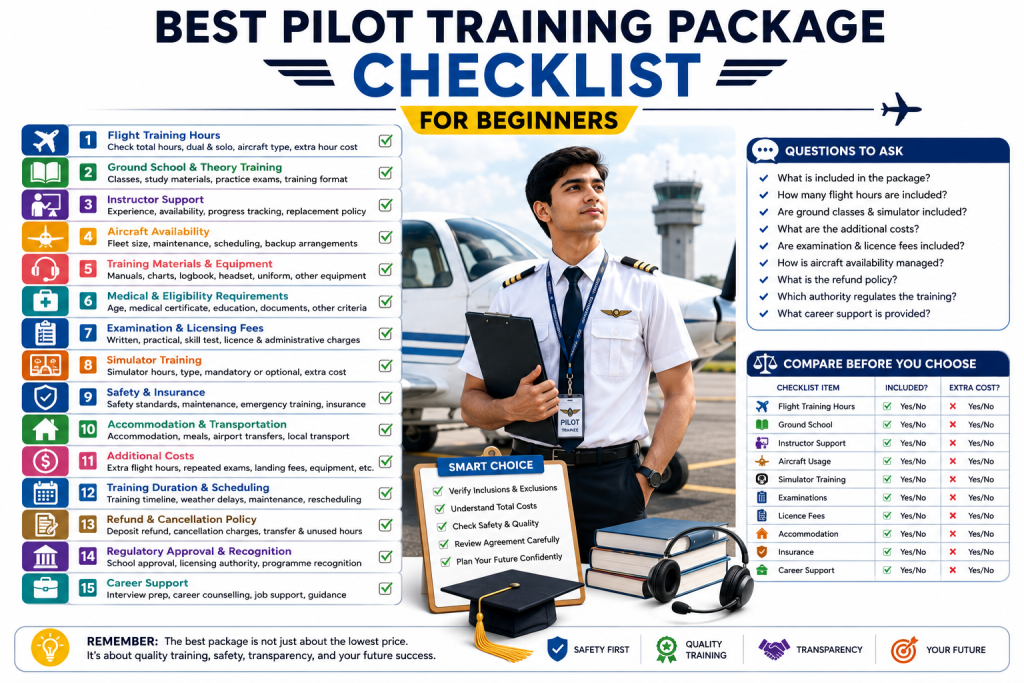
Best Pilot Training Package Checklist for Beginners
1. Check the Included Flight Training Hours
Flight training is usually one of the largest expenses in pilot training. Beginners should carefully check the number of flight hours included in a package.
Do not look only at the total number of hours. Find out what type of flying is covered and whether the advertised hours represent a minimum requirement, an estimated training amount, or a fixed package allowance.
Students may need additional flight training depending on their progress and the requirements of the applicable aviation authority.
Before enrolling, ask:
- How many flight hours are included?
- Are both dual and solo flights included?
- Which aircraft will be used?
- Are landing or navigation charges included?
- What is the cost of additional flight hours?
- What happens if more training is required?
Understanding these details can help prevent unexpected costs later.
2. Review Ground School and Theory Training
Pilot training involves much more than operating an aircraft. Students must also develop theoretical knowledge in areas relevant to their licence and training program.
Check whether the package includes ground school and what type of instruction is provided.
The package may include:
- Classroom lessons
- Online learning
- Study materials
- Revision sessions
- Practice examinations
- Instructor support
Ask whether ground classes are conducted according to a fixed schedule and whether additional classes carry an extra charge.
3. Evaluate Flight Instructor Support
Instructors play an important role in a student’s progress. Beginners should understand how instructor support works before selecting a training package.
Ask whether you will have a dedicated instructor or train with multiple instructors. Also find out how your progress will be assessed.
Important questions include:
- How are instructors assigned?
- How often is student progress reviewed?
- How is additional training identified?
- What happens if an instructor is unavailable?
- How quickly can replacement instructors be arranged?
Good communication between the student and instructor can make training more organized and productive.
4. Check Aircraft Availability
Aircraft availability can directly affect your training schedule.
Even when a flight school has several training aircraft, maintenance requirements and operational scheduling can affect how frequently students fly.
Before enrolling, ask:
- Which aircraft models are used?
- How many training aircraft are available?
- How are maintenance periods managed?
- What happens if an aircraft becomes unavailable?
- Are alternative aircraft available?
- How are flight slots scheduled?
Regular flying can help students maintain continuity in their training, so aircraft availability is an important factor to consider.
5. Understand Training Materials and Equipment
Some pilot training packages include study materials and basic equipment, while others charge separately.
Ask for a written list of everything included in the package.
Depending on the program, this could include:
- Training manuals
- Navigation charts
- Logbook
- Flight planning materials
- Headset
- Uniform
- Other required training equipment
Do not assume that commonly used equipment is automatically included. Confirm the details before making a payment.
6. Check Medical and Eligibility Requirements
Before investing in pilot training, beginners should confirm that they meet the applicable eligibility requirements.
These requirements can vary depending on the licence, country, and aviation authority. They may include age, medical certification, education, identification documents, and other conditions.
If you plan to train in one country and work or obtain additional licensing in another, check whether the training and licence will meet the requirements of your intended aviation authority.
Always verify current requirements through the appropriate official authority before making major financial commitments.
7. Check Examination and Licensing Fees
A training package may not always include every examination or licensing expense.
Ask whether the quoted price covers:
- Written examinations
- Practical tests
- Skill tests
- Licence application fees
- Administrative charges
- Examination preparation
- Examiner-related costs
You should also ask what happens if you need to repeat an examination or practical test.
Having this information in advance makes it easier to prepare a realistic training budget.
8. Ask About Simulator Training
Some flight training programs include simulator sessions as part of the training process.
Depending on the equipment and approved training program, simulator training can help students practice procedures, cockpit familiarization, instrument-related tasks, and other activities in a controlled environment.
If simulator training is included, check:
- Number of simulator hours
- Type of simulator used
- Whether the sessions are mandatory
- Cost of additional sessions
- How simulator training fits into the overall syllabus
Students should not assume that simulator hours automatically replace aircraft training. The amount of regulatory credit depends on the applicable training program and equipment.
9. Review Safety and Insurance Provisions
Safety should be one of the most important considerations when comparing flight schools.
Ask how the organization handles aircraft maintenance, operational safety, emergency procedures, instructor supervision, and student safety briefings.
If insurance is included, find out exactly what the coverage provides and what exclusions apply.
Important questions include:
- What safety procedures are followed?
- How are maintenance issues handled?
- What emergency training is provided?
- Is student insurance included?
- What additional coverage might be required?
A training package should be evaluated on overall quality and safety, not only on price.
10. Check Accommodation and Transportation Costs
Students who travel to another city or country for pilot training may have significant living and transportation expenses.
If accommodation is offered as part of the package, check whether it is included or charged separately.
Find out about:
- Accommodation duration
- Room arrangements
- Transportation to the airport
- Meals
- Utility charges
- Airport transfers
If accommodation is not included, estimate your expected living costs separately when comparing different training packages.
11. Understand Additional Flight Hours and Extra Charges
One of the most important things beginners should understand is that the advertised package price may not represent the final training cost.
Students may require additional flight hours depending on their progress. Other expenses may include repeated examinations, extra instructor time, landing charges, equipment, or administrative services.
Ask for the current rates for additional services.
A useful way to think about your budget is:
Total expected cost = Package price + Additional training + Examination and licensing costs + Equipment + Living expenses + Other applicable charges
The actual cost will vary depending on the training program and location, but considering these categories can help you prepare a more realistic budget.
12. Check Training Duration and Scheduling
Flight training does not always follow a fixed timeline.
Weather conditions, aircraft maintenance, instructor availability, examination schedules, operational restrictions, and student progress can affect the training period.
Ask:
- How frequently can students normally fly?
- How are lessons scheduled?
- What happens during poor weather?
- How are maintenance delays handled?
- Is the advertised completion period guaranteed?
- What happens if training is interrupted?
A realistic training timeline is more useful than relying on an overly optimistic completion promise.
13. Review the Refund and Cancellation Policy
Never overlook the financial terms of a training agreement.
Before paying a deposit or full package amount, carefully review the refund, cancellation, transfer, and unused-hours policies.
Ask:
- Is the initial deposit refundable?
- What happens if I discontinue training?
- Can unused training hours be transferred?
- Are administrative fees refundable?
- What happens if the school cannot provide training for an extended period?
Keep copies of the agreement, invoices, receipts, and payment records for future reference.
14. Verify Licensing and Regulatory Recognition
Beginners should confirm that the training organization is properly approved or authorized for the training being offered.
Find out which aviation authority regulates the training and whether the program meets the applicable licensing requirements.
Do not rely only on promotional information. Where possible, verify the school’s status through the relevant official aviation authority.
If your goal is a professional pilot career, also confirm that the training pathway fits the licence and qualifications you will eventually need.
Aviation regulations can vary between countries, so requirements should always be checked for the intended jurisdiction.
15. Look at Career Support
Some flight schools provide career-related support as part of or alongside their training programs.
This may include:
- Interview preparation
- Career counselling
- Résumé guidance
- Airline preparation
- Instructor career pathways
- General employment guidance
Career support can be useful, but it should not be confused with guaranteed employment.
If a school makes employment or placement claims, ask for clear information about what is actually guaranteed, what is optional, and what depends on the student’s qualifications and the employment market.
Questions to Ask Before Buying a Pilot Training Package
Before signing an agreement, beginners should ask the flight school the following questions:
- What exactly is included in the package?
- How many flight hours are included?
- Are ground school classes included?
- Are simulator sessions included?
- Which aircraft will be used?
- What is the cost of additional flight hours?
- Are examination fees included?
- Are licensing and administrative charges included?
- What additional expenses should I expect?
- What are the medical and eligibility requirements?
- How long does training normally take?
- How are weather and maintenance delays handled?
- What is the refund and cancellation policy?
- Which aviation authority regulates the training?
- What happens if I need additional training?
- What career support is provided?
Getting clear answers to these questions can make it much easier to compare different pilot training packages.
Pilot Training Package Comparison Checklist
Use this table to compare different flight schools before making a decision.
| Checklist Item | Included? | Extra Cost? | What to Verify |
|---|---|---|---|
| Flight training hours | Yes/No | Yes/No | Number and type of hours |
| Ground school | Yes/No | Yes/No | Subjects and training format |
| Instructor support | Yes/No | Yes/No | Availability and supervision |
| Aircraft usage | Yes/No | Yes/No | Aircraft type and availability |
| Simulator training | Yes/No | Yes/No | Number of hours and equipment |
| Training materials | Yes/No | Yes/No | Manuals and required resources |
| Examinations | Yes/No | Yes/No | Written and practical tests |
| Licence fees | Yes/No | Yes/No | Application and administrative fees |
| Additional flight hours | No | Yes/No | Hourly rate |
| Accommodation | Yes/No | Yes/No | Duration and facilities |
| Transportation | Yes/No | Yes/No | Airport and local transport |
| Insurance | Yes/No | Yes/No | Coverage and exclusions |
| Medical requirements | No | Yes/No | Applicable certification |
| Refund policy | No | No | Cancellation and refund conditions |
| Career support | Yes/No | Yes/No | Services actually provided |
This comparison is useful because the goal is not simply to find the package with the lowest price. Instead, you should understand what you are paying for and what additional costs may arise.
Common Mistakes Beginners Should Avoid
Choosing a Package Only Because It Is Cheap
Price is important, but it should not be the only factor.
A low-priced package may exclude flight hours, examinations, equipment, accommodation, or other costs that you will eventually need to pay.
Ignoring Additional Training Costs
Not every student progresses at exactly the same rate. Some students may require additional training beyond the hours initially included in a package.
Always ask about the cost of extra flight and instructor hours.
Not Reading the Agreement
Important information about payments, cancellations, refunds, training schedules, and additional charges should be clearly understood before signing.
Never depend entirely on verbal promises.
Failing to Verify Regulatory Approval
Make sure the training organization is appropriately approved or authorized for the training it provides.
Regulatory recognition is particularly important if you plan to use the training toward a professional pilot career.
Overlooking Aircraft Availability
A school may advertise a fleet of training aircraft, but that does not necessarily mean every aircraft will always be available.
Ask how aircraft scheduling and maintenance are managed.
Assuming Everything Is Included
A package described as “complete” may still have exclusions.
Always request a detailed written list of included and excluded costs.
Expecting a Fixed Completion Date
Training timelines can change because of weather, maintenance, instructor availability, student progress, and other operational factors.
Treat estimated timelines as estimates unless the agreement clearly states otherwise.
Accepting Employment Claims Without Checking the Details
Career support can be valuable, but beginners should carefully examine any claims about airline placement or guaranteed employment.
Training completion does not automatically guarantee a job.
How to Choose the Right Pilot Training Package
Choosing a suitable package becomes easier when you follow a structured process.
Step 1: Define Your Pilot Training Goal
Start by identifying the type of licence and aviation career you are interested in.
Your goal will determine the type and amount of training you need.
Step 2: Check Your Eligibility
Confirm your medical, age, education, documentation, and other applicable requirements.
Doing this early can prevent problems after enrollment.
Step 3: Shortlist Suitable Flight Schools
Look for flight schools or training organizations that provide the training pathway you require and operate under the appropriate regulatory framework.
Step 4: Request a Complete Cost Breakdown
Ask each school for a detailed quotation showing what is included and what is charged separately.
Step 5: Compare Training Inclusions
Compare flight hours, ground school, instructors, aircraft, simulator sessions, examinations, equipment, and other services.
Step 6: Estimate Additional Expenses
Consider the possibility of additional flight hours, repeated examinations, equipment purchases, accommodation, transportation, and other expenses.
Step 7: Verify Regulatory Information
Check the school’s approval or authorization through the appropriate aviation authority.
Also confirm that the training fits your intended licensing pathway.
Step 8: Read the Training Agreement
Carefully review payment terms, refund policies, cancellation conditions, additional charges, and other contractual details.
Step 9: Ask Questions Before Paying
If anything is unclear, ask the training provider for an explanation before making a major payment.
Where possible, get important financial or contractual information in writing.
Final Pilot Training Package Checklist
Before enrolling, make sure you have checked the following:
- Pilot training goal and licence pathway
- Eligibility requirements
- Medical requirements
- Included flight hours
- Ground school
- Instructor support
- Aircraft availability
- Simulator training
- Training materials
- Examination fees
- Licence and administrative fees
- Additional flight-hour rates
- Accommodation costs
- Transportation costs
- Insurance coverage
- Training schedule
- Expected training duration
- Refund and cancellation policy
- Regulatory approval or recognition
- Career support details
Frequently Asked Questions
1. What should a beginner look for in a pilot training package?
A beginner should check flight hours, ground school, instructor support, aircraft availability, simulator training, examination fees, licensing costs, additional charges, scheduling, refund policies, and regulatory recognition.
2. Is the cheapest pilot training package always the best option?
No. A low-cost package may exclude important expenses such as additional flight hours, examinations, equipment, or accommodation. Beginners should compare the complete cost and services rather than looking only at the advertised price.
3. How many flight hours should a pilot training package include?
The required training hours depend on the licence, training program, and applicable aviation authority. Beginners should check the current official requirements and ask the school how many hours are included in its package.
4. Are additional flight hours common during pilot training?
Some students may need additional training beyond the hours included in a package. Individual progress varies, so it is important to ask about additional hourly rates before enrolling.
5. Should ground school be included in a pilot training package?
Ground school is an important part of pilot training. Beginners should check whether theoretical instruction is included, what subjects are covered, and whether study materials or examination preparation are provided.
6. Why is aircraft availability important?
Aircraft availability can affect how frequently a student can fly. Maintenance, scheduling, and operational issues may sometimes reduce availability, so students should understand how the school manages these situations.
7. Should I check the flight school’s regulatory approval?
Yes. Beginners should verify that the training organization is appropriately approved or authorized for the training it provides and that the program fits the licensing pathway they intend to follow.
8. Are examination and licence fees usually included?
Not necessarily. Some packages include certain examination or administrative charges, while others charge them separately. Always request a detailed cost breakdown.
9. What happens if bad weather delays flight training?
Weather can affect flight schedules. Ask the school how weather-related cancellations are handled and whether students can reschedule their flights without additional charges.
10. Should accommodation be included in a pilot training package?
It depends on the training provider. If accommodation is not included, beginners should calculate expected housing, food, transportation, and other living expenses separately.
11. What should I ask about the refund policy?
Ask about deposit refunds, cancellation charges, unused training hours, transfer options, administrative fees, and what happens if you discontinue training.
12. Can a pilot training package guarantee a job after graduation?
Students should be cautious about employment guarantees. A training provider may offer career guidance or placement assistance, but employment generally depends on qualifications, licensing, experience, hiring requirements, and market conditions.
13. How can I compare two pilot training packages?
Compare the complete cost, included flight hours, ground school, aircraft availability, instructor support, simulator training, examinations, additional charges, training duration, regulatory status, and refund terms.
14. What is the biggest mistake beginners make when selecting a training package?
One common mistake is choosing a package based only on its advertised price. Beginners should understand all included and excluded costs before making a decision.
15. When should I pay for a pilot training package?
Payment should be made only after you have confirmed your eligibility, understood the training pathway, reviewed the complete cost breakdown, verified the training provider’s regulatory status, and read the agreement carefully.
Conclusion
Choosing the right pilot training package requires more than comparing prices. Beginners should examine every part of the training program, including flight hours, ground school, instructor support, aircraft availability, simulator sessions, examination fees, equipment, additional costs, scheduling, safety provisions, and regulatory requirements.
A well-structured checklist can help you identify what is included and what may require additional payment. It can also make it easier to compare different flight schools on the basis of overall value rather than advertised price alone.
Before enrolling, take time to verify the applicable aviation requirements, ask detailed questions, calculate potential additional expenses, and read the training agreement carefully. A clear understanding of the package from the beginning can help you make a more informed decision and approach your pilot training with realistic expectations.

