
Introduction
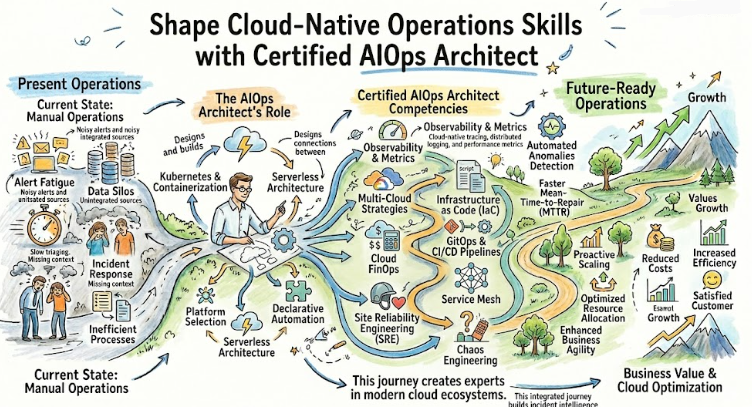
The Certified AIOps Architect designation has become a cornerstone for technical professionals striving to master the fusion of artificial intelligence and enterprise infrastructure. This guide is crafted for DevOps leaders, SREs, and cloud engineers who recognize that traditional, reactive operations are no longer sufficient for the scale of modern distributed systems. By moving beyond basic automation and into the world of algorithmic intelligence, you can unlock the ability to manage complex environments with precision and foresight. Through the Certified AIOps Architect pathway, you will gain the authoritative skills needed to architect self-correcting systems and data-driven observability. Supported by aiopsschool, this roadmap provides the strategic insight required to accelerate your professional growth in an increasingly autonomous landscape.
What is the Certified AIOps Architect?
The Certified AIOps Architect is a premier professional validation for individuals capable of designing and implementing AI-enhanced operational frameworks. This certification exists to bridge the gap between high-level data science and practical systems administration, focusing on how machine learning can resolve real-world production challenges. It represents a paradigm shift where architects utilize big data and telemetry to create proactive, intelligent environments. By aligning with modern enterprise practices, this credential ensures that engineers can manage the massive data volumes generated by cloud-native workflows without increasing manual effort.
Who Should Pursue Certified AIOps Architect?
This curriculum is specifically designed for senior cloud architects, platform engineers, and site reliability specialists who handle mission-critical infrastructure. It is also an ideal transition for data engineers looking to apply their expertise to the infrastructure layer and for engineering directors tasked with leading digital transformation. Whether you are part of India’s thriving technology sector or managing global cloud operations, this path offers the technical depth to lead high-impact AI initiatives. Even experienced engineers with a strong foundation in scripting and cloud orchestration will find this a clear and structured route to specialization.
Why Certified AIOps Architect is Valuable and Beyond
In an industry where systems scale exponentially, the demand for architects who can implement intelligent operations has never been higher. This certification ensures career longevity by transitioning you from a manager of tools to a designer of intelligent systems. Enterprises are rapidly adopting AIOps to mitigate the risks of human error, reduce infrastructure overhead, and provide faster incident resolution through pattern recognition. By mastering these concepts, you position yourself as an indispensable asset capable of delivering a high return on investment through optimized and resilient digital services.
Certified AIOps Architect Certification Overview
The certification program is delivered through a Certified AIOps Architect and hosted on the aiopsschool. It utilizes a rigorous assessment model that pairs conceptual mastery with intensive, hands-on lab exercises that simulate complex enterprise scenarios. The curriculum is structured to cover the entire AIOps lifecycle—from initial data ingestion and noise suppression to the final stage of automated system remediation. Governed by a board of industry experts, the program is continuously updated to reflect the latest advancements in neural networks and predictive infrastructure modeling.
Certified AIOps Architect Certification Tracks & Levels
The learning journey is organized into three progressive tiers: Foundation, Professional, and Advanced. The Foundation level provides the groundwork for data-centric operations, while the Professional level focuses on the practical deployment of machine learning for anomaly detection and root cause analysis. The Advanced level is reserved for strategic thinkers who oversee cross-functional initiatives across DevOps, SRE, and FinOps domains. These distinct levels allow for a tailored progression that matches your current expertise and your long-term career aspirations.
Complete Certified AIOps Architect Certification Table
| Track | Level | Who it’s for | Prerequisites | Skills Covered | Recommended Order |
| Operations | Foundation | Associate Engineers | Basic Automation | Data Flow, Monitoring | 1 |
| Architecture | Professional | Senior Practitioners | Foundation Level | ML Modeling, Self-Healing | 2 |
| Governance | Advanced | Principal Architects | Professional Level | Strategy, ROI, Compliance | 3 |
Detailed Guide for Each Certified AIOps Architect Certification
Certified AIOps Architect – Foundation
What it is
This certification validates a professional’s grasp of AIOps core concepts, including how big data enables smarter monitoring and the basics of event correlation.
Who should take it
It is perfect for junior DevOps engineers or traditional system administrators who want to understand how AI is reshaping the operational landscape.
Skills you’ll gain
- Proficiency in handling multi-source telemetry data.
- Understanding the core components of an AIOps platform.
- Knowledge of how AI reduces operational noise and alert fatigue.
Real-world projects you should be able to do
- Setup a telemetry pipeline that aggregates logs and metrics from a hybrid cloud.
- Configure a basic event correlation engine to group related alerts.
Preparation plan
- 7-14 Days: Immerse yourself in the fundamental definitions and the business case for AIOps.
- 30 Days: Complete foundational labs focused on data normalization and basic analytical reporting.
- 60 Days: Review best practices for modern observability and take comprehensive practice exams.
Common mistakes
- Overlooking the importance of data quality before applying algorithms.
- Confusing traditional automation with true AI-driven intelligence.
Best next certification after this
- Same-track option: Certified AIOps Architect – Professional
- Cross-track option: Cloud Security Associate
- Leadership option: Agile Professional Certification
Certified AIOps Architect – Professional
What it is
This level confirms the practitioner’s ability to build and fine-tune AIOps solutions that perform intelligent incident management and predictive maintenance.
Who should take it
Experienced SREs and platform leads who are responsible for maintaining the health and performance of large-scale, automated environments.
Skills you’ll gain
- Implementing supervised and unsupervised learning for IT metrics.
- Building complex, closed-loop remediation workflows.
- Advanced root cause analysis using pattern discovery in distributed logs.
Real-world projects you should be able to do
- Deploy a machine learning model that predicts system failure based on performance trends.
- Architect an automated response system that scales resources before a bottleneck occurs.
Preparation plan
- 7-14 Days: Study the specific machine learning algorithms most effective for time-series infrastructure data.
- 30 Days: Engage in deep-dive labs involving the integration of AIOps with existing CI/CD pipelines.
- 60 Days: Focus on performance optimization of the AIOps engine and reducing false positive alerts.
Common mistakes
- Trusting AI models blindly without setting up proper human verification steps.
- Failing to integrate AIOps outputs into existing team communication workflows.
Best next certification after this
- Same-track option: Certified AIOps Architect – Advanced
- Cross-track option: Data Engineering Professional
- Leadership option: Technical Director Roadmap
Choose Your Learning Path
DevOps Path
The DevOps path focuses on integrating intelligence into the continuous delivery cycle. Engineers learn to use AI to predict deployment risks and monitor the health of new releases automatically. This allows for faster delivery cycles with a significantly lower risk of production outages by catching anomalies before they impact the end user.
DevSecOps Path
In this path, the focus is on utilizing AI for proactive threat hunting and security telemetry analysis. Professionals learn to distinguish between normal user behavior and sophisticated security threats using behavioral analytics. This strengthens the infrastructure’s defense by automating the detection and response to security incidents.
SRE Path
The SRE path is dedicated to system reliability and the elimination of manual “toil.” AIOps is used here to manage Service Level Objectives (SLOs) and error budgets through intelligent automation. This ensures that the most critical services remain highly available while reducing the burden on the engineering team.
AIOps / MLOps Path
The AIOps path is for those building the central intelligent platform. It covers end-to-end design from data lakes to orchestration.
The MLOps path focuses on the lifecycle management of machine learning models in operations, ensuring models remain accurate as infrastructure evolves.
DataOps Path
DataOps focuses on the integrity and velocity of the data pipelines that feed AIOps engines. Without clean, reliable data, AI cannot function effectively. This path teaches how to build resilient data architectures that ensure telemetry is always available for real-time analysis.
FinOps Path
The FinOps path applies algorithmic intelligence to cloud cost management. By using predictive analytics, engineers can forecast spending and automate the optimization of cloud resources. This ensures that infrastructure remains cost-effective as it scales to meet business demands.
Role → Recommended Certified AIOps Architect Certifications
| Role | Recommended Certifications |
| DevOps Engineer | AIOps Foundation + Professional |
| SRE | AIOps Professional + SRE Track |
| Platform Engineer | AIOps Professional |
| Cloud Engineer | AIOps Foundation |
| Security Engineer | AIOps DevSecOps Specialization |
| Data Engineer | AIOps DataOps Specialization |
| FinOps Practitioner | AIOps FinOps Specialization |
| Engineering Manager | AIOps Advanced |
Next Certifications to Take After Certified AIOps Architect
Same Track Progression
Upon mastering the Architect level, your path leads toward becoming a Principal AI Operations Consultant. This involves staying at the forefront of generative AI and how it can be used to generate remediation code and interpret complex system logs into human-readable incident reports for stakeholders.
Cross-Track Expansion
Expanding your expertise into MLOps or Big Data architecture provides a holistic perspective on the modern tech stack. Understanding the entire data lifecycle—from creation to consumption by AI—makes you a highly versatile leader capable of managing complex, interdisciplinary technical teams.
Leadership & Management Track
For those aiming for executive roles, transitioning into a VP of Infrastructure or Head of Platform Engineering is the next stage. This requires using your technical AIOps foundation to drive organizational strategy, reduce operational costs, and lead large-scale digital transformation initiatives.
Training & Certification Support Providers for Certified AIOps Architect
DevOpsSchool
A primary provider of expert-led training, offering comprehensive courses that help engineers master the DevOps lifecycle and modern operational tools through a practical, hands-on approach.
Cotocus
This organization specializes in professional training and consulting, providing the high-level expertise needed to master complex cloud architectures and automated infrastructure systems.
Scmgalaxy
A large community-based platform that offers extensive tutorials and certification guidance for professionals looking to excel in configuration management and integrated delivery pipelines.
BestDevOps
Focusing on elite technical education, this provider ensures that engineers are equipped with the most relevant and high-demand skills in the modern IT landscape.
devsecopsschool
Dedicated to the fusion of security and operations, this institution provides the specialized training required to build secure, automated, and resilient software delivery systems.
sreschool
This school focuses on the principles and practices of Site Reliability Engineering, teaching professionals how to maintain high availability and manage reliability at scale.
aiopsschool
The leading authority for AIOps education, providing the specific certification pathways and architectural knowledge needed to lead the next generation of intelligent operations.
dataopsschool
This provider focuses on the management of data pipelines, ensuring that engineers can deliver the high-quality telemetry needed to power modern AI and analytics platforms.
finopsschool
Focused on the intersection of cloud technology and finance, this institution teaches the skills needed to optimize cloud spending and maximize technical efficiency through data.
Frequently Asked Questions (General)
- How does this certification impact my career growth?It positions you as a forward-thinking specialist in a niche but rapidly growing field, making you eligible for high-level architectural and leadership roles.
- Is the Certified AIOps Architect exam purely multiple-choice?No, the assessment typically includes a mix of conceptual questions and practical, lab-based tasks to ensure you can apply the knowledge in real scenarios.
- What is the recommended experience level for the Professional tier?It is generally recommended to have 3 to 5 years of experience in systems administration, DevOps, or cloud engineering before attempting the Professional level.
- Are the training materials accessible online?Yes, all official training programs are designed for remote learning, providing access to virtual labs and digital study materials from anywhere in the world.
- Does the certification focus on specific cloud providers like AWS or Azure?The core principles are cloud-agnostic, though labs often use major cloud platforms to demonstrate how the concepts are implemented in the real world.
- How much time should I dedicate to studying each week?Most successful candidates dedicate 5 to 10 hours a week to study and hands-on practice over a period of several months.
- Is there a renewal process for the certification?Yes, to keep the credential active and current, professionals are typically required to recertify or move to a higher level every few years.
- Can I take the exam in languages other than English?The primary language for the certification is English, ensuring that the terminology remains consistent with global industry standards.
- Is there a focus on cost optimization in the curriculum?Yes, the program includes specific strategies for using AI to identify wasted resources and reduce cloud expenditure without sacrificing performance.
- How does this certification help with incident response?It provides the framework for automating the identification and remediation of common issues, drastically reducing the time spent on manual troubleshooting.
- Are there any community forums for students?Yes, candidates typically gain access to an exclusive community of learners and experts for networking and collaborative problem-solving.
- Does the program cover the ethical use of AI in operations?Yes, the Advanced and Professional levels often touch upon data privacy and the ethical considerations of using AI to manage enterprise infrastructure.
FAQs on Certified AIOps Architect
1. How do I know if my background is suitable for this certification?
If you have experience managing servers, cloud environments, or software pipelines and want to move into AI-driven automation, this is the right path for you.
2. What is the most unique aspect of the AIOps Architect program?
It focuses specifically on the “intelligence” layer of operations, teaching you how to build systems that can learn from their own telemetry data.
3. Will this certification help me get a job in India’s tech market?
Absolutely, India has a massive demand for AI-savvy infrastructure professionals as companies there move toward large-scale autonomous operations.
4. Is the lab environment included in the course fee?
Most official training packages include access to the necessary lab environments for a specified period to ensure you get the required hands-on practice.
5. How does this differ from a standard DevOps certification?
A standard DevOps certification focuses on the process and tools for delivery, while this program focuses specifically on using AI to manage the resulting infrastructure.
6. Are there any weekend batches available for working professionals?
Yes, most providers offer flexible scheduling, including weekend and evening sessions, to accommodate the needs of working engineers.
7. Does the certification cover both supervised and unsupervised learning?
Yes, it covers the different types of machine learning and how each is uniquely applied to various types of operational data like logs and metrics.
8. Is there a formal certificate provided upon completion?
Yes, upon passing the assessment, you receive a formal, verifiable digital certificate that can be shared on professional platforms like LinkedIn.
Final Thoughts: Is Certified AIOps Architect Worth It?
From a mentorship perspective, this certification is one of the most strategic moves you can make in the current technical climate. We are witnessing a transition where manual operations are becoming a bottleneck for business growth. This program doesn’t just teach you a new tool; it provides you with a new lens through which to view infrastructure management. If you are looking to move away from the “firefighting” culture and into a role where you build the brains that prevent the fires, this path is essential. It is a challenging but highly rewarding investment that defines the next generation of technical leadership.

