
Introduction
Becoming a pilot is a significant investment of both time and money. When students begin comparing flight schools, one of the first things they usually look at is the advertised pilot training fee. However, the amount shown in a course brochure or on a flight school’s website does not always represent the complete cost of becoming a licensed pilot.
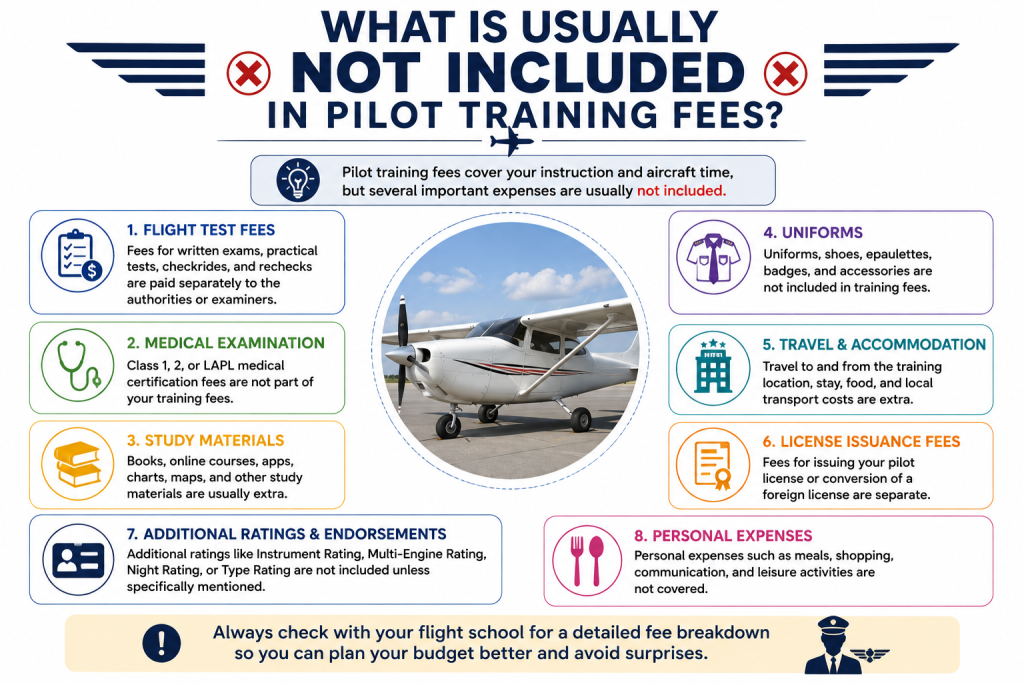
A training package may include flight hours, instructor charges, ground classes, or simulator sessions, while other expenses may be billed separately. Medical examinations, official examinations, flight tests, additional flying hours, equipment, licensing charges, accommodation, transportation, and retesting are some examples of costs that may not be included.
The exact fee structure varies between flight schools, countries, aircraft types, licensing programs, and individual students. Therefore, understanding what is and is not included can help students create a more realistic budget and avoid unexpected financial pressure during training.
Understanding Pilot Training Fees
Pilot training fees generally represent the cost of the training services provided by a flight school. Depending on the program, a package may include some combination of:
- Flight training
- Instructor charges
- Ground school
- Simulator sessions
- Aircraft rental
- Internal assessments
- Training materials
However, there is no universal definition of what a “pilot training fee” must include.
One school may advertise a package based on a certain number of flying hours, while another may provide a broader package covering ground school and some examination preparation.
Before enrolling, students should ask for a detailed written breakdown rather than relying only on the headline price.
Why Advertised Pilot Training Fees Can Be Misleading
An advertised training fee can sometimes make the overall cost appear simpler than it actually is.
For example, a flight school may calculate its course price using the minimum number of flight hours required by the applicable regulations. An individual student, however, may need additional training before demonstrating the required skills.
Other costs can also arise during the training period.
These may include:
- Medical examinations
- Aviation authority examinations
- Flight tests
- Additional flight hours
- Retest charges
- Books and charts
- Pilot equipment
- Accommodation
- Food
- Transportation
- Licence application fees
This does not mean that flight schools are necessarily hiding costs. Many expenses are simply separate from the school’s core training services.
The important point is to understand the complete financial commitment before starting.
What Is Usually Not Included in Pilot Training Fees?
Medical Examination Fees
Aviation medical certification is an important part of becoming a pilot, but the cost of the medical examination may not be included in flight-school fees.
Depending on the licence and aviation authority, a student may need an initial medical examination and additional assessments during their aviation career.
Possible expenses can include:
- Medical examination charges
- Specialist consultations when required
- Additional medical tests
- Follow-up examinations
- Medical certificate processing
Students should determine which medical certificate is required for their intended licence and complete the appropriate examination with an authorized medical examiner where applicable.
It is also sensible to understand the relevant medical requirements before making a large financial commitment to flight training.
Aviation Authority Examination Fees
Pilot training usually involves theoretical or knowledge examinations required by the relevant aviation authority.
These examinations may involve separate charges.
Possible costs include:
- Initial examination fees
- Individual subject fees
- Re-examination charges
- Administrative charges
The exact structure depends on the country and licensing authority.
Students should ask whether their flight school handles these fees as part of the course package or whether they must pay the authority directly.
Flight Test and Skill Test Fees
A practical flight test is another expense that may not be included in the advertised training fee.
Depending on the licensing system, students may have to pay for:
- Examiner fees
- Aircraft use during the test
- Instructor or school charges
- Administrative processing
- Additional preparation before a retest
Some schools include the first flight test in their package, while others do not.
Students should therefore ask specifically whether the advertised fee includes the practical test or only the training required to prepare for it.
Additional Flight Hours
Additional flying hours can be one of the most important expenses to consider.
Pilot training is skill-based, and students do not all progress at exactly the same rate. A student may complete the minimum required hours but still need additional practice before an instructor considers them ready for a particular test.
Additional hours can become necessary because of:
- Individual learning pace
- Difficulty with particular manoeuvres
- Gaps in training
- Weather interruptions
- Instructor assessments
- Aircraft availability
- Additional practice before a flight test
- Refresher training
Students should ask the school for the hourly rate for both the aircraft and instructor before enrolling.
Ground School Materials
Some schools provide basic study materials, while others charge separately for them.
Possible expenses include:
- Textbooks
- Flight manuals
- Navigation charts
- Practice-question resources
- Online learning platforms
- Printed study materials
- Examination preparation resources
Students should ask whether these materials are included and whether they receive permanent access to digital resources.
Pilot Headset
Aviation headsets are an important part of flight training.
Some schools may provide shared headsets for training flights, while others expect students to purchase their own.
A personal headset can be useful because students may spend many hours training in a noisy aircraft environment.
When budgeting for training, students should check whether a headset is provided and whether there are any specific equipment requirements.
Flight Computer and Navigation Equipment
Depending on the training program, students may need additional equipment for flight planning and navigation.
Examples can include:
- Flight computer
- Navigation plotter
- Flight logbook
- Charts
- Kneeboard
- Flight planning materials
- Writing instruments
The exact equipment list depends on the school, aircraft, and licensing program.
Students should request the school’s recommended equipment list before purchasing anything.
Uniform and Personal Equipment
Some flight schools require students to follow a particular dress code or wear a uniform.
Potential expenses may include:
- Pilot shirts
- Trousers
- Epaulettes
- Pilot shoes
- Identification cards
- Flight bags
- Other required personal equipment
These costs may be small compared with flight hours, but they can add to the overall training budget.
Accommodation and Food
Accommodation is generally separate from flight-training fees unless the school specifically offers a residential training package.
Students who move to another city or country may need to budget for:
- Hostel or dormitory accommodation
- Rental housing
- Food
- Electricity
- Internet
- Laundry
- Household expenses
The total amount can vary significantly depending on the location and duration of training.
Students should calculate living expenses for the entire expected training period rather than budgeting only for the flight-school fee.
Transportation Costs
Getting to and from the airport or training center can create additional expenses.
Depending on the location, students may use:
- Public transportation
- Taxis
- Ride services
- Private vehicles
- Motorcycles
- School transportation, where available
Students may also need transportation to examination centers, medical facilities, or another training location.
If a flight school operates from an airport far from the student’s accommodation, transportation costs can become a recurring expense.
Licensing and Documentation Fees
Obtaining a pilot licence involves administrative processes that may have separate charges.
Depending on the country and licence, expenses can include:
- Licence application fees
- Licence issue fees
- Document verification
- Administrative charges
- Logbook processing
- Identification or documentation requirements
These charges are generally determined by the relevant aviation authority rather than by the flight school.
Students should ask the school which licensing expenses are included in the package and which must be paid separately.
English Language or Language-Testing Costs
English language proficiency is an important part of international aviation.
Depending on the licensing system and individual circumstances, a student may need to complete an aviation English assessment or demonstrate the required language proficiency.
Possible expenses may include:
- Language assessments
- Aviation English preparation
- Examination charges
- Retesting
However, not every student will require a separate language course or test, so students should verify the applicable requirements for their licence.
Simulator Training
Flight simulators can provide valuable practice without requiring an aircraft to be airborne.
However, simulator training may be structured differently by each flight school.
A package may include a specific number of simulator sessions, while additional sessions may be charged separately.
Students should ask:
- How many simulator hours are included?
- What type of simulator is used?
- Are additional sessions available?
- What is the additional hourly rate?
Understanding these details can make it easier to compare different training packages.
Re-Examination and Retest Fees
Students may face additional expenses if they do not pass a written examination or practical test on the first attempt.
Possible costs include:
- Examination retake fees
- Flight-test retake fees
- Examiner charges
- Aircraft rental
- Additional instructor training
The cost of failing a test is therefore not always limited to the examination fee itself.
A student may need additional lessons before attempting the test again.
Additional Training After a Failed Test
If a student does not meet the required standard during a check or practical test, the instructor may recommend additional training.
This can involve:
- Additional flight hours
- Simulator sessions
- Ground instruction
- Focused practice on specific manoeuvres
- Another assessment
These costs should be considered when creating a realistic training budget.
Aircraft Fuel and Operational Charges
Aircraft operating costs are structured differently by different flight schools.
Some schools include fuel in their aircraft hourly rate. Others may have separate charges for particular operational expenses.
Students should ask exactly what is covered by the quoted aircraft rate.
Questions worth asking include:
- Is fuel included?
- Is instructor time included?
- Are landing charges included?
- Are airport fees included?
- Are navigation charges included where applicable?
- Are there any additional aircraft operating charges?
A detailed answer can prevent confusion later.
Landing and Airport Fees
Landing or airport-related charges may sometimes be separate from basic training fees.
These can depend on:
- The airport being used
- The type of operation
- The aircraft
- Local airport policies
- The training route
Some schools incorporate these costs into their aircraft rates, while others may charge them separately.
Students should confirm the school’s fee structure before calculating their total budget.
Examination Travel Costs
A written examination or practical test may take place at a location different from the normal flight-training base.
This can create additional expenses for:
- Transportation
- Accommodation
- Food
- Local travel
- Parking
Students should ask where their examinations and flight tests will take place and whether travel is their responsibility.
Visa and Immigration Expenses for International Students
Students travelling abroad for pilot training may have expenses that domestic students do not.
These can include:
- Visa application fees
- Residence permits
- International flights
- Travel insurance where required
- Document translation
- Document certification
- Immigration-related charges
The exact requirements depend on the destination country and the student’s nationality.
International students should research these expenses before committing to a foreign training program.
Costs That Can Increase the Total Training Budget
The final cost of pilot training can increase for several reasons.
Needing More Flight Hours
Regulatory minimum hours are not necessarily the same as the number of hours every student will need.
Some students may require additional practice to reach the required level of proficiency.
Weather Delays
Poor weather can interrupt flying schedules.
If training takes longer than expected, students may also face additional accommodation, food, and transportation expenses.
Aircraft Availability
Aircraft may occasionally be unavailable because of:
- Scheduled maintenance
- Unscheduled maintenance
- Operational restrictions
- Scheduling conflicts
Training interruptions can affect the overall timeline.
Instructor Availability
Flight training depends heavily on instructor availability.
If scheduling problems create long gaps between flights, a student may require additional refresher training.
Long Breaks Between Flights
Students who take extended breaks may need additional practice before returning to their previous level of proficiency.
This can increase both flight hours and training costs.
Training at Multiple Locations
Some programs involve training at more than one airport or location.
Moving between locations can increase:
- Travel expenses
- Accommodation costs
- Transportation costs
- Living expenses
Students should understand the complete training structure before making financial plans.
Pilot Training Fee Checklist
| Expense Category | May Be Included? | What Students Should Confirm |
|---|---|---|
| Flight hours | Sometimes | Number of included hours |
| Instructor fees | Sometimes | Whether instructor time is separate |
| Ground school | Often | Subjects and duration |
| Simulator training | Varies | Number of included sessions |
| Medical examination | Often separate | Initial and follow-up costs |
| Written examinations | Often separate | Exam and retest charges |
| Flight test | Varies | Aircraft and examiner fees |
| Additional flight hours | Usually separate | Aircraft and instructor rates |
| Study materials | Varies | Books, charts, and online resources |
| Headset | Usually separate | Required equipment |
| Accommodation | Usually separate | Monthly or course-period cost |
| Food | Usually separate | Meal arrangements |
| Transportation | Usually separate | Airport and local travel |
| Licence fees | Often separate | Aviation authority charges |
| Visa expenses | International students | Application and related costs |
This is a general checklist. Individual flight schools may include or exclude different items.
Questions to Ask a Flight School Before Enrolling
Before paying a large deposit or signing a training agreement, students should ask the school for clear answers to important financial questions.
1. What exactly is included in the advertised fee?
Ask for a written breakdown instead of relying on a general course price.
2. How many flight hours are included?
Determine whether the package is based on minimum regulatory hours or a larger estimated training requirement.
3. Is instructor time included?
Some schools combine aircraft and instructor charges, while others list them separately.
4. Are simulator sessions included?
Ask how many simulator hours are included and what additional sessions cost.
5. Are examination fees included?
Confirm whether written examinations are paid through the school or directly to the aviation authority.
6. Is the flight test included?
Find out whether aircraft and examiner charges for the practical test are included.
7. What happens if additional flight hours are required?
Ask for the hourly aircraft and instructor rates.
8. Are study materials included?
Confirm whether books, charts, online platforms, and other learning resources are included.
9. Are accommodation and meals included?
If not, ask whether the school offers accommodation or can provide recommendations.
10. What happens if I fail a test?
Ask about the cost of additional training, aircraft use, examiner charges, and retesting.
11. Are airport and landing fees included?
These charges can vary depending on where training takes place.
12. What licence and authority fees are separate?
Ask the school to identify fees that must be paid directly to the aviation authority.
13. Are there any additional costs for international students?
Ask about documentation, visa-related requirements, travel, and other expenses.
14. Can I receive the complete fee structure in writing?
This is one of the most important questions to ask before enrollment.
How to Create a Realistic Pilot Training Budget
A realistic budget should include more than the amount charged by the flight school.
Students can divide their expected expenses into several categories.
Core Training
Include:
- Flight hours
- Instructor charges
- Ground school
- Simulator training
Examinations and Licensing
Budget for:
- Written examinations
- Flight tests
- Retests
- Licence applications
- Administrative charges
Medical Requirements
Include:
- Initial medical examination
- Follow-up assessments
- Additional medical tests if required
Equipment
Consider:
- Headset
- Flight computer
- Navigation equipment
- Charts
- Logbook
- Uniform
- Flight bag
Living Expenses
For students relocating for training, include:
- Accommodation
- Food
- Transportation
- Utilities
- Other daily expenses
Additional Training
Set aside money for:
- Additional flight hours
- Refresher training
- Additional simulator sessions
- Training required after an unsuccessful test
Contingency Fund
It is sensible to maintain some financial flexibility for unexpected expenses.
Training delays, additional flying, examination retakes, or changes in personal circumstances can affect the final cost.
Common Mistakes Students Make
Choosing a School Only Because It Has the Lowest Advertised Fee
A low initial price does not automatically mean the lowest overall training cost.
Students should compare what is included in each package and estimate possible additional expenses.
Ignoring Additional Flight Hours
Students should always ask what happens if they require more hours than those included in the package.
Assuming Minimum Hours Equal Final Hours
Minimum regulatory requirements are not necessarily a guarantee that every student will complete training at exactly that number of hours.
Forgetting Examination Costs
Written examinations and practical tests may involve separate charges.
Not Asking About Retest Costs
Students should understand the financial implications of unsuccessful attempts before beginning training.
Ignoring Living Expenses
For students moving to another city or country, living costs can become a significant part of the total investment.
Not Getting the Fee Structure in Writing
A verbal explanation may not provide enough clarity.
A written fee structure allows students and families to understand what is included and what may be charged later.
How to Compare Pilot Training Schools Properly
Comparing flight schools only by course price can lead to an incomplete decision.
Students should compare:
- Total estimated training cost
- Included flight hours
- Aircraft type
- Instructor charges
- Simulator availability
- Examination support
- Licensing costs
- Accommodation
- Training duration
- Additional-hour rates
- Retest policies
- Payment schedule
- Refund policies
- Aircraft availability
- Student support
The objective should be to understand the overall expected cost and training experience, not simply find the lowest advertised number.
A school with a higher initial fee may include more services, while a lower-priced package may require several additional payments. A detailed comparison can reveal these differences.
Frequently Asked Questions
1. What is usually not included in pilot training fees?
Common exclusions can include medical examinations, official examination fees, flight-test charges, additional flight hours, equipment, licensing fees, accommodation, transportation, and retesting. However, every flight school has its own fee structure.
2. Are pilot medical examination fees included in flight-school fees?
Usually, the medical examination is handled separately, but this depends on the training provider. Students should ask whether medical certification is included in their package.
3. Are pilot licence examination fees separate?
They may be. Official examination fees are often determined by the relevant aviation authority and may not be part of the school’s training fee.
4. Do pilot training fees include the flight test?
It depends on the school and training package. Some packages may include certain test-related costs, while others charge aircraft and examiner fees separately.
5. What happens if I need additional flight hours?
Additional flight hours are generally charged according to the school’s aircraft and instructor rates. Students should ask for these rates before enrolling.
6. Are pilot headsets included in training fees?
Not necessarily. Some schools provide shared equipment, while others expect students to purchase their own headset.
7. Is accommodation included in pilot training?
Accommodation is usually separate unless the school specifically offers a residential training package that includes housing.
8. Do international students have additional expenses?
They may have additional costs related to visas, international travel, accommodation, documentation, insurance where required, and local transportation.
9. How can I calculate the total cost of pilot training?
Start with the school’s complete fee structure and then add medical examinations, authority fees, equipment, accommodation, transportation, living expenses, and a reasonable allowance for additional training or retesting.
10. What should I ask a flight school before paying the training fee?
Ask for a written breakdown showing included flight hours, instructor fees, examinations, flight tests, simulator sessions, equipment, additional-hour rates, retest costs, licensing charges, accommodation, and any other expected expenses.
Conclusion
Pilot training fees should not be viewed simply as one fixed number. The advertised course price may cover important parts of training, but other expenses can arise throughout the journey toward a pilot licence.
Medical examinations, aviation authority examinations, flight tests, additional flight hours, study materials, headsets, navigation equipment, licensing charges, accommodation, transportation, and retesting are examples of costs that may be separate from the core training package.
The actual cost also depends on the student’s progress, the flight school’s pricing structure, the aircraft being used, the training location, and the requirements of the applicable aviation authority.

