
Introduction
Becoming a professional pilot can require a significant financial investment, especially during the early stages of training.
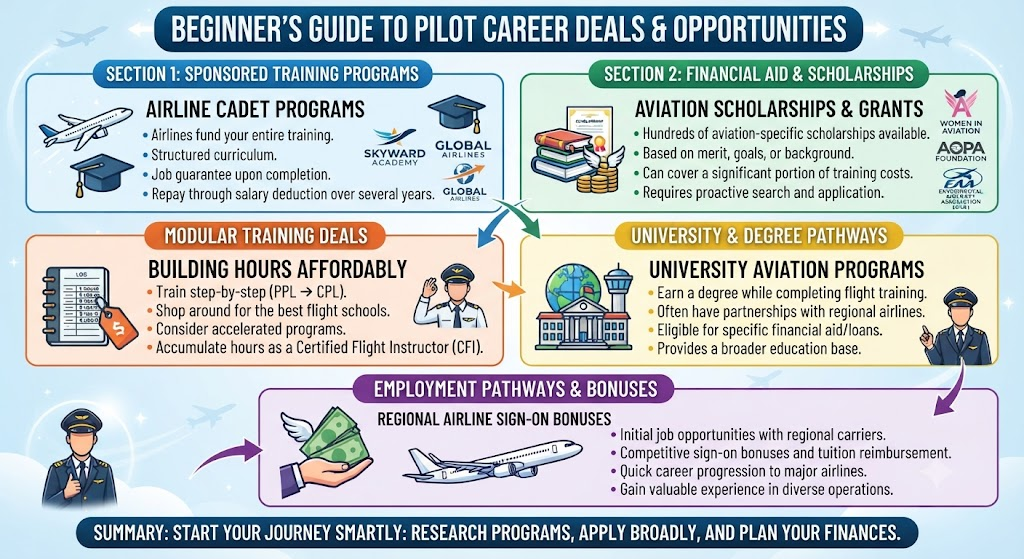
Beginners can explore scholarships, training packages, financing options, cadet pathways, and other opportunities to manage these expenses.
However, the lowest advertised price does not always represent the best overall value.
A good pilot career deal should be evaluated based on total cost, training quality, regulatory requirements, transparency, and long-term career suitability.
What Are Pilot Career Deals?
The term “pilot career deals” can refer to different opportunities designed to make pilot training more manageable or provide additional value to aspiring pilots.
These opportunities may include flight school discounts, scholarships, installment payment arrangements, bundled training packages, cadet programs, financing options, and student support services.
A deal can look attractive because of a reduced initial fee, but beginners should look beyond the headline price. The total amount required to complete training can depend on flying hours, examination fees, medical requirements, licensing costs, accommodation, aircraft availability, and additional training.
Therefore, a useful pilot career deal is not simply the cheapest option. It is an opportunity where the cost, services, conditions, and expected training pathway are clearly understood.
Why Beginners Should Look for the Right Pilot Training Deal
Pilot training involves several expenses that may continue throughout the training period. Students need to plan for both direct and indirect costs.
The major expenses may include:
- Flight training
- Ground school
- Examinations
- Medical examinations
- Licensing and administrative charges
- Study materials
- Simulator sessions
- Accommodation
- Transportation
- Additional flying hours
- Skill tests and related requirements
A suitable financial arrangement can make these expenses easier to plan. It can also help students avoid making decisions based only on the initial admission fee.
For example, one flight school may advertise a lower package price but charge separately for several services. Another may have a higher initial price but include more training resources. Comparing the complete cost can therefore provide a more realistic picture.
Types of Pilot Career Deals Beginners Can Explore
Pilot Training Scholarships
Scholarships can reduce the financial burden of pilot training. They may be offered by educational institutions, aviation organizations, foundations, or other eligible organizations.
Scholarship opportunities can have strict requirements related to academic performance, age, nationality, financial circumstances, aptitude tests, or other criteria.
Before applying, beginners should carefully check:
- Eligibility requirements
- Application deadlines
- Amount or percentage of financial support
- Expenses covered
- Expenses not covered
- Renewal conditions
- Selection process
A scholarship covering only part of training can still be useful, but students should calculate how much funding they will need from other sources.
Flight School Discounts
Some flight schools may offer discounts on particular training packages, admission periods, or bundled services.
A discount should always be evaluated against the original and final costs. Students should also determine whether the discounted package includes the same services as the standard package.
Important questions include whether flying hours, instructor fees, examination preparation, simulator sessions, and administrative charges are included.
Cadet Pilot Programs
Cadet pilot programs are structured pathways that may combine training and career preparation. Depending on the program, students may receive a defined training curriculum and guidance related to airline-oriented preparation.
However, beginners should never automatically interpret a cadet program as a guaranteed employment opportunity.
Some programs have strict selection procedures, contractual conditions, performance requirements, or financial obligations. Students should read the complete terms before making a commitment.
Training Financing Options
Financing can help students spread training expenses over a longer period.
Depending on the provider and the student’s circumstances, financing may involve loans or structured payment arrangements. Students should understand interest rates, repayment periods, processing charges, collateral requirements, and consequences of delayed payments.
Borrowing money for pilot training is a major financial decision. The repayment obligation should be considered independently of future employment expectations.
Installment-Based Training Plans
Some training providers may allow students to pay fees in stages instead of paying the complete amount upfront.
This can make budgeting easier, particularly when training is conducted over an extended period.
Students should confirm whether installment payments involve additional charges and what happens if training is delayed, interrupted, or discontinued.
Bundled Flight Training Packages
A bundled package may combine multiple services into one training plan.
For example, a package might include ground training, a specified number of flying hours, simulator access, or examination preparation.
The important point is to verify exactly what is included. A package containing a fixed number of flying hours may not cover additional hours required if a student needs more practice.
Ground School and Simulator Packages
Ground training and simulator sessions can support the theoretical and practical aspects of aviation education.
Some institutions may provide these services separately, while others may include them within a broader training package.
Students should check whether simulator access is unlimited, restricted to certain hours, or charged separately.
Accommodation or Student Support Offers
Training providers located away from a student’s home may offer accommodation or other student-support arrangements.
These can sometimes simplify the transition to flight school, but students should compare accommodation costs, transportation, food expenses, and other living costs before deciding.
Airline-Linked Training Pathways
Some training pathways may have relationships with airlines or aviation organizations.
These arrangements can provide structured career preparation, but students should carefully distinguish between training support and actual employment commitments.
Any employment-related statement should be reviewed in the written program conditions rather than relying only on verbal explanations.
Government or Institution-Based Support
Depending on the student’s country and circumstances, financial assistance may sometimes be available through educational institutions, government schemes, or other recognized organizations.
Eligibility and availability can vary considerably, so students should verify current requirements before relying on such assistance in their financial planning.
How to Compare Pilot Career Deals
Comparing pilot training opportunities requires more than looking at the advertised course price.
Total Training Cost
Calculate the expected cost from the beginning of training through the required licensing or qualification stage.
Included Flying Hours
Find out exactly how many flying hours are included and whether additional hours are charged separately.
Aircraft Availability
A training package is less useful if aircraft availability causes significant delays.
Instructor Availability
Ask whether sufficient instructors are available to maintain a consistent training schedule.
Training Duration
The estimated training period can affect accommodation, transportation, and living expenses.
Regulatory Requirements
Students should verify whether the training pathway meets the requirements of the relevant aviation authority.
Examination and Licensing Costs
Check whether examination fees, skill tests, licensing charges, and administrative expenses are included.
Additional Training
Some students may need additional flying or simulator sessions. Ask how these are priced.
Refund and Cancellation Policies
Understand what happens to paid fees if training is interrupted or discontinued.
Career Support
Career guidance can be useful, but students should determine exactly what “career support” means and avoid interpreting it as an employment guarantee.
Practical Explanation: How to Calculate the Real Cost of a Pilot Training Deal
The advertised training price is only one part of the financial picture.
A beginner can use a simple framework:
Total Estimated Cost = Training Fees + Flight Hours + Exams + Licensing + Medicals + Accommodation + Living Expenses + Additional Training
For example, imagine two hypothetical training options.
Option A has a lower initial package price but excludes accommodation, examinations, additional flying hours, and several administrative charges.
Option B has a higher package price but includes more services.
Option A may appear cheaper at first, but its final cost could become higher after all additional expenses are included.
The purpose of this comparison is not to choose one specific type of program. Instead, it demonstrates why beginners should compare the complete expected cost before making a decision.
Pilot Career Deal Comparison
| Deal Type | Main Benefit | What Beginners Should Check | Possible Limitation |
|---|---|---|---|
| Scholarship | Can reduce training expenses | Eligibility, coverage, application conditions | Limited availability |
| Training Discount | May reduce selected fees | Original price and included services | May apply only to certain components |
| Cadet Program | Structured career-oriented pathway | Selection criteria and contract terms | May have strict conditions |
| Financing | Spreads expenses over time | Interest, repayment, fees | Creates financial obligations |
| Installment Plan | Easier short-term budgeting | Payment schedule and additional charges | Missed payments may affect training |
| Bundled Package | Combines several services | Exact inclusions and exclusions | Additional hours may cost extra |
| Simulator Package | Provides structured simulator access | Number of sessions and restrictions | May not replace required flight training |
Common Mistakes Beginners Should Avoid
Choosing Only by the Lowest Price
The cheapest advertised package may not be the least expensive option after additional expenses are considered.
Ignoring Hidden Charges
Students should ask about examination fees, licensing expenses, aircraft-related charges, additional flying hours, simulator fees, and administrative costs.
Not Checking Included Flying Hours
A package may appear affordable because it includes fewer flying hours. Students should understand how many hours are actually required and how additional hours will be charged.
Assuming a Cadet Program Guarantees Employment
A structured pathway does not automatically mean guaranteed employment. Selection criteria, performance standards, contractual terms, and market conditions can all matter.
Failing to Verify Eligibility
Some scholarships, financing arrangements, and cadet programs may have specific eligibility requirements.
Ignoring Aircraft Availability
Training delays can increase the overall duration and therefore affect accommodation and living expenses.
Not Reading Refund Conditions
Students should understand what happens to fees if they leave the program or cannot continue training.
Comparing Packages Without Calculating Total Cost
A direct comparison of advertised prices can be misleading if the packages contain different services.
Taking Financing Without Understanding Repayment
Students should understand the complete repayment obligation before accepting a loan or financing arrangement.
Choosing a School Without Evaluating Training Quality
Cost should be considered alongside instructor availability, aircraft condition, training standards, operational reliability, and regulatory compliance.
How to Identify a Genuine Pilot Career Deal
Beginners should approach unusually attractive offers carefully. A transparent opportunity should clearly explain what the student receives and what the student is expected to pay.
Look for:
- Clearly stated pricing
- Written terms and conditions
- Transparent eligibility requirements
- Clearly defined training inclusions
- Information about additional costs
- Appropriate regulatory information
- Clearly explained refund policies
- Verifiable program details
- Realistic career statements
- No unexplained employment guarantees
Students should ask for important information in writing rather than relying entirely on verbal statements.
A genuine opportunity should allow the student to understand the financial and contractual commitment before making a payment.
Practical Evaluation Checklist
| Evaluation Factor | Questions to Ask | Why It Matters |
|---|---|---|
| Total Cost | What will the complete training pathway cost? | Helps prevent unexpected financial pressure |
| Flying Hours | How many hours are included? | Determines how much practical training is covered |
| Additional Fees | Which costs are excluded? | Reveals the potential final cost |
| Aircraft Availability | How regularly are aircraft available? | Can affect training progress |
| Instructor Availability | Are enough instructors available? | Supports consistent training |
| Training Duration | What is the estimated completion period? | Helps with financial and personal planning |
| Refund Policy | What happens if training is discontinued? | Protects students from unclear financial conditions |
| Career Support | What exactly is included? | Prevents unrealistic employment expectations |
| Regulatory Compliance | Does the program meet applicable requirements? | Essential for valid licensing and training |
| Contract Terms | What obligations does the student accept? | Helps avoid unexpected commitments |
Important Considerations Before Choosing a Deal
Regulatory Requirements
Pilot training should meet the requirements of the relevant aviation authority. Students should understand the licenses, examinations, medical requirements, and flying experience applicable to their intended career path.
Medical Requirements
Medical eligibility can be an important consideration before investing heavily in flight training. Students should understand the applicable medical requirements and complete the appropriate examination process.
Training Quality
A low price is not useful if training quality, aircraft availability, or instructor support is inadequate.
Financial Capacity
Students should create a realistic budget that considers both training and living expenses.
Career Goals
Someone aiming for a commercial airline career may have different requirements from someone interested in recreational or private flying.
Location
Training location can affect accommodation, transportation, weather conditions, airport accessibility, and overall expenses.
Training Timeline
A longer-than-expected training period can increase living and other indirect costs.
Aircraft and Instructor Availability
Consistent access to aircraft and qualified instructors can influence training progress.
Additional Qualifications
Some aviation careers require additional qualifications or training beyond the initial pilot license. Students should consider the complete career pathway rather than only the first training stage.
Long-Term Career Prospects
Pilot training is a long-term investment. Students should consider the skills, qualifications, experience, and financial commitments required after initial training.
Contractual Obligations
Any agreement involving financing, cadet programs, bundled training, or other commitments should be read carefully before signing.
Benefits and Limitations of Pilot Career Deals
Benefits
The right opportunity can provide several advantages:
- Lower immediate financial pressure
- More predictable budgeting
- Access to structured training
- Potential access to scholarships or financial assistance
- Better organization of training services
- Access to additional educational resources
- Potential career guidance
However, these benefits depend on the actual terms of the opportunity.
Limitations
Pilot career deals can also have limitations:
- Strict eligibility requirements
- Limited availability
- Contractual commitments
- Additional charges
- Non-refundable payments
- Financing obligations
- Restrictions on changing training providers
- No automatic employment guarantee
Understanding these limitations is just as important as understanding the advertised benefits.
FAQs
1. What is a pilot career deal?
A pilot career deal is a broad term for an opportunity that may help beginners manage pilot training costs or provide structured training benefits. It can include scholarships, discounts, financing, installment plans, bundled services, or cadet pathways.
2. Are pilot training discounts available for beginners?
Discounts may be available depending on the training provider and program. Beginners should check the complete terms because a discount may apply only to specific services or time periods.
3. How can beginners find pilot training scholarships?
Students can investigate scholarship opportunities through recognized educational institutions, aviation organizations, foundations, and other legitimate sources. Eligibility criteria and funding coverage should always be verified before applying.
4. Are cadet pilot programs worth considering?
They can be worth considering for students who prefer a structured training pathway. However, applicants should carefully review selection requirements, costs, contractual obligations, performance conditions, and employment-related terms.
5. Does a low-cost pilot training package always provide good value?
No. A low initial price may exclude important expenses such as additional flying hours, examinations, licensing, accommodation, or other charges. Value should be assessed using the complete estimated cost and training quality.
6. What hidden costs should beginners look for?
Potential additional costs can include examinations, medical assessments, licensing, additional flying hours, simulator sessions, study materials, accommodation, transportation, and administrative fees.
7. Can pilot training be financed through installments or loans?
Some students may have access to installment arrangements or financing, depending on their circumstances and the provider. Before accepting financing, students should understand interest, repayment schedules, fees, and other financial obligations.
8. Does a cadet program guarantee a pilot job?
Not necessarily. Students should carefully examine the written terms and distinguish between career preparation, conditional pathways, and genuine employment commitments.
9. How should students compare two pilot training offers?
Students should compare total estimated costs, included flying hours, aircraft and instructor availability, training duration, regulatory compliance, additional fees, refund conditions, and contractual requirements.
10. What is the most important factor when choosing an affordable pilot training option?
There is no single factor that applies to everyone. Beginners should consider overall value, including total cost, training quality, regulatory compliance, transparency, financial sustainability, and suitability for their long-term career goals.
Conclusion
Finding the best pilot career deal for beginners is not simply about finding the lowest training fee. A good opportunity should provide clear costs, transparent conditions, appropriate training standards, and a realistic pathway toward the student’s aviation goals.
Scholarships, discounts, financing options, installment plans, bundled packages, and structured programs can all be useful depending on individual circumstances. However, each opportunity should be evaluated carefully before money or contractual commitments are involved.
The most sensible approach is to calculate the complete expected cost, understand what is included, identify possible additional expenses, verify regulatory requirements, and assess the quality of training. By comparing opportunities carefully, beginners can make a more informed decision and avoid choosing an offer simply because its advertised price looks attractive.

