
Introduction
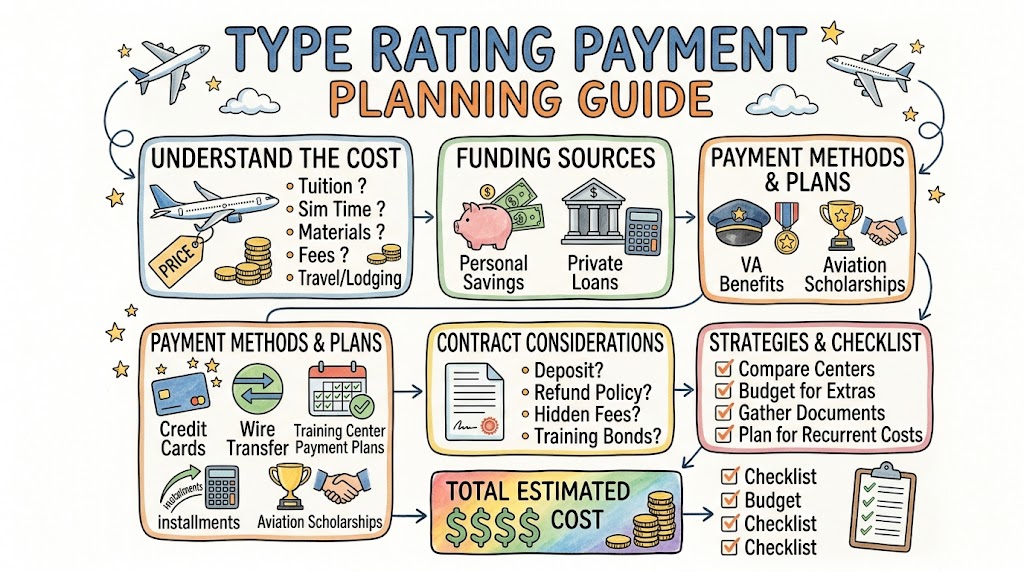
A type rating is one of the largest financial commitments many commercial pilots make after completing their licence training. The advertised course fee may already look expensive, but the actual amount paid can become much higher after adding taxes, simulator assessments, base training, travel, accommodation, licence endorsement, and repeat-session costs.
Poor payment planning can place a pilot under serious financial pressure. It may also create training delays when the next instalment becomes due before the pilot has arranged sufficient funds.
A good payment plan should cover the entire training journey, not only the initial admission fee. It should clearly identify how much is payable, when each payment is due, what is refundable, and how unexpected expenses will be managed.
This Pilotsdeal.com guide explains how commercial pilots can plan type rating payments carefully and reduce financial risk before enrolling.
Why Type Rating Payment Planning Is Important
Type rating training is usually completed within a relatively short period, but the payment schedule can be demanding.
Training providers may request:
- A registration fee
- A seat-booking deposit
- A payment before ground school
- Another payment before simulator sessions
- A skill-test fee
- A separate base-training payment
- Licence and documentation charges
Without a detailed payment plan, a pilot may pay a large deposit without knowing how the remaining amount will be arranged.
Strong payment planning helps a pilot:
- Avoid last-minute borrowing
- Reduce loan pressure
- Compare complete course costs
- Prepare for hidden expenses
- Protect emergency savings
- Prevent training interruption
- Understand cancellation risks
- Make a more informed career decision
Understand the Complete Type Rating Cost
The first step is to calculate the complete estimated cost of the program.
Do not use only the course fee shown in an advertisement.
The total amount may include:
- Ground-school tuition
- Computer-based training
- Cockpit procedure training
- Full-flight simulator sessions
- Instructor charges
- Skill-test fees
- Examiner fees
- Multi-Crew Cooperation training
- Upset Prevention and Recovery Training
- Base training
- Aircraft landing charges
- Licence endorsement
- Administrative fees
- Taxes
- Travel and visa costs
- Accommodation and food
- Local transportation
- Study materials
- Additional simulator sessions
- Currency-conversion charges
A complete budget protects you from choosing a course that appears affordable but has many exclusions.
Type Rating Cost Planning Table
| Cost Category | Questions to Ask |
|---|---|
| Course tuition | What training modules are included? |
| Simulator training | How many sessions and hours are covered? |
| Skill test | Are simulator and examiner fees included? |
| Base training | Is it included or charged separately? |
| MCC or APS MCC | Is it required and included? |
| UPRT | Must it be completed before the course? |
| Taxes | Is the quoted price tax-inclusive? |
| Travel | Who pays for flights, visa, and transfers? |
| Accommodation | Is accommodation included for the full course? |
| Licence endorsement | Are authority fees included? |
| Additional training | What is the price of one extra simulator session? |
| Cancellation | How much of the payment is refundable? |
Request a Written Payment Schedule
Before paying any amount, request a written payment schedule.
The document should clearly show:
- Total course price
- Deposit amount
- Deposit deadline
- Number of instalments
- Due date for each instalment
- Amount payable before simulator training
- Skill-test payment
- Base-training payment
- Taxes and administrative fees
- Penalty for late payment
- Refund conditions
- Currency used for payment
Do not depend only on telephone calls or verbal promises.
Every important payment condition should appear in the contract, invoice, or official email issued by the training provider.
Common Type Rating Payment Structures
Training organisations may use different payment models.
Full Advance Payment
The pilot pays the entire course fee before training begins.
Possible advantages include:
- Simple payment process
- Possible early-payment discount
- No instalment deadlines during training
- Immediate confirmation of the course seat
Possible risks include:
- Large financial exposure
- Difficulty obtaining a refund
- Reduced control if the course is delayed
- Greater loss if the provider fails to deliver
Full payment should be considered only after carefully verifying the provider, contract, refund policy, and confirmed training schedule.
Deposit Plus Balance Payment
The pilot pays a booking deposit and clears the remaining amount before the course begins.
This is a common arrangement.
Before paying the deposit, confirm:
- Whether it is refundable
- What happens if the visa is rejected
- What happens if the medical becomes invalid
- Whether the seat can be moved to another batch
- Whether the balance deadline can be extended
- Whether the provider can cancel the batch
Stage-Wise Instalments
The pilot pays according to training progress.
For example:
- Registration and seat booking
- Ground-school payment
- Simulator payment
- Skill-test payment
- Base-training payment
This structure may reduce financial risk because payments are linked to completed or confirmed training stages.
However, pilots must ensure that each upcoming instalment is already arranged before training begins.
Loan-Funded Payment
The course is funded partly or fully through a bank, financial institution, family loan, or education finance company.
Loan funding can make training possible, but it creates repayment obligations even when airline employment is delayed.
Before taking a loan, calculate:
- Interest rate
- Processing fee
- Loan insurance
- Repayment period
- Monthly instalment
- Moratorium period
- Early-payment charges
- Total amount repayable
- Requirement for collateral
- Co-borrower obligations
Create a Type Rating Payment Timeline
A payment timeline shows when money will be needed.
An example timeline may look like this:
| Training Stage | Possible Payment |
|---|---|
| Course registration | 10% |
| Seat confirmation | 20% |
| Before ground school | 20% |
| Before simulator sessions | 30% |
| Before skill test | 10% |
| Before base training | 10% |
This is only an example. Actual percentages vary between providers.
Your personal plan should identify:
- Payment date
- Amount
- Source of funds
- Currency
- Transfer charges
- Confirmation receipt
- Remaining balance
Build a Complete Personal Budget
A type rating budget should have separate sections.
Training Budget
Include:
- Course fee
- Simulator sessions
- Skill test
- Base training
- Additional modules
- Licence charges
Living Budget
Include:
- Accommodation
- Food
- Local travel
- Mobile and internet
- Laundry
- Medical expenses
- Personal supplies
Travel Budget
Include:
- Air tickets
- Visa
- Travel insurance
- Airport transfers
- Baggage charges
- Return travel
Emergency Budget
Include money for:
- Extended accommodation
- Simulator rescheduling
- Skill-test retake
- Additional training
- Flight changes
- Medical renewal
- Document correction
- Currency fluctuation
Keep a Financial Contingency Reserve
A pilot should not use the entire available budget for the advertised course fee.
A contingency reserve can help cover unexpected costs without interrupting training.
A practical reserve may be based on:
- One additional simulator session
- One skill-test retake
- Two to four extra weeks of accommodation
- Return-flight changes
- Additional licence documentation
- Exchange-rate movement
The exact reserve depends on the aircraft type, course location, and provider policies.
A larger reserve is especially important when training abroad.
Plan for Base Training Separately
Base training is frequently excluded from the main type rating fee.
It may involve:
- Actual aircraft use
- Fuel
- Airport charges
- Instructor charges
- Examiner charges
- Aircraft positioning
- Travel
- Accommodation
- Administrative costs
Pilots should ask:
- Is base training included?
- How many landings are provided?
- When will it take place?
- Is aircraft availability guaranteed?
- Is a separate deposit required?
- What happens if base training is delayed?
- Is travel included?
- Is the amount refundable?
Base-training delays can create major additional living expenses.
Understand Simulator Retake Costs
A pilot may need additional simulator training because of:
- Performance difficulties
- Training gaps
- Failed progress checks
- Skill-test failure
- Illness
- Technical interruption
- Instructor recommendation
Ask the provider for the exact cost of:
- One additional simulator session
- Instructor briefing
- Examiner retest
- Simulator rescheduling
- Administrative processing
These costs should be added to the emergency reserve.
Compare Loan Options Carefully
A type rating loan should not be selected only because it offers quick approval.
Compare:
| Loan Factor | Why It Matters |
|---|---|
| Interest rate | Determines borrowing cost |
| Processing fee | Increases upfront expense |
| Moratorium | Delays repayment start |
| Loan period | Affects monthly instalment |
| Collateral | Creates asset risk |
| Co-borrower | Adds family responsibility |
| Early repayment | May involve penalties |
| Insurance | Can add hidden cost |
| Total repayment | Shows the real loan burden |
A lower monthly instalment does not always mean a cheaper loan. A longer repayment period can significantly increase total interest.
Calculate the Monthly Repayment Burden
Before borrowing, estimate how the monthly instalment will affect you if airline employment is delayed.
Ask yourself:
- Can I repay the loan without a pilot salary?
- Is family income being used for repayment?
- How many months of repayment savings are available?
- What happens if recruitment slows down?
- Can I take temporary non-flying work?
- Is there a penalty for missed instalments?
- Does the loan begin before training ends?
A type rating does not guarantee immediate airline employment. Payment planning must include this possibility.
Avoid Using All Your Emergency Savings
Emergency savings should not be completely used for training.
Pilots still need funds for:
- Medical renewals
- Licence renewals
- Interview travel
- Simulator assessments
- Airline application expenses
- Accommodation during job searches
- Family emergencies
- Loan payments
Keeping a separate emergency fund reduces financial pressure after completing the course.
Manage Currency Exchange Risk
International type rating courses may be priced in euros, dollars, pounds, or another foreign currency.
The final amount paid can change because of:
- Exchange-rate movement
- Bank conversion rates
- International transfer fees
- Correspondent bank charges
- Card transaction fees
- Tax deducted on foreign remittances
- Payment-processing charges
Before enrolling, ask:
- Which currency must be used?
- Is the price fixed in that currency?
- Can payment be made in local currency?
- Which exchange rate will apply?
- Who pays bank charges?
- Can instalments be paid early?
- What happens if the currency rises sharply?
A small change in exchange rate can create a significant difference on a large training payment.
Use a Separate Training Account
Creating a separate bank account or savings account for type rating funds can improve financial control.
This account can be used for:
- Course instalments
- Travel payments
- Accommodation
- Visa charges
- Base training
- Emergency expenses
Separating training money from daily spending makes it easier to track the remaining budget.
Track Every Payment
Maintain a payment record containing:
- Payment date
- Amount
- Currency
- Exchange rate
- Bank charges
- Invoice number
- Payment reference
- Purpose
- Remaining balance
- Receipt
Store digital and physical copies of:
- Contracts
- Invoices
- Receipts
- Bank-transfer records
- Refund policies
- Course confirmation
- Payment schedules
- Email communication
These records are useful if a payment dispute occurs.
Verify the Recipient Before Transferring Money
Before making a large payment, verify:
- Official company name
- Registered address
- Bank account name
- Tax details
- Invoice number
- Approval number
- Official email domain
- Contact person
- Training location
Avoid transferring large amounts to:
- Personal bank accounts
- Unverified agents
- Third-party accounts without explanation
- Accounts with a different company name
- Cryptocurrency wallets
- Cash-only arrangements
Contact the provider directly through its official contact details before making the transfer.
Understand the Refund Policy
A refund policy should explain what happens when:
- The pilot cancels
- The training provider cancels
- The visa is refused
- The pilot fails a medical examination
- The batch is postponed
- The simulator becomes unavailable
- Base training cannot be arranged
- The pilot fails an assessment
- The pilot withdraws after training begins
Ask whether deductions apply for:
- Registration
- Reserved simulator slots
- Study material
- Administrative charges
- Bank fees
- Currency losses
- Completed training hours
The words “non-refundable” should never be ignored in a training contract.
Be Careful With Early-Payment Discounts
A provider may offer a discount for paying the entire amount in advance.
Before accepting, calculate:
- Actual discount value
- Financial risk
- Refund protection
- Course confirmation
- Simulator availability
- Base-training certainty
- Provider reputation
Saving a small percentage may not be worth taking a much larger refund risk.
Avoid Credit Card Debt for Large Payments
Credit cards may be useful for small deposits or emergency payments, but carrying a large balance can become expensive.
Possible problems include:
- High interest
- Currency-conversion fees
- Late-payment penalties
- Minimum-payment traps
- Reduced credit limit
- Long repayment period
A structured education loan or planned instalment may be safer than uncontrolled credit card borrowing.
Include Post-Type-Rating Expenses
Payment planning should continue beyond course completion.
Pilots may still need money for:
- Airline applications
- Interview travel
- Simulator assessments
- Licence endorsement
- Rating renewal
- Recency training
- Medical renewal
- Uniform and equipment
- Accommodation near airline bases
- Line-training expenses where applicable
Do not assume all training expenses end after the skill test.
Sample Type Rating Payment Plan
The following example is for planning purposes only.
| Expense | Estimated Budget Share |
|---|---|
| Main course fee | 60% |
| Base training | 12% |
| Travel and visa | 7% |
| Accommodation and food | 8% |
| Licensing and documentation | 3% |
| Additional training reserve | 5% |
| Emergency reserve | 5% |
| Total | 100% |
A pilot should adjust the percentages according to the course location and package inclusions.
Payment Planning Checklist
Before making the first payment, confirm:
- Total course cost
- Complete list of inclusions
- Complete list of exclusions
- Payment schedule
- Refund policy
- Training approval
- Simulator availability
- Base-training arrangement
- Skill-test charges
- Additional-session cost
- Travel and accommodation budget
- Currency risk
- Loan repayment ability
- Emergency reserve
- Post-training job-search budget
Common Type Rating Payment Mistakes
Paying Before Verifying Approval
A low-cost course is not useful if it cannot be endorsed on your licence.
Budgeting Only for the Course Fee
Travel, accommodation, base training, and retakes can substantially increase the final cost.
Taking a Loan Without Repayment Planning
The loan remains payable even when airline employment is delayed.
Ignoring Currency Changes
Foreign exchange movement can increase instalment amounts.
Paying the Entire Fee Too Early
Large advance payments reduce your protection if training is postponed or cancelled.
Not Reading Refund Conditions
Some deposits and simulator-booking fees may be non-refundable.
Depending on Verbal Promises
All important commitments should be written in the contract.
Using All Personal Savings
Pilots still need money for interviews, renewals, emergencies, and loan repayments.
Frequently Asked Questions
Should I pay the full type rating fee in advance?
Full advance payment may provide a discount, but it also increases financial risk. Verify the provider, schedule, and refund policy before paying.
Can type rating fees be paid in instalments?
Many providers offer staged payments, but the schedule varies. Ask for a written instalment plan.
Is base training included in the type rating payment?
Not always. Base training is often charged separately.
Can I get a loan for a type rating?
Some banks and finance providers offer education or professional training loans. Compare the total repayment amount, not only the monthly instalment.
How much emergency money should I keep?
The reserve should be enough to cover additional simulator training, accommodation delays, travel changes, and licence expenses.
What happens if I miss an instalment?
The provider may delay or suspend training, cancel simulator slots, or charge a penalty. Check the contract.
Are type rating deposits refundable?
Some are refundable under specific conditions, while others are not. Read the written cancellation policy carefully.
Should I borrow the complete training amount?
Borrowing the full amount increases repayment pressure. Use a mix of savings, family support, instalments, or loans only after calculating the risk.
How can I avoid hidden fees?
Request an itemised quotation showing course, simulator, examiner, base training, taxes, travel, and licence expenses.
Should I keep money for expenses after the type rating?
Yes. Pilots may still need funds for airline interviews, simulator assessments, rating renewal, and job-search travel.
Key Takeaways
- Calculate the complete type rating cost before enrolling.
- Request a written payment schedule.
- Compare full payment, instalment, and loan options.
- Keep base training as a separate budget item.
- Prepare for additional simulator and retest expenses.
- Compare loans using total repayment cost.
- Maintain an emergency reserve.
- Protect post-training savings.
- Plan for currency-conversion expenses.
- Track every payment and receipt.
- Verify bank details before transferring money.
- Read the refund policy carefully.
- Avoid borrowing without a realistic repayment plan.
- Keep funds available for airline applications after training.
Conclusion
Type rating payment planning is as important as choosing the training provider. A well-prepared pilot should understand the total cost, instalment schedule, refund rules, loan burden, and emergency expenses before making the first payment. Careful financial planning can protect your training progress and reduce pressure while you work toward an airline career.

