
Introduction
Completing a Commercial Pilot Licence is an important achievement, but it does not automatically qualify a pilot to operate every commercial aircraft. Pilots who want to fly aircraft such as the Airbus A320, Boeing 737 or ATR 72 normally need training and certification for that specific aircraft type.
This qualification is known as a type rating.
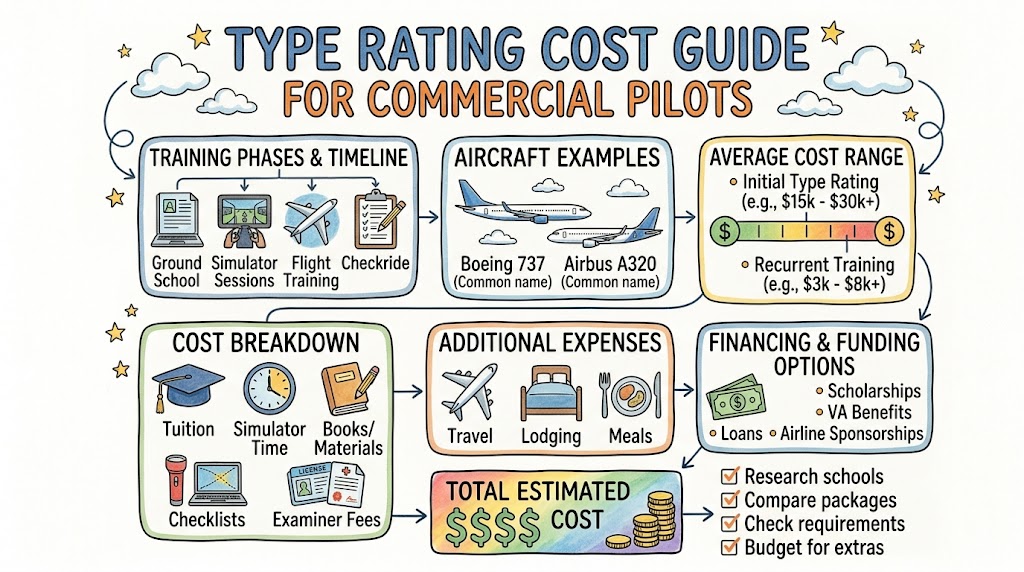
Type rating training is also one of the largest expenses commercial pilots may face after completing their CPL. Course fees, full-flight simulator sessions, examinations, base training, travel, accommodation and licence endorsement can create a substantial financial commitment.
Published prices reviewed in July 2026 show that course-only offers can begin near €10,000, while complete training packages may reach €25,000 or more. Indian training providers commonly publish estimates ranging from approximately ₹12 lakh to over ₹25 lakh, depending on the aircraft and included services.
This Pilotsdeal.com guide explains the major costs, hidden expenses and financial decisions commercial pilots should understand before selecting a type rating program.
What Is a Type Rating?
A type rating is an additional qualification added to a pilot licence that authorises the pilot to operate a particular aircraft type.
Examples include:
- Airbus A320 family
- Boeing 737 NG
- Boeing 737 MAX
- ATR 42/72
- Boeing 777
- Boeing 787
- Airbus A330
- Airbus A350
- Embraer 170/190
- Bombardier Q400
Aircraft requiring individual type ratings are identified by the applicable aviation authority. EASA publishes official aircraft type-rating and licence-endorsement lists, while DGCA rules state that a pilot licence indicates the aircraft classes and types the holder is entitled to fly.
In the United States, the FAA states that a type rating is required for all jets and aircraft with a maximum take-off weight of at least 12,500 pounds.
Requirements vary between DGCA, EASA, FAA and other aviation authorities. Pilots should therefore confirm that the chosen course is approved or accepted by the authority issuing their licence.
Average Type Rating Cost
There is no universal type rating fee. Prices vary significantly according to the aircraft, training country, regulatory approval and services included.
General Planning Range
| Training Option | Indicative Published Cost | Important Note |
|---|---|---|
| A320 course-only offer in Europe | €10,300–€15,500 | Base training excluded |
| Boeing 737 NG course-only offer | €12,000–€15,500 | Base training excluded |
| A320 modular or complete options | €10,000–€25,000 | Depends on included modules |
| A320 estimated cost in India | ₹18–₹25 lakh | Provider-published market estimate |
| General type rating estimate in India | ₹12–₹25 lakh or more | Aircraft and package dependent |
| Historical base-training benchmark | €5,000–€10,000 | Separate from many course fees |
Current BAA Training offers advertise an A320 type rating at €10,300 and a Boeing 737 NG type rating at €12,000, but both specifically exclude base training. Jetline Training publishes A320 prices between €10,000 and €25,000 depending on modules such as MCC and base-training landings.
These figures are planning references, not guaranteed quotations. Promotional pricing, taxes, currency movements and simulator availability can change the final amount.
Main Components of Type Rating Training
A type rating course usually combines theoretical knowledge, procedural training, simulator sessions and assessment.
Ground School and Computer-Based Training
The theoretical stage covers the aircraft’s:
- Electrical systems
- Hydraulic systems
- Pneumatic systems
- Fuel system
- Flight controls
- Autoflight system
- Navigation equipment
- Engines and auxiliary power unit
- Landing gear
- Fire protection
- Limitations
- Normal procedures
- Abnormal procedures
- Emergency procedures
Training may be delivered through classroom sessions, online lessons, computer-based training or a combination of methods.
Cockpit Procedure Training
Pilots practise cockpit flows, checklists and standard operating procedures using training devices or fixed-base simulators.
This stage helps pilots understand:
- Cockpit layout
- Crew coordination
- Checklist discipline
- Flight-management-system operation
- Normal operating sequences
- Abnormal system handling
Full-Flight Simulator Training
Full-flight simulator sessions are one of the most expensive parts of type rating training.
Pilots practise:
- Normal take-offs and landings
- Engine failures
- Rejected take-offs
- Instrument approaches
- Go-arounds
- Low-visibility operations
- Windshear recovery
- System failures
- Emergency descents
- Crew resource management
- Decision-making under pressure
The simulator must represent the relevant aircraft type and meet the approval requirements of the applicable aviation authority.
Skill Test
At the end of the course, the pilot normally completes a skill test with an authorised examiner.
The assessment evaluates:
- Aircraft knowledge
- Standard procedures
- Manual flying
- Instrument procedures
- Crew coordination
- Abnormal situations
- Emergency management
- Operational decision-making
Examiner charges may be included in the package or billed separately.
Base Training
Base training usually involves take-offs and landings in the actual aircraft after simulator training.
It is frequently excluded from the advertised type rating price. For example, a 2026 Jetline offer listed an A320 course from €10,995 and base training separately from €9,000.
Pilots should never assume that a low advertised fee includes aircraft base training.
Type Rating Cost by Aircraft
Airbus A320 Type Rating Cost
The Airbus A320 is a common type-rating choice for pilots targeting narrow-body airline operations.
Current European advertisements show:
- A320 type rating promotional offer: approximately €10,300
- Standard displayed price before promotion: approximately €15,500
- Base training: excluded from that advertised offer
- Wider modular-package range: approximately €10,000–€25,000
A 2026 Indian provider estimates the average A320 type rating cost at approximately ₹18–₹25 lakh, depending on simulator location, base training and aircraft availability. This is a provider estimate rather than an official DGCA fee.
Boeing 737 Type Rating Cost
Boeing 737 training prices depend on whether the course covers the Classic, NG or MAX variant.
A current BAA Training offer displays:
- Boeing 737 NG standard price: €15,500
- Promotional price: €12,000
- Base training: not included
The same provider has previously published a broader Boeing 737 type rating range of approximately €16,000–€34,000, demonstrating how included services can significantly change the final amount.
Pilots should also check whether differences training is required when moving between the 737 NG and 737 MAX.
ATR 42/72 Type Rating Cost
ATR type ratings are relevant to pilots targeting regional airline operations.
Some training providers do not publish a fixed ATR price and instead issue individual quotations. A DGCA-focused ATR 72-600 program from BAA Training lists approximately 172 training hours over 31 days, including theory and full-flight simulator training, with MCC and base training offered as additional options.
An older Indian market estimate placed ATR type rating costs around ₹12–₹15 lakh, but pilots should obtain a current written quote because aircraft availability and base-training costs can change quickly.
Type Rating Training Duration
Training duration depends on the aircraft, candidate experience and course structure.
Current DGCA-focused program examples include:
| Aircraft Program | Published Duration |
|---|---|
| Airbus A320 DGCA type rating | 184 hours over 42 days |
| Boeing 737 NG DGCA type rating | 166 hours over 36 days |
| ATR 72-600 DGCA type rating | 172 hours over 31 days |
These durations are provider-specific examples rather than universal regulatory timelines.
Additional time may be required for:
- Document approval
- Simulator scheduling
- Examination availability
- Base training
- Licence endorsement
- Remedial sessions
- Weather-related aircraft delays
Detailed Type Rating Cost Breakdown
Course Fee
The main course fee may cover:
- Learning material
- Computer-based training
- Ground school
- Procedure-training devices
- Full-flight simulator sessions
- Instructor charges
- Internal examinations
- Skill test preparation
The written quotation should clearly state how many simulator sessions and training hours are included.
Base Training Cost
Base training can add several thousand euros or several lakh rupees to the total budget.
Its price depends on:
- Aircraft type
- Number of required landings
- Aircraft positioning
- Airport fees
- Fuel
- Instructor and examiner availability
- Number of pilots sharing the flight
- Local aviation requirements
MCC or APS MCC
Multi-Crew Cooperation training teaches pilots how to operate effectively in a two-pilot cockpit.
Depending on the licensing system and airline preference, the pilot may need:
- Standard MCC
- APS MCC
- Integrated MCC within the type rating
- A bridging or upgrade course
Some providers include MCC, while others list it as an optional additional module.
UPRT
Upset Prevention and Recovery Training may be required before entering certain multi-pilot type rating programs.
Pilots must confirm whether they already meet the applicable advanced UPRT requirement and whether the quoted package includes it.
Skill-Test and Examiner Fees
Ask whether the package includes:
- Examiner fee
- Simulator used for the test
- Administrative charges
- Repeat skill-test fees
- Licence paperwork
- Certificate issuance
A failed test or incomplete session can result in additional simulator and examiner charges.
Travel and Visa Expenses
Pilots completing training abroad should budget for:
- Return flights
- Visa charges
- Travel insurance
- Airport transfers
- Local transportation
- Currency-conversion charges
- Document attestation
- Medical or licence validation
A lower overseas course fee may become more expensive after these costs are included.
Accommodation and Food
A course may require four to eight weeks away from home.
Before enrolling, confirm whether accommodation is:
- Included
- Discounted
- Shared
- Located near the simulator
- Available throughout possible delays
Extra accommodation may be required if the skill test or base training is postponed.
Licence Endorsement
Completing the training course does not necessarily mean the rating immediately appears on the pilot’s licence.
The pilot may need to submit:
- Course completion certificate
- Skill-test documentation
- Simulator details
- Examiner report
- Medical certificate
- Logbook records
- Licence application
- Authority fees
Pilots training outside their home country should verify the endorsement or conversion process before paying the course deposit.
Sample Type Rating Budget for an Indian Pilot
The following is an illustrative planning budget rather than a training-provider quotation.
| Expense | Possible Planning Amount |
|---|---|
| Type rating course | ₹15–₹22 lakh |
| Base training | ₹3–₹7 lakh |
| Travel and visa | ₹75,000–₹2 lakh |
| Accommodation and food | ₹1–₹2.5 lakh |
| Licensing and documentation | ₹25,000–₹1 lakh |
| Equipment and study material | ₹25,000–₹75,000 |
| Contingency fund | ₹1–₹3 lakh |
| Possible overall budget | ₹21–₹38.25 lakh |
A course advertised at ₹18 lakh can therefore cost considerably more when base training, travel and repeat-session risk are excluded.
Airline-Sponsored Versus Self-Sponsored Type Rating
Airline-Sponsored Type Rating
An airline-sponsored program may involve:
- Full airline payment
- Partial airline payment
- Salary deductions
- A training bond
- Repayment if the pilot leaves early
- Conditional employment after successful training
The pilot should read every bond and repayment clause carefully.
Self-Sponsored Type Rating
In a self-sponsored program, the pilot directly pays the training provider.
Advantages may include:
- Freedom to choose the provider
- Greater scheduling flexibility
- Ability to apply to multiple airlines
- Faster access when recruitment is active
However, a self-sponsored type rating does not guarantee an airline job.
Pilots should study current recruitment requirements before investing. Some airlines prefer non-type-rated candidates for their own training pipeline, while others recruit pilots who already hold a valid rating.
Type Rating, Base Training and Line Training
These terms are related but not identical.
Type Rating
Aircraft-specific theoretical and simulator training followed by a skill test.
Base Training
Take-offs and landings completed in the actual aircraft when required.
Line Training
Operational training conducted during commercial flights under airline supervision.
Line training is usually connected to an airline operator and should not automatically be treated as part of a privately purchased type rating. A training provider also distinguishes type rating, base training and line training as separate stages.
Be cautious of organisations selling expensive “guaranteed line training” without transparent airline, aircraft and employment arrangements.
How to Compare Type Rating Quotations
Do not compare only the headline price. Request an itemised written quotation covering:
- Regulatory approval and licence acceptance
- Total ground-school hours
- Number of simulator sessions
- Simulator type and qualification
- Instructor charges
- Skill-test and examiner fees
- Base training
- Number of aircraft landings
- MCC or APS MCC
- UPRT requirements
- Study material
- Taxes
- Accommodation
- Airport transfers
- Licence endorsement support
- Repeat-session prices
- Refund and cancellation policy
- Course validity and completion deadline
Two courses advertised at the same price may offer very different levels of training.
Red Flags to Avoid
Commercial pilots should be cautious when a provider:
- Cannot show valid training approval
- Refuses to provide a complete written quotation
- Promises guaranteed airline employment
- Demands full payment before issuing a contract
- Does not name the simulator location
- Hides base-training charges
- Cannot explain the licence-endorsement process
- Advertises unrealistically short training
- Provides no refund or cancellation terms
- Pressures pilots to pay immediately
- Sells line training without a clearly identified airline
- Avoids explaining repeat-test fees
Always verify the provider directly with the relevant aviation authority.
How to Reduce Type Rating Costs
Secure an Airline Offer First
Whenever possible, obtain an airline selection or conditional employment offer before funding a type rating.
This reduces the risk of choosing an aircraft type that does not match available jobs.
Compare Complete Packages
Calculate the total cost after adding:
- Base training
- Travel
- Accommodation
- Taxes
- Examination fees
- Licence endorsement
- Repeat-session contingency
Prepare Before Training Begins
Review aircraft systems, instrument procedures, multi-crew operations and standard call-outs before starting the course.
Good preparation can reduce the risk of expensive remedial simulator sessions.
Choose Approval Over Location
A nearby course is not valuable if the qualification cannot be endorsed on your licence.
Confirm regulatory acceptance in writing.
Maintain a Contingency Fund
Keep additional funds available for:
- Simulator delays
- Extra accommodation
- Repeat sessions
- Re-examination
- Base-training postponement
- Additional documentation
Do not commit the entire budget to the advertised course fee.
Frequently Asked Questions
How much does a type rating cost in India?
Published 2026 market estimates commonly place type rating costs between approximately ₹12 lakh and ₹25 lakh or more. A320-specific estimates may reach ₹18–₹25 lakh before every additional expense is considered.
Is type rating included in CPL training?
It is usually separate from standard CPL training unless the pilot is enrolled in an airline-linked or integrated program that specifically includes it.
Which type rating is best for commercial pilots?
The best choice depends on airline recruitment, regional fleets, licence authority, course approval and the pilot’s career plan. No aircraft type is automatically best for every pilot.
Does a type rating guarantee an airline job?
No. It provides aircraft-specific qualification but does not guarantee employment, airline selection or line training.
Is base training included in the course fee?
Not always. Many advertised A320 and Boeing 737 prices specifically exclude base training.
How long does type rating training take?
Many programs take approximately four to six weeks, although the complete process may be longer when base training and licence endorsement are included. Provider-published DGCA programs currently range from 31 to 42 days.
Can I complete a type rating abroad?
Yes, but the training and skill test must be acceptable to the authority responsible for endorsing the rating on your licence.
What happens if I fail a simulator session?
The pilot may need remedial training, another simulator session or a repeated skill test. These can create significant additional costs.
Should I complete A320 or Boeing 737 training?
Choose according to realistic airline opportunities rather than aircraft popularity alone. Review recruitment requirements before paying.
Can an airline pay for my type rating?
Some airlines sponsor training, recover the expense through salary deductions or require a training bond. Policies vary between employers.
Key Takeaways
- Type rating is aircraft-specific training added to a pilot licence.
- Advertised course prices may exclude base training.
- A320 and Boeing 737 course-only offers can begin near €10,000–€12,000.
- Indian market estimates commonly range from ₹12 lakh to more than ₹25 lakh.
- Travel, accommodation, licensing and remedial training can substantially increase the final expense.
- A type rating does not guarantee airline employment.
- Pilots should verify regulatory approval before paying.
- Every quotation should be compared on total cost, not headline price.
- Airline-sponsored training generally creates less financial risk than an unsupported self-sponsored rating.
- A contingency fund is essential.
Conclusion
Type rating training is a major professional and financial decision for commercial pilots. Before enrolling, confirm airline demand, regulatory approval, simulator quality and every included cost. A carefully selected type rating can support an airline career, but pilots should avoid making the investment only because a particular aircraft is popular.

