
Introduction
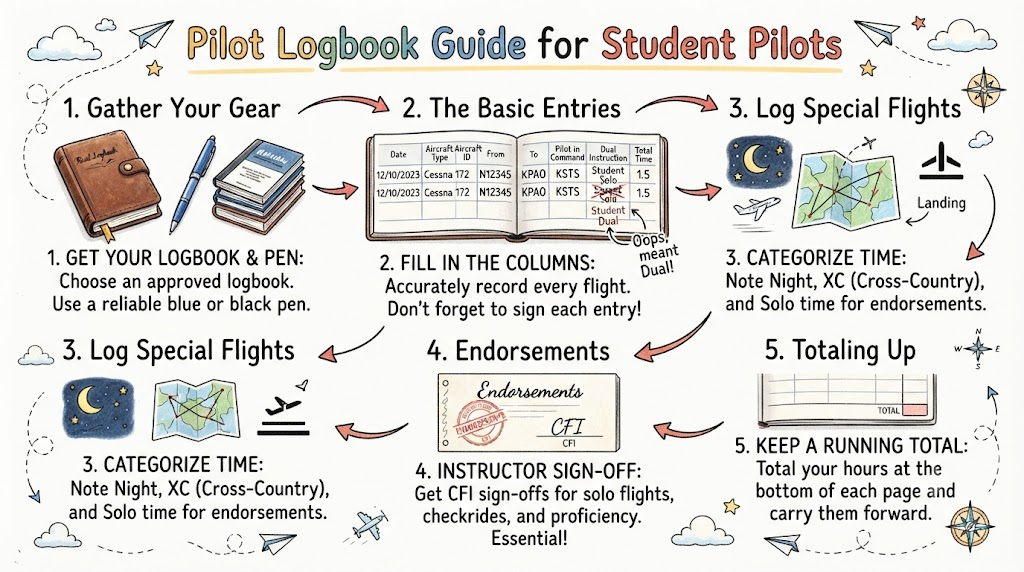
A pilot logbook is one of the most important records in a student pilot’s training journey. It is not just a notebook where flying hours are written. It is an official record of your flight training, aircraft time, instructor lessons, solo flights, simulator practice, and progress toward your pilot license.
For student pilots, maintaining a clean and accurate logbook from the first day is very important. It helps you track flying hours, understand your training progress, prepare for license requirements, and build a professional habit early in your aviation career.
This Pilot Logbook Guide for Student Pilots will help beginners understand what a pilot logbook is, how to fill it correctly, and what mistakes to avoid.
What Is a Pilot Logbook?
A pilot logbook is a record book used to document every flight completed by a pilot or student pilot. It includes details such as flight date, aircraft type, aircraft registration number, route, flight time, instructor name, and training remarks.
In simple words, your logbook is proof of your flying experience. It shows how many hours you have flown, what type of training you have completed, and whether you are meeting the required progress for your pilot license.
A logbook can be in paper format or digital format. Many students still use a physical logbook because it can be checked and signed by instructors. Digital logbooks are also useful for backups and quick calculations.
Why Student Pilots Need a Logbook
Every student pilot needs a logbook because flying hours are a major part of pilot training. Without proper records, it becomes difficult to prove your training progress.
A student pilot logbook helps you:
- Track total flying hours
- Record dual and solo flight time
- Maintain proof of training lessons
- Record simulator practice
- Prepare for license applications
- Review instructor remarks
- Track cross-country and night flying hours
- Avoid confusion during document verification
A well-maintained logbook also shows discipline. In aviation, accuracy and responsibility matter a lot. A student who maintains proper records develops a professional habit early.
What Details Should Be Recorded in a Pilot Logbook?
Every flight entry should be clear and complete. Missing details can create confusion later, especially during license checks or training reviews.
A student pilot should record:
- Date of flight
- Aircraft type
- Aircraft registration number
- Departure airport
- Arrival airport
- Flight duration
- Dual or solo flight status
- Day or night flying
- Cross-country flight details
- Simulator time, if applicable
- Instructor name
- Instructor signature, if required
- Lesson type
- Remarks about performance
It is best to fill the logbook soon after the flight while the details are still fresh.
Types of Flying Hours Student Pilots Should Track
Student pilots should not only track total hours. Different types of flying hours are important for different parts of training.
Dual Instruction Hours
These are hours flown with a flight instructor. During dual flights, the instructor teaches takeoff, landing, aircraft handling, navigation, radio communication, emergency procedures, and other skills.
Solo Flying Hours
Solo hours are completed when the student flies without an instructor in the aircraft. These hours are important because they show confidence and independent flying ability.
Cross-Country Hours
Cross-country flying helps students learn navigation, flight planning, weather checking, fuel planning, and communication between airports.
Night Flying Hours
Night flying teaches students how to fly in low-light conditions. It includes learning runway lights, night landing techniques, and visibility management.
Instrument Flying Hours
Instrument flying is training where students learn to control the aircraft using cockpit instruments. This is useful when outside visibility is limited.
Simulator Hours
Simulator training helps students practice procedures, navigation, emergency situations, and instrument flying without using an actual aircraft.
Check Ride Preparation Hours
Before a flight test or license skill test, students may complete extra practice flights. These should also be recorded clearly.
How to Fill a Pilot Logbook Correctly
Filling a logbook is simple, but it must be done carefully. Small mistakes can create problems later.
Step 1: Enter the Flight Date
Write the correct date of the flight. Make sure it matches your flight school records.
Step 2: Add Aircraft Details
Enter the aircraft type and registration number. For example, if you trained on a Cessna aircraft, mention the correct model and registration.
Step 3: Record the Route
Write the departure and arrival airport. If it was a local training flight, mention the training area or airport as per your school’s format.
Step 4: Add Flight Time
Record the correct flight duration. Do not guess the time. Confirm it with your instructor or flight school record.
Step 5: Mention Flight Type
Clearly mark whether it was dual, solo, cross-country, night, instrument, or simulator training.
Step 6: Add Instructor Details
If the flight was with an instructor, write the instructor’s name and get the required signature.
Step 7: Add Remarks
Write short remarks about the lesson. For example: “Landing practice,” “Circuit training,” “Navigation exercise,” or “Emergency procedure practice.”
Step 8: Review Before Closing
Check the entry once before closing the logbook. Make sure all details are correct and readable.
Paper Logbook vs Digital Logbook
Both paper and digital logbooks are useful. Student pilots should understand the difference before choosing one.
| Feature | Paper Logbook | Digital Logbook |
|---|---|---|
| Format | Physical book | App or online tool |
| Instructor signature | Easy to sign manually | May depend on system |
| Backup | Can be lost or damaged | Easy digital backup |
| Calculations | Manual calculation needed | Automatic totals |
| Official use | Commonly accepted | Depends on authority or school |
| Ease of access | Must carry physically | Can access from phone or laptop |
For student pilots, the best option is to maintain the official logbook required by the flight school and also keep a digital backup for safety.
Common Logbook Mistakes Student Pilots Should Avoid
Many beginners make mistakes because they do not understand the importance of logbook accuracy.
Avoid these common mistakes:
- Not updating the logbook after every flight
- Writing incorrect flight duration
- Forgetting instructor signatures
- Entering wrong aircraft registration
- Not recording simulator hours
- Mixing rough notes with official entries
- Leaving blank columns
- Depending only on memory
- Not checking totals regularly
- Not keeping backup copies
A logbook should be neat, clear, and professional. Treat it as an official aviation document.
How a Logbook Helps in Pilot License Applications
When a student applies for a pilot license, flying hours must be verified. The logbook helps show whether the student has completed the required training hours and flight types.
Flight schools and aviation authorities may check:
- Total flying hours
- Solo flying hours
- Dual instruction hours
- Cross-country hours
- Night flying hours
- Simulator hours
- Instructor signatures
- Training completion records
If the logbook is incomplete or confusing, it may delay the license process. This is why students should maintain it properly from the beginning.
Tips to Maintain a Clean and Accurate Logbook
A good logbook habit saves time and stress later. Here are some simple tips for student pilots:
- Update your logbook after every flight
- Use clear handwriting
- Confirm flight time with your instructor
- Do not overwrite or make messy corrections
- Keep your logbook in a safe place
- Maintain a digital backup
- Review total hours weekly
- Ask your instructor to verify entries
- Keep training receipts separately
- Follow your flight school’s logbook format
These small habits help you stay organized throughout training.
Why Parents Should Understand the Student Pilot Logbook
Many parents support pilot training financially, so they should also understand the importance of a logbook. It helps them see the student’s training progress and understand how flying hours are being completed.
A logbook can also help families compare flying progress with training expenses. This creates better planning and avoids confusion about how much training has been completed.
How pilotsdeal.com Can Help Student Pilots
pilotsdeal.com can be a helpful platform for aviation learners who want simple information about pilot training, flying hours, training costs, logbook awareness, and student pilot planning.
For beginners, aviation can feel confusing in the early stages. Platforms like pilotsdeal.com can help students understand practical topics in easy language, especially before joining or during flight training.
Final Thoughts
A pilot logbook is more than a training record. It is a professional document that follows a pilot throughout their aviation journey. For student pilots, maintaining it correctly from the first flight is very important.
A clean and accurate logbook helps you track flying hours, prove training progress, prepare for license applications, and build professional discipline. Whether you use a paper logbook, a digital logbook, or both, the most important rule is simple: update it regularly and keep it accurate.
Every flight teaches something. Your logbook keeps that journey recorded.
FAQs
1. What is a pilot logbook?
A pilot logbook is an official record of a pilot’s flying experience. It includes flight dates, aircraft details, flying hours, instructor information, and training remarks.
2. Why is a logbook important for student pilots?
A logbook helps student pilots track flying hours, training progress, solo flights, simulator time, and license requirements.
3. When should I update my pilot logbook?
You should update your logbook immediately after every flight. This helps avoid mistakes and missing details.
4. What details are required in a pilot logbook?
A logbook usually includes date, aircraft type, registration number, route, flight duration, flight type, instructor name, signature, and remarks.
5. Can student pilots use a digital logbook?
Yes, student pilots can use a digital logbook for backup and easy tracking. However, they should follow their flight school and aviation authority rules.
6. Are simulator hours recorded in a logbook?
Yes, simulator hours should be recorded separately if they are part of the training program.
7. What happens if a logbook has mistakes?
Mistakes can create confusion during training review or license verification. Students should correct errors as per instructor or flight school guidance.
8. Should instructor signatures be included?
Yes, instructor signatures are important for verifying dual training flights and lesson completion.
9. Is a paper logbook better than a digital logbook?
Both are useful. A paper logbook is commonly used for official records, while a digital logbook is helpful for backup and automatic calculations.
10. How can I keep my logbook safe?
Keep it in a secure place, avoid damage, take regular photos or scans, and maintain a digital backup.

