
Introduction
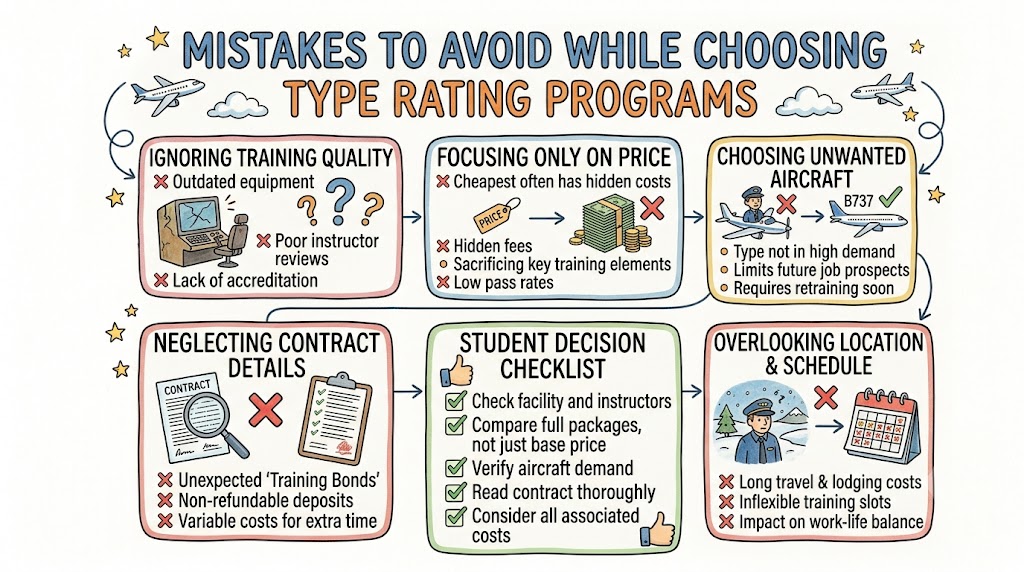
Choosing a type rating program is a major career and financial decision for a commercial pilot. A program may cost several lakh rupees and require weeks of ground school, simulator training, assessments and travel.
Unfortunately, many students select a course after looking only at the advertised price, aircraft name or promised completion time. They may not verify whether the training organisation is properly approved, whether the simulator is suitable, whether base training is included or whether the qualification will be accepted by their licensing authority.
A poor decision can result in hidden expenses, long delays, licence-endorsement problems or a type rating that does not support the student’s employment plans.
This Pilotsdeal.com guide explains the most common mistakes pilots should avoid when comparing type rating programs.
Why Choosing the Right Type Rating Program Matters
A type rating qualifies a licensed pilot to operate a particular aircraft type or family, such as:
- Airbus A320
- Boeing 737
- ATR 42/72
- Bombardier Q400
- Embraer E-Jet
- Airbus A330
- Boeing 777
- Boeing 787
- Airbus A350
The exact licensing requirements depend on the aviation authority and aircraft. For example, FAA rules require an appropriate type rating to act as pilot in command of large aircraft, turbojet-powered aeroplanes, powered-lift aircraft and other aircraft specifically designated by the regulator.
EASA publishes updated class and type rating endorsement lists showing the official rating designations used for flight-crew licensing. The aeroplane list available in July 2026 was updated on February 12, 2026.
Because type rating rules and endorsements are authority-specific, students must choose a program that matches their licence and career plans.
Mistake 1: Choosing a Program Only Because It Is Cheap
The lowest advertised fee does not always represent the lowest total cost.
A cheap course may exclude:
- Full-flight simulator sessions
- Skill-test simulator time
- Examiner charges
- MCC or APS MCC
- Advanced UPRT
- Base training
- Taxes
- Accommodation
- Airport transfers
- Licence documentation
- Additional training sessions
- Retest charges
Another program may appear more expensive but include most of these services.
Students should compare complete packages rather than headline prices.
Better Approach
Request an itemised quotation showing:
- Every included training module
- Every excluded expense
- Number of simulator sessions
- Skill-test charges
- Examiner fees
- Base-training arrangements
- Taxes
- Travel and living costs
- Cost of additional training
Calculate the estimated amount required from enrolment to licence endorsement.
Mistake 2: Failing to Verify Regulatory Approval
One of the most serious mistakes is paying for a program without verifying the training organisation’s approval.
DGCA publishes information concerning approved training organisations authorised to conduct flight-crew type rating programs. Students pursuing an Indian licence should verify the organisation, approved course and applicable aircraft type through official DGCA records before making a payment.
EASA also maintains information about approved training organisations under its regulatory responsibility. These organisations remain subject to certification and continued surveillance.
Questions to Verify
Ask the provider:
- What is the organisation’s legal name?
- Which aviation authority approved it?
- What is its approval number?
- Which aircraft types are included in its approval?
- Is the advertised training location approved?
- Is the approval currently valid?
- Is the simulator approved for the planned training and test?
- Will the course be accepted by your licence-issuing authority?
Do not accept a website logo or the words “internationally approved” as sufficient evidence.
Mistake 3: Assuming Approval Covers Every Course
A training organisation may be approved, but its approval may not cover every aircraft, location, training device or course being advertised.
For example, a provider may be authorised for:
- A320 training but not Boeing 737 training
- Ground school but not the complete simulator course
- One simulator centre but not another
- Training under one authority but not another
- Renewal training but not an initial type rating
Better Approach
Request a copy or official reference showing the exact scope of approval.
Match the approval against:
- Aircraft type
- Aircraft variant
- Training location
- Simulator
- Course category
- Skill-test arrangement
- Licensing authority
General company approval is not enough. The exact program must fall within the approved scope.
Mistake 4: Not Confirming Licence Acceptance
A course can be valid under one regulatory system but difficult to endorse under another.
A DGCA, EASA, FAA or other national licence holder may face different requirements concerning:
- Training prerequisites
- Simulator qualification
- Examiner authorisation
- Skill-test documentation
- Base training
- Licence conversion
- Differences training
- Application procedures
Indian regulations state that licences and related training must be obtained through organisations approved or recognised by the Director-General, subject to the applicable requirements.
Better Approach
Before paying, ask your licensing authority or obtain authoritative written guidance confirming:
- The course is acceptable
- The examiner is authorised
- The simulator is recognised
- The documents can be submitted
- Additional training will not be required
- The rating can be endorsed on your existing licence
Do not rely entirely on the training provider’s sales representative for regulatory interpretation.
Mistake 5: Selecting an Aircraft Type Without Studying Airline Demand
Some students choose an A320, Boeing 737 or ATR type rating simply because the aircraft is popular.
Popularity alone does not guarantee employment.
The right aircraft depends on:
- Airlines operating in the target region
- Current recruitment requirements
- Fleet expansion or reduction
- Whether airlines recruit rated pilots
- Whether airlines provide their own type ratings
- Experience and recency requirements
- Licence and work-permit eligibility
- Base-location preferences
Better Approach
Before enrolling, review several realistic airline opportunities and ask:
- Does the airline operate this aircraft?
- Does it recruit low-hour type-rated pilots?
- Does it accept self-sponsored ratings?
- Does it require airline-specific training?
- Does it prefer non-type-rated candidates?
- Is previous airline experience required?
- How recent must simulator or aircraft experience be?
Choose a rating that supports a genuine career plan, not only an attractive aircraft name.
Mistake 6: Believing a Type Rating Guarantees Employment
A type rating is a licence qualification. It is not an airline job guarantee.
A training provider may advertise:
- Placement assistance
- Airline connections
- Interview preparation
- Recruitment support
- Access to airline vacancies
- Conditional opportunities
These phrases do not necessarily mean that employment is included.
Better Approach
Ask for a clear distinction between:
- Training admission
- Airline interview
- Conditional selection
- Letter of intent
- Provisional job offer
- Final employment contract
- Line-training opportunity
Employment claims should be supported by verifiable written documentation from the airline.
Be cautious when a provider promises guaranteed employment without airline assessment, medical verification or background checks.
Mistake 7: Confusing Type Rating With Airline Training
Type rating, operator conversion, base training and line training are separate stages.
Type Rating
Aircraft-specific ground and simulator training followed by the required skill test.
Base Training
Take-offs and landings conducted in the actual aircraft when required.
Operator Conversion Training
Training covering an airline’s manuals, operating procedures, policies and aircraft configuration.
Line Training
Supervised operational flying within an airline environment.
Completing a type rating does not automatically include operator conversion or line experience.
Better Approach
Ask the provider to identify each stage as:
- Included
- Excluded
- Optional
- Guaranteed
- Subject to additional selection
- Conducted by another organisation
- Payable separately
Never assume a “complete airline package” includes all stages unless the contract lists them clearly.
Mistake 8: Ignoring Base Training
Base training is one of the most commonly misunderstood parts of a type rating package.
A provider may say that base training is “available” without confirming:
- Aircraft
- Operator
- Airport
- Date
- Number of landings
- Additional cost
- Waiting period
Aircraft availability, operational commitments and airport restrictions can delay base training.
Questions to Ask
- Is base training included in the price?
- How many take-offs and landings are included?
- Which aircraft operator provides it?
- At which airport will it take place?
- Is the date confirmed?
- What is the average waiting period?
- Who pays for travel and accommodation?
- What happens when the flight is cancelled?
- Is the payment refundable?
- Will the completion documents be accepted?
A verbal assurance that base training will be arranged later is not the same as a confirmed written arrangement.
Mistake 9: Ignoring Simulator Details
Full-flight simulator training is a central part of a modern multi-pilot type rating.
However, students sometimes pay without knowing:
- Simulator qualification
- Aircraft configuration represented
- Location
- Availability
- Number of sessions
- Session duration
- Instructor allocation
- Skill-test arrangements
EASA’s regulatory framework includes certification specifications and oversight arrangements for flight simulation training devices, highlighting the importance of device qualification and approved use.
Better Approach
Confirm:
- Exact simulator model
- Qualification level
- Approving authority
- Aircraft and engine configuration
- Total simulator hours
- Number of training sessions
- Number of pilots per session
- Briefing and debriefing time
- Skill-test simulator booking
- Backup arrangements after technical failure
Avoid contracts that describe simulator training only as “according to requirements” without providing a schedule.
Mistake 10: Counting Simulator Session Time Incorrectly
A four-hour simulator booking may not mean that one student receives four hours of pilot-flying practice.
In a paired course, the session may be divided between:
- Pilot flying
- Pilot monitoring
- Instructor demonstrations
- Repeated exercises
- Briefing or setup
Both crew roles are important, but students should understand how the hours are structured.
Better Approach
Ask for:
- Total simulator sessions
- Duration of each session
- Number of trainees
- Pilot-flying allocation
- Pilot-monitoring allocation
- Skill-test session duration
- Additional-session cost
Compare programs using actual training content rather than only the total number printed in a brochure.
Mistake 11: Ignoring Aircraft Variants and Differences Training
An aircraft family may contain several versions with different engines, avionics or operational characteristics.
Examples include:
- A320 CEO and NEO
- Boeing 737 Classic, NG and MAX
- ATR 42 and ATR 72
- Different engine variants
- Different flight-management-system standards
EASA’s rating and endorsement lists identify aircraft categorisation and may indicate relevant variants or differences requirements.
Better Approach
Ask:
- Which aircraft variant does the course represent?
- Which engines are installed in the simulator model?
- Is differences training included?
- Will the target airline require additional training?
- Does the licence endorsement cover the expected aircraft family?
- Is familiarisation training required for another version?
The title “A320 type rating” or “B737 type rating” may not explain every configuration detail.
Mistake 12: Overlooking MCC or APS MCC Requirements
Multi-Crew Cooperation training develops communication, teamwork, workload management and decision-making in a multi-pilot cockpit.
Depending on the licensing route, a pilot may require:
- MCC
- APS MCC
- Integrated multi-crew training
- Additional airline bridging training
Some type rating packages include MCC, while others require it before enrolment.
Better Approach
Confirm:
- Whether MCC is a prerequisite
- Whether your existing certificate is accepted
- Whether APS MCC is preferred by target airlines
- Whether the course includes MCC
- Which simulator or training device is used
- Whether additional fees apply
Avoid paying for a second course when your existing qualification may already meet the requirement.
Mistake 13: Forgetting Advanced UPRT Requirements
Advanced Upset Prevention and Recovery Training may be required before entering certain first multi-pilot type rating courses under the EASA licensing system.
EASA materials identify advanced UPRT as a prerequisite before a pilot begins the first relevant multi-pilot or high-performance complex aircraft type rating course.
Better Approach
Before enrolment, confirm:
- Whether advanced UPRT is required
- Whether your previous course is acceptable
- Whether it must be completed before ground school
- Whether it is included in the quotation
- Whether aircraft flying is involved
- Whether travel and accommodation are additional
Missing a prerequisite can delay training and cause the loss of booked simulator slots.
Mistake 14: Not Checking Entry Requirements
A student may pay a non-refundable deposit before discovering that they do not meet the program’s eligibility requirements.
Possible requirements include:
- Valid CPL or ATPL
- Valid instrument rating
- Multi-engine qualification
- Valid Class 1 medical
- Minimum pilot-in-command experience
- English-language proficiency
- MCC
- Advanced UPRT
- Licence verification
- Theoretical examination credits
- Authority-specific documentation
Better Approach
Request a written eligibility assessment before making the payment.
Submit copies of your:
- Licence
- Medical certificate
- Logbook summary
- Instrument rating
- Multi-engine endorsement
- MCC certificate
- UPRT certificate
- English proficiency record
- Passport
Ask the provider to confirm your acceptance in writing.
Mistake 15: Ignoring Instructor Experience
A modern simulator and attractive classroom cannot compensate for weak instruction.
Instructor quality affects:
- Aircraft systems understanding
- Standard operating procedures
- Crew coordination
- Manual flying
- Abnormal procedures
- Decision-making
- Skill-test preparation
Questions to Ask
- Are instructors currently qualified?
- Do they have operational experience on the aircraft?
- How are instructors standardised?
- What is the student-to-instructor ratio?
- Are progress reports provided?
- How are weak areas managed?
- Does the same instructor follow the student?
- What happens when an instructor becomes unavailable?
Avoid choosing a program solely because the training centre looks modern in promotional photographs.
Mistake 16: Ignoring Simulator and Course Availability
Some providers accept deposits before securing all simulator slots.
This may result in long gaps between:
- Ground school
- Procedure training
- Simulator sessions
- Skill test
- Base training
Long delays can increase accommodation expenses and reduce training continuity.
Better Approach
Ask for a written schedule showing:
- Ground-school start and end dates
- Simulator session dates
- Skill-test date
- Examiner availability
- Base-training estimate
- Course-completion deadline
Also ask what happens when the provider postpones a session.
A confirmed training schedule is more valuable than an early admission date followed by uncertain waiting periods.
Mistake 17: Not Asking About Additional Training Costs
Not every student completes the course within the standard number of sessions.
Additional training may be required after:
- Progress-check difficulties
- Unsatisfactory simulator performance
- Skill-test failure
- Illness
- Long training gaps
- Instructor recommendation
- Incomplete procedural knowledge
Costs That May Apply
- Additional simulator rental
- Instructor fees
- New examiner fee
- Rebooking charge
- Accommodation extension
- Flight changes
- Administrative processing
Request the price of one additional simulator session before enrolling.
Keep a contingency reserve instead of spending the entire budget on the basic course fee.
Mistake 18: Paying the Complete Amount Too Early
Some providers offer discounts for full advance payment.
Although an early-payment discount may appear attractive, it increases the student’s financial exposure.
Potential problems include:
- Course postponement
- Simulator unavailability
- Visa rejection
- Medical issues
- Provider cancellation
- Base-training delays
- Refund disputes
Better Approach
Prefer a stage-based payment structure when possible:
- Registration deposit
- Ground-school payment
- Simulator payment
- Skill-test payment
- Base-training payment
Payments linked to confirmed training stages can reduce risk.
Mistake 19: Not Reading the Refund Policy
Students sometimes focus on the training schedule and ignore cancellation conditions.
The contract should explain what happens when:
- The student withdraws
- The provider cancels
- A visa is refused
- The medical becomes invalid
- The course is postponed
- The simulator is unavailable
- The student fails an assessment
- Base training cannot be arranged
Check for Deductions
Refunds may exclude:
- Registration fees
- Administrative charges
- Study material
- Reserved simulator slots
- Bank-transfer charges
- Currency losses
- Completed training
Do not pay until you understand which amounts are refundable and which are not.
Mistake 20: Trusting Verbal Promises
Sales representatives may make reassuring statements about:
- Airline jobs
- Base training
- Course dates
- Accommodation
- Refunds
- Simulator availability
- Licence endorsement
Verbal commitments can be difficult to prove during a disagreement.
Better Approach
Request written confirmation through:
- Contract
- Official quotation
- Invoice
- Admission letter
- Official company email
- Signed training schedule
When a promise is important to your decision, it should appear in writing.
Mistake 21: Paying an Unverified Agent
Agents may help with enrolment, documentation, travel and communication. However, the pilot must verify the agent’s relationship with the training organisation.
Warning signs include:
- Payment requested in a personal account
- No official invoice
- Unclear company identity
- Pressure to transfer money quickly
- Communication only through messaging apps
- No direct contact with the training provider
- Different names on the contract and bank account
Better Approach
Contact the training organisation independently and confirm:
- The agent is authorised
- The quoted program exists
- The payment instructions are correct
- The student’s seat is recorded
- The agent’s promises match the provider’s terms
Large payments should normally go to a verified organisational bank account.
Mistake 22: Ignoring the Contract and Training Bond
An airline-linked program may include a service bond or repayment obligation.
The agreement may require the pilot to repay training expenses when:
- Resigning early
- Failing to join
- Not completing training
- Losing required documentation
- Violating employment conditions
Review These Clauses
- Total bond value
- Bond duration
- Monthly reduction
- Interest
- Early resignation
- Airline termination
- Medical disqualification
- Training failure
- Guarantor responsibility
- Legal jurisdiction
Independent legal advice may be appropriate when the financial obligation is significant.
Mistake 23: Taking a Large Loan Without Employment Planning
A type rating does not guarantee immediate airline employment.
A pilot may still face:
- Recruitment delays
- Additional assessments
- Interview travel
- Licence-endorsement waiting time
- Recency requirements
- Rating renewal
- Economic or fleet changes
Better Approach
Before borrowing, calculate:
- Monthly instalment
- Interest rate
- Total repayment
- Moratorium period
- Processing fees
- Collateral risk
- Repayment without pilot income
- Family financial responsibilities
Maintain enough savings to cover several months of repayments and job-search expenses.
Mistake 24: Ignoring Rating Recency and Validity
Completing a type rating does not mean it remains operationally useful indefinitely without further activity or checking.
Recency, revalidation and proficiency requirements vary by authority and operation. Under FAA rules, for example, pilots must meet recent-experience requirements before acting as pilot in command carrying passengers, and additional proficiency requirements can apply to aircraft requiring multiple pilots or turbojet operations.
Better Approach
Ask:
- How long will the rating remain valid?
- What is required for revalidation or renewal?
- What happens when airline employment is delayed?
- Will refresher simulator training be necessary?
- How much does a proficiency check cost?
- Does the target airline require recent experience?
A self-sponsored rating completed too early may create additional renewal costs before employment.
Mistake 25: Ignoring Travel and Living Expenses
International training costs more than the course fee.
Additional expenses may include:
- Visa
- Airfare
- Travel insurance
- Accommodation
- Food
- Airport transfers
- Local transportation
- Mobile connectivity
- Laundry
- Extended stay
- Return travel for base training
- Foreign exchange charges
Better Approach
Prepare a daily living budget and include at least two to four weeks of possible delay.
Confirm whether accommodation is:
- Included
- Shared or private
- Near the training centre
- Available during schedule changes
- Refundable after early completion
Mistake 26: Not Comparing Multiple Programs
Selecting the first available course prevents proper comparison.
Students should compare at least three suitable programs using the same criteria.
Type Rating Program Comparison Scorecard
| Selection Factor | Suggested Weight |
|---|---|
| Regulatory approval and licence acceptance | 25% |
| Simulator and training quality | 18% |
| Complete cost transparency | 15% |
| Base-training arrangement | 10% |
| Instructor and examiner quality | 10% |
| Course schedule and availability | 8% |
| Contract and refund protection | 7% |
| Career relevance | 7% |
| Total | 100% |
Score each provider from one to five.
A provider that fails the approval or licence-acceptance test should not be selected, even if it receives a high score in other categories.
Final Checklist Before Enrolment
Confirm all of the following:
- Training organisation approval
- Exact scope of approval
- Licence acceptance
- Aircraft type and variant
- Simulator qualification
- Total simulator sessions
- Skill-test inclusion
- Examiner charges
- MCC requirements
- Advanced UPRT requirements
- Base-training arrangements
- Instructor qualifications
- Course schedule
- Additional-session cost
- Refund policy
- Payment schedule
- Travel and accommodation
- Airline-employment claims
- Rating validity and recency
- Complete written contract
Frequently Asked Questions
What is the biggest mistake when choosing a type rating program?
The biggest mistake is paying before verifying regulatory approval and licence acceptance.
Should I select the cheapest type rating course?
Not automatically. Compare the total cost, including skill test, examiner, base training, taxes, travel and additional sessions.
Does an approved training organisation guarantee a good course?
Approval confirms that the organisation meets relevant regulatory requirements within its approved scope. Students should still evaluate instructor quality, simulator availability, scheduling and support.
Is base training included in every type rating?
No. It is frequently excluded or sold separately.
Does a type rating guarantee an airline job?
No. It provides an aircraft-specific qualification but does not guarantee airline selection, employment or line training.
Should I complete an A320 or Boeing 737 type rating?
The decision should depend on target airlines, recruitment conditions, regional fleet demand and your financial position.
How can I verify a type rating provider?
Check the organisation through the relevant aviation authority and confirm its approval number, aircraft type, location and course scope.
What happens after failing a simulator assessment?
The pilot may need remedial training, an additional simulator session or another test. These services may create extra costs.
Is overseas type rating training acceptable?
It may be acceptable when the course, simulator, examiner and documentation meet the licence-issuing authority’s requirements.
Should the complete fee be paid in advance?
Full advance payment increases financial exposure. A staged payment arrangement may provide better protection when available.
Key Takeaways
- Never choose a type rating program based only on price.
- Verify the organisation and exact course approval.
- Confirm licence acceptance before paying.
- Study real airline demand before selecting the aircraft.
- Do not treat a type rating as a job guarantee.
- Separate type rating, base training and line training.
- Check simulator qualification and training hours.
- Confirm aircraft variant and differences requirements.
- Review MCC and UPRT prerequisites.
- Obtain a complete cost breakdown.
- Ask about additional sessions and retest costs.
- Read refund and bond conditions carefully.
- Do not trust important verbal promises.
- Verify agents and bank details.
- Plan for recency, renewal and delayed employment.
- Compare several programs before making the final choice.
Conclusion
Choosing a type rating program requires more than finding an attractive price or popular aircraft. Pilots should verify regulatory approval, licence acceptance, simulator quality, total costs, base-training arrangements and career relevance. Careful research before payment can protect both your finances and your future airline career.

