
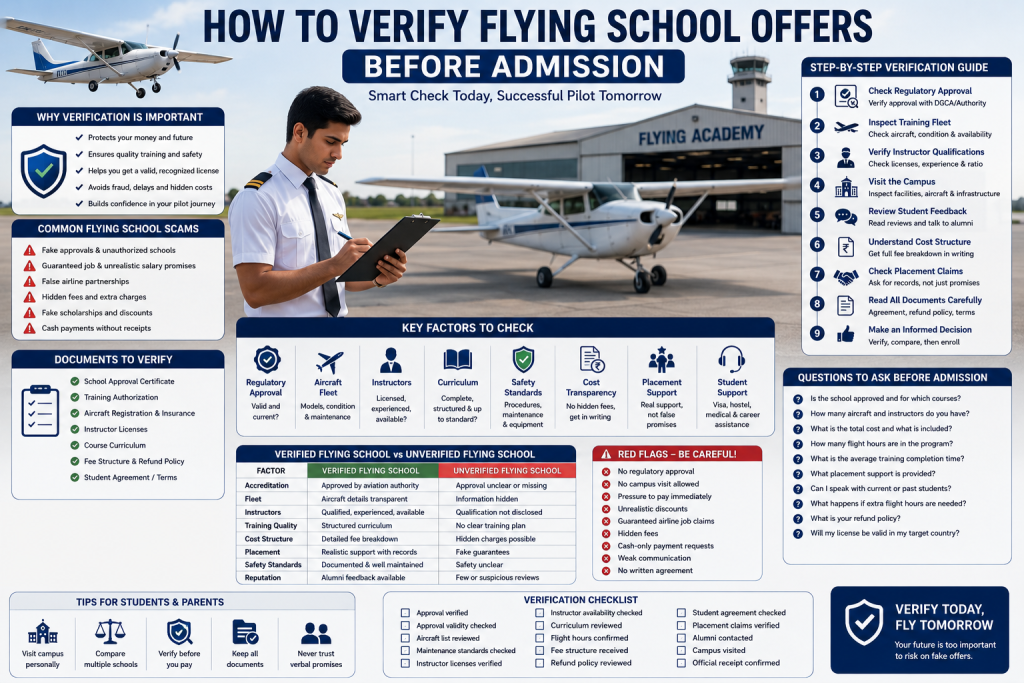
Introduction
Choosing a flying school is one of the most important decisions in a future pilot’s career. Pilot training is not only a dream investment but also a serious financial, professional, and safety-related commitment. A good flying school can build strong aviation skills, confidence, discipline, and career direction. A poor or unverified school can lead to wasted money, delayed training, incomplete licensing, and serious career setbacks.
Many students are attracted by exciting advertisements, discounted packages, placement promises, and fast-track pilot training offers. While some offers may be genuine, others may be misleading or incomplete. Before paying any admission fee, every student should carefully verify the flying school, its approvals, aircraft, instructors, training quality, cost structure, and placement claims.
This guide explains how to verify flying school offers before admission so that students and parents can make safe, informed, and confident decisions.
Why Verifying a Flying School Is Important
Flying school verification protects your career, money, and future license eligibility. Pilot training requires discipline, proper instruction, safe aircraft, approved curriculum, and recognized licensing procedures.
A verified flying school helps students receive training that meets aviation authority standards. It also ensures that flight hours, ground school, instructor records, and aircraft usage are properly documented.
Verification is important because it affects:
- Career growth
- License recognition
- Training quality
- Flight safety
- Financial planning
- Employment readiness
- Student confidence
A flying school may have attractive marketing, but students should never rely only on advertisements. Proper verification gives a clear picture of whether the school can actually deliver what it promises.
Common Flying School Admission Scams
Pilot training is expensive, and that makes the aviation education market attractive to dishonest operators. Students should be aware of common scams before making payments.
Fake Aviation Academies
Some institutions may present themselves as aviation academies without proper approval or training facilities. They may use attractive websites, social media pages, and fake testimonials to appear professional.
Unauthorized Training Centers
Some centers may offer ground classes or admission support but may not be authorized to conduct actual flight training. Students must confirm whether the institution is approved for the specific training program they are offering.
False Placement Guarantees
Many students are attracted by claims such as guaranteed airline jobs or direct airline placement. No flying school should be trusted blindly if it promises employment without clear proof, written terms, and realistic conditions.
Unrealistic Salary Promises
Some schools advertise high pilot salaries immediately after training. While aviation can be rewarding, fresh graduates usually need to complete licenses, build experience, and meet airline selection standards.
Fake Airline Partnerships
A school may claim partnership with airlines without official confirmation. Students should ask for written proof and verify such claims independently.
Hidden Fees
Some schools advertise low tuition fees but later add charges for fuel, exams, uniforms, accommodation, medicals, license processing, simulator sessions, or extra flying hours.
Fraudulent Scholarships
Fake scholarships are sometimes used to collect registration fees from students. Always verify scholarship details, eligibility, selection process, and official documentation.
Step-by-Step Guide to Verify a Flying School
Before admission, students should follow a structured verification process.
Verify Regulatory Approval
The first and most important step is checking whether the flying school is approved by the relevant aviation authority.
Depending on the country, flying schools may be regulated by authorities such as:
- DGCA
- FAA
- EASA
- CASA
- Transport Canada
- Other national civil aviation authorities
Regulatory approval confirms that the school meets required training, safety, aircraft, instructor, and operational standards.
Students should verify:
- School approval certificate
- Training authorization
- Approved courses
- Validity of approval
- License type offered
- Approved aircraft and instructors
- Compliance with aviation authority rules
Never join a school only because it claims to be approved. Ask for documents and verify them through official channels.
Check the Flight Training Fleet
A good flying school should have access to safe, maintained, and available aircraft.
Check the following:
- Number of aircraft
- Aircraft models
- Aircraft condition
- Maintenance records
- Aircraft availability
- Backup aircraft availability
- Simulator facilities
- Single-engine and multi-engine training options
A school with very few aircraft and too many students may cause training delays. Students should also ask how often aircraft are grounded for maintenance and how flight scheduling is managed.
Inspect Instructor Qualifications
Instructors play a major role in shaping pilot skills. A flying school is only as strong as its instructors.
Verify:
- Certified flight instructor licenses
- Instructor experience
- Total flying hours
- Teaching experience
- Student-to-instructor ratio
- Availability of instructors
- Airline or commercial aviation background
- Communication style and teaching quality
Students should speak with instructors before admission if possible. Good instructors explain clearly, follow safety standards, and guide students with patience.
Visit the Campus Before Admission
A campus visit is one of the best ways to verify a flying school. Brochures and websites may look impressive, but a physical visit shows the real training environment.
During the visit, inspect:
- Classrooms
- Hangars
- Aircraft
- Maintenance area
- Simulator labs
- Briefing rooms
- Student facilities
- Safety standards
- Hostel or accommodation
- Administrative office
Observe whether the school environment feels organized, professional, and transparent. If a school avoids campus visits or gives excuses, treat it as a warning sign.
Verify Student Reviews and Alumni Feedback
Reviews can provide useful insights, but students should read them carefully.
Check:
- Google reviews
- Aviation forums
- Alumni feedback
- Social media comments
- Student discussion groups
- Independent aviation communities
Look for repeated patterns. If many students complain about delayed flying hours, hidden fees, poor scheduling, or weak support, take it seriously.
Be careful with fake reviews. Genuine reviews usually include specific details about training, instructors, aircraft availability, and student experience.
Check Placement Records Carefully
Many flying schools advertise placement support. This can be helpful, but students must understand the difference between placement assistance and guaranteed employment.
Ask for:
- Alumni placement records
- Airline selection history
- Internship support
- Interview preparation
- Career counseling
- Written placement terms
- Realistic job pathway
Avoid schools that make vague claims without data. A genuine school will explain that pilot jobs depend on licensing, skill, medical fitness, airline requirements, market demand, and selection performance.
Review the Training Curriculum
A good flying school should provide a clear training curriculum.
Check whether the program includes:
- Ground school
- Flight training
- Simulator training
- Navigation training
- Instrument training
- Multi-engine training
- Safety procedures
- Radio communication
- Emergency training
- Check ride preparation
- CPL or PPL syllabus requirements
Students should know exactly what they will study, how training is structured, and how progress will be measured.
Understand the Complete Cost Structure
Pilot training involves many costs beyond basic tuition. Before admission, ask for a complete written fee structure.
Common costs include:
- Admission fee
- Ground school fee
- Flight hour charges
- Fuel surcharge
- Simulator charges
- Exam fees
- Medical examination
- Uniforms
- Books and study materials
- Accommodation
- Food expenses
- License processing
- Extra flying hours
- Retest or recheck charges
Never rely only on verbal fee promises. Ask for a written breakdown and confirm what is included and what is not included.
Verify Student Support Services
Student support can make training smoother, especially for students moving to another city or country.
Check whether the school offers:
- Visa support
- Accommodation support
- Medical guidance
- Financing assistance
- Career counseling
- Airline interview preparation
- Student progress tracking
- Documentation support
- License conversion guidance
Support services should be clearly explained, not just advertised.
Red Flags That Indicate a Fake or Risky Flying School
Students should be cautious if they notice any of these warning signs:
- No regulatory approval
- No clear address
- No campus visit allowed
- No aircraft details
- No instructor information
- No written fee structure
- Pressure to pay immediately
- Unrealistic discounts
- Guaranteed airline job claims
- Fake airline partnership claims
- No official receipts
- Cash-only payment requests
- Poor communication
- No refund policy
- No student references
- Weak online presence
- Fake testimonials
- No training schedule
- No safety information
- No proper admission agreement
If a flying school avoids questions, delays sharing documents, or pressures students to pay quickly, it is better to step back and verify more carefully.
Questions Every Student Should Ask Before Admission
Before joining a flying school, ask these important questions:
- Is the flying school approved by the aviation authority?
- Which pilot training licenses are offered?
- Is the approval currently valid?
- How many aircraft are available for students?
- What aircraft models are used for training?
- Are aircraft owned, leased, or shared?
- How often are students able to fly?
- What is the average training completion time?
- How many instructors are available?
- What are the instructor qualifications?
- What is the student-to-instructor ratio?
- How many flight hours are included in the package?
- What happens if extra flying hours are needed?
- Are simulator hours included?
- Is accommodation included in the fee?
- Are medical and examination fees included?
- What is the refund policy?
- Are there any hidden charges?
- Does the school provide placement support?
- Can the school provide alumni references?
- Is the license recognized in the student’s target country?
- What documents will the student receive after training?
- How is student progress monitored?
- What safety procedures are followed?
- Are all payment receipts issued officially?
Documents Students Should Verify
Before paying fees, students should request and verify important documents.
| Document | Why It Matters |
|---|---|
| School Approval Certificate | Confirms regulatory recognition |
| Training Authorization | Confirms permission to conduct training |
| Aircraft Registration | Confirms aircraft identity and legality |
| Aircraft Insurance | Shows safety and legal coverage |
| Instructor Licenses | Confirms instructor qualification |
| Course Curriculum | Shows training structure |
| Student Agreement | Defines student and school responsibilities |
| Fee Structure | Prevents hidden cost confusion |
| Refund Policy | Protects student finances |
| Safety Manual | Shows safety procedures |
| Maintenance Records | Confirms aircraft care |
| Placement Policy | Clarifies career support claims |
Verified Flying School vs Unverified Flying School
| Category | Verified Flying School | Unverified Flying School |
|---|---|---|
| Accreditation | Approved by aviation authority | Approval unclear or missing |
| Fleet | Aircraft details are transparent | Aircraft information is hidden |
| Instructors | Licensed and experienced | Qualification not disclosed |
| Training Quality | Structured curriculum | Unclear training plan |
| Placement | Realistic support | Fake guarantees |
| Transparency | Written documents provided | Verbal promises only |
| Student Support | Clear support services | Limited or no support |
| Cost Structure | Detailed fee breakdown | Hidden charges possible |
| Safety Standards | Documented safety procedures | Safety unclear |
| Reputation | Alumni feedback available | Few or suspicious reviews |
Flying School Verification Checklist
| Item | Verified | Notes |
|---|---|---|
| Regulatory approval checked | Yes / No | Confirm with authority |
| Approval validity confirmed | Yes / No | Check expiry date |
| Course authorization verified | Yes / No | Match with offered program |
| Aircraft list reviewed | Yes / No | Check number and models |
| Aircraft condition inspected | Yes / No | Visit campus if possible |
| Maintenance standards checked | Yes / No | Ask for records |
| Instructor licenses verified | Yes / No | Review qualifications |
| Instructor availability checked | Yes / No | Ask schedule details |
| Student-to-instructor ratio checked | Yes / No | Avoid overcrowding |
| Curriculum reviewed | Yes / No | Match license requirements |
| Flight hours confirmed | Yes / No | Get in writing |
| Simulator hours confirmed | Yes / No | Check inclusion |
| Full fee structure received | Yes / No | Avoid hidden charges |
| Refund policy reviewed | Yes / No | Read carefully |
| Student agreement checked | Yes / No | Keep a copy |
| Placement claims verified | Yes / No | Ask for proof |
| Alumni contacted | Yes / No | Speak directly |
| Reviews checked | Yes / No | Look for patterns |
| Campus visited | Yes / No | Strongly recommended |
| Official receipt confirmed | Yes / No | Avoid cash without proof |
Tips for Parents Supporting Future Pilots
Parents play a major role in helping students choose the right flying school. Because pilot training is a large investment, parents should participate in the verification process.
Parents should:
- Visit the campus with the student
- Review all documents
- Compare multiple schools
- Understand the full cost
- Avoid emotional decisions
- Check refund policies
- Confirm safety standards
- Speak with alumni
- Verify placement claims
- Plan finances realistically
A flying career takes time, patience, discipline, and proper training. Parents should support the dream but also protect the student from misleading offers.
Best Practices Before Paying Admission Fees
Before making any payment, follow these best practices:
- Read the admission contract carefully
- Ask for written confirmation of all promises
- Verify bank account details
- Avoid cash payments
- Request official receipts
- Confirm refund rules
- Keep email and message records
- Compare at least three schools
- Do not rush because of limited-time discounts
- Consult aviation professionals if unsure
A genuine flying school will not hesitate to provide transparent information.
Frequently Asked Questions
1. How do I know if a flying school is genuine?
A genuine flying school should have valid regulatory approval, qualified instructors, aircraft access, a clear curriculum, transparent fees, and proper documentation. Students should verify approval certificates, visit the campus, speak with alumni, and avoid relying only on advertisements.
2. How can I verify DGCA approval?
Students should ask the school for its approval certificate and confirm whether the approval is valid for the specific course being offered. It is also important to verify the school name, location, aircraft details, and approval validity before admission.
3. Should I visit the campus before enrolling?
Yes, visiting the campus is highly recommended. A campus visit helps students inspect classrooms, aircraft, simulators, hangars, safety practices, and the overall training environment. It also helps identify whether the school is transparent and professional.
4. Are airline placement guarantees trustworthy?
Placement guarantees should be treated carefully. Pilot jobs depend on license completion, skill, medical fitness, airline hiring needs, and interview performance. Genuine schools may provide placement support, but guaranteed airline jobs should always be verified in writing.
5. What documents should I request before admission?
Students should request school approval certificates, training authorization, aircraft details, instructor licenses, curriculum, student agreement, fee structure, refund policy, and official payment details. These documents help confirm whether the offer is genuine.
6. How much should pilot training cost?
Pilot training cost varies based on country, license type, aircraft used, flight hours, fuel costs, accommodation, and exam fees. Students should request a complete written fee structure and compare multiple schools before deciding.
7. Can online reviews be trusted?
Online reviews can be useful, but they should not be the only source of verification. Students should look for detailed reviews, repeated patterns, alumni feedback, and independent aviation community discussions. Fake reviews are often vague or overly promotional.
8. What are common flying school admission scams?
Common scams include fake approvals, false airline partnerships, guaranteed job promises, hidden fees, fake scholarships, unauthorized training programs, and pressure-based admission offers. Students should verify every claim before paying.
9. Is simulator training important?
Yes, simulator training is important because it helps students practice procedures, emergencies, instrument flying, and cockpit discipline in a controlled environment. However, simulator hours should be clearly explained in the curriculum and fee structure.
10. What should parents verify before paying fees?
Parents should verify school approval, aircraft availability, instructor qualifications, fee structure, refund policy, safety standards, accommodation, and placement claims. They should also keep written proof of all commitments made by the school.
Conclusion
Verifying a flying school offer before admission is one of the smartest steps an aspiring pilot can take. Pilot training is a serious investment, and every promise should be checked carefully before any payment is made.
Students should verify regulatory approval, inspect aircraft, review instructor qualifications, understand the fee structure, speak with alumni, and read all documents carefully. They should never rush into admission because of discounts, pressure, or unrealistic job promises.
A well-verified flying school can provide safe training, strong aviation knowledge, proper licensing support, and better career preparation. With careful research and the right guidance, students can begin their pilot journey with confidence and clarity.

