
Introduction
A surgeon may hold strong general plastic surgery qualifications without having the same level of experience in every cosmetic procedure.
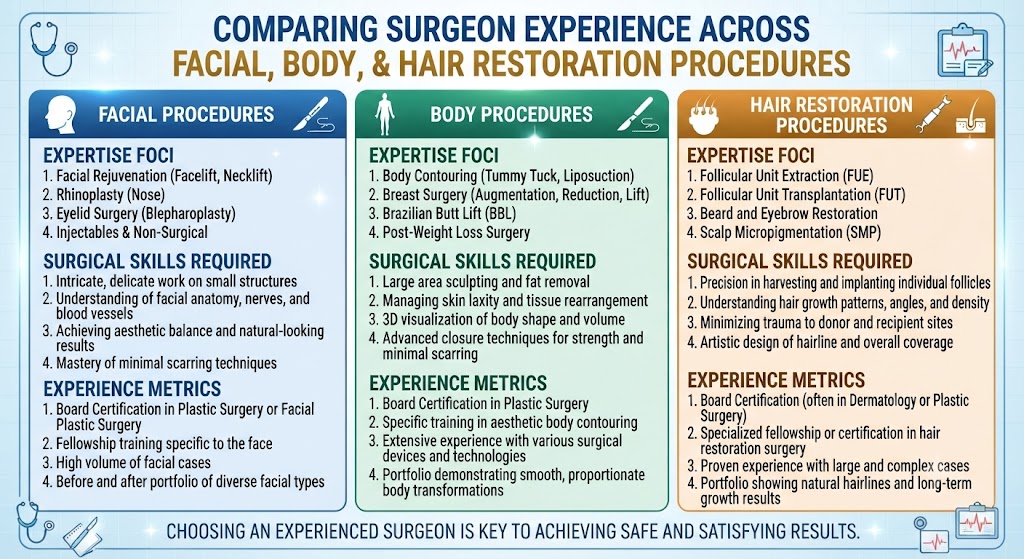
Facial operations require detailed work around visible structures, expressions, symmetry and, in some cases, breathing or eyelid function. Body contouring may involve larger treatment areas, longer operations, extensive incisions and carefully planned recovery. Hair restoration requires diagnosis of hair loss, management of a limited donor supply, natural hairline design and long-term planning.
Patients should therefore look beyond statements such as “experienced cosmetic surgeon” or “thousands of procedures completed.” The more useful question is whether the surgeon has appropriate training and recent, procedure-specific experience with patients whose needs are similar to theirs.
Professional certification provides evidence of formal education, approved training and examinations, but it does not replace a review of the surgeon’s experience with the exact procedure. The American Board of Plastic Surgery, for example, explains that specialty certification represents education and training beyond basic medical licensing, together with successful completion of specialty examinations.
BestCosmeticHospitals.com can help patients begin comparing cosmetic hospitals, specialists, destinations, procedures and estimated costs. Every surgeon’s registration, specialist recognition, experience and hospital affiliation should still be verified independently.
Why Procedure-Specific Experience Matters
Plastic surgery covers many different areas of the face and body. Hair restoration also involves a specialized combination of medical diagnosis, surgical planning and team-based technical work.
A surgeon who regularly performs tummy tuck surgery may not have the same depth of experience in revision rhinoplasty. A facial specialist who performs facelifts every week may not routinely undertake large post-weight-loss body lifts. A physician offering hair transplantation may perform certain stages personally while delegating other work to a clinical team.
Procedure-specific experience can influence:
- Patient selection
- Surgical planning
- Choice of technique
- Scar placement
- Recognition of anatomical differences
- Management of unexpected findings
- Prevention and treatment of complications
- Recovery instructions
- Long-term treatment planning
- Revision options
No amount of experience can guarantee a particular result. It can, however, help patients identify whether a surgeon’s everyday clinical work matches the treatment they are considering.
Start with Core Qualifications
Before comparing procedure numbers or photographs, patients should confirm the surgeon’s basic professional credentials.
Medical Registration
The surgeon should have an active medical licence in the country where the procedure will take place.
Verify:
- Full registered name
- Registration number
- Licence status
- Registered specialty
- Restrictions or conditions
- Disciplinary findings where publicly available
Registration should be checked through an official medical council, government regulator or recognized licensing authority.
Specialist Training
A medical licence confirms permission to practise medicine, but it does not necessarily prove specialist plastic surgery training.
Depending on the country, relevant credentials may include:
- Plastic and reconstructive surgery certification
- Facial plastic surgery training
- Otolaryngology or head-and-neck surgery training for selected facial procedures
- Dermatology or plastic surgery backgrounds combined with hair restoration training
- Recognized national specialist registration
- Board certification or its local equivalent
Professional titles differ between countries. Patients should identify what training stands behind terms such as cosmetic surgeon, aesthetic surgeon, facial surgeon or hair transplant doctor.
Certification
Certification systems vary internationally. Patients considering treatment abroad should confirm that a surgeon holds the recognized qualification required in that country and has training in the planned procedure. ISAPS recommends checking certification or its national equivalent, procedure-specific training and professional standing before choosing an overseas plastic surgeon.
Continuing Education
Cosmetic techniques, surgical devices, implants and safety practices continue to develop.
Patients may ask whether the surgeon:
- Attends specialist education
- Participates in professional meetings
- Maintains certification requirements
- Reviews complications and outcomes
- Undertakes training when adopting a new technique
- Contributes to teaching or clinical research
Professional activity may support credibility, but it should not replace evidence of safe clinical practice.
Understanding Different Types of Surgeon Experience
Surgeon experience should not be reduced to a single number.
A useful comparison examines several layers.
Total Surgical Experience
This refers to the surgeon’s overall career in surgery or plastic surgery.
It may indicate broad clinical maturity, but it does not reveal how often the surgeon performs the treatment you are considering.
Procedure-Specific Experience
This measures experience with the exact operation, such as:
- Primary rhinoplasty
- Revision rhinoplasty
- Deep-plane facelift
- Eyelid surgery
- Liposuction
- Tummy tuck surgery
- Post-weight-loss body lift
- Follicular unit excision
- Strip-method hair transplantation
- Corrective hair transplant surgery
This is usually more relevant than total career length alone.
Recent Experience
A surgeon may have performed many procedures over an entire career but relatively few in recent years.
Ask how often the procedure has been performed during a recent and clearly stated period.
Experience with Similar Patients
Results and risks may differ according to:
- Age
- Skin quality
- Anatomy
- Previous surgery
- Hair type
- Pattern of hair loss
- Scarring tendency
- Body weight changes
- Medical conditions
- Treatment goals
Patients should ask whether the surgeon regularly treats people with similar characteristics and concerns.
Revision Experience
Revision surgery can be more complex because tissues, scars, blood supply and anatomy may have changed after an earlier operation.
A surgeon who performs primary procedures is not automatically experienced in difficult revision cases.
Comparing Facial Surgery Experience
Facial surgery requires careful planning because even small changes may be highly visible. Surgeons must consider facial proportions, symmetry, scars, expression and the relationship between different features.
Facial procedures may include:
- Rhinoplasty
- Facelift
- Neck lift
- Eyelid surgery
- Brow lift
- Facial fat transfer
- Chin or cheek augmentation
- Ear surgery
- Facial revision surgery
What to Look for in a Facial Surgeon
Detailed Knowledge of Facial Anatomy
The surgeon should understand how skin, fat, muscles, cartilage, bone, nerves and blood vessels interact.
For procedures such as rhinoplasty or eyelid surgery, planning may also need to protect breathing, vision or eyelid function.
Procedure Concentration
Ask what percentage of the surgeon’s clinical practice involves facial surgery and how frequently the exact procedure is performed.
A surgeon performing one facelift occasionally should not be compared only by career length with someone whose practice is strongly focused on facial rejuvenation.
Experience with Different Facial Structures
Facial proportions, skin thickness and healing patterns vary.
The surgeon should be able to explain how the plan will be adjusted to the patient rather than applying the same technique to everyone.
Primary and Revision Cases
Ask whether the surgeon handles:
- First-time procedures
- Corrective procedures
- Complex asymmetry
- Previous implant problems
- Scarring
- Functional concerns
- Complications from earlier operations
A surgeon should not describe revision surgery as identical to a first operation.
Natural Expression and Proportion
Facial surgery should be planned around the whole face rather than treating one feature in isolation.
Ask how the proposed change may affect:
- Facial balance
- Expression
- Hairline
- Eyelid position
- Neck contour
- Nasal breathing
- Long-term ageing
Facelift Experience
A facelift surgeon should understand different facial ageing patterns, tissue layers, incision placement and strategies for the face and neck.
ASPS advises patients considering a facelift to select a properly trained and board-certified plastic surgeon. Its membership standards include extensive surgical training, plastic surgery residency and comprehensive examinations.
Useful questions include:
- How many facelifts do you perform regularly?
- Which facelift techniques do you use?
- How do you determine which technique is suitable?
- Do you treat the neck during the same procedure?
- Where will the scars be placed?
- How do you reduce tension around the ears and hairline?
- Do you perform revision facelifts?
- How are nerve injuries, bleeding or healing problems managed?
Rhinoplasty Experience
Rhinoplasty surgeons may need experience in both appearance and nasal function.
Ask whether the surgeon evaluates:
- Nasal airflow
- Septal structure
- Skin thickness
- Facial proportions
- Previous nasal injury
- Earlier surgery
- Cartilage availability
- Realistic limits of change
A surgeon experienced mainly in straightforward primary rhinoplasty may not be the right specialist for a complex breathing problem or revision operation.
Eyelid Surgery Experience
Eyelid surgery requires attention to eye protection, lid position, tissue removal and existing dryness or visual concerns.
Ask how the surgeon assesses:
- Eyelid support
- Brow position
- Tear production
- Previous eye surgery
- Visual symptoms
- Upper and lower eyelid differences
- Risk of excessive skin removal
Patients with functional eye concerns may require coordinated assessment involving an appropriate eye specialist.
Comparing Body Contouring Experience
Body procedures often involve larger surgical areas than facial operations. Some procedures remove skin, reshape tissue, reposition the navel or combine surgery across several body regions.
Common body procedures include:
- Liposuction
- Tummy tuck surgery
- Arm lift
- Thigh lift
- Body lift
- Breast lift
- Breast augmentation
- Breast reduction
- Fat transfer
- Surgery after major weight loss
What to Look for in a Body Contouring Surgeon
Experience with the Exact Operation
A surgeon who regularly performs small-volume liposuction may not have equivalent experience in circumferential body lifts or complex post-weight-loss surgery.
Ask for separate procedure numbers rather than one total covering every body operation.
Patient Selection
An experienced body surgeon should assess:
- General health
- Weight stability
- Smoking or nicotine use
- Previous abdominal surgery
- Hernias
- Skin quality
- Blood-clot risk
- Medication
- Future pregnancy plans where relevant
- Ability to manage recovery
A surgeon who recommends surgery without exploring health and recovery factors may not be completing a thorough assessment.
Safe Procedure Combination
Patients may be interested in combining liposuction, tummy tuck surgery or breast procedures to reduce travel or recovery periods.
The surgeon should explain:
- Why procedures should or should not be combined
- Expected operating time
- Anesthesia considerations
- Blood-clot precautions
- Overnight monitoring
- Mobility after surgery
- Whether staging surgery is safer
A responsible surgeon should be willing to recommend fewer procedures or staged treatment when appropriate.
Scar and Contour Planning
Body surgery involves more than removing skin or fat.
The surgeon should discuss:
- Scar length and position
- Clothing and underwear lines
- Skin tension
- Natural body proportions
- Contour transitions
- Existing asymmetry
- Possibility of irregularities
- Expected changes after swelling settles
Liposuction Experience
Liposuction removes fat from selected areas to change body contour. Different treatment areas require different approaches and limits.
ASPS advises patients to ask how much liposuction experience the surgeon has, how many procedures have been performed and which body areas are regularly treated.
Ask:
- Which areas do you treat most frequently?
- How do you calculate a safe treatment plan?
- Which technique do you use and why?
- Who performs the fat removal?
- How do you reduce contour irregularities?
- Do you perform corrective liposuction?
- Will I require overnight observation?
- How will blood-clot risk be assessed?
Experience with one technology should not be treated as proof that it is best for every patient.
Tummy Tuck Experience
A tummy tuck may remove excess skin and fat and, in selected cases, address weakened or separated abdominal muscles.
A surgeon experienced in abdominoplasty should be able to discuss:
- Standard and extended approaches
- Muscle repair
- Existing scars
- Navel placement
- Hernia concerns
- Drain or drain-free techniques
- Blood-clot prevention
- Wound care
- Mobility during recovery
- Management of delayed healing
Ask to see examples involving patients with similar amounts of excess skin and comparable body structure.
Post-Weight-Loss Surgery
Patients who have lost a substantial amount of weight may require treatment across several areas.
Relevant experience may include:
- Lower body lift
- Arm lift
- Thigh lift
- Breast reshaping
- Upper body lift
- Staged surgical planning
- Nutritional assessment
- Long scar management
A surgeon should explain the order in which procedures may be performed and why completing everything in one operation may not be appropriate.
Comparing Hair Restoration Experience
Hair restoration differs from many facial and body procedures because the surgeon must work with a limited donor supply while considering future hair loss.
The result may depend on:
- Correct diagnosis
- Patient suitability
- Donor density
- Hair characteristics
- Hairline design
- Graft extraction
- Graft handling
- Recipient-site planning
- Long-term hair-loss progression
- The roles performed by the surgeon and technicians
Diagnosis Comes Before Surgery
Hair loss can have different causes, and not every patient is suitable for transplantation.
The physician should assess:
- Pattern and duration of hair loss
- Family history
- Scalp condition
- Donor area
- Hair density
- Hair calibre and curl
- Previous transplant surgery
- Medication
- Medical causes
- Future progression
ISHRS notes that some patients have hair-loss conditions that are unsuitable for surgery, insufficient donor supply or expectations that cannot be achieved responsibly.
Physician Involvement
Hair transplant clinics may operate through large teams. Patients should know exactly who completes each stage.
ISHRS states that properly trained and licensed physicians should be responsible for diagnostic evaluation, treatment planning, donor harvesting, hairline design, creation of recipient sites, management of medical problems and postoperative care, subject to the legal scope of appropriately licensed professionals in each country.
Ask:
- Who diagnoses my hair loss?
- Who designs the hairline?
- Who removes the donor follicles?
- Who makes the recipient sites?
- Who places the grafts?
- How many patients will the doctor supervise that day?
- Are technicians licensed where required?
- Who manages an emergency or adverse reaction?
Do not assume the doctor shown in advertising will personally perform the procedure.
FUE and Strip-Method Experience
Hair transplantation may involve follicular unit excision, often called FUE, or removal of a donor strip followed by follicular-unit preparation.
A surgeon may have greater experience in one technique.
Ask:
- Why is this method suitable for my donor area?
- What are the advantages and limitations?
- What scarring can occur?
- How will overharvesting be avoided?
- How will the remaining donor supply be preserved?
- Is another procedure likely in the future?
- What happens if hair loss continues?
The best technique depends on the patient, not only on which technology a clinic promotes.
Hairline Design Experience
A natural-looking hairline must consider:
- Age
- Facial shape
- Existing hairline
- Future hair loss
- Donor limitations
- Hair direction
- Density distribution
- Long-term appearance
An aggressive low hairline may use too much donor hair and become difficult to maintain if surrounding hair continues to thin.
Corrective Hair Restoration
Repair cases may involve:
- Unnatural hairlines
- Poor graft direction
- Excessive donor removal
- Visible scars
- Low density
- Plug-like grafts
- Uneven growth
- Inappropriate previous planning
Corrective work may require a physician with specific repair experience rather than a clinic focused mainly on first-time procedures.
Facial, Body and Hair Experience Comparison
| Comparison Area | Facial Procedures | Body Procedures | Hair Restoration |
|---|---|---|---|
| Main planning focus | Facial proportion, symmetry, expression and function | Contour, scars, skin removal and recovery demands | Diagnosis, donor preservation and natural hair distribution |
| Relevant experience | Exact facial procedure and revision work | Exact body area, procedure size and combined operations | Hair-loss diagnosis, extraction method, design and long-term planning |
| Important anatomy | Facial nerves, eyelids, cartilage, skin and deep tissues | Skin, fat, muscles, blood supply and previous scars | Scalp, donor follicles, hair direction and density |
| Before-and-after review | Similar face shape, age, anatomy and procedure | Similar skin excess, body structure and surgical plan | Similar hair loss, donor quality, hair type and graft requirement |
| Team questions | Surgeon, anesthetist and facial-care team | Surgeon, anesthetist, nurses and recovery team | Physician, assistants and technicians performing each stage |
| Revision concerns | Scarring, asymmetry, function and altered anatomy | Wound healing, contour irregularity and scar correction | Donor depletion, unnatural design and previous graft placement |
| Long-term planning | Ageing and structural change | Weight change, pregnancy and scar maturation | Progressive hair loss and limited donor supply |
| Facility needs | Accredited surgical environment and emergency support | Suitable operating facility, monitoring and recovery capacity | Licensed clinical setting, sterility and physician-led care |
How to Compare Procedure Numbers
Patients often ask, “How many procedures has the surgeon performed?”
That is useful, but the answer needs context.
Ask:
- Is the number for this exact procedure?
- Does it cover the surgeon’s entire career or a recent period?
- Were all procedures performed personally by the named surgeon?
- Does the figure include non-surgical treatments?
- Does it include primary and revision cases together?
- How many similar procedures are performed each month?
- How many patients are treated in one day?
- Are outcomes tracked?
A high number does not automatically prove quality. Extremely high daily volume may also raise questions about surgeon involvement, consultation time and postoperative attention.
The goal is to understand whether the surgeon performs the procedure regularly, responsibly and with appropriate follow-up.
Years of Experience Versus Relevant Experience
A surgeon with many years in practice may have broad knowledge, but years alone can be misleading.
Consider two examples:
- Surgeon A has practised for 25 years but performs only a few hair transplants annually.
- Surgeon B has practised for 12 years and has a clinical practice strongly focused on hair restoration.
The second surgeon may have more relevant recent experience for that procedure.
A balanced comparison should examine:
- Years in the specialty
- Years performing the procedure
- Recent procedure frequency
- Patient complexity
- Revision experience
- Continuing education
- Outcome monitoring
- Facility standards
- Quality of consultation and aftercare
No single measure should determine the decision.
Reviewing Before-and-After Photographs
Photographs can help patients understand a surgeon’s approach, but they are not a guarantee.
Facial Surgery Photographs
Look for:
- Similar facial structure
- Comparable age
- Consistent lighting
- Standard camera angles
- Clear scar visibility
- Front, side and angled views
- Final results after suitable healing
- Examples showing movement where relevant
Do not focus only on dramatic transformations. Look for consistency, balance and whether the result suits each patient.
Body Surgery Photographs
Review:
- Similar body structure
- Similar amount of excess skin or fat
- Comparable procedure combination
- Scar location
- Contour transitions
- Symmetry
- Front, side and back views where relevant
- Results taken after swelling has settled
Ask whether the photographs show the surgeon’s own patients and whether editing has been used.
Hair Restoration Photographs
Look for:
- Clear preoperative hair loss
- Similar hair type and colour
- Donor area views
- Hairline close-ups
- Consistent lighting
- Wet and dry hair where available
- Results at a meaningful follow-up period
- Graft number and technique
- Evidence of donor preservation
Hair fibres, styling, lighting and concealers can make density appear greater, so images should be reviewed carefully.
Ask About Outcomes and Complications
No surgeon can promise complication-free treatment.
A responsible specialist should be able to discuss:
- Common complications
- Less common serious complications
- Their approach to prevention
- Warning signs
- Emergency treatment
- Revision possibilities
- Financial responsibility
- Follow-up arrangements
Ask whether the surgeon or hospital records:
- Infections
- Bleeding
- Readmissions
- Unexpected hospital transfers
- Return to the operating room
- Wound-healing problems
- Revision procedures
- Patient-reported concerns
Numbers should be interpreted in context. A surgeon managing difficult revision cases may have a different risk profile from one treating only straightforward first-time patients.
Evaluate the Consultation
The consultation often provides more useful evidence than advertising.
An experienced surgeon should:
- Review medical history
- Examine the relevant area
- Ask about previous procedures
- Discuss goals and limitations
- Explain alternatives
- Describe scars and recovery
- Discuss risks
- Explain why the recommended technique is appropriate
- Identify when surgery should be delayed or avoided
- Allow time for questions
Be cautious when surgery is recommended through messages or photographs without a meaningful clinical assessment.
A surgeon who advises against an unsuitable procedure may demonstrate stronger judgement than one who accepts every patient.
Compare the Surgical Team, Not Only the Surgeon
Cosmetic treatment involves multiple professionals.
Depending on the procedure, the team may include:
- Anesthetist
- Assistant surgeon
- Operating-room nurses
- Recovery nurses
- Hair transplant technicians
- Wound-care specialists
- Physiotherapists
- International patient coordinators
Ask:
- Who will be present?
- What are their qualifications?
- Which tasks will each person perform?
- Who remains responsible for medical decisions?
- How many patients will the team treat that day?
- Who provides emergency care?
This is particularly important in hair restoration, where marketing may focus on a named physician while much of the procedure is delegated.
Evaluate the Operating Facility
Surgeon expertise cannot compensate for an unsuitable surgical environment.
Ask whether the facility has:
- A valid licence
- Current accreditation where available
- Appropriate operating equipment
- Qualified anesthesia support
- Sterilization systems
- Recovery monitoring
- Emergency medication
- Resuscitation equipment
- Overnight-care arrangements
- Intensive-care access or a transfer plan
ASPS explains that accredited facilities are assessed against standards involving equipment, operating-room safety, personnel and surgeon credentials.
The accreditation should apply to the exact location where the operation will occur.
Comparing Surgeons for Cosmetic Surgery Abroad
International patients should verify both the surgeon and the healthcare system in which the surgeon works.
Compare:
- National medical registration
- Specialist certification
- Hospital licence
- Procedure-specific experience
- Language and communication
- Who performs each stage
- Emergency support
- Length of stay
- Remote follow-up
- Treatment of complications after returning home
- Revision arrangements
- Complete medical records
Do not assume that a country known for one procedure has equally qualified providers at every clinic.
A destination may contain excellent specialists, average providers and unsafe operators at the same time.
Cost Should Not Be Used as a Measure of Experience
A higher fee does not automatically prove superior expertise, and a lower fee does not automatically indicate poor care.
Costs may vary according to:
- Country
- City
- Hospital type
- Surgeon qualifications
- Procedure complexity
- Anesthesia
- Operating time
- Technology
- Implant or material costs
- Aftercare
- International-patient services
Patients comparing plastic surgery cost by country should first confirm that they are comparing equivalent procedures and inclusions.
The quotation should identify:
- Named surgeon
- Exact procedure
- Hospital
- Anesthesia
- Tests
- Materials or implants
- Medication
- Follow-up
- Complication costs
- Revision terms
The most experienced surgeon is not necessarily the most expensive, but cost savings should never replace credential and safety checks.
Surgeon Experience Evaluation Table
| Evaluation Factor | What to Verify | Stronger Evidence | Weak Evidence |
|---|---|---|---|
| Medical licence | Official register | Active and independently confirmed | Website claim only |
| Specialist recognition | National authority or recognized board | Relevant plastic, facial or hair-restoration training | General medical qualification |
| Exact procedure experience | Recent procedure-specific numbers | Clear and consistent case history | One combined total for every treatment |
| Similar patient experience | Comparable anatomy and concerns | Several relevant cases | Unrelated examples |
| Revision experience | Corrective case history | Clear explanation of complexity and limits | Revision work described as routine |
| Before-and-after work | Standardized original cases | Consistent views and realistic outcomes | Edited or inconsistent images |
| Team involvement | Named professionals and duties | Clear physician and staff responsibilities | Unclear delegation |
| Complication management | Written safety and emergency plan | Open discussion and defined process | Claims of no complications |
| Facility | Licence and accreditation | Verified surgical standards | Attractive interiors only |
| Follow-up | Written schedule and contacts | Local and remote arrangements | Messaging access without a plan |
Questions to Ask a Facial Surgery Specialist
- How often do you perform this exact facial procedure?
- What percentage of your work involves facial surgery?
- Do you perform revision cases?
- How will the procedure affect facial expression and proportion?
- Are functional issues such as breathing or eyelid support relevant?
- Where will the scars be placed?
- Can I review patients with anatomy similar to mine?
- Who will provide anesthesia?
- How are complications managed?
- How long will follow-up continue?
Questions to Ask a Body Contouring Specialist
- How frequently do you perform this exact body procedure?
- Do you regularly treat patients with similar skin excess or anatomy?
- Should my procedures be combined or staged?
- How long is the expected operation?
- How will blood-clot risk be assessed?
- Where will the scars be positioned?
- Is overnight monitoring recommended?
- What assistance will I need during recovery?
- How are wound-healing problems managed?
- What is included in the revision policy?
Questions to Ask a Hair Restoration Specialist
- What is the medical cause of my hair loss?
- Am I a suitable candidate for transplantation?
- Who will design my hairline?
- Who will remove donor grafts?
- Who will create recipient sites?
- What work will technicians perform?
- How many procedures will the physician supervise that day?
- How will my donor supply be protected?
- What happens if my natural hair loss continues?
- Do you perform corrective hair transplant surgery?
Warning Signs When Comparing Surgeons
Be cautious when a surgeon or clinic:
- Uses an unclear professional title
- Refuses to provide a registration number
- Claims to be the best without verifiable evidence
- Performs every cosmetic procedure without a clear area of focus
- Gives one very large procedure number without details
- Guarantees a perfect outcome
- Claims surgery has no risks
- Uses heavily edited photographs
- Will not identify the operating facility
- Will not identify the anesthetist
- Cannot explain who performs each part of a hair transplant
- Delegates key medical decisions to a salesperson
- Pressures the patient to pay immediately
- Promotes the same technique for every patient
- Avoids discussing complications
- Has no written follow-up or revision policy
- Treats an unusually high number of surgical patients each day without explaining physician involvement
How BestCosmeticHospitals.com Supports Surgeon Research
BestCosmeticHospitals.com provides a structured starting point for patients comparing:
- Best cosmetic surgeons in the world
- Best cosmetic hospitals in the world
- Facial surgery specialists
- Body contouring surgeons
- Hair restoration physicians
- Procedure availability
- Cosmetic surgery abroad
- Best countries for plastic surgery
- Hospital facilities
- Plastic surgery cost by country
- Recovery expectations
- International-patient services
Patients can use this information to build a shortlist and prepare consultation questions.
The platform should not replace official credential checks, medical assessment or direct consultation with qualified professionals.
Final Surgeon Comparison Checklist
Before selecting a surgeon, confirm that you have:
- Verified the medical licence
- Confirmed specialist recognition
- Checked procedure-specific training
- Reviewed recent experience
- Asked for exact procedure numbers
- Confirmed experience with similar patients
- Reviewed primary and revision work separately
- Examined standardized photographs
- Discussed risks and limitations
- Identified the complete clinical team
- Confirmed who performs each stage
- Verified the operating facility
- Reviewed emergency arrangements
- Received a written treatment plan
- Received an itemized quotation
- Understood follow-up care
- Reviewed complication and revision policies
- Avoided making the decision only on price or popularity
- Consulted more than one specialist when uncertain
Frequently Asked Questions
1. Can one plastic surgeon be experienced in facial and body procedures?
Yes, some qualified plastic surgeons work across both areas. Patients should still ask how frequently the surgeon performs the exact procedure being considered.
2. Are years in practice the best measure of surgeon experience?
No. Years provide general context, but recent procedure frequency, similar cases, training, outcomes and revision experience may be more relevant.
3. How many procedures should an experienced surgeon perform?
There is no universal number that proves competence. Patients should ask about recent procedure volume, complexity, personal involvement and outcome tracking.
4. Is a facial plastic surgeon better for every facial procedure?
Not automatically. Relevant qualifications, the exact procedure, functional concerns, hospital privileges and individual experience should all be assessed.
5. Does body contouring require different experience from liposuction?
Yes. Extensive skin-removal and body-lift procedures can involve different scars, planning, recovery and risks from limited-area liposuction.
6. Who should perform the surgical stages of a hair transplant?
A properly trained and licensed physician should remain responsible for diagnosis, planning and key surgical decisions. Delegation must follow local law and professional standards.
7. Are before-and-after photographs reliable evidence?
They are useful supporting evidence but cannot guarantee results. Images should be standardized, unedited and relevant to the patient’s anatomy and procedure.
8. Is revision experience important for first-time patients?
It can show that the surgeon understands complications and altered anatomy. However, strong primary-procedure experience remains the main consideration for first-time treatment.
9. Should patients select the surgeon offering the newest technique?
Not solely for that reason. The surgeon should explain the evidence, benefits, limitations and personal experience with the technique.
10. Can an online consultation confirm a surgeon’s suitability?
It can support early research, but many procedures require an in-person examination, medical assessment and detailed discussion before final approval.
Conclusion
Comparing surgeon experience across facial, body and hair restoration procedures requires more than checking a qualification, social media profile or total procedure number.
Patients should begin with medical registration and recognized specialist training. They should then examine recent experience with the exact procedure, similar patients, complications, revision work, team involvement and the quality of the operating facility.
Facial surgery requires detailed attention to visible anatomy, proportion and function. Body contouring requires experience with larger surgical areas, scar planning, recovery and patient selection. Hair restoration requires accurate diagnosis, donor management, natural design and clear physician responsibility for medical and surgical decisions.
BestCosmeticHospitals.com can help organize comparisons between surgeons, hospitals, countries, procedures and estimated treatment expenses. Final decisions should be made only after independent verification and detailed consultation with qualified medical professionals.

