
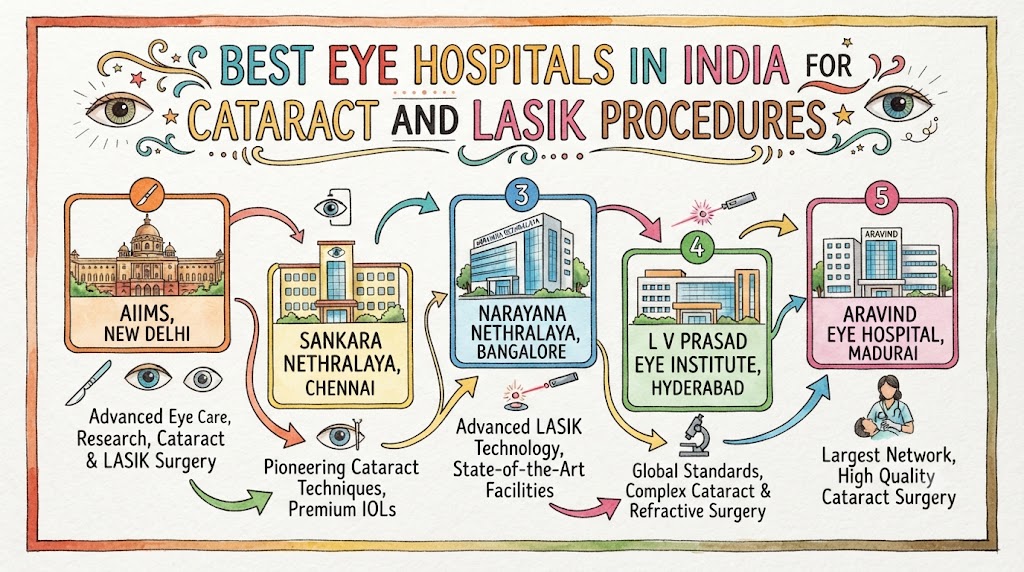
Choosing an eye hospital for cataract surgery or LASIK requires more than comparing prices or selecting the nearest facility. Patients should evaluate the experience of the ophthalmologist, diagnostic technology, surgical safety standards, procedure options, follow-up support, and transparency of communication. The best eye hospitals in India generally provide detailed preoperative examinations, qualified specialists, modern surgical systems, infection-control protocols, and structured recovery guidance. However, the most suitable hospital and procedure depend on each patient’s eye condition, medical history, lifestyle, and diagnostic results.
Understanding Cataract and LASIK Procedures
Cataract surgery and LASIK are both commonly performed eye procedures, but they treat different vision problems.
Cataract surgery removes a natural eye lens that has become cloudy and replaces it with an artificial intraocular lens. LASIK reshapes the cornea to reduce dependence on glasses or contact lenses in eligible patients.
A hospital that performs both procedures should have separate evaluation pathways because patient eligibility, surgical methods, recovery expectations, and possible risks differ.
What Is Cataract Surgery?
A cataract develops when the natural lens inside the eye becomes cloudy. This may cause blurred vision, glare, difficulty driving at night, faded colours, or frequent changes in spectacle power.
During cataract surgery, the cloudy lens is removed and replaced with an artificial lens called an intraocular lens. The ophthalmologist may discuss different lens categories depending on the patient’s eye health and visual needs.
Common cataract surgery approaches may include:
- Phacoemulsification
- Micro-incision cataract surgery
- Femtosecond laser-assisted cataract surgery
- Monofocal lens implantation
- Toric lens implantation
- Multifocal or extended-depth-of-focus lens implantation
Not every lens or surgical method is appropriate for every patient. Retina health, corneal condition, glaucoma, lifestyle, occupation, and realistic visual expectations should all be considered.
What Is LASIK Surgery?
LASIK is a refractive procedure used to correct certain levels of nearsightedness, farsightedness, and astigmatism. During the procedure, the surgeon creates a thin corneal flap and reshapes the underlying corneal tissue using a laser.
Related vision-correction techniques may include:
- Conventional LASIK
- Wavefront-guided LASIK
- Topography-guided LASIK
- Femto LASIK
- PRK
- SMILE
- Implantable contact lenses
The availability of a procedure does not mean that every patient should undergo it. Corneal thickness, tear-film quality, prescription stability, pupil size, age, pregnancy status, and existing eye conditions can affect eligibility.
Cataract Surgery and LASIK Compared
| Comparison Area | Cataract Surgery | LASIK |
|---|---|---|
| Main purpose | Removes a cloudy natural lens | Corrects refractive error by reshaping the cornea |
| Typical candidates | Patients with vision affected by cataracts | Adults with stable spectacle power and suitable corneas |
| Lens replacement | Yes | No |
| Main diagnostic focus | Lens, retina, eye pressure, cornea and lens power | Corneal thickness, shape, tear film and prescription stability |
| Recovery | Often gradual over days or weeks | Many patients resume routine activities relatively quickly |
| Future glasses | May still be required depending on lens choice and eye health | Glasses may still be needed for some tasks or later age-related changes |
| Eligibility | Based on cataract severity and overall eye health | Based on detailed refractive and corneal testing |
| Results | Vary according to eye condition, lens choice and healing | Vary according to prescription, corneal response and healing |
How to Compare the Best Eye Hospitals in India
The term “best” should not be based only on hospital size, online popularity, advertising, or treatment price. Patients should use practical comparison criteria that relate directly to safety and quality of care.
1. Qualifications and Experience of Ophthalmologists
Patients should verify whether the hospital has ophthalmologists with appropriate training in cataract, cornea, refractive surgery, retina, glaucoma, or other relevant specialties.
For cataract surgery, ask about the surgeon’s experience with different cataract types, lens calculations, complex cases, and management of associated eye conditions.
For LASIK, consider whether the ophthalmologist is trained in refractive surgery and regularly evaluates patients for LASIK, PRK, SMILE, or alternative procedures.
Important points to review include:
- Medical qualifications
- Ophthalmology specialization
- Surgical training
- Experience with the recommended procedure
- Experience managing complex or high-risk cases
- Availability of retina, cornea, or glaucoma specialists
- Communication style and willingness to answer questions
A highly experienced surgeon may still advise against surgery when diagnostic findings show that the procedure is unsuitable.
2. Hospital Accreditation and Quality Standards
Accreditation can indicate that a hospital follows defined standards for patient care, documentation, safety, infection control, and facility management.
Patients may ask whether the hospital holds recognised national or international quality accreditation. Accreditation alone does not guarantee a perfect outcome, but it can be one useful factor when comparing facilities.
Also review:
- Operation theatre protocols
- Sterilisation procedures
- Patient identification systems
- Medication safety
- Emergency readiness
- Surgical documentation
- Complaint and feedback processes
3. Advanced Diagnostic Technology
Accurate diagnosis and surgical planning are essential for both cataract and LASIK procedures.
For cataract surgery, useful diagnostic facilities may include:
- Optical biometry
- Corneal topography
- Optical coherence tomography
- Specular microscopy
- Retinal examination
- Eye-pressure measurement
- Ultrasound testing when required
For LASIK evaluation, hospitals may use:
- Corneal topography
- Corneal tomography
- Pachymetry
- Wavefront analysis
- Tear-film evaluation
- Pupil-size measurement
- Cycloplegic refraction
- Dilated retinal examination
Modern equipment is helpful only when testing is performed correctly and interpreted by a qualified ophthalmologist.
4. Range of Cataract and Refractive Procedures
The best hospitals for cataract surgery should provide more than one treatment option and explain why a particular method or lens is suitable.
Similarly, the best hospitals for LASIK surgery should not recommend LASIK automatically. They should evaluate whether PRK, SMILE, implantable lenses, spectacles, or no surgery may be safer.
A broad range of services can support more personalised decision-making, but patients should remain cautious when a hospital promotes the most expensive technology without explaining its clinical need.
5. Preoperative Evaluation
A detailed examination can identify conditions that may affect safety or results.
Before cataract surgery, the hospital should assess:
- Cataract type and severity
- Retina condition
- Corneal health
- Eye pressure
- Lens power requirements
- Existing glaucoma or macular disease
- Diabetes-related eye changes
- Previous eye surgery
Before LASIK, the hospital should evaluate:
- Stability of spectacle prescription
- Corneal thickness
- Corneal shape
- Dry-eye symptoms
- Pupil size
- Retina health
- Keratoconus risk
- Pregnancy or breastfeeding status
- Autoimmune or systemic conditions
Patients should be cautious if surgery is offered without a complete evaluation.
Questions Patients Should Ask Before Choosing a Hospital
Patients can use the following questions during consultations:
- Who will perform the procedure?
- What qualifications and experience does the surgeon have?
- Why is this procedure suitable for my eyes?
- Are there safer alternatives?
- Which diagnostic tests are required?
- What risks and limitations should I understand?
- What type of cataract lens or laser technology is being recommended?
- What is included in the total treatment cost?
- How many follow-up visits are included?
- Who should I contact if I experience a problem after surgery?
- Will I still need glasses after treatment?
- What happens if the expected visual improvement is not achieved?
- Are medicines and postoperative tests charged separately?
- How does the hospital manage surgical complications?
- Can I obtain a written treatment and cost estimate?
Clear answers should be provided in language the patient understands.
Comparing Hospital Services
| Comparison Criterion | What Patients Should Check |
|---|---|
| Ophthalmologist expertise | Relevant specialization, surgical experience and communication |
| Diagnostic facilities | Complete preoperative testing for the proposed procedure |
| Procedure options | Availability of suitable alternatives rather than one standard recommendation |
| Safety systems | Sterilisation, infection control, emergency support and documentation |
| Cost transparency | Written estimate showing tests, surgery, lens, medicines and follow-up |
| Follow-up care | Scheduled reviews and access to medical support after surgery |
| Patient education | Realistic explanation of benefits, limitations and recovery |
| Additional specialists | Retina, cornea, glaucoma or medical support when required |
| International services | Travel coordination, records assistance and follow-up planning |
| Accessibility | Location, transport, accommodation and support for older patients |
Factors Affecting Cataract Surgery Cost in India
Cataract surgery cost in India can vary considerably. The lowest advertised price may not represent the final amount.
Important cost factors include:
Type of Surgery
Standard phacoemulsification, micro-incision procedures, and laser-assisted techniques may have different charges.
Type of Intraocular Lens
The cost may change depending on whether the patient receives:
- A standard monofocal lens
- An aspheric lens
- A toric lens
- A multifocal lens
- An extended-depth-of-focus lens
Premium lenses are not automatically better for every patient. Certain retinal, corneal, or glaucoma conditions may affect suitability.
Surgeon and Hospital Charges
Fees may vary according to the surgeon’s experience, hospital category, location, facility standards, and complexity of the case.
Diagnostic Tests
Biometry, retinal scans, corneal testing, blood investigations, and medical clearance may be billed separately.
Medicines and Follow-Up
Eye drops, protective glasses, postoperative tests, and additional follow-up visits can affect the final cost.
Additional Eye Conditions
Patients with glaucoma, corneal disease, retinal problems, weak lens support, previous surgery, or advanced cataracts may require more complex planning.
Factors Affecting LASIK Surgery Cost in India
LASIK surgery cost in India may depend on:
- Type of refractive procedure
- Laser platform
- Diagnostic testing
- Prescription complexity
- One-eye or two-eye treatment
- Surgeon experience
- Hospital location
- Follow-up package
- Enhancement policy
- Treatment of dry eye before or after surgery
Patients should ask whether the quoted amount includes preoperative tests, medicines, postoperative visits, and possible enhancement procedures.
Cost should not be the only deciding factor. An inexpensive procedure may become unsuitable or unsafe when proper screening is not performed.
Insurance and Payment Planning
Insurance coverage for eye procedures varies.
Cataract surgery may be covered under some health-insurance policies when medically necessary. Coverage may depend on waiting periods, hospital networks, room limits, lens categories, and policy conditions.
LASIK is often considered an elective refractive procedure, although some policies or employer benefits may provide limited support under specific conditions.
Before treatment, patients should:
- Read the policy terms
- Contact the insurer
- Confirm network-hospital status
- Ask about lens or procedure limits
- Request pre-authorisation when required
- Keep medical reports and invoices
- Obtain a written cost estimate from the hospital
International patients should also check whether their insurance covers treatment outside their home country.
Recovery and Follow-Up Care
Recovery support is an important part of choosing an eye hospital.
After Cataract Surgery
Patients may be advised to:
- Use prescribed eye drops
- Avoid rubbing the eye
- Protect the eye from dust and injury
- Attend scheduled follow-up visits
- Avoid strenuous activity temporarily
- Report severe pain, sudden vision loss, increasing redness, flashes, floaters, or discharge
Vision may improve gradually, but recovery varies according to the patient’s eye health and surgical factors.
After LASIK
Patients may experience temporary dryness, glare, halos, fluctuating vision, or light sensitivity.
The hospital should provide:
- Clear eye-drop instructions
- Dry-eye management guidance
- Activity restrictions
- Follow-up scheduling
- Emergency contact information
- Advice about driving, screens, exercise, swimming, and eye makeup
Patients should not miss follow-up visits simply because their vision appears clear.
International Patient Considerations
India receives patients from many countries seeking ophthalmology care. International patients should compare hospitals carefully rather than choosing only by price.
Important considerations include:
- Medical-record review before travel
- Clear treatment plan
- Passport and visa support where applicable
- Estimated duration of stay
- Accommodation near the hospital
- Language assistance
- Airport and local transport arrangements
- Payment methods
- Postoperative travel restrictions
- Communication with a local ophthalmologist after returning home
Patients should avoid booking flights immediately after surgery without discussing travel safety with the treating ophthalmologist.
Common Mistakes Patients Should Avoid
Choosing Only by Price
Low prices may exclude diagnostics, medicines, premium lenses, follow-up visits, or management of complications.
Assuming the Newest Technology Is Always Best
Advanced technology may provide benefits in selected cases, but clinical suitability is more important than marketing claims.
Ignoring Surgeon Experience
Hospital branding should not replace careful evaluation of the ophthalmologist who will perform the procedure.
Skipping a Second Opinion
A second opinion may be useful when the diagnosis is unclear, the recommended treatment is expensive, or multiple procedures are available.
Expecting Perfect Vision
Cataract surgery and LASIK can improve vision, but results vary. Some patients may still require glasses, additional treatment, or management of other eye conditions.
Hiding Medical Information
Patients should disclose diabetes, blood-pressure problems, medications, allergies, pregnancy, previous eye surgery, and other medical conditions.
Missing Follow-Up Appointments
Postoperative reviews help the doctor assess healing, eye pressure, infection risk, dryness, and visual progress.
Practical Tips for Choosing Eye Care
- Compare at least two suitable hospitals when possible.
- Check the surgeon’s relevant specialization.
- Ask for a written diagnosis and treatment plan.
- Understand why the recommended procedure is appropriate.
- Request an itemised cost estimate.
- Review what is included in follow-up care.
- Discuss possible risks and alternative treatments.
- Confirm who will perform the surgery.
- Ask how complications are managed.
- Take a family member to the consultation when helpful.
- Avoid making a decision under pressure.
- Consult a qualified ophthalmologist before finalising treatment.
BestEyeHospitals.com can be used as an informational resource to research and compare eye hospitals, ophthalmologists, procedures, treatment costs, technologies, and destinations. Patients should still verify all information directly with the hospital and seek personalised medical advice from a qualified eye specialist.
Key Takeaways
- Cataract surgery and LASIK treat different vision problems.
- The most suitable hospital depends on the patient’s diagnosis and treatment needs.
- Ophthalmologist experience is as important as hospital technology.
- Complete preoperative testing is necessary for safe treatment planning.
- Patients should compare accreditation, safety standards, follow-up care, and cost transparency.
- The cheapest or newest procedure is not always the most appropriate option.
- Cataract and LASIK results vary according to eye health, procedure choice, surgeon experience, healing, and patient expectations.
- A second opinion can support informed decision-making.
- Patients should receive a written treatment plan and complete cost estimate.
- Personalised advice must come from a qualified ophthalmologist after examination.
Frequently Asked Questions
1. How can I identify the best eye hospitals in India?
Compare ophthalmologist qualifications, diagnostic facilities, accreditation, surgical safety, procedure options, cost transparency, patient communication, and postoperative care. The most appropriate hospital will depend on your specific eye condition.
2. Is cataract surgery the same as LASIK?
No. Cataract surgery removes a cloudy natural lens and replaces it with an artificial lens. LASIK reshapes the cornea to correct refractive errors in eligible patients.
3. Can the same hospital perform cataract surgery and LASIK?
Many ophthalmology hospitals provide both procedures. However, each treatment requires different diagnostic tests, surgical planning, and eligibility criteria.
4. How do I choose a cataract surgeon?
Review the surgeon’s ophthalmology qualifications, cataract-surgery experience, ability to manage complex cases, communication style, and approach to lens selection and follow-up care.
5. Is LASIK suitable for everyone who wears glasses?
No. Suitability depends on prescription stability, age, corneal thickness, corneal shape, tear-film health, retina condition, medical history, and other factors.
6. What affects cataract surgery cost in India?
The cost may depend on the hospital, surgeon, surgical method, intraocular lens, diagnostic tests, medicines, follow-up visits, and complexity of the cataract.
7. What affects LASIK surgery cost in India?
The price can vary according to the laser system, procedure type, preoperative testing, surgeon experience, hospital location, follow-up package, and whether treatment is required for one or both eyes.
8. Will I have perfect vision after cataract or LASIK surgery?
No procedure can guarantee perfect vision. Results vary, and some patients may still require glasses for reading, driving, or other activities.
9. Should I obtain a second opinion before eye surgery?
A second opinion can be helpful when several treatment options are available, the diagnosis is uncertain, the cost is high, or the patient wants greater confidence before proceeding.
10. How long does recovery take?
Recovery varies according to the procedure, eye condition, surgical technique, healing response, and postoperative care. The treating ophthalmologist should provide personalised recovery guidance.
Conclusion
Selecting among the best eye hospitals in India for cataract and LASIK procedures requires careful comparison of specialists, diagnostics, technology, safety systems, costs, and postoperative support. Patients should focus on clinical suitability rather than advertising, convenience, or price alone. A detailed examination, transparent consultation, realistic expectations, and structured follow-up plan are essential for responsible decision-making. Cataract and LASIK procedures may improve vision for suitable patients, but outcomes and recovery differ from person to person. Always consult a qualified ophthalmologist for a complete eye examination and personalised medical guidance.

