
Introduction
Modern organizations depend on cloud infrastructure that is scalable, reliable, and easy to manage. As businesses expand across multiple cloud platforms, manually creating and maintaining infrastructure becomes inefficient, error-prone, and difficult to scale. This is where Infrastructure as Code (IaC) transforms the way IT teams build and operate cloud environments.
Terraform has become one of the most widely adopted Infrastructure as Code tools because it enables teams to define infrastructure using code instead of manual configurations. From provisioning virtual machines and Kubernetes clusters to networking, storage, databases, and security resources, Terraform helps organizations automate infrastructure deployment consistently across different cloud providers.
However, learning Terraform is more than understanding syntax. Engineers must know how to design reusable modules, manage remote state, collaborate within teams, integrate Terraform into CI/CD pipelines, and follow cloud governance best practices. This is why organizations increasingly invest in structured Terraform Training delivered by experienced professionals who understand real-world cloud deployments.
Professionals looking to strengthen their DevOps, Kubernetes, Platform Engineering, and Cloud Automation skills can also explore the practical training and consulting services offered by Rajesh Kumar at https://www.rajeshkumar.xyz/, where the focus is on hands-on learning and production-oriented practices.
Who Is Rajesh Kumar?
Rajesh Kumar is recognized for helping technology professionals and organizations build practical expertise across modern DevOps and cloud technologies. His work spans DevOps implementation, Kubernetes, Site Reliability Engineering (SRE), DevSecOps, Platform Engineering, cloud automation, Infrastructure as Code, CI/CD, Docker, GitOps, Jenkins, and enterprise DevOps transformation.
Rather than focusing only on theoretical concepts, his approach emphasizes practical implementation, troubleshooting, automation, and production-ready engineering practices. This makes the learning experience valuable for software engineers, operations teams, cloud architects, platform engineers, and enterprise organizations seeking real business outcomes.
His training and consulting programs are designed to help teams understand how modern cloud infrastructure works while applying industry best practices in everyday engineering workflows.
Why Terraform Training Matters for Modern Organizations
Cloud infrastructure changes rapidly. Organizations launch new services, expand into multiple regions, and adopt hybrid or multi-cloud architectures. Managing this infrastructure manually often leads to:
- Configuration inconsistencies
- Deployment delays
- Human errors
- Difficult disaster recovery
- Poor scalability
- Limited collaboration
Structured Terraform Training helps organizations replace manual infrastructure management with repeatable, automated processes.
Key advantages include:
- Consistent infrastructure provisioning
- Faster deployment cycles
- Version-controlled infrastructure
- Reduced operational risks
- Better collaboration across engineering teams
- Improved cloud governance
- Simplified infrastructure maintenance
For cloud-first organizations, Infrastructure as Code has become a core engineering capability rather than an optional skill.
Understanding Infrastructure as Code (IaC)
Infrastructure as Code is the practice of defining infrastructure using code files instead of manually configuring cloud resources.
Instead of creating servers through cloud dashboards repeatedly, engineers define everything in Terraform configuration files.
These configurations can include:
- Virtual Machines
- Kubernetes Clusters
- Load Balancers
- Databases
- Virtual Networks
- IAM Policies
- DNS Records
- Storage Buckets
- Security Groups
This approach improves consistency because every environment can be recreated using the same source code.
Why Cloud Engineers Need Terraform Skills
Cloud engineers today are expected to manage infrastructure efficiently while supporting rapid software delivery.
Terraform allows engineers to:
Automate Infrastructure
Provision complete cloud environments within minutes.
Maintain Consistency
Development, testing, staging, and production environments remain identical.
Reduce Manual Errors
Infrastructure is created through validated code instead of repetitive manual steps.
Improve Team Collaboration
Infrastructure definitions are stored in Git repositories, allowing version control, reviews, and collaboration.
Support Multi-Cloud Deployments
Terraform works with multiple cloud providers using a consistent workflow.
Terraform in DevOps Automation
Infrastructure automation plays a central role in modern DevOps practices.
Terraform complements other DevOps technologies such as:
- Jenkins
- GitHub Actions
- Azure DevOps
- GitLab CI
- Docker
- Kubernetes
- Ansible
- Helm
By integrating Terraform into deployment pipelines, organizations automate infrastructure provisioning before application deployment begins.
This creates repeatable and reliable software delivery pipelines.
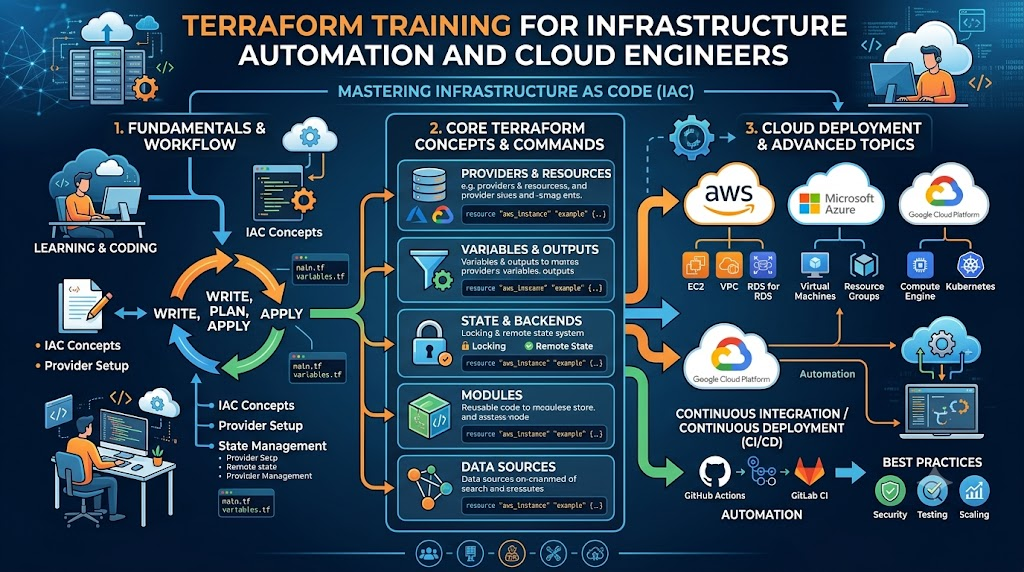
Terraform Training Topics Covered
A comprehensive Terraform Training program typically includes both foundational and advanced concepts.
Terraform Fundamentals
- Infrastructure as Code concepts
- Terraform architecture
- Providers
- Resources
- Variables
- Outputs
- State files
- Execution workflow
Working with Cloud Providers
Students learn infrastructure provisioning across platforms including:
- AWS
- Azure
- Google Cloud Platform
Modules
Training covers:
- Module creation
- Module reuse
- Module versioning
- Shared infrastructure libraries
Remote State Management
Participants understand:
- Backend configuration
- State locking
- Collaboration workflows
- State security
Infrastructure Automation
Topics include:
- Automated provisioning
- Environment management
- Configuration consistency
- Resource lifecycle management
CI/CD Integration
Terraform integrates with:
- Jenkins Training workflows
- CI/CD Pipeline Training
- GitOps Training practices
- Automated deployment pipelines
Terraform and Kubernetes
Terraform is frequently used alongside Kubernetes.
Cloud-native organizations use Terraform to create:
- Kubernetes clusters
- Virtual networks
- Worker nodes
- Load balancers
- Storage services
- IAM roles
- DNS infrastructure
After infrastructure creation, Kubernetes deployments manage containerized applications.
This combination supports scalable cloud-native application delivery.
Terraform and Platform Engineering
Platform Engineering focuses on creating standardized platforms that improve developer productivity.
Terraform helps platform teams build:
- Shared cloud infrastructure
- Internal developer platforms
- Reusable infrastructure modules
- Standard deployment environments
- Secure cloud foundations
Infrastructure automation reduces repetitive engineering work while improving operational consistency.
Terraform for Multi-Cloud Environments
Many enterprises avoid relying on a single cloud provider.
Terraform provides a consistent workflow across:
- Amazon Web Services
- Microsoft Azure
- Google Cloud Platform
- VMware
- Kubernetes
- Oracle Cloud
- Alibaba Cloud
Cloud engineers learn how to manage infrastructure across multiple providers without switching between different automation tools.
Terraform Security Best Practices
Infrastructure automation should also prioritize security.
Training covers important practices including:
- Secret management
- Least privilege access
- Secure state storage
- IAM automation
- Resource tagging
- Compliance policies
- Encryption
- Security reviews
These practices help organizations automate infrastructure without compromising governance.
Terraform Training for Enterprise Teams
Enterprise organizations often require standardized cloud practices across multiple teams.
Corporate Terraform programs typically focus on:
- Infrastructure standards
- Module libraries
- Governance
- Security automation
- Cloud cost optimization
- Production deployment
- Team collaboration
- CI/CD integration
This helps engineering teams deliver cloud infrastructure more efficiently.
Business Benefits of Terraform Training
Organizations investing in Terraform Training often experience several operational improvements.
| Business Area | Improvement |
|---|---|
| Infrastructure Deployment | Faster provisioning |
| Cloud Operations | Reduced manual effort |
| DevOps | Better automation |
| Engineering Productivity | Improved collaboration |
| Security | Standardized configurations |
| Compliance | Version-controlled infrastructure |
| Cloud Migration | Simplified deployments |
| Disaster Recovery | Reproducible infrastructure |
Tools and Technologies Covered
| Area | Tools / Topics | Business Value |
|---|---|---|
| Terraform Training | Infrastructure as Code, Modules, Providers | Automated infrastructure provisioning |
| Jenkins Training | Continuous Integration | Faster software delivery |
| CI/CD Pipeline Training | Automated deployments | Improved release efficiency |
| GitOps Training | Git-based infrastructure management | Consistent deployments |
| Docker Kubernetes Training | Containers and orchestration | Scalable cloud-native applications |
| AWS DevOps | AWS automation services | Reliable cloud infrastructure |
| Monitoring and Observability | Prometheus, Grafana, Logging | Better system visibility |
| DevSecOps | Security automation and compliance | Secure software delivery |
| SRE | Reliability engineering practices | Higher application availability |
| Platform Engineering | Internal developer platforms | Increased developer productivity |
Why Choose Rajesh Kumar for Terraform and DevOps Training?
Choosing the right trainer significantly influences how quickly professionals can apply new skills in real projects.
A practical learning approach offers advantages such as:
- Strong understanding of modern DevOps ecosystems
- Hands-on infrastructure automation exercises
- Practical cloud deployment scenarios
- Focus on production-ready implementation
- Integration of Terraform with Kubernetes, Docker, Jenkins, GitOps, and CI/CD
- Guidance based on real engineering workflows
- Enterprise-oriented learning for teams and organizations
- Emphasis on automation, scalability, reliability, and cloud best practices
Professionals interested in expanding their expertise can learn more about available training and consulting programs at https://www.rajeshkumar.xyz/.
Best Fit Audience
Terraform Training is valuable for:
- Cloud Engineers
- DevOps Engineers
- Platform Engineers
- Infrastructure Engineers
- Site Reliability Engineers
- Software Developers
- DevSecOps Engineers
- Cloud Architects
- IT Managers
- Enterprise Engineering Teams
- Cloud Migration Teams
- Technology Startups
Business Benefits of Terraform, DevOps, and Cloud Automation
Organizations that invest in Infrastructure as Code capabilities gain long-term operational advantages.
These include:
- Faster cloud provisioning
- Improved deployment consistency
- Better infrastructure governance
- Reduced operational complexity
- Stronger DevOps collaboration
- Lower configuration drift
- Enhanced cloud scalability
- Improved disaster recovery readiness
- Better compliance management
- Higher engineering productivity
These outcomes help organizations build cloud environments that are reliable, secure, and easier to maintain.
Frequently Asked Questions
1. Why is Terraform Training important for cloud engineers?
Terraform Training helps cloud engineers automate infrastructure provisioning, improve deployment consistency, reduce manual errors, and manage cloud environments efficiently using Infrastructure as Code practices.
2. How does Terraform integrate with CI/CD Pipeline Training?
Terraform integrates with CI/CD pipelines to automate infrastructure provisioning before application deployment, enabling faster, repeatable, and reliable software releases.
3. Can Terraform be used with Docker Kubernetes Training?
Yes. Terraform provisions the underlying cloud infrastructure, while Docker and Kubernetes manage containerized applications running on that infrastructure.
4. Who should attend Terraform Training?
Cloud engineers, DevOps engineers, infrastructure engineers, platform engineers, SRE professionals, software developers, cloud architects, and enterprise IT teams can all benefit from Terraform Training.
5. How does Terraform support Platform Engineering?
Terraform enables platform teams to create reusable infrastructure modules, standardize cloud environments, automate provisioning, and improve developer productivity through Infrastructure as Code.
Conclusion
Infrastructure automation has become a foundational capability for organizations embracing cloud-native development, DevOps, and modern software delivery. Terraform simplifies the management of cloud resources through Infrastructure as Code, allowing engineering teams to build secure, scalable, and repeatable environments with greater confidence.
When combined with Kubernetes, CI/CD, GitOps, Platform Engineering, DevSecOps, and Site Reliability Engineering practices, Terraform becomes an essential part of a modern cloud engineering toolkit. Structured training helps professionals move beyond basic syntax to designing production-ready infrastructure that supports business growth and operational excellence.
Whether you are an individual engineer aiming to strengthen your cloud automation skills or an organization planning to standardize infrastructure practices, investing in practical Terraform Training can accelerate your DevOps journey. To explore hands-on learning, enterprise training, mentoring, and consulting across Terraform, DevOps, Kubernetes, SRE, DevSecOps, Platform Engineering, and cloud technologies, visit https://www.rajeshkumar.xyz/ and discover programs focused on real-world implementation and long-term engineering success.

