
Introduction
Pilot training is a dream career path for many aviation enthusiasts, but it comes with one major reality: high training costs. Among all the factors that influence these costs, the most important one is flying hours. Every minute spent in the air directly adds to the total expense of becoming a pilot.
Flying hours represent the actual time a student pilot flies an aircraft during training. Since aircraft operation involves fuel, maintenance, instructor supervision, and airport charges, each flying hour carries a significant cost. Understanding how flying hours affect overall pilot training expenses is essential for planning a successful aviation career.
In this blog, we will break down how flying hours influence pilot training costs, what affects their pricing, and how students can manage them efficiently.
What Are Flying Hours in Pilot Training?
Flying hours refer to the total time a student spends operating an aircraft during training. These hours are mandatory for obtaining pilot licenses and are carefully recorded in a logbook.
Types of Flying Hours
1. Dual Flying Hours
- Training with an instructor
- Used for learning basic and advanced skills
- Higher cost due to instructor involvement
2. Solo Flying Hours
- Flown by the student independently
- Builds confidence and decision-making skills
- Lower cost compared to dual flights
3. Simulator Hours
- Training in flight simulators
- Used for practice before real flying
- Much cheaper than actual aircraft hours
Each type plays a different role in training and affects overall cost differently.
Why Flying Hours Matter in Pilot Training Costs
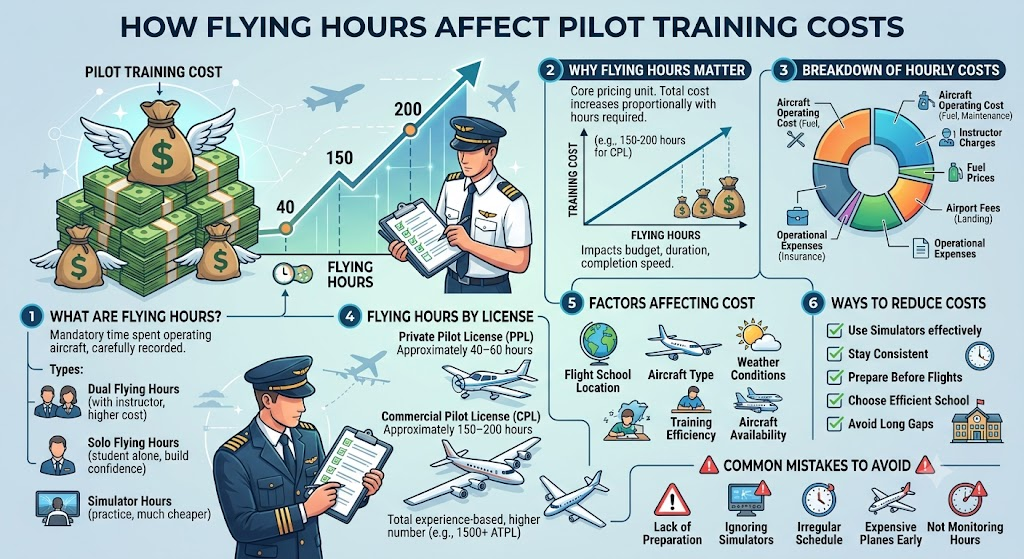
Flying hours are the core pricing unit in aviation training. Flight schools usually charge based on cost per hour.
For example:
- If 1 flying hour costs a fixed amount
- And a student needs 150–200 hours for CPL
- Then total cost increases proportionally
This means the more flying hours required, the higher the total pilot training cost.
Flying hours directly impact:
- Total training budget
- Course duration
- Speed of license completion
Breakdown of Flying Hour Costs
Several components are included in the cost of one flying hour:
1. Aircraft Operating Cost
- Fuel consumption
- Engine wear and tear
- Routine maintenance
2. Instructor Charges
- Paid during dual flights
- Experienced instructors may cost more
3. Fuel Prices
- Aviation fuel is expensive
- Directly affects hourly rates
4. Airport Fees
- Landing and takeoff charges
- Vary by airport location
5. Operational Expenses
- Insurance
- Ground handling
- Administrative costs
All these are combined into the final per-hour flying rate.
How Flying Hours Are Calculated
Different pilot licenses require different flying hour totals:
Private Pilot License (PPL)
- Approximately 40–60 hours
- Entry-level certification
Commercial Pilot License (CPL)
- Approximately 150–200 hours
- Required for airline career
Airline Transport Pilot License (ATPL)
- 1500+ total flight hours (experience-based requirement)
Flight schools track every hour using:
- Digital logbooks
- Instructor verification
- Aircraft monitoring systems
Even small delays or inefficiencies can increase total required hours.
Factors That Affect Flying Hour Costs
1. Flight School Location
Training costs vary by country and airport infrastructure.
2. Aircraft Type
Modern aircraft cost more per hour than basic trainers.
3. Weather Conditions
Bad weather reduces flying days, increasing total training duration.
4. Training Efficiency
Well-prepared students require fewer extra hours.
5. Aircraft Availability
Limited aircraft leads to delays and additional training hours.
Ways to Reduce Flying Hour Costs
✔ Use Simulator Training Effectively
Simulators reduce real aircraft usage and save cost.
✔ Stay Consistent with Training
Regular flying prevents skill loss and extra hours.
✔ Prepare Before Flights
Good preparation reduces repetition of lessons.
✔ Choose the Right Flight School
Efficient schools help optimize training hours.
✔ Avoid Long Gaps
Breaks increase the need for refresher flying hours.
Common Mistakes Students Make
1. Lack of Proper Preparation
Poor preparation increases repeated flying hours.
2. Ignoring Simulator Sessions
Skipping simulators leads to expensive real-flight training.
3. Irregular Training Schedule
Gaps in flying cause skill loss and extra cost.
4. Choosing Expensive Aircraft Early
Advanced aircraft increase hourly cost unnecessarily.
5. Not Monitoring Flight Hours
Lack of tracking leads to overspending.
FAQs
1. What are flying hours in pilot training?
Flying hours are the total time a student spends flying an aircraft during training, recorded for licensing requirements.
2. Why do flying hours affect pilot training costs?
Because flight schools charge per hour of flying, making it the biggest component of total training cost.
3. How many flying hours are needed to become a pilot?
It depends on the license, such as 40–60 hours for PPL and 150–200 hours for CPL.
4. Are simulator hours cheaper than flying hours?
Yes, simulator training is significantly cheaper than actual aircraft flying hours.
5. What factors increase flying hour costs?
Aircraft type, fuel prices, instructor fees, airport charges, and delays increase costs.
6. Can students reduce flying hour costs?
Yes, through simulator training, consistent practice, and proper preparation.
7. Do all students require the same flying hours?
No, it varies based on skill level, learning speed, and training efficiency.
8. What happens if extra flying hours are needed?
Students must pay additional fees for extra training hours.
9. Is flying hour cost fixed everywhere?
No, it varies depending on country, flight school, and aircraft type.
10. Why do training gaps increase costs?
Because students need extra hours to regain flying skills after breaks.
Conclusion
Flying hours are the most important factor in determining the overall cost of pilot training. Every hour spent in the air includes expenses like fuel, instructor fees, maintenance, and airport charges, which makes them the biggest contributor to aviation training costs.
Understanding how flying hours work helps aspiring pilots plan better, reduce unnecessary expenses, and complete training more efficiently. By using simulators, maintaining consistent training schedules, and choosing the right flight school, students can significantly reduce their total cost.
With proper planning and awareness, becoming a pilot becomes not just achievable but also financially manageable.

