
Introduction
Many people have valuable stories, experiences, ideas, and lessons to share, but the technical side of creating a website often prevents them from getting started. Terms such as hosting, coding, themes, databases, and website maintenance can make online publishing appear more complicated than it needs to be.
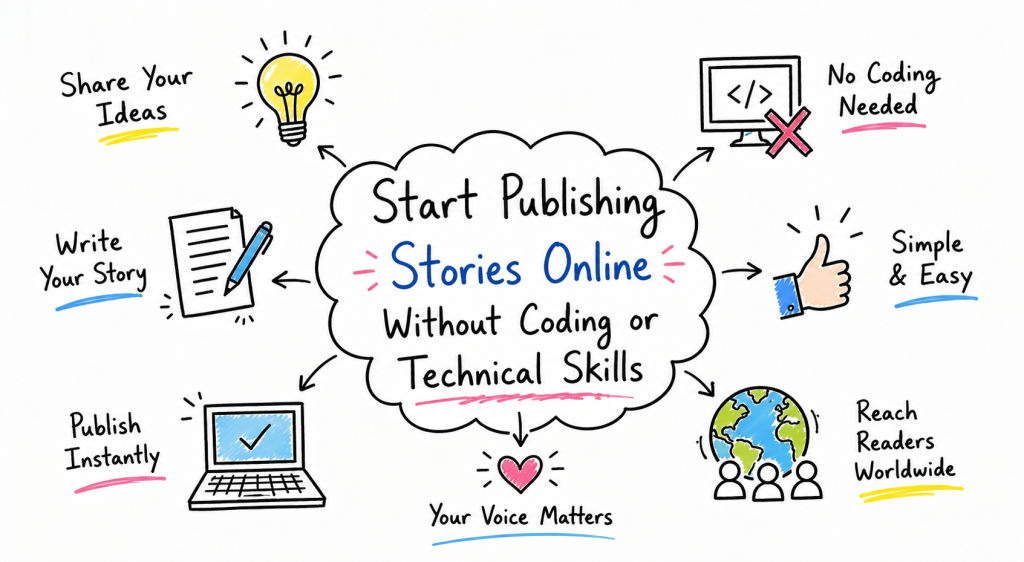
Fortunately, writers no longer need programming knowledge to publish stories online free. Modern publishing platforms provide simple writing environments where users can create a personal blog, prepare an article, format the content, and make it available to readers without managing technical systems.
This change has opened online publishing to students, independent writers, professionals, poets, educators, researchers, and everyday storytellers. The most important requirements are no longer technical skills. A clear idea, an authentic voice, thoughtful preparation, and a willingness to publish consistently are far more valuable.
This guide explains how beginners can start publishing stories online, organise their work, improve readability, avoid common mistakes, and build a meaningful digital writing identity without coding.
Online Publishing Is No Longer Limited to Technical Users
Traditional website creation often involved several separate tasks. A writer had to purchase hosting, connect a domain, install publishing software, configure a theme, manage updates, and solve technical problems. These responsibilities could easily distract someone whose main goal was simply to write.
A beginner-friendly publishing platform removes much of that complexity. Instead of building a complete website from the ground up, writers can focus on creating and organising content.
A simple blogging platform generally allows writers to:
- Create a personal publishing space
- Add titles and article content
- Format paragraphs and headings
- Organise stories by subject
- Publish work for online readers
- Manage previous articles from one place
This approach makes digital publishing accessible to people who have never written code or managed a website.
Coding Skills Are Different from Writing Skills
Coding and storytelling are separate abilities. Coding involves giving structured instructions to computers, while storytelling involves communicating ideas, emotions, experiences, and information to people.
A strong writer does not automatically need to become a website developer. Similarly, a skilled developer is not automatically an effective storyteller.
Writers should focus on skills that directly improve their published work, including:
- Selecting meaningful topics
- Developing a clear writing voice
- Structuring ideas logically
- Creating engaging openings
- Writing readable paragraphs
- Editing unnecessary words
- Checking grammar and accuracy
- Understanding the intended audience
Technical knowledge may be useful in some situations, but it should not become a compulsory barrier for someone who wants to start writing online.
A No-Code Publishing Platform Simplifies the Process
A no-code platform provides a ready-made environment for writing and publishing. The technical system works behind the scenes, allowing the writer to manage content through simple controls.
BlogAion, for example, allows writers to create personal blogs and begin publishing without coding or technical website-management experience. Writers can claim personal BlogAion subdomains and use them as organised online homes for stories, articles, tutorials, poetry, research, opinions, and professional knowledge.
The platform also offers clean presentation, responsive pages, fast reading experiences, and light and dark reading modes. These features support comfortable reading while allowing authors to concentrate on the quality of their content.
This does not mean that every writer will immediately build a large audience. Online publishing still requires patience, useful content, responsible sharing, and consistent improvement. However, removing technical barriers makes the first step much easier.
A Clear Story Idea Creates a Strong Beginning
Many beginners spend too much time thinking about blog design and not enough time thinking about the story they want to tell. The strength of an article usually depends more on its purpose than its visual appearance.
Before writing, define the central idea in one sentence.
For example:
- A personal experience that taught an important lesson
- A fictional story about friendship and trust
- A travel experience that changed your perspective
- A practical guide based on professional knowledge
- A poem connected to memory or emotion
- A student project explaining a researched topic
- An opinion supported by logical reasoning
A clear central idea helps you decide which details belong in the story and which details can be removed.
Trying to cover several unrelated subjects in one article can confuse readers. Keep each published piece focused on one main message.
A Simple Structure Makes Stories Easier to Read
Good stories do not need complicated structures. Beginners can use a simple three-part approach.
Opening
The opening should create interest and establish the situation. It can introduce a person, problem, setting, memory, idea, or important observation.
Avoid spending several paragraphs providing unnecessary background. Give readers a reason to continue.
Development
The middle section should expand the main idea. This is where you can describe events, explain challenges, share examples, present information, or develop characters.
Each paragraph should support the central purpose of the story.
Ending
The ending should provide a sense of completion. It may explain the lesson, resolve the situation, summarise the main argument, or leave readers with a thoughtful final idea.
A strong ending does not always need to be dramatic. It simply needs to feel connected to the story that came before it.
Readable Formatting Supports the Reader
Publishing a long block of text can make even a valuable story difficult to read. Online readers often view content on mobile phones, tablets, laptops, and desktop computers. Clear formatting helps them follow the article comfortably.
Use short paragraphs, especially when presenting detailed ideas. Add descriptive headings to longer articles so readers can understand the structure.
Bullet points can be helpful when presenting steps, examples, features, or recommendations. However, they should not replace normal storytelling paragraphs.
Writers should also:
- Use clear and familiar language
- Remove repeated ideas
- Avoid excessively long sentences
- Explain unfamiliar terms
- Use headings that accurately describe sections
- Check spacing before publishing
- Read the article on different screen sizes when possible
A clean, distraction-free blogging platform can support this experience by keeping the visual focus on the written work.
Personal Blogs Build an Organised Writing Identity
Social media can help writers share quick thoughts, but posts often disappear beneath newer updates. A personal blog provides a more organised and lasting space for published work.
When stories are stored together, readers can explore an author’s writing style, interests, knowledge, and development over time. This can gradually become a personal writing portfolio.
A student may use a blog to organise educational articles and project reflections. A professional may publish industry insights and practical tutorials. A creative writer may collect poetry, fiction, and personal essays. An educator may share lessons and research-based explanations.
The purpose does not need to remain fixed forever. Writers can begin with one topic and refine their direction as they gain experience.
BlogAion supports individual blogs and gives writers an organised space for personal and professional publishing. This can be useful for people who want their work to have a more permanent home than a fast-moving social feed.
A Memorable Subdomain Strengthens Recognition
A personal subdomain acts as the address of a writer’s blog within a publishing platform. Choosing a clear and memorable name can make the blog easier to recognise.
A useful subdomain may be based on:
- Your name
- Your pen name
- Your writing subject
- Your professional area
- The name of your publication
- A short creative phrase
Keep the name simple enough to remember and type. Avoid unnecessary numbers, unusual spellings, or long combinations of words.
The name should also leave some room for future growth. A very narrow name may become limiting if you later want to write about related subjects.
BlogAion allows writers to claim personal subdomains, helping them establish a distinct identity within the platform.
Consistent Publishing Matters More Than Frequent Publishing
Beginners sometimes believe they must publish every day. This can lead to rushed articles, stress, and early burnout.
A realistic schedule is more valuable than an ambitious schedule that cannot be maintained. One carefully prepared story every week or every two weeks may be more effective than several unfinished posts.
Create a simple publishing routine:
- Record new ideas in one place.
- Select one idea with a clear purpose.
- Prepare a basic outline.
- Write the first draft without excessive editing.
- Take a short break before reviewing it.
- Correct grammar, structure, and unclear sentences.
- Publish only after checking the final version.
Consistency helps writers develop discipline and gives readers a better understanding of the type of content they can expect.
Originality Builds Reader Trust
Readers connect with writing that feels honest and personal. Copying another writer’s wording, structure, or opinions may produce content quickly, but it does not create a meaningful identity.
Original writing does not require a completely new subject. Many writers discuss similar themes. Originality comes from your perspective, examples, reasoning, voice, and experiences.
A common topic such as productivity can become distinctive when it includes a genuine lesson from your own routine. A familiar travel destination can become interesting when described through personal observations. A professional tutorial can become more useful when it includes practical mistakes and solutions.
Writers should also verify factual statements before publishing. Unsupported claims can reduce credibility, especially in educational, professional, medical, legal, or financial subjects.
Community Discovery Can Introduce New Voices
Publishing on a personal blog creates an organised home for content, while community discovery can help readers find writers they may not already know.
BlogAion includes a shared discovery environment where readers can explore fresh stories and independent voices across different subjects and locations. This can provide an additional route for content discovery without changing the writer’s personal publishing identity.
However, discovery should not be treated as a guarantee of traffic or popularity. Writers still need to create useful titles, publish meaningful work, and share their articles responsibly.
A community blogging platform works best when writers participate thoughtfully, respect different perspectives, and focus on contributing valuable content rather than seeking immediate attention.
Collaborative Publishing Expands Creative Possibilities
Some stories and publications benefit from more than one contributor. A multi-author blogging platform can support educational projects, community publications, research groups, professional knowledge hubs, creative magazines, and interest-based collections.
BlogAion supports multiple contributors, allowing blog owners to develop collaborative publications.
Before inviting additional writers, establish basic editorial guidelines. These may cover:
- Main publication subject
- Expected writing style
- Article length preferences
- Accuracy and proofreading standards
- Publishing responsibilities
- Rules for respectful communication
- Methods for reviewing submitted work
Clear expectations help contributors work together while maintaining a consistent reader experience.
Common Publishing Mistakes to Avoid
Starting is important, but publishing without preparation can reduce the quality of a writer’s work.
Waiting for perfect writing
No first article will represent your final ability. Publish a carefully edited piece, learn from the experience, and improve gradually.
Selecting too many subjects
A blog with many unrelated topics can appear unfocused. Begin with a few connected categories and expand only when necessary.
Ignoring proofreading
Spelling errors, repeated sentences, and unclear paragraphs can distract readers. Review every article before publishing.
Writing only for search engines
Keywords can support discoverability, but unnatural repetition weakens readability. Write for people first and use relevant phrases naturally.
Expecting immediate results
Building recognition takes time. Focus on improving the quality and organisation of your published work rather than expecting instant traffic.
Depending entirely on social media
Social platforms can support sharing, but they should not be the only location for your writing. A personal publishing space gives your work a more organised and lasting home.
Practical Preparation Before Publishing
Before selecting the publish option, complete a final review.
Confirm that:
- The title accurately represents the story
- The opening creates interest
- The main idea remains clear
- Paragraphs appear in a logical order
- Unnecessary repetition has been removed
- Factual statements have been checked
- Grammar and spelling have been reviewed
- Headings make the article easier to follow
- The conclusion feels connected to the topic
- The article reflects your own voice
Reading the story aloud can reveal awkward sentences that are easy to miss during silent editing.
Publishing online without coding is simple, but thoughtful preparation still separates rushed content from work that readers value.
Frequently Asked Questions
Can beginners publish stories online without coding?
Yes. A beginner-friendly publishing platform manages the technical structure, allowing writers to focus on preparing, formatting, and publishing content. Basic computer or mobile skills are usually enough to begin. Writers do not need to learn programming languages merely to create a personal blog and share stories.
Is technical website management necessary for online writing?
Technical website management is not necessary when using a managed publishing platform. The platform handles much of the underlying system. Writers remain responsible for their content, including planning, editing, organising, checking accuracy, and maintaining a realistic publishing routine.
Which types of stories can be published online?
Writers can publish personal experiences, fiction, poetry, tutorials, professional insights, educational articles, opinions, research-based explanations, and creative essays. The selected content should follow the platform’s rules and avoid plagiarism, misleading information, or material that violates the rights of others.
Can BlogAion be used to create a personal writing space?
Yes. BlogAion allows writers to create individual blogs and claim personal subdomains. These blogs can provide organised spaces for personal stories, professional articles, tutorials, research, poetry, fiction, and opinions without requiring coding knowledge.
Is frequent publishing required for building a blog?
Frequent publishing is not compulsory. A realistic and consistent schedule is more useful than publishing rushed content every day. Writers should select a schedule that gives them enough time to research, write, edit, proofread, and present each article clearly.
Can several writers contribute to the same publication?
Yes, BlogAion supports multi-contributor blogs. This can be useful for collaborative magazines, educational communities, research publications, professional knowledge platforms, and interest-based blogs. Blog owners should create clear editorial guidelines before inviting contributors.
Conclusion
The ability to publish stories online should not depend on coding knowledge or technical website-management skills. Modern publishing platforms allow writers to concentrate on ideas, structure, originality, readability, and meaningful communication.
A successful beginning does not require a complex website or a perfect publishing plan. Start with one clear subject, write an honest and focused story, review it carefully, and publish it in an organised personal space. Continue learning from each article rather than waiting until every detail feels perfect.
BlogAion offers a free, beginner-friendly environment where writers can create personal blogs, claim subdomains, publish different forms of writing, and participate in a shared discovery community. Its clean presentation and no-code approach can help independent writers begin without unnecessary technical barriers.

