
Introduction
An instrument rating is one of the most valuable qualifications a future pilot can earn because it develops the ability to operate an aircraft by referring primarily to cockpit instruments and approved navigation procedures. However, the advertised course price rarely represents the complete financial commitment. Aircraft rental, instructor time, simulator sessions, theory classes, examinations, approach charges, additional practice, and accommodation can significantly increase the final amount. This guide explains the major expenses, training requirements, international differences, budgeting methods, and questions students should consider before selecting an instrument-rating programme.
What Is an Instrument Rating?
An instrument rating allows a qualified pilot to operate under Instrument Flight Rules, commonly called IFR, subject to the privileges and limitations of the pilot’s licence and the regulations of the relevant aviation authority.
During instrument training, students learn to control and navigate an aircraft without depending primarily on outside visual references. The course develops skills related to:
- Aircraft control using flight instruments
- Instrument departure procedures
- Air traffic control clearances
- Radio navigation
- GPS and area-navigation procedures
- Holding patterns
- En-route IFR operations
- Precision and non-precision approaches
- Missed-approach procedures
- Weather interpretation
- Flight planning and fuel management
- Abnormal and emergency procedures
- Aeronautical decision-making
In the United States, the current instrument-rating regulation includes training in preflight preparation, air traffic control procedures, flight by reference to instruments, navigation systems, instrument approaches, emergency operations, and post-flight procedures.
Why Future Pilots Need Instrument Training
A private pilot may legally fly under Visual Flight Rules when weather and visibility meet the required minimums. An instrument-rated pilot can operate under IFR when properly qualified, current, medically eligible, and flying a suitably equipped aircraft.
Instrument training is important for future pilots because it improves:
- Weather awareness
- Cockpit workload management
- Navigation accuracy
- Radio communication
- Aircraft-control precision
- Approach planning
- Situational awareness
- Risk management
- Professional flying discipline
An instrument rating does not make every weather condition safe. Thunderstorms, icing, severe turbulence, aircraft limitations, pilot experience, and equipment condition must still be considered before every flight.
Instrument Rating and Commercial Pilot Training
An instrument rating and a commercial pilot licence are different qualifications.
The instrument rating provides privileges related to IFR operations. A commercial pilot licence allows a pilot to exercise specified commercial privileges, subject to national regulations and licence limitations.
Many future professional pilots complete training in the following order:
- Private pilot licence
- Instrument rating
- Commercial pilot licence
- Multi-engine rating or endorsement
- Flight instructor or other professional training
- Airline-oriented courses where applicable
Some integrated programmes combine instrument training with commercial and multi-engine training. For example, IGRUA’s approved ab-initio programme includes CPL training, an instrument rating, and a multi-engine endorsement within one course.
Basic Eligibility Requirements
Eligibility varies by country, aircraft category, licence type, and training route.
Students may be required to hold:
- A valid private pilot licence or higher qualification
- An appropriate medical certificate
- Required cross-country flight experience
- A valid radio-telephony qualification
- English-language proficiency
- Required theoretical examination passes
- Recent flying experience
- A valid logbook and training records
- Appropriate aircraft class or type privileges
Under current US rules, an applicant generally needs at least a private pilot certificate, or must be applying for one at the same time, and must complete the required ground training, endorsements, knowledge test, flight training, and practical test.
Students should never assume that eligibility rules are identical across countries. Written confirmation should be obtained from the aviation authority and the approved training organisation before paying a deposit.
Instrument Rating Flight-Hour Requirements
Training-hour requirements depend on the licensing authority and programme.
United States
For a standard US instrument-airplane rating, the current regulation generally requires:
- 50 hours of cross-country pilot-in-command time
- At least 10 cross-country hours in an airplane
- 40 hours of actual or simulated instrument time
- At least 15 instrument-training hours with an appropriately rated instructor
- Three hours of recent instrument training within the two calendar months before the practical test
- A specified IFR cross-country training flight involving approaches at multiple airports and three different types of approaches
The 40 hours do not necessarily mean that all training must be completed in an aircraft. Approved simulator or flight-training-device credit may be available, subject to the applicable training rules and device approval.
United Kingdom
The UK competency-based modular route generally includes at least 40 hours of instrument instruction for a single-engine rating and 45 hours for a multi-engine rating. Depending on the training route and the student’s previous experience, approved simulator credit may be available. The applicant must also complete the relevant theoretical requirements and pass a skill test with a qualified examiner.
India
Indian students should verify the latest DGCA requirements, examination validity, medical status, flight-hour distribution, simulator credit, skill-test requirements, and licence-endorsement procedures directly through the DGCA and a DGCA-approved Flying Training Organisation. Current official programme information shows that instrument training may be delivered as part of a complete CPL and multi-engine training route rather than as an isolated course.
Average Instrument Rating Cost
The final price depends on:
- Required aircraft hours
- Simulator credit
- Aircraft model
- Aircraft rental rate
- Instructor charges
- Existing cross-country experience
- Student proficiency
- Airport and approach charges
- Examination fees
- Location and accommodation
- Whether the programme is single-engine or multi-engine
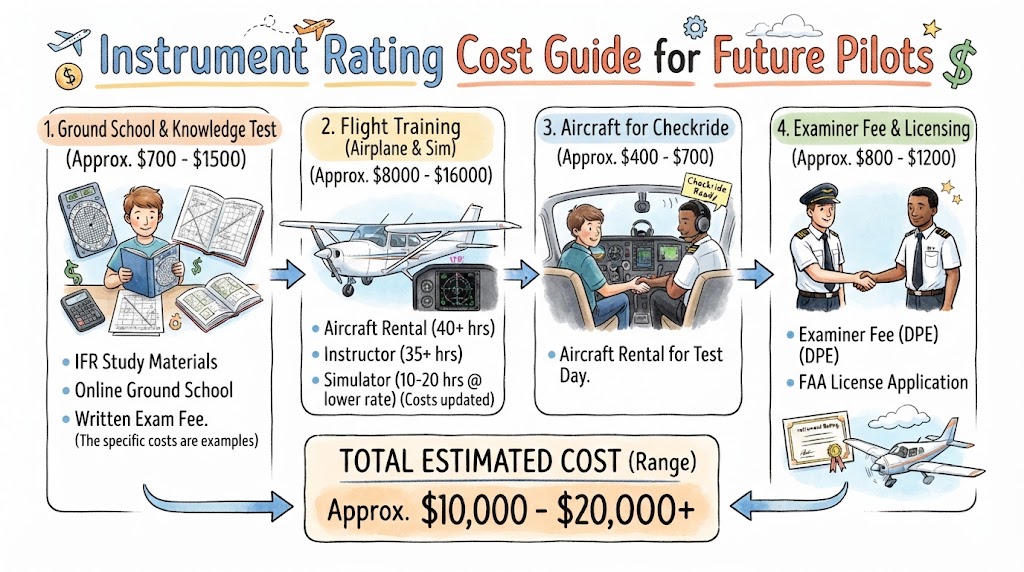
Recent published US estimates illustrate the variation. One 2026 guide places an instrument rating around US$8,000 to US$15,000, while another academy lists an estimated course price of approximately US$17,052.50. These differences show why students must compare included hours and services rather than relying on one average figure.
A student who already has the required cross-country time and uses approved simulator sessions efficiently may spend less than someone who must build additional experience, train in a costly aircraft, or repeat lessons.
Complete Instrument Rating Cost Breakdown
The following figures are general planning estimates rather than fixed quotations.
| Training expense | Illustrative cost range | What it may include |
|---|---|---|
| Registration and administration | US$50–US$400 | Enrolment, records and scheduling |
| Ground school | US$300–US$1,500 | Regulations, weather, navigation and procedures |
| Aircraft rental | US$4,000–US$12,000 | Dual IFR and simulated-instrument flights |
| Flight instructor | US$1,500–US$4,500 | Flight training, briefings and preparation |
| Simulator training | US$500–US$3,000 | Approved procedural and approach practice |
| Knowledge examination | US$150–US$250 | Written or computer-based examination |
| Examiner or checkride | US$700–US$1,500 | Oral and practical examination |
| Aircraft for practical test | US$300–US$1,000 | Test flight and repositioning |
| Books and digital resources | US$100–US$600 | Manuals, charts, subscriptions and applications |
| Headset and equipment | US$100–US$1,200 | Headset, kneeboard and training equipment |
| Additional training reserve | US$1,000–US$4,000 | Extra flights, simulator sessions or retesting |
| Possible total | US$8,700–US$30,950 | Varies significantly by student and programme |
The lower part of the range may apply to efficient modular training using a lower-cost aircraft and approved simulator credit. The upper range may apply to premium aircraft, extensive extra training, multi-engine instrument programmes, busy airports, or students who must build additional cross-country time.
Aircraft Rental Costs
Aircraft rental is normally the largest part of the instrument-rating budget.
Common instrument trainers include:
- Cessna 152
- Cessna 172
- Piper PA-28 Warrior
- Piper Archer
- Diamond DA40
- Cirrus SR20
- Piper PA-44 Seminole
- Diamond DA42
Training in a basic single-engine aircraft is generally less expensive than training in a technologically advanced or multi-engine aircraft.
The rental rate may be affected by:
- Aircraft age
- Engine and propeller reserves
- Fuel consumption
- Avionics equipment
- GPS capability
- Insurance
- Maintenance costs
- Airport location
- Local fuel prices
- Aircraft demand
- Taxes and surcharges
A glass-cockpit aircraft may cost more per hour, but students intending to fly modern aircraft may value the experience. The best option is not automatically the cheapest or most advanced aircraft. It should be reliable, properly maintained, approved for the training, and suitable for the student’s goals.
Wet Rate Versus Dry Rate
Students should determine whether the advertised aircraft price is a wet rate or a dry rate.
Wet rate
A wet rate generally includes fuel and oil. It may not include:
- Flight instructor
- Ground briefing
- Landing charges
- Approach fees
- Taxes
- Fuel surcharges
- Examiner costs
- Aircraft rental during the test
Dry rate
A dry rate generally excludes fuel. The student may pay for fuel separately or reimburse the school according to an agreed calculation.
A dry rental price can appear lower than a wet rate but become more expensive after fuel is included.
Students should compare the complete hourly cost:
Aircraft rental + fuel + instructor + briefing + airport charges + taxes
Flight Instructor Costs
Instrument training requires instruction from a pilot who holds the necessary instructor privileges for the rating.
Instructor charges may apply to:
- Aircraft training
- Simulator sessions
- Ground lessons
- Pre-flight briefings
- Post-flight discussions
- Flight planning
- Weather analysis
- Oral-examination preparation
- Progress checks
- Practical-test preparation
Some schools charge only for the time entered in the aircraft logbook. Others charge from the scheduled meeting time until the debriefing is complete.
A two-hour appointment may therefore generate only 1.2 hours of aircraft time but two hours or more of instructor charges.
Students should request a written explanation of how instructor time is calculated.
Ground School Costs
Instrument ground school normally covers:
- IFR regulations
- Air traffic control procedures
- Aviation weather
- Weather reports and forecasts
- Navigation systems
- Instrument charts
- Departure procedures
- Arrival procedures
- Holding patterns
- Instrument approaches
- Aircraft systems
- Risk management
- Lost-communication procedures
- Aeronautical decision-making
US regulations allow the required aeronautical knowledge training to be completed with an authorized instructor or through an appropriate home-study course, followed by the necessary instructor endorsement and knowledge test.
Ground-school options may include:
- Classroom training
- Live online classes
- Recorded video courses
- One-to-one instruction
- Self-study programmes
- Integrated academy training
A low-cost online programme can help with theory, but students may still require individual instructor time to understand difficult topics and prepare for the practical-test oral examination.
Simulator Training Costs
Approved simulators and flight-training devices can make instrument training more efficient.
Simulator sessions may be used to practise:
- Instrument scans
- Holding patterns
- Intercepting courses
- Navigation failures
- Weather scenarios
- GPS procedures
- Instrument approaches
- Missed approaches
- Communication failures
- Emergency decision-making
Simulator training offers several advantages:
- Lower hourly cost than many aircraft
- No fuel expense
- Fewer weather cancellations
- Ability to pause and repeat exercises
- Safe practice of equipment failures
- Efficient approach repetition
The amount of simulator time that can be credited depends on the country, course, device approval, and training organisation. The UK CAA, for example, permits specified simulator credit within competency-based instrument-rating courses.
IGRUA currently lists hourly rates of ₹12,000 for its DA42 simulator and ₹9,000 for its DA40 simulator, excluding applicable GST according to its published rate information. Its listed aircraft rates are ₹45,000 per hour for the DA42 and ₹32,000 per hour for the DA40, demonstrating the potential cost difference between aircraft and simulator training.
Knowledge Test and Examination Expenses
The instrument-rating process may involve:
- Theoretical training
- Written or computer-based examinations
- Instructor endorsements
- Oral examination
- Flight or skill test
- Examiner charges
- Aircraft rental during the test
- Authority application fees
Students should ask whether the course price includes:
- Examination registration
- Testing-centre charges
- Examiner fees
- Examiner travel
- Aircraft rental
- Approach charges
- Licence-issue fees
- Retesting expenses
A course advertised as “all-inclusive” should still be supported by a written list of included and excluded items.
Instrument Approach and Airport Charges
Instrument training often involves repeated approaches at controlled or instrument-equipped airports.
Possible charges include:
- Landing fees
- Touch-and-go charges
- Instrument approach fees
- Air traffic service charges
- Navigation charges
- Airport parking
- Handling fees
- Repositioning costs
Busy airports can also increase aircraft time because students may spend longer:
- Taxiing
- Waiting for takeoff
- Receiving clearances
- Being vectored by air traffic control
- Holding before an approach
- Returning to the training airport
One current US training-cost guide notes that busy-airport delays can increase expenses because students may spend more paid aircraft time taxiing or waiting.
Sample Training-Hour Plan
The following example is not a regulatory syllabus.
| Training activity | Example hours | Main purpose |
|---|---|---|
| Ground school | 25–40 | Weather, regulations, navigation and procedures |
| Individual briefing | 8–15 | Flight planning and lesson preparation |
| Simulator training | 10–20 | Procedures, holds and approach practice |
| Aircraft instrument training | 15–25 | Aircraft control and IFR operations |
| Cross-country IFR training | 3–6 | En-route planning and multiple approaches |
| Practical-test preparation | 3–6 | Oral review and flight-test practice |
| Practical test | 1.5–3 | Oral and flight evaluation |
Actual training time depends on regulatory requirements, approved credit, previous experience, aircraft availability, and student performance.
Single-Engine Versus Multi-Engine Instrument Training
Single-engine instrument training
Single-engine training normally has lower:
- Aircraft rental costs
- Fuel consumption
- Maintenance charges
- Insurance expenses
- Hourly training rates
It may be suitable for private pilots, commercial students completing a modular route, and pilots who do not immediately require multi-engine instrument privileges.
Multi-engine instrument training
Multi-engine instrument training adds complexity related to:
- Engine failures under instrument conditions
- Asymmetric aircraft control
- Higher speeds
- Greater systems knowledge
- Workload management
- Multi-engine approach procedures
- More expensive aircraft operation
UK competency-based requirements distinguish between single-engine and multi-engine instrument programmes, with a minimum of 40 instrument-training hours for the single-engine route and 45 for the multi-engine route, subject to available credits.
Students should confirm whether a quoted package is for:
- Single-engine IR
- Multi-engine IR
- Single-engine IR with later multi-engine extension
- Combined CPL and IR
- Integrated airline-oriented training
Country-Wise Cost Comparison
| Country or region | General cost position | Important cost factors |
|---|---|---|
| United States | Moderate to high | Aircraft choice, simulator credit and cross-country experience |
| Canada | Moderate to high | Taxes, winter weather and flight-test costs |
| United Kingdom | High | ATO fees, VAT, simulator type and skill-test charges |
| Australia | High | Aircraft rates, fuel, distance and airport fees |
| India | Often included in CPL packages | DGCA requirements, aircraft availability and simulator access |
| South Africa | Potentially competitive | Travel, accommodation and licence conversion |
| European Union | High | ATO requirements, examinations, VAT and skill tests |
United States
Current published estimates vary considerably. A 2026 guide lists approximately US$8,000–US$15,000, while another school lists an estimated price above US$17,000. The difference may reflect aircraft type, course structure, included instruction, training duration, and student assumptions.
United Kingdom
Students should compare traditional IR and competency-based routes. Previous instrument experience may receive credit, but minimum training, theoretical examinations, radio-telephony requirements, approved training, and a skill test still apply.
India
Instrument training is frequently connected with CPL and multi-engine training. IGRUA currently publishes an ab-initio CPL package with instrument rating and multi-engine endorsement at ₹55 lakh, with approximately ₹2.5 lakh of additional expenditure for specified equipment and materials. Examination and licensing fees are paid separately, while accommodation and food also create additional costs.
This figure represents an entire ab-initio CPL programme, not the standalone price of an instrument rating.
Overseas training
International students must add:
- Airfare
- Visa costs
- Accommodation
- Food
- Medical examinations
- Local transportation
- Insurance
- Licence verification
- Examination fees
- Conversion flights
- Currency-exchange changes
- Additional training required by the home authority
An overseas course with a lower headline price may not remain cheaper after conversion and living expenses are included.
Factors That Increase Instrument Training Costs
Missing cross-country experience
Students who have not completed the required cross-country time may need additional flights before becoming eligible for the instrument test.
Inconsistent training
Long gaps between lessons can weaken instrument scanning, procedural memory, radio communication, and approach management.
Aircraft unavailability
Maintenance, inspections, avionics problems, and high student demand can delay training.
Instructor changes
Repeatedly changing instructors may require additional evaluation flights and briefing time.
Weather
Poor weather can provide useful real-world IFR experience when conditions remain within safe training limits. However, severe weather, icing, thunderstorms, high winds, or unsuitable ceilings can cancel flights and extend accommodation expenses.
Busy airspace
Extended taxiing, holding, vectoring, and approach delays consume paid aircraft and instructor time.
Practical-test delays
A long gap between the final preparation flight and the practical test may require refresher training.
Failed examinations
Retesting can create additional costs for instruction, aircraft rental, examiner fees, transportation, and accommodation.
Hidden Expenses Students Should Consider
Instrument-rating budgets often overlook:
- Ground briefing
- Post-flight debriefing
- Fuel surcharges
- Tax or VAT
- Airport charges
- Approach fees
- Chart subscriptions
- Navigation applications
- Headset purchase or rental
- Aircraft renter’s insurance
- Damage-waiver fees
- Examiner travel
- Licence application
- Medical renewal
- Radio-telephony examinations
- English-language testing
- Accommodation
- Local transport
- Training extensions
- Currency conversion
- Retesting
Students should keep a contingency reserve of approximately 15% to 25% above the original estimate.
Full-Time Versus Part-Time Instrument Training
Full-time training
Potential advantages include:
- Better continuity
- Faster skill development
- Less repeated instruction
- Easier practical-test preparation
- More consistent aircraft and instructor scheduling
Possible disadvantages include:
- Larger upfront payments
- Accommodation costs
- Travel expenses
- Lost employment income
- Dependence on continuous aircraft availability
Part-time training
Potential advantages include:
- Payments can be spread over time
- Students may continue working
- Less need for temporary accommodation
- More time for theory study
Possible disadvantages include:
- Longer course duration
- Greater risk of lesson gaps
- Repeated revision
- Scheduling difficulties
- More exposure to seasonal weather delays
Instrument skills are highly dependent on practice and consistency. Part-time students should try to maintain a regular training schedule.
How to Compare Instrument-Rating Schools
Evaluate the following areas before enrolling.
Regulatory approval
- Is the school approved for the intended course?
- Will the training be accepted by your licensing authority?
- Is the simulator approved for loggable credit?
- Are instructors appropriately qualified?
Aircraft and equipment
- How many IFR-equipped aircraft are available?
- Are the navigation systems current?
- Is the aircraft approved for the required approaches?
- Is a backup aircraft available?
- How often does maintenance interrupt training?
Instructor availability
- Can lessons be scheduled consistently?
- Will one instructor manage most of the course?
- Are instrument instructors available during weekends?
- How is briefing time charged?
Price transparency
- Is the aircraft rate wet or dry?
- Are fuel surcharges included?
- Is instructor time included?
- Are simulator instructors charged separately?
- Are airport fees included?
- Are taxes included?
- Is the practical-test aircraft included?
Student results
- What is the average completion time?
- How many hours do students usually need?
- How long is the waiting period for a test?
- How many students require extra training?
- What support is provided after an unsuccessful test?
Questions Students Should Ask Before Enrolling
- What type of instrument rating does the programme provide?
- How many aircraft hours are included?
- How many simulator hours are included?
- Is simulator instructor time charged separately?
- What is the average student completion time?
- Does the estimate assume that I already have the required cross-country hours?
- Are airport and approach charges included?
- Is the aircraft rate wet or dry?
- Are knowledge-test and examiner fees included?
- Is aircraft rental during the practical test included?
- What is the hourly rate for additional training?
- What happens when the aircraft is unavailable?
- Is the deposit refundable?
- Does prepaid credit expire?
- Will this training meet my home country’s conversion requirements?
Ways to Reduce Instrument Training Costs Safely
Students can manage expenses without compromising training quality or safety.
Complete theory preparation early
Study weather, regulations, charts, navigation systems, and procedures before expensive aircraft lessons begin.
Practise cockpit procedures
Use approved training aids to practise:
- Checklists
- Radio calls
- Approach briefings
- Holding entries
- Cockpit flows
- Missed-approach procedures
Use approved simulator time effectively
Simulator sessions can reduce aircraft costs when they are properly integrated into the course and receive permitted regulatory credit.
Train consistently
Regular lessons improve retention and reduce repeated instruction.
Arrive prepared
Complete weather checks, route planning, performance calculations, and chart review before the paid lesson begins where school procedures allow.
Build cross-country time strategically
Students who still need cross-country experience should discuss how eligible flights can support both instrument preparation and future commercial requirements.
Compare total cost
A slightly higher hourly rate may produce a lower total if the school has:
- Better aircraft availability
- More experienced instructors
- Efficient scheduling
- Approved simulators
- Shorter test waiting periods
Avoid unsafe cost-cutting
Never select a school solely because it offers:
- Unusually low aircraft rates
- Incomplete maintenance information
- Unqualified instruction
- Unapproved simulator credit
- Guaranteed completion hours
- Unclear refund policies
Sample Student Budget
The following example is for planning only.
| Budget item | Example calculation | Estimated amount |
|---|---|---|
| Aircraft with instructor | 22 hours × US$320 | US$7,040 |
| Simulator with instructor | 15 hours × US$140 | US$2,100 |
| Ground instruction | 15 hours × US$80 | US$1,200 |
| Ground-school course | Fixed amount | US$500 |
| Knowledge examination | Fixed amount | US$175 |
| Examiner fee | Fixed amount | US$1,000 |
| Aircraft for practical test | 2 hours × US$320 | US$640 |
| Charts and subscriptions | Fixed amount | US$300 |
| Administration and licensing | Fixed amount | US$250 |
| Contingency reserve | Approximately 20% | US$2,641 |
| Estimated planned budget | US$15,846 |
This example assumes that the student already meets the required cross-country experience. Time building, accommodation, travel, medical costs, and retesting would increase the total.
Financing and Payment Options
Students may consider:
- Personal savings
- Family support
- Education loans
- Flight-school instalment plans
- Scholarships
- Employer sponsorship
- Airline cadet programmes
- Modular pay-as-you-train arrangements
Before borrowing, review:
- Interest rate
- Loan-processing charges
- Repayment period
- Moratorium terms
- Security requirements
- Guarantor obligations
- Early-repayment penalties
- Foreign-currency risk
- Refund policy
- Repayment responsibility if training is delayed
An instrument rating can support professional development, but it does not guarantee immediate employment or a particular salary.
Common Budgeting Mistakes
Planning only for minimum hours
Minimum regulatory hours do not guarantee that every student will reach test standard within the same period.
Ignoring cross-country requirements
Students may need significant time building before becoming eligible for the practical test.
Comparing only aircraft rates
Instructor, simulator, airport, approach, examination, and accommodation charges may change the total more than a small difference in aircraft price.
Paying a large deposit without reviewing terms
Students should understand refund rules, expiry dates, cancellation charges, and aircraft-availability policies.
Training irregularly
Long breaks can require revision flights and additional simulator sessions.
Ignoring the practical test
Examiner fees and test-aircraft rental may add a substantial amount to the budget.
Depending on perfect weather and scheduling
Maintenance, weather, instructor availability, and examiner delays should be included in the financial plan.
Career Value of an Instrument Rating
An instrument rating is an important qualification for pilots planning careers in:
- Airline operations
- Charter aviation
- Corporate flying
- Cargo transportation
- Air ambulance services
- Flight instruction
- Aerial survey
- Advanced commercial operations
Employers may also consider:
- Total flight time
- Instrument recency
- Multi-engine experience
- Pilot-in-command time
- Licence type
- Medical fitness
- Training history
- Simulator performance
- Communication skills
- Professional behaviour
The rating supports career development but should be viewed as one part of a broader pilot-training pathway.
Instrument Rating Cost Checklist
Before paying for training, confirm that the budget includes:
- Registration fees
- Ground school
- Individual ground instruction
- Aircraft rental
- Fuel charges
- Flight instructor
- Simulator rental
- Simulator instructor
- Airport and landing fees
- Instrument approach charges
- Knowledge examination
- Examiner fee
- Aircraft rental for the test
- Charts and subscriptions
- Headset and equipment
- Medical and licensing charges
- Accommodation
- Transportation
- Cross-country time building
- Additional training
- Retesting reserve
- Licence-conversion costs
Frequently Asked Questions
1. What is the average cost of an instrument rating?
Recent US estimates range from approximately US$8,000 to more than US$17,000, depending on the school, aircraft, simulator use, included instruction, and student experience. Students needing additional cross-country time may spend considerably more.
2. How many hours are required for a US instrument rating?
A standard US instrument-airplane applicant generally needs 40 hours of actual or simulated instrument time, including at least 15 hours with an appropriately rated instructor. The applicant also normally needs 50 hours of cross-country pilot-in-command time.
3. Can simulator training reduce the total cost?
Approved simulator training can reduce aircraft expenses and allow efficient practice of approaches, holds, failures, and procedures. The amount that can be credited depends on the authority, approved device, and training route.
4. Is aircraft rental included in the instructor price?
Usually not. Many schools charge separate rates for the aircraft and instructor. Ground briefings, fuel, taxes, and airport fees may also be separate.
5. Does the course price include the practical test?
Not always. Examiner charges, aircraft rental during the test, airport fees, and application costs may be excluded from the advertised package.
6. Is a multi-engine instrument rating more expensive?
Yes, in most cases. Multi-engine aircraft have higher rental, fuel, maintenance, and insurance costs, and the training includes additional engine-out and asymmetric-flight procedures.
7. Can a student complete instrument training part-time?
Yes. Part-time training can make payments easier to manage, but long gaps between lessons may lead to repeated training and a higher final cost.
8. What hidden expenses should international students consider?
International students should budget for visas, airfare, accommodation, food, transportation, medical examinations, insurance, licence verification, conversion tests, and currency changes.
9. Should students choose the cheapest flight school?
Students should compare total cost, regulatory approval, aircraft availability, maintenance standards, instructor experience, simulator approval, completion time, and refund policies. The lowest advertised hourly rate may not provide the lowest final cost.
10. Does an instrument rating guarantee an airline job?
No. It is an important professional qualification, but employers also consider total flight time, licence status, multi-engine experience, instrument proficiency, medical fitness, assessments, and recruitment requirements.
Conclusion
Instrument-rating training is a major investment that develops precision flying, weather knowledge, navigation skills, radio communication, and professional decision-making. Future pilots should compare complete written quotations rather than relying on the advertised aircraft rate, verify whether cross-country time and simulator credit are included, and budget separately for instructors, examinations, airport charges, equipment, accommodation, and additional practice. Choosing an approved school with qualified instructors, reliable aircraft, transparent fees, and consistent scheduling can be more valuable than selecting the lowest headline price. A realistic contingency fund will also help students complete training without rushing lessons or compromising safety.

