
Introduction
Flying hours are one of the most important parts of pilot training. Every student pilot must complete a required amount of flying time before becoming eligible for different pilot licenses. These hours show practical flying experience, skill development, instructor training, solo practice, and readiness for flight tests.
Many beginners ask one common question: How many flying hours are needed for pilot training?
The answer depends on the type of license, country rules, aviation authority, aircraft category, flight school, training quality, weather, aircraft availability, and student performance. A student preparing for a Private Pilot License may need fewer hours than a student preparing for a Commercial Pilot License. A student who trains regularly may progress faster, while a student with long gaps may need extra practice.
This guide explains flying hours in simple language so beginner students and parents can understand how pilot training hours work.
What Are Flying Hours in Pilot Training?
Flying hours are the time a student spends training in an aircraft or approved training environment. These hours may include flying with an instructor, solo flying, cross-country flying, night flying, instrument flying, and other required flight exercises.
In simple words, flying hours are the practical experience a student gains during pilot training.
These hours are recorded in a pilot logbook. The logbook works like an official record of training progress. It shows when the student flew, which aircraft was used, how long the flight lasted, what type of training was completed, and whether the flight was dual or solo.
Flying hours are not just numbers. They show real learning, confidence, discipline, and safety development.
Why Flying Hours Matter
Flying hours matter because aviation is a practical profession. A pilot cannot learn flying only from books. Theory is important, but practical flying experience builds real skill.
Flying hours help students develop:
- Aircraft handling skills
- Takeoff and landing confidence
- Airspeed and altitude control
- Navigation ability
- Radio communication
- Weather awareness
- Emergency handling
- Decision-making
- Checklist discipline
- Confidence as a pilot
Flying hours are also required for license eligibility. Aviation authorities set minimum flight-hour requirements before a student can apply for a license or skill test.
How Many Flying Hours Are Needed for Pilot Training?
The number of flying hours needed for pilot training depends on the license and country.
For example, a beginner may first take an introductory flying lesson. After that, the student may begin structured training for a Private Pilot License, Commercial Pilot License, or another license path.
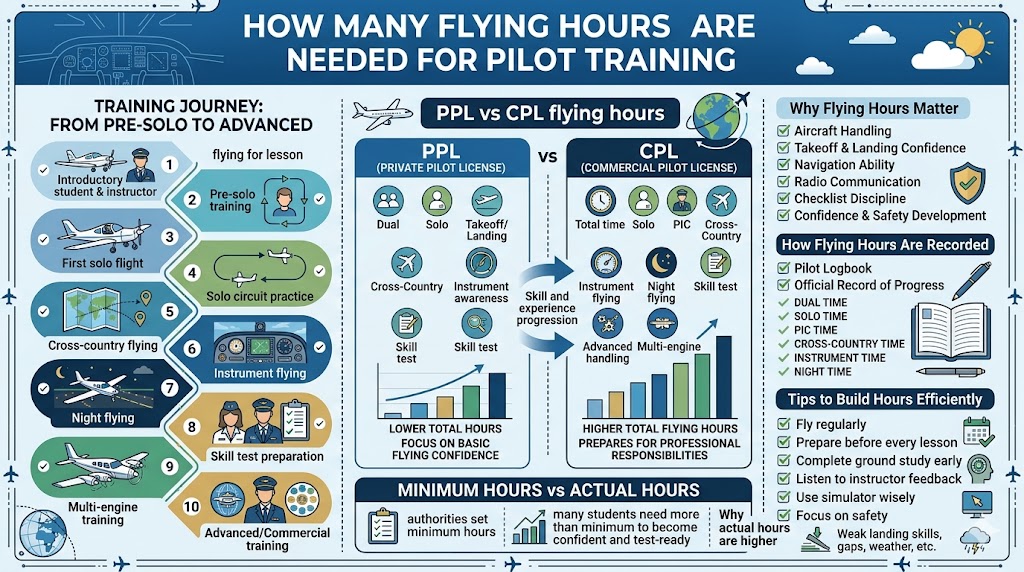
A general pilot training journey may include:
- Introductory flying lesson
- Pre-solo training
- First solo flight
- Solo circuit practice
- Cross-country flying
- Instrument flying
- Night flying
- Skill test preparation
- Advanced or multi-engine training
- Commercial pilot training hours
There is no single universal number for all students worldwide. Students should always check the latest requirements from their aviation authority and flight school.
Flying Hours Needed for a Private Pilot License
A Private Pilot License, or PPL, is usually for personal flying, hobby flying, or the first stage of pilot training. It allows a pilot to fly privately but not usually for paid commercial flying.
PPL training generally includes:
- Dual flying with instructor
- Solo flying
- Takeoff and landing practice
- Basic navigation
- Cross-country flying
- Emergency procedures
- Basic instrument awareness
- Flight test preparation
In some countries, the minimum requirement may be around 40 hours, but many students need more than the minimum to become fully confident and test-ready. The actual number depends on skill, consistency, weather, instructor evaluation, and school training standards.
A student should not focus only on reaching the minimum number. The real goal is to become safe, confident, and ready for the flight test.
Flying Hours Needed for a Commercial Pilot License
A Commercial Pilot License, or CPL, is required for students who want to work professionally as pilots. CPL training needs more flying hours than PPL because it prepares students for professional aviation responsibilities.
CPL training may include:
- Total flight time requirement
- Solo flying
- Pilot-in-command time
- Cross-country flying
- Instrument flying
- Night flying
- Skill test preparation
- Advanced aircraft handling
- Multi-engine training, if required
In many countries, CPL hour requirements are much higher than PPL requirements. Some aviation authorities require around 200 to 250 total flying hours for commercial pilot training, depending on the country and training route.
Students should remember that airline jobs may require more experience than the minimum CPL requirement. A CPL makes a student eligible for professional flying privileges, but job requirements may depend on airline standards, aircraft type, ratings, and market conditions.
Flying Hours for First Solo Flight
The first solo flight is one of the biggest milestones in pilot training. It is the first time a student flies the aircraft without an instructor onboard.
There is no fixed hour number that applies to every student. Some students may go solo earlier, while others may need more practice. The decision is made by the flight instructor.
A student may be ready for solo flight when they can show:
- Safe takeoff technique
- Stable circuit flying
- Good landing control
- Proper radio communication
- Checklist discipline
- Situational awareness
- Good airspeed control
- Safe go-around decision
- Confidence without overconfidence
The first solo flight is based on safety and instructor approval, not only the number of hours completed.
Flying Hours for Cross-Country Training
Cross-country flying teaches students how to fly from one airport or location to another using navigation planning. This is a very important part of pilot training.
Cross-country training helps students learn:
- Route planning
- Map reading
- GPS use
- Fuel planning
- Weather checking
- Radio communication
- Airspace awareness
- Diversion planning
- Arrival and departure procedures
Cross-country hours may be required for both PPL and CPL training. These hours help students move beyond local training circuits and understand real flight planning.
Flying Hours for Instrument Training
Instrument flying means controlling the aircraft mainly by using cockpit instruments instead of outside visual references. This is important because pilots may face low visibility, clouds, haze, or night conditions.
Instrument training helps students understand:
- Attitude indicator
- Altimeter
- Airspeed indicator
- Heading indicator
- Vertical speed indicator
- Navigation instruments
- Basic instrument procedures
Instrument flying hours may be required as part of PPL, CPL, or instrument rating training. The exact number depends on the aviation authority and license type.
Flying Hours for Night Flying
Night flying is different from daytime flying. At night, pilots depend more on instruments, runway lights, navigation planning, and visual judgment.
Night flying training may include:
- Night takeoff
- Night landing
- Circuit flying at night
- Navigation using lights and instruments
- Runway light recognition
- Emergency awareness
- Visual illusion management
Night flying is often required for professional pilot training because commercial pilots may need to operate during different times of the day.
Flying Hours for Multi-Engine Training
Multi-engine training is usually required or recommended for students who want to move toward advanced professional flying. A multi-engine aircraft has more than one engine and requires more skill, planning, and system knowledge.
Multi-engine training may include:
- Engine management
- Asymmetric thrust handling
- Multi-engine takeoff
- Multi-engine landing
- Engine failure procedures
- Advanced checklist use
- Higher workload management
Multi-engine aircraft are usually more expensive to fly than single-engine aircraft. Students should plan their budget carefully if multi-engine training is part of their career path.
Minimum Hours vs Actual Hours
Minimum required hours and actual completion hours are not always the same.
Aviation authorities set minimum hours for license eligibility. But many students need more than the minimum to become confident and ready for the test.
Extra hours may be needed because of:
- Weak landing skills
- Long gaps between lessons
- Weather delays
- Aircraft unavailability
- Instructor changes
- Lack of preparation
- Repeated lessons
- Exam delays
- Confidence issues
- Extra solo practice
- Skill test preparation
Students should not feel discouraged if they need extra hours. In aviation, safety and skill matter more than finishing quickly.
Flying Hours Table for Beginners
| Training Stage | Purpose | Typical Hour Requirement Type | Beginner Tip |
|---|---|---|---|
| Introductory Lesson | First flying experience | Usually short flight exposure | Use it to understand flying basics |
| Pre-Solo Training | Learn takeoff, landing, circuit | Based on instructor approval | Do not compare with other students |
| First Solo Flight | Fly without instructor onboard | No universal fixed number | Safety and readiness matter most |
| PPL Training | Private or hobby flying | Lower than CPL | Focus on basic flying confidence |
| CPL Training | Professional pilot preparation | Higher total flight time | Plan budget carefully |
| Cross-Country Flying | Navigation practice | Required in many license paths | Learn planning and decision-making |
| Instrument Flying | Flying by instruments | Required depending on license | Practice scan and control discipline |
| Night Flying | Flying after sunset | Required in many professional paths | Respect visual limitations |
| Multi-Engine Training | Advanced aircraft training | Depends on rating and career path | More costly, but useful professionally |
| Skill Test Preparation | Final exam readiness | Extra practice may be needed | Do not rush the test |
How Flying Hours Are Recorded
Flying hours are recorded in a pilot logbook. This logbook is very important because it proves the student’s training experience.
A logbook usually includes:
- Date of flight
- Aircraft type
- Aircraft registration
- Departure airport
- Arrival airport
- Flight duration
- Dual flying time
- Solo flying time
- Pilot-in-command time
- Cross-country time
- Instrument time
- Night flying time
- Instructor signature
- Remarks or lesson details
Students should maintain the logbook carefully from the beginning of training. Mistakes in logbook entries can create problems during license application or verification.
Who Verifies Flying Hours?
Flying hours are usually verified by instructors, flight schools, examiners, and aviation authorities.
The instructor checks and signs training flights. The flight school maintains training records. The examiner may review the logbook before a skill test. The aviation authority may check records before issuing a license.
This is why students should never treat logbook entries casually. A proper logbook is part of professional pilot discipline.
How to Build Flying Hours Efficiently
Flying hours are costly, so students should use them wisely. Good preparation can reduce repeated lessons and save money.
1. Fly Regularly
Regular flying helps students remember skills. Long breaks can lead to skill loss and extra revision flights.
2. Prepare Before Every Lesson
Read the lesson topic before flying. Know what you will practice. Ask questions before the flight.
3. Complete Ground Study Early
Strong theory knowledge helps students understand practical flying better.
4. Review Every Flight
After each lesson, write down what went well and what needs improvement.
5. Listen to Instructor Feedback
Instructor feedback helps students correct mistakes early.
6. Use Simulator Training Wisely
Simulators can help students practice procedures, radio calls, instrument flying, and emergency handling.
7. Maintain a Proper Logbook
Update your logbook regularly and check entries for accuracy.
8. Plan Budget for Extra Hours
Do not plan only for minimum hours. Keep a backup budget for extra practice.
9. Avoid Long Training Gaps
Long gaps can increase total cost and delay training progress.
10. Focus on Safety
Never rush flying hours just to finish training faster. Safety must always come first.
Common Mistakes Students Make with Flying Hours
Thinking Minimum Hours Guarantee a License
Minimum hours only make you eligible. You still need skill, knowledge, instructor approval, and test readiness.
Not Maintaining the Logbook Properly
Poor logbook records can create problems during license processing.
Taking Long Breaks Between Lessons
Long breaks can reduce confidence and increase repeated practice.
Ignoring Instructor Feedback
Students who ignore feedback may repeat the same mistakes and need extra hours.
Flying Without Preparation
Every flight should have a learning goal. Flying without preparation wastes time and money.
Choosing a School Only by Low Cost
A cheaper hourly rate does not always mean lower total cost. Poor aircraft availability or weak scheduling can increase delays.
Forgetting Special Hour Requirements
Students should track solo, cross-country, instrument, night, and pilot-in-command hours separately.
Cost Impact of Flying Hours
Flying hours directly affect pilot training cost. More flying hours usually mean higher total expenses because students pay for aircraft rental, fuel, instructor time, maintenance, airport charges, and other operational costs.
Extra flying hours may increase the budget, but sometimes they are necessary for safety and confidence. Students should not see extra practice as failure. In aviation, proper training is always better than rushing.
The best way to control cost is to train regularly, prepare well, avoid unnecessary gaps, and choose a flight school with good aircraft availability and transparent pricing.
Questions to Ask a Flight School About Flying Hours
Before joining a flight school, students should ask:
- How many flying hours are required for this license?
- How many hours are included in the course fee?
- What is the aircraft hourly rate?
- Are instructor charges included?
- Are fuel charges included?
- Are simulator hours included?
- Can simulator hours be counted?
- How are solo hours recorded?
- How often can I fly per week?
- What happens if I need extra flying hours?
- Are cross-country hours included?
- Are night flying hours included?
- Are instrument hours included?
- How is logbook verification done?
- What is the average completion time for students?
- What is the aircraft availability?
These questions help students understand the real training plan and avoid hidden cost surprises.
Real-World Example
Imagine a student named Rahul begins pilot training with the goal of becoming a commercial pilot. At first, he thinks only about the total flying-hour requirement. But his instructor explains that all hours are not the same.
Rahul starts tracking:
- Dual flying hours with instructor
- Solo flying hours
- Cross-country flying hours
- Instrument flying hours
- Night flying hours
- Pilot-in-command hours
- Simulator practice
- Extra landing practice
He updates his logbook after every flight and reviews his progress weekly. When he struggles with landings, he takes extra practice instead of rushing. Later, he realizes that those extra hours improved his confidence and safety.
This example shows that flying hours are not only a license requirement. They are part of becoming a better pilot.
How Parents Can Understand Flying Hours
Parents often look at pilot training from a cost point of view. This is natural because flying hours are expensive. But parents should understand that every student learns at a different speed.
One student may need fewer hours to master landings. Another student may need more practice. Weather, aircraft availability, confidence, and training gaps can also affect progress.
Parents should support students by focusing on:
- Safety
- Proper training
- Instructor feedback
- Consistent flying
- Correct logbook records
- Transparent school fees
- Backup budget for extra hours
Pilot training should never be rushed only to save money. A safe pilot is more important than a fast training timeline.
FAQs
1. How many flying hours are needed for pilot training?
The number depends on the license type, country, aviation authority, aircraft category, school, and student performance. PPL usually needs fewer hours than CPL.
2. Are flying hour requirements the same in every country?
No. Flying-hour rules vary by country and aviation authority. Students should check the latest rules from their local regulator and flight school.
3. How many hours are needed before first solo flight?
There is no fixed universal number. A student can fly solo only after the instructor confirms safe takeoffs, landings, circuit flying, radio communication, and overall readiness.
4. How many flying hours are needed for PPL?
PPL hour requirements vary by country. Some authorities set minimum requirements around 40 hours, but many students may need more to become test-ready.
5. How many flying hours are needed for CPL?
CPL requirements are higher than PPL. Depending on the country and training route, students may need around 200 to 250 total flying hours or more.
6. Do simulator hours count as flying hours?
Simulator hours may count for certain training requirements depending on the aviation authority, license type, and approved simulator. Students should confirm with their flight school.
7. What happens if I need extra flying hours?
Extra flying hours are common. They may increase cost, but they help improve skill, confidence, and safety before tests.
8. How are flying hours recorded?
Flying hours are recorded in a pilot logbook. The logbook includes flight date, aircraft type, duration, dual or solo time, route, instructor signature, and remarks.
9. Can I complete pilot training in minimum hours?
Some students may complete training close to minimum hours, but many need extra practice. License eligibility depends on both required hours and skill readiness.
10. Why do flying hours affect training cost?
Flying hours affect cost because aircraft rental, fuel, instructor fees, maintenance, and airport charges are usually connected to flight time.
Conclusion
Understanding how many flying hours are needed for pilot training is important for every beginner student. Flying hours are the foundation of practical pilot training. They build confidence, skill, safety awareness, and license eligibility.
However, students should remember that flying is not only about completing minimum hours. A good pilot focuses on safe training, proper logbook records, instructor feedback, regular practice, and strong decision-making.
Before joining a flight school, ask clear questions about required hours, included hours, aircraft rates, simulator use, extra-hour charges, and logbook verification. Plan your budget carefully and keep extra room for additional practice.
Pilot training is a journey of discipline and responsibility. Complete your flying hours with patience, respect the training process, and always choose safety over speed.

