
Introduction
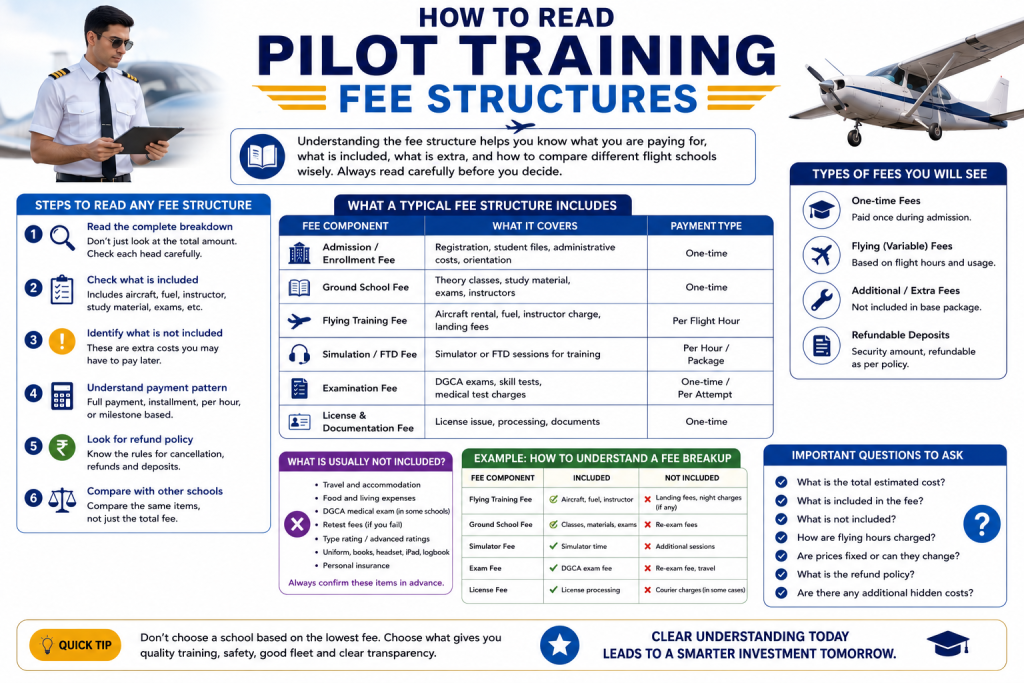
Choosing a pilot training program is an important financial decision. The advertised course fee may look straightforward at first, but pilot training often involves several different expenses that may be listed separately.
A training package might include a certain number of flying hours, ground classes, simulator sessions, or instructor fees, while examination charges, medical assessments, equipment, licensing fees, accommodation, and additional flying may be excluded.
This is why students should learn how to read a pilot training fee structure before making a payment. Understanding what is included, what is charged separately, and what may increase the final cost can make it easier to compare flight schools and prepare a realistic budget.
Actual fees vary depending on the country, aviation authority, training organization, aircraft type, license being pursued, training location, and individual student progress.
Understanding a Pilot Training Fee Structure
A pilot training fee structure is a breakdown of the expenses associated with completing a particular training program.
Flight schools may present their charges in different ways. Some may advertise a complete package, while others separate theoretical training, flying, examinations, equipment, and administrative costs.
Common pricing approaches include:
- Fixed course packages
- Hourly aircraft charges
- Pay-as-you-go flying
- Block-hour packages
- Stage-wise payments
- Separate theory and practical fees
Students should not assume that two programs with similar advertised prices provide the same training.
The first step is to find out exactly what each quoted amount covers.
Main Components of Pilot Training Fees
Admission and Registration Fees
Some flight schools charge an initial registration or admission fee when a student joins the program.
This may cover administrative processing, enrollment, documentation, or other initial services.
Before paying, students should ask:
- Is the fee refundable?
- Is it included in the total course cost?
- Does it need to be paid only once?
- What happens if the student withdraws from the program?
Understanding these conditions early can prevent confusion later.
Ground School or Theory Training Fees
Pilot training is not limited to flying aircraft. Students also need to study theoretical subjects that support safe and informed flight operations.
Ground training may cover subjects such as:
- Aviation regulations
- Air navigation
- Meteorology
- Aircraft and general knowledge
- Human performance
- Flight planning
- Radio communication
Some schools include ground training in their overall package, while others charge separately.
Students should check whether the quoted fee covers the complete theory program or only selected classes.
Flight Training Charges
Actual flying is usually one of the largest components of pilot training expenses.
Flight charges can depend on:
- Aircraft type
- Aircraft operating costs
- Flight duration
- Instructor charges
- Fuel
- Airport or landing fees
- Training location
A student should understand whether the advertised hourly rate refers only to the aircraft or represents the complete cost of a training flight.
Instructor Fees
Instructor charges may be included in the aircraft hourly rate or listed separately.
Students should specifically ask whether the quoted flying rate includes:
- Pre-flight briefing
- Instructor time during flight
- Post-flight briefing
- Ground instruction
- Additional instructor sessions
A low aircraft rate may not necessarily represent a low overall training cost if instructor charges are added separately.
Simulator Training Fees
Some pilot training programs include simulator sessions as part of the curriculum.
Simulator charges may be:
- Included in the course package
- Charged per session
- Charged according to the amount of simulator time
- Included only up to a specified limit
Students should confirm how much simulator training is included and whether additional sessions have separate charges.
Simulator training can complement aircraft training, but students should not assume that simulator time automatically replaces any required aircraft flying.
Examination Fees
Pilot training can involve theoretical examinations, practical assessments, and other regulatory requirements.
Examination costs may be included in a package or paid separately to the relevant authority or organization.
Students should ask:
- Who collects the examination fee?
- Is it included in the quoted course price?
- What happens if an examination must be repeated?
- Are administrative charges included?
Skill Test and Check Fees
Practical assessments may involve additional expenses.
Depending on the training program, students may need to account for:
- Aircraft usage
- Examiner charges
- Instructor preparation
- Ground preparation
- Administrative fees
These costs should be identified before the student reaches the testing stage.
Medical Examination Costs
Aviation medical examinations can represent a separate expense.
Depending on the applicable requirements, students may need to pay for:
- Initial medical assessment
- Additional medical investigations when required
- Periodic medical examinations
Medical requirements vary according to the aviation authority, license, and type of operation. Students should verify the applicable requirements rather than assuming that one standard applies everywhere.
Study Materials and Training Equipment
Students may also need to purchase equipment and learning materials.
These may include:
- Flight manuals
- Navigation materials
- Charts
- Logbooks
- Headsets
- Uniforms
- Pilot bags
- Other training equipment
Some schools provide certain items as part of the course, while others require students to purchase them separately.
Included vs Not Included in Pilot Training Fees
The following is a general example of how expenses may be treated. Actual inclusions differ between training providers.
| Expense | May Be Included | May Be Charged Separately |
|---|---|---|
| Ground training | Sometimes | Sometimes |
| Flight hours | According to package | Additional hours may cost extra |
| Instructor charges | Sometimes | Sometimes |
| Simulator sessions | Sometimes | Sometimes |
| Examination fees | Sometimes | Often separate |
| Medical examination | Rarely | Commonly separate |
| Study materials | Sometimes | Often separate |
| Uniform | Sometimes | Sometimes |
| Headset | Rarely | Usually separate |
| Skill test | Sometimes | Often separate |
| Licensing fees | Rarely | Usually separate |
| Accommodation | Rarely | Usually separate |
| Travel | Rarely | Usually separate |
Students should always request the actual inclusions from the training provider in writing.
Understanding “Estimated” Pilot Training Costs
A flight school may describe its total training cost as an estimate rather than a guaranteed final amount.
This is important because students do not always complete training using exactly the same number of flying hours.
Additional expenses can arise from:
- Additional flight hours
- Weather-related delays
- Training interruptions
- Repeated examinations
- Repeated skill tests
- Aircraft availability
- Instructor availability
- Airport charges
- Regulatory fees
- Other personal expenses
An estimated cost is therefore best treated as a planning figure rather than an automatic final bill.
Students should ask what assumptions were used to calculate the estimate.
Understanding Minimum Flight Hours vs Actual Flight Hours
One of the most important points when reading a pilot training fee structure is understanding the difference between minimum required flight hours and the number of hours an individual student may actually need.
A program may advertise a specific number of hours based on regulatory or course requirements. However, individual students may require additional training to reach the required level of proficiency.
Additional hours can depend on:
- Individual progress
- Skill development
- Weather
- Aircraft availability
- Training interruptions
- Instructor assessment
- Test performance
Therefore, multiplying the advertised minimum flight hours by an hourly rate does not always produce the final cost of training.
How Hourly Flight Rates Work
Students should also understand how an aircraft’s hourly rate is calculated.
Flight schools may use different methods to calculate flying time, including terms such as:
- Flight time
- Hobbs time
- Tach time
- Block time
The exact meaning and billing method can differ between organizations.
Before enrolling, students should ask:
“How is my flying time calculated, and what exactly does the hourly rate include?”
This simple question can make a significant difference when comparing fee structures.
Additional Charges Students Should Ask About
Landing and Airport Fees
Some airports may charge landing or operational fees.
Students should determine whether these charges are already included in the flying rate or billed separately.
Fuel Surcharges
Fuel costs can influence flight-training expenses.
Students should ask whether the quoted aircraft rate already accounts for fuel or whether additional fuel-related charges may apply.
Examination Reattempt Fees
If a student needs to repeat an examination, additional fees may apply.
The student should understand both the examination fee and any associated administrative charges.
Additional Flying Hours
Additional flying is one of the most important costs to consider.
Students should ask for the current hourly rate for extra training rather than assuming it will be the same as the rate used in an advertised package.
Aircraft Change or Upgrade Costs
Different aircraft may have different operating costs.
If training progresses to another aircraft type, students should find out whether the hourly rate changes.
Accommodation and Living Expenses
Students who train away from home may need to budget separately for:
- Accommodation
- Food
- Transportation
- Utilities
- Personal expenses
These expenses can become a significant part of the overall cost of training.
Travel Expenses
Students may also need to travel to:
- The flight school
- Examination centers
- Medical facilities
- Licensing offices
- Other training locations
Travel costs should therefore be considered when preparing a complete training budget.
How to Compare Two Pilot Training Fee Structures
Comparing only the total advertised price can be misleading.
Instead, students should compare each program using the same categories.
Important comparison points include:
- Total included flying hours
- Aircraft type
- Aircraft hourly rate
- Instructor charges
- Ground training
- Simulator hours
- Examination costs
- Skill-test costs
- Study materials
- Equipment
- Additional-hour rates
- Payment schedule
- Refund policy
- Accommodation options
For example, a training package that appears more expensive may include more flying hours and additional services than a cheaper package.
The goal should be to compare the overall value and likely total cost, not just the starting price.
Sample Pilot Training Fee Breakdown
Students can organize a training quotation into a simple budget.
For example:
- Registration: ₹X
- Ground training: ₹X
- Flight training package: ₹X
- Simulator: ₹X
- Examination: ₹X
- Medical examination: ₹X
- Training equipment: ₹X
- Licensing: ₹X
- Estimated additional flying: ₹X
- Accommodation and living expenses: ₹X
These figures are only placeholders and should not be treated as actual training prices.
The purpose of this approach is to make it easier to identify expenses that may otherwise be overlooked.
Questions to Ask a Flight School Before Paying Fees
Before making a significant payment, students should ask for clear answers to important financial questions.
- What exactly is included in the advertised fee?
- How many flight hours are included?
- What is the aircraft’s hourly rate?
- Is the instructor fee included?
- Are simulator sessions included?
- Are examination fees included?
- Are skill-test and examiner charges included?
- What happens if additional flying hours are required?
- What is the cost of repeating a failed test?
- Are landing and airport charges included?
- Is the medical examination included?
- Are books, charts, uniforms, and equipment included?
- What is the refund policy?
- What payment schedule is required?
- Can the school provide an itemized written quotation?
Getting these details before enrollment can make financial planning much easier.
Refund and Cancellation Policies
Students should read the refund and cancellation terms before making a large payment.
Different training providers can have different policies regarding:
- Withdrawal from the course
- Training interruption
- Medical issues
- Transfer to another school
- Course cancellation
- Unused flight hours
- Delayed training
A student should know what happens to unused fees if training stops unexpectedly.
The safest approach is to obtain the applicable refund policy in writing rather than relying only on a verbal explanation.
Payment Plans and Installments
Some training providers may allow students to pay fees in stages rather than paying the entire training cost upfront.
Possible payment structures can include:
- Initial enrollment payment
- Ground-school payment
- Flight-training installments
- Stage-wise payments
- Pay-per-hour flying
Installment payments can make budgeting easier, but students should still understand when payments are due and whether any additional administrative or financing costs apply.
The payment schedule should be compared alongside the total training cost.
Common Mistakes When Reading Pilot Training Fees
Looking Only at the Total Package Price
A low advertised price may not include every expense required to complete training.
Students should always check the detailed breakdown.
Assuming All Flight Hours Are Included
A package may contain a limited number of flying hours.
Students should confirm exactly how many hours are included and what additional hours will cost.
Ignoring Additional-Hour Rates
The additional flying rate can have a major effect on the final cost if a student needs more training.
Forgetting Examination and Licensing Costs
Regulatory examinations, skill tests, and licensing expenses may be separate from tuition.
Not Checking What “Instructor Included” Means
Students should determine whether the instructor charge covers only flight time or also includes briefings and other instructional activities.
Ignoring Refund Terms
Students should understand the financial consequences of leaving a program or interrupting training.
Comparing Different Training Packages Directly
Two programs can have completely different inclusions even if their advertised prices appear similar.
Not Asking for a Written Breakdown
A written quotation makes it easier to compare programs and identify additional costs.
How to Build a Realistic Pilot Training Budget
A realistic budget should include more than the advertised course fee.
Training Costs
Consider:
- Ground training
- Flight hours
- Simulator sessions
- Instructor fees
Regulatory Costs
Consider:
- Examinations
- Medical certification
- Skill tests
- Licensing
Equipment Costs
Consider:
- Headset
- Uniform
- Charts
- Books
- Logbook
- Other required equipment
Living Costs
Students training away from home may need to include:
- Accommodation
- Food
- Transportation
- Utilities
- Personal expenses
Contingency Budget
A contingency amount can help cover unexpected expenses such as additional flying hours, repeated assessments, or other training-related costs.
This is particularly useful because students do not always complete their training at exactly the minimum number of hours.
Frequently Asked Questions
1. What does a pilot training fee usually include?
It depends on the training provider. A package may include some combination of ground training, flight hours, instructor fees, or simulator sessions. Examination, medical, licensing, equipment, accommodation, and additional flying costs may be separate.
2. Why do pilot training fees vary between flight schools?
Fees can vary because of differences in aircraft type, location, operating costs, instructor rates, training facilities, included flying hours, airport charges, and course structure.
3. Are examination fees normally included in pilot training packages?
Not always. Some programs may include certain examination-related costs, while others require students to pay them separately. Students should check the specific fee structure.
4. Are additional flying hours charged separately?
In many training programs, additional hours beyond the included package are charged separately. The exact rate should be confirmed with the training provider before enrollment.
5. Does the aircraft hourly rate include the instructor?
It depends on the flight school. Some providers combine the aircraft and instructor charges, while others list them separately.
6. Are medical examination costs included in flight training fees?
Medical examinations are often separate expenses, although arrangements vary. Students should check the specific training program and applicable medical requirements.
7. Why is the advertised package price sometimes lower than the final training cost?
The advertised price may be based on a certain number of flight hours or exclude items such as examinations, licensing, equipment, accommodation, and additional flying.
8. How should students compare two flight school fee structures?
Students should compare the number of included flying hours, aircraft type, instructor charges, simulator training, examinations, additional-hour rates, licensing costs, equipment, payment terms, and refund policies.
9. What should students ask before paying a training fee?
Students should ask for an itemized breakdown showing exactly what is included, what is excluded, how additional charges are calculated, and what happens if training takes longer than expected.
10. How much extra money should a student keep aside for unexpected costs?
There is no universal amount because training costs vary significantly. Students should ask the school for realistic information about additional flying, examination retakes, and other possible expenses and then build a suitable contingency into their personal budget.
Conclusion
Learning how to read a pilot training fee structure is an important part of preparing for flight school. The advertised course price is only one part of the financial picture, and students should understand every major expense before making a commitment.
The most important areas to check include the number of included flying hours, aircraft rates, instructor charges, ground training, simulator sessions, examinations, skill tests, medical assessments, licensing, equipment, accommodation, and additional flying.
Students should also pay close attention to payment schedules and refund policies. Most importantly, they should ask for an itemized written quotation rather than relying solely on a headline course price.

