
Introduction
Pilot training is a major financial commitment, and the total cost may include much more than flight lessons alone. Students may need to pay for ground classes, aircraft rental, instructor fees, examinations, medical assessments, licensing expenses, study materials, and other training-related requirements.
Because paying the entire training cost at once may not be practical for every student, some flight schools and training providers offer installment plans. These arrangements allow eligible costs to be divided into multiple payments instead of requiring one large upfront payment.
However, an installment plan does not automatically mean that pilot training becomes cheaper. The total amount payable, payment schedule, interest, additional charges, refund conditions, and expenses outside the plan all need to be understood before making a commitment.
This guide explains how pilot training installment plans generally work, what they may cover, how they differ from other financing options, and what students should check before signing an agreement.
What Is a Pilot Training Installment Plan?
A pilot training installment plan is an arrangement that allows a student to pay eligible training expenses in several payments rather than paying the entire amount upfront.
The structure can differ significantly between training providers.
For example, a flight school may require:
- An initial registration or admission payment
- A deposit before training begins
- Monthly installments
- Payments after specific training stages
- Payment based on completed flight hours
- Separate payments for examinations and licensing
Some schools may combine several of these approaches.
The important point is that students should not assume that an installment plan covers every expense associated with becoming a pilot. The written agreement should clearly identify what is included and what must be paid separately.
Why Do Flight Schools Offer Installment Plans?
Flight training can continue for months or longer, depending on the student’s progress, weather, aircraft availability, examinations, instructor availability, and other factors.
A staged payment arrangement can help students organize their finances during this period.
Possible reasons for offering installment arrangements include:
- Reducing the amount required at enrollment
- Spreading training payments over time
- Connecting payments with training stages
- Making budgeting easier
- Separating different components of the training program
- Allowing students to pay as training progresses
Not every flight school offers the same payment options. Some may require substantial upfront payments, while others may provide monthly or stage-based arrangements.
How Pilot Training Installment Plans Usually Work
Although the details vary, the process often follows a basic structure.
Step 1: Review the Training Cost Estimate
The student first receives an estimated cost for the selected training program.
This estimate may include some training components but exclude other expenses.
Students should therefore ask for a detailed breakdown instead of looking only at the headline course price.
Step 2: Make the Initial Payment
The school may require an initial payment before training starts.
This could be a deposit, registration charge, admission fee, or first installment.
Students should ask whether this payment is refundable and what happens if they later decide not to continue.
Step 3: Follow the Payment Schedule
The remaining amount is divided according to the agreed schedule.
Depending on the arrangement, payments may be:
- Monthly
- Weekly
- Stage-based
- Hour-based
- Linked to specific training milestones
Step 4: Continue Training While Payments Remain Current
Some providers may require students to keep their accounts up to date before additional training can be scheduled.
Students should understand the consequences of delayed payments before entering into the agreement.
What Can Be Included in an Installment Plan?
There is no universal list of expenses included in pilot training installment plans.
Depending on the provider, an arrangement may cover some of the following:
- Ground school tuition
- Flight training
- Aircraft rental
- Instructor charges
- Simulator sessions
- Training materials
- Certain administrative charges
However, students should verify every item.
A school may advertise an installment amount for tuition while charging flight hours, examinations, medical assessments, or licensing separately.
This is why the complete payment structure is more important than the advertised monthly figure.
What May Not Be Included in Pilot Training Installments?
Many expenses associated with pilot training can remain separate from the main installment arrangement.
These may include:
- Aviation medical examinations
- Written examination fees
- Practical or skill-test fees
- Licensing charges
- Additional flight hours
- Repeated training sessions
- Study materials
- Headsets and other equipment
- Accommodation
- Food
- Transportation
- Visa-related expenses where applicable
- Insurance
- Additional simulator sessions
- Other administrative or operational charges
The exact exclusions depend on the training provider and the country in which training takes place.
Students should ask for a written list of both included and excluded costs.
Installment Plan vs Paying the Full Amount Upfront
Students may sometimes have a choice between paying a large amount upfront and using an installment arrangement.
| Factor | Upfront Payment | Installment Plan |
|---|---|---|
| Initial financial requirement | Usually higher | Usually lower |
| Payment timing | Mostly upfront | Spread over an agreed period |
| Budgeting | Large initial expense | Periodic payments |
| Financing charges | May be lower or absent | May apply depending on arrangement |
| Financial flexibility | Lower initially | Potentially greater |
| Refund considerations | Important | Important |
| Additional training costs | May still apply | May still apply |
| Total cost | Depends on agreement | May be higher if interest or fees apply |
Neither option is automatically better.
A student should compare the complete financial obligation rather than choosing solely on the basis of the initial payment.
Installment Plans vs Pilot Training Loans
An installment plan offered directly by a flight school is not necessarily the same as a loan.
Flight School Installment Plan
Under a direct installment arrangement, the student generally pays the training provider according to its payment schedule.
The agreement may specify:
- Initial deposit
- Number of payments
- Due dates
- Payment amounts
- Refund conditions
- Late-payment terms
Pilot Training Loan
A loan involves a separate financing arrangement with a lender.
The lender may have its own requirements regarding:
- Eligibility
- Interest
- Repayment period
- Processing fees
- Guarantees or security where applicable
- Repayment start date
- Other contractual conditions
A student should carefully compare the total amount that will eventually be repaid rather than focusing only on the monthly installment.
Installment Plans vs Pay-As-You-Go Training
Pay-as-you-go training is another approach.
Under this model, students may pay for lessons or flight hours as they receive them rather than committing to a fixed installment schedule.
| Factor | Installment Plan | Pay-As-You-Go |
|---|---|---|
| Payment structure | Predetermined schedule | Payment as training occurs |
| Budget predictability | Often easier to plan | Can vary month to month |
| Long-term commitment | May be higher | May offer greater flexibility |
| Upfront payment | Depends on agreement | Usually lower |
| Additional training | Depends on plan | Usually paid as required |
| Contract terms | Important | Still important |
The better option depends on the student’s financial situation and the school’s payment policies.
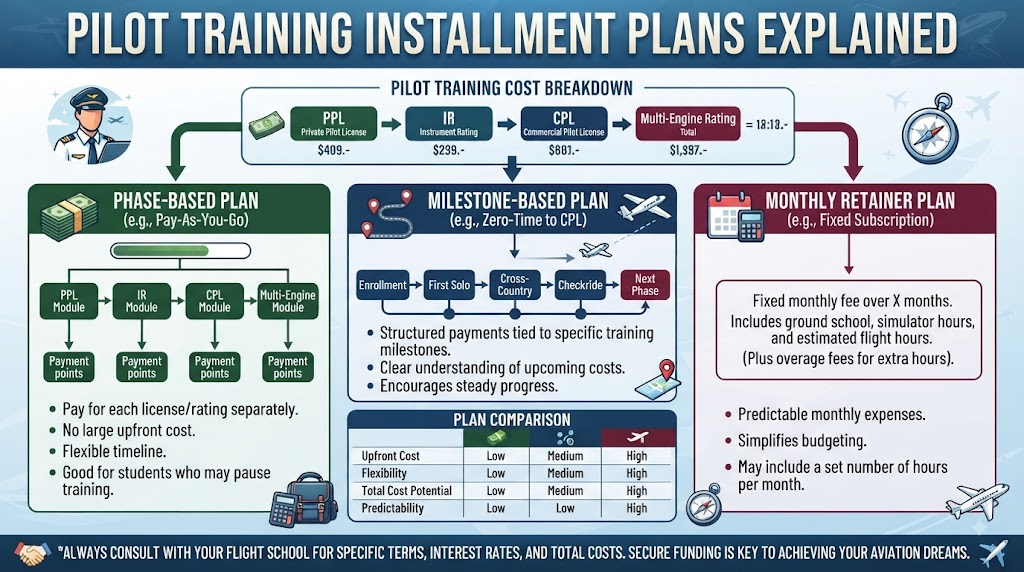
Common Pilot Training Payment Structures
Flight schools can use several different payment models.
Fixed Monthly Installments
The student pays an agreed amount every month for a specified period.
This can make regular budgeting easier, but students should determine whether interest or administrative charges are included.
Stage-Based Payments
Payments are linked to different stages of training.
For example, a provider may require separate payments for ground training, initial flight training, advanced flight training, or other stages.
Hour-Based Payments
Students may pay according to the number of flight hours completed.
This can make the amount payable vary from one period to another.
Deposit Plus Installments
The student makes a larger initial payment and then pays the remaining amount through scheduled installments.
Mixed Payment Structure
Some training providers may use a combination of payment methods.
For example, tuition could be paid in installments while flight hours, examinations, and licensing expenses are charged separately.
Understanding the Total Cost of an Installment Plan
One of the most important things to understand is that the installment amount does not necessarily represent the complete training cost.
Students should consider:
Total amount payable = Initial payment + installments + interest + applicable fees + separate training expenses
For example, a student may see a relatively small monthly payment but later discover that examinations, additional flight hours, accommodation, and licensing costs are not included.
The monthly amount therefore needs to be considered alongside the full cost structure.
Interest and Financing Charges
If an installment arrangement involves financing, interest may increase the total amount payable.
Students should understand the difference between:
Principal
The original amount being financed.
Interest
The additional amount charged for borrowing money.
Processing Fee
A charge that may be applied when arranging financing.
Administrative Fee
A fee associated with managing the payment arrangement.
Late-Payment Fee
A charge that may apply if an installment is not paid on time.
Not every installment plan includes all of these charges.
Students should ask for a complete written calculation showing the total amount payable over the full payment period.
Hidden or Additional Charges to Check
A student should never assume that the advertised installment is the only financial obligation.
Before signing, check whether there are:
- Processing charges
- Administrative fees
- Late-payment penalties
- Early repayment charges
- Cancellation fees
- Refund deductions
- Taxes
- Documentation charges
- Rescheduling charges
- Additional training fees
A written fee schedule can make these costs easier to identify.
What Happens If a Student Needs More Flight Hours?
The estimated training cost is not always the final cost.
Students progress at different rates, and some may require additional training before meeting the required standards.
Additional costs can result from:
- Extra flight lessons
- Additional simulator sessions
- Repeated exercises
- Additional instructor time
- Repeated examinations
- Training delays
Students should ask the flight school how these additional expenses are handled.
An important question is whether additional flight hours can also be paid through the existing installment arrangement or whether they must be paid separately.
What Happens If a Student Stops Training?
Before signing an installment agreement, students should understand the withdrawal and cancellation conditions.
Important questions include:
- Is the unused balance refundable?
- Is the initial deposit refundable?
- Are completed training hours deducted?
- Are administrative charges deducted?
- Is there a cancellation fee?
- Can unused funds be transferred?
- Are future installment obligations cancelled automatically?
The answer can vary significantly between providers.
Students should not assume that stopping training automatically ends all financial obligations.
What Happens If Training Is Delayed?
Flight training can sometimes be interrupted for reasons beyond the student’s control.
Possible causes include:
- Poor weather
- Aircraft maintenance
- Aircraft availability
- Instructor availability
- Examination schedules
- Student availability
- Other operational circumstances
Students should ask what happens to the payment schedule if training is temporarily interrupted.
A delayed training schedule does not necessarily mean that contractual payment dates automatically change.
The agreement should be checked carefully.
What Should Students Check Before Signing?
A pilot training installment plan should be reviewed as carefully as the training curriculum itself.
Students should confirm:
- Total estimated training cost
- Initial deposit
- Installment amount
- Payment frequency
- Number of installments
- Interest charges
- Processing fees
- Taxes
- Included training services
- Excluded expenses
- Additional flight-hour charges
- Examination fees
- Medical expenses
- Licensing costs
- Refund policy
- Cancellation policy
- Late-payment conditions
- Early repayment conditions
- Training interruption policy
If any important term is unclear, students should ask the provider to explain it before making a payment.
Questions to Ask a Flight School About Installment Plans
Before enrolling, students can ask the following questions:
- What is the total estimated training cost?
- How much must be paid before training begins?
- How many installments are required?
- What does each installment cover?
- Are flight hours included?
- Are examination fees included?
- Are medical expenses included?
- What happens if additional flight hours are required?
- Is interest charged?
- Are there processing or administrative fees?
- What happens if a payment is late?
- What happens if I withdraw from training?
- How is a refund calculated?
- Can unused funds be transferred?
- What happens if my training is temporarily paused?
Getting clear answers to these questions can prevent misunderstandings later.
Example of a Hypothetical Installment Plan
Consider a fictional pilot training program with an estimated cost of ₹12,00,000.
Suppose the hypothetical payment structure is:
- Initial payment: ₹2,00,000
- Remaining amount: ₹10,00,000
- Ten monthly installments: ₹1,00,000 each
The total is:
₹2,00,000 + ₹10,00,000 = ₹12,00,000
This example assumes there is no interest or additional fee.
Now imagine that financing charges are added. The total amount paid could become higher than ₹12,00,000.
This is why students should always compare the total repayment amount rather than simply asking how much they will pay each month.
These figures are purely hypothetical and do not represent typical or guaranteed pilot training fees.
Why the Cheapest Monthly Payment May Not Be the Cheapest Option
Consider two hypothetical plans.
Plan A
- Higher monthly payment
- Shorter repayment period
- Lower total financing charges
Plan B
- Lower monthly payment
- Longer repayment period
- Higher financing charges
Plan B may appear more affordable because the monthly amount is smaller. However, the student could end up paying more over the complete repayment period.
The important comparison is therefore:
Total amount payable, not just monthly affordability.
Financial Risks Students Should Consider
Installment plans can provide payment flexibility, but students should also understand the financial risks.
Training Takes Longer Than Expected
Additional flight hours can increase the final training cost.
Financing Continues After Training
If a student uses a loan or financing arrangement, repayment obligations may continue after flight training has ended.
Unexpected Expenses
Medical assessments, examinations, accommodation, transportation, licensing, and equipment may require additional funds.
Payment Delays
Missed payments may result in penalties or other consequences under the agreement.
Withdrawal From Training
Leaving a course may not automatically remove all financial obligations.
How to Create a Realistic Pilot Training Budget
Students should prepare a budget that goes beyond the advertised training fee.
| Expense Category | What to Consider |
|---|---|
| Training fees | Ground and flight training |
| Flight hours | Estimated and additional hours |
| Examinations | Written and practical examinations |
| Medical | Required aviation medical assessments |
| Licensing | Application and licensing expenses |
| Accommodation | Rent, hostel, or other housing |
| Food | Daily living expenses |
| Transportation | Travel to and from training |
| Equipment | Headset, charts, study materials, etc. |
| Insurance | Applicable insurance requirements |
| Emergency fund | Unexpected training or personal expenses |
Keeping an emergency reserve can help students manage unexpected costs without disrupting their training.
How Parents or Sponsors Can Evaluate an Installment Plan
Parents and financial sponsors should also examine the complete agreement.
They should consider:
- Total training cost
- Initial payment
- Monthly or scheduled installments
- Interest
- Additional fees
- Refund terms
- Additional flight-hour expenses
- Expected training duration
- Living expenses
- Possible unexpected costs
- Financial obligations after training
Reviewing these details together can help families make a more informed financial decision.
Warning Signs in Pilot Training Payment Plans
Students should be cautious if a provider:
- Refuses to provide payment terms in writing
- Does not clearly explain the total cost
- Focuses only on a low monthly payment
- Avoids explaining additional charges
- Provides unclear refund conditions
- Pressures students to make an immediate payment
- Does not explain what happens if training takes longer
- Cannot clearly identify what is included and excluded
A transparent payment arrangement should allow students to understand their financial obligations before committing.
Common Mistakes Students Make
Looking Only at the Monthly Payment
A small monthly payment does not necessarily mean a low overall cost.
Ignoring Interest
Financing charges can significantly affect the total amount repaid.
Assuming Everything Is Included
Medical examinations, examinations, accommodation, licensing, and additional flight hours may be separate.
Not Reading Refund Conditions
Students should understand what happens to unused payments if they leave the program.
Not Asking About Additional Flight Hours
Training estimates may change if additional hours are required.
Failing to Budget for Living Expenses
Students studying away from home may need to pay for accommodation, food, transportation, and other daily expenses.
Signing Without Written Terms
Important financial commitments should be documented clearly.
Borrowing More Than Necessary
Students should carefully consider how much they can realistically afford to repay before taking on financing.
Pilot Training Installment Plan Checklist
| Item to Check | Confirmed? |
|---|---|
| Total training estimate | Yes/No |
| Initial deposit | Yes/No |
| Installment amount | Yes/No |
| Payment frequency | Yes/No |
| Interest charges | Yes/No |
| Processing fees | Yes/No |
| Additional flight-hour costs | Yes/No |
| Examination costs | Yes/No |
| Medical expenses | Yes/No |
| Licensing expenses | Yes/No |
| Refund policy | Yes/No |
| Cancellation policy | Yes/No |
| Late-payment terms | Yes/No |
| Early repayment conditions | Yes/No |
| Training interruption policy | Yes/No |
Students can use this checklist when comparing different payment arrangements.
Frequently Asked Questions
1. What is a pilot training installment plan?
A pilot training installment plan allows eligible training expenses to be divided into multiple payments instead of being paid entirely upfront. The exact payment structure depends on the training provider.
2. Are installment plans cheaper than paying upfront?
Not necessarily. An installment arrangement may include interest, processing charges, or other fees. Students should compare the complete amount payable rather than only the initial payment or monthly installment.
3. What is usually included in pilot training installments?
It varies by provider. Some plans may include tuition or certain flight-training expenses, while medical assessments, examinations, licensing, accommodation, equipment, and additional flight hours may remain separate.
4. Can additional flight hours be paid through installments?
This depends on the flight school’s policy. Students should ask specifically how additional training hours are charged and whether they can be added to the existing payment arrangement.
5. What happens if I miss an installment payment?
The consequences depend on the agreement. Possible consequences may include late charges, suspension of training, or other contractual measures. Students should understand these conditions before signing.
6. Is a pilot training deposit refundable?
Refund policies vary. Some deposits may be partially or fully non-refundable, while other arrangements may provide refunds under specific conditions. The written agreement should be reviewed carefully.
7. Is an installment plan the same as a pilot training loan?
No. An installment plan may be offered directly by a training provider, while a loan generally involves a separate lender and repayment agreement. Loan arrangements may also include interest and additional fees.
8. Should I choose the plan with the lowest monthly payment?
Not necessarily. A lower monthly payment may come with a longer repayment period and higher total financing costs. Students should compare the complete amount payable.
9. Can pilot training costs increase after enrollment?
Yes. The final cost can increase if a student requires additional flight hours, repeats examinations, needs extra training, or incurs other expenses not included in the original estimate.
10. What should I check before signing an installment agreement?
Check the total cost, initial payment, installment schedule, interest, fees, included and excluded expenses, additional training charges, refund policy, cancellation conditions, late-payment terms, and any obligations that continue after leaving the program.
Conclusion
Pilot training installment plans can help students spread eligible training expenses over a longer period instead of making one large payment. However, an installment arrangement should be evaluated based on its complete financial structure, not simply the size of the monthly payment.
Before committing to a plan, students should understand the total estimated training cost, initial deposit, installment schedule, interest, processing fees, additional flight-hour charges, examination and medical expenses, refund conditions, and cancellation rules.

