
Introduction
Pilot training is a significant financial commitment, and students often need to understand exactly where their money is going before enrolling. While not every flight school can change its fees, there may be legitimate opportunities to discuss payment options, package structures, or existing discounts. Professional negotiation is less about demanding a lower price and more about understanding the complete cost and finding reasonable terms. This guide explains how students can approach pilot training fee discussions confidently and respectfully.
Main Content
Understanding Pilot Training Fees
Pilot training fees are rarely limited to the cost of sitting in an aircraft and flying. A training program can include several different expenses, and the exact structure depends on the flight school, aircraft, location, training program, and student’s progress.
Common expenses may include:
- Flight training.
- Instructor fees.
- Ground school.
- Simulator sessions.
- Training materials.
- Examination or assessment fees.
- Administrative charges.
- Medical examination expenses.
- Licensing-related costs.
- Additional flight hours.
- Accommodation or transportation, where applicable.
Before discussing fees, students should ask for a detailed breakdown of the total expected cost.
This is important because two flight schools may advertise similar prices while including very different services in their packages. One quotation might include certain training materials or instructor charges, while another might list them separately.
The advertised package price should therefore not be the only factor used to compare training options.
Why Students Should Understand the Fee Structure
A student cannot negotiate effectively without first understanding what the quoted amount represents.
Before discussing the price, ask the training provider whether the quoted figure is:
- A fixed fee.
- An estimated cost.
- A package price.
- A cost based on a specific number of flight hours.
- A starting price that excludes certain expenses.
Students should also identify which expenses may be charged separately.
For example, if additional flight hours are required during training, the final amount may be higher than the initial estimate. This does not necessarily mean the training provider has acted unfairly; the actual training time needed can differ between students.
Understanding these details allows students to make a more informed financial decision.
Is Pilot Training Fee Negotiation Possible?
Negotiation is possible in some situations, but it should never be assumed.
Many flight schools have standardized fees, especially where costs are directly connected to aircraft operation, instructor time, maintenance, or other fixed expenses. Some providers may have limited flexibility, while others may offer different packages or payment arrangements.
Students can reasonably ask whether there are existing options involving:
- Package pricing.
- Installment payments.
- Stage-based payments.
- Official discounts.
- Accommodation arrangements.
- Training material packages.
- Other services included within the quoted amount.
The important point is to ask rather than demand.
A professional question such as, “Are there any available package or payment options that could make the overall cost more manageable?” is generally more useful than simply asking for a large discount.
Research Before Negotiating
Research should come before negotiation.
Students should compare several legitimate training options and examine what each provider includes in its quoted price.
Important comparison points may include:
- Aircraft type.
- Training hours included.
- Instructor charges.
- Ground training.
- Simulator access.
- Examination-related expenses.
- Administrative fees.
- Additional training costs.
- Payment schedule.
- Refund and cancellation conditions.
The goal is not necessarily to find the cheapest school.
A training program with a slightly higher initial quotation may provide more comprehensive services, better scheduling arrangements, or a clearer fee structure.
Comparing the overall value can therefore be more useful than comparing a single number.
Calculate the Total Expected Cost
Students should distinguish between an advertised package price and the potential overall cost of completing training.
For example, a package may cover a specific number of flight hours. If a student requires additional training to reach the relevant training objectives, those additional hours may create extra expenses.
This is one reason students should ask how additional training is billed.
Useful questions include:
- What is the hourly aircraft charge?
- Is the instructor fee separate?
- Are additional simulator sessions charged separately?
- Are there administrative charges for extra training?
- What other costs could arise during the program?
No training provider can necessarily predict every student’s final cost with complete certainty.
A clear explanation of possible additional expenses, however, can help students plan their finances more realistically.
Prepare Questions Before Negotiating
A fee discussion becomes much easier when students prepare questions in advance.
Instead of beginning with a request for a discount, students can first establish a clear understanding of the training package.
Useful questions may include:
- What exactly is included in the quoted fee?
- Which expenses are charged separately?
- How are additional flight hours billed?
- Are instructor charges included?
- What is the payment schedule?
- Are there any administrative charges?
- What are the refund conditions?
- Are there existing student discounts?
- Are installment options available?
- Can the complete fee structure be provided in writing?
These questions demonstrate that the student is making a serious financial decision rather than simply trying to reduce the price.
How to Start the Negotiation Professionally
Professional communication can make a major difference.
A student might begin by saying:
“I have reviewed the fee structure and would like to understand whether there are any available package, payment, or discount options.”
Another approach could be:
“I am comparing the overall costs of different training programs. Could you explain whether there is any flexibility in the payment structure or any officially available student discounts?”
These approaches are direct without being confrontational.
Students should avoid making statements that insult the training provider or suggest that the school should immediately match another provider’s price without comparing the services included.
Negotiate Value, Not Just Price
Not every useful negotiation results in a lower total fee.
Sometimes the better question is whether the existing package can provide additional value.
For example, a student might ask whether certain training materials, simulator access, administrative services, or other legitimate items are already included.
This approach shifts the discussion from:
“Can you make it cheaper?”
to:
“What exactly am I receiving for this amount, and are there available options that improve the overall value?”
That is a more useful way to approach a professional financial discussion.
Discuss Payment Plans
For some students, the timing of payments may be as important as the total amount.
If the school offers suitable arrangements, students can ask about:
- Monthly installments.
- Stage-based payments.
- Payments connected to training milestones.
- Different package structures.
Not every flight school will offer these options, so students should ask about the actual policy rather than assuming that installment plans are available.
Any payment arrangement should be clearly documented before the student makes a financial commitment.
Ask About Existing Discounts
Students should also ask whether the training provider already has any official discount or financial arrangements.
The school may have specific policies for certain programs, enrollment periods, or package structures.
However, students should never misrepresent their circumstances to obtain a discount.
A professional approach is simply to ask:
“Are there any current discounts or officially available financial arrangements for students enrolling in this program?”
This keeps the discussion straightforward and transparent.
Get Everything in Writing
One of the most important parts of discussing training fees is obtaining written information.
A student should have a clear record of important financial terms, including:
- Total quoted fees.
- Included services.
- Payment schedule.
- Additional charges.
- Refund conditions.
- Cancellation terms.
- Any agreed discount.
- Any special payment arrangement.
Written documentation reduces the possibility of misunderstandings later.
Students should carefully read contracts and financial documents before signing them or making significant payments.
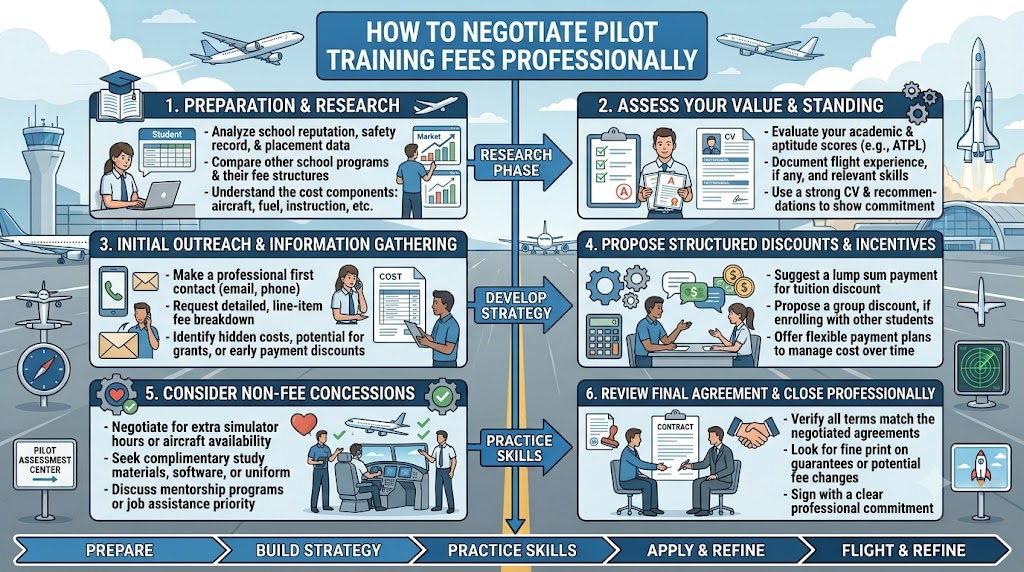
Practical Fee Negotiation Strategy
Step 1: Collect the Complete Fee Breakdown
Before negotiating, request a detailed explanation of all major costs.
Do not rely only on a headline figure.
Step 2: Compare Training Programs
Review multiple training options and compare what each package actually includes.
Look at total expected costs rather than only the initial advertised price.
Step 3: Identify Legitimate Areas for Discussion
Determine whether the training provider offers official discounts, packages, payment plans, or other options.
Step 4: Prepare Professional Questions
Write down your questions before contacting the flight school.
This helps keep the conversation focused and prevents important details from being overlooked.
Step 5: Communicate Respectfully
Explain your financial considerations clearly without making unrealistic demands.
A respectful conversation is more productive than aggressive bargaining.
Step 6: Consider Overall Value
Look beyond price and consider training quality, aircraft availability, instructor support, facilities, scheduling, and the complete training structure.
Step 7: Request Written Confirmation
Before agreeing to revised terms, make sure the final arrangement is documented clearly.
What Students Should Review Before Negotiating
| Fee Area | What to Check | Why It Matters |
|---|---|---|
| Flight hours | Number of hours included and hourly charges | Helps estimate the actual training cost |
| Instructor fees | Whether instructor charges are included | Prevents unexpected expenses |
| Ground training | Classes and materials included | Clarifies what the package covers |
| Simulator charges | Included sessions and additional rates | Helps identify possible extra costs |
| Examination costs | Whether assessments or related fees are included | Provides a clearer financial estimate |
| Administrative fees | Registration and other charges | Helps avoid overlooked expenses |
| Additional training | Cost of extra flight or training hours | Important if more training is required |
| Refund conditions | Cancellation and refund terms | Helps students understand financial risk |
Common Mistakes Students Should Avoid
Focusing Only on the Lowest Price
The cheapest quotation is not automatically the best option.
Students should consider what is included, how clearly the fees are explained, and what additional expenses may arise.
A low initial price can become less attractive if many important services are charged separately.
Negotiating Without Understanding the Fee Structure
Asking for a discount before understanding the costs can lead to an unproductive conversation.
Students should first identify the different components of the fee.
Making Unrealistic Demands
A flight school may have fixed operating expenses that cannot simply be removed.
Demanding a very large discount without understanding those costs is unlikely to produce a useful discussion.
Comparing Incomplete Quotes
One school may quote only a package price, while another may provide a more detailed estimate that includes additional expenses.
These figures cannot be compared fairly without understanding what each includes.
Ignoring Additional Costs
Students sometimes focus heavily on the initial payment and overlook expenses that can arise later.
Additional training, examinations, materials, administration, and other costs should be considered when planning the overall budget.
Relying on Verbal Promises
A verbal discussion can be easily misunderstood.
Important financial arrangements should be documented in writing.
Choosing Training Solely on Price
Pilot training is a major professional investment.
Students should also consider factors such as training quality, aircraft availability, instructor support, maintenance standards, scheduling, and the overall learning environment.
Paying Without Understanding the Agreement
Students should carefully review payment terms, refund policies, cancellation conditions, and other contractual information before making significant financial commitments.
Professional and Less Effective Ways to Discuss Fees
| Less Effective Approach | More Professional Approach |
|---|---|
| “Your fees are too expensive.” | “Could you explain the complete fee structure and what is included?” |
| “Give me a big discount.” | “Are there any officially available discounts or package options?” |
| “Another school is cheaper.” | “I am comparing the total cost structures. Could you help me understand the differences?” |
| “I will pay only this amount.” | “Is there any flexibility in the payment structure?” |
| “I don’t want to pay extra later.” | “Could you explain which additional costs might arise during training?” |
| “Just reduce the price.” | “Are there options that could improve the overall value of the training package?” |
Important Considerations
Negotiating pilot training fees should never mean compromising important aspects of training.
Students should not choose an unsuitable training provider simply because it offers a lower price. Safety, aircraft condition, qualified instruction, appropriate facilities, and compliance with applicable requirements remain important considerations.
Training costs can also change because of factors such as aircraft operating expenses, maintenance, fuel costs, instructor availability, training duration, and additional flight hours.
For this reason, students should avoid assuming that an initial quotation represents the final amount they will necessarily spend.
Another important consideration is affordability over the entire training period.
A student may be able to make an initial payment but struggle with later expenses. Before enrolling, it is better to understand the expected financial commitment and plan accordingly.
Students should also distinguish between an estimated cost and a guaranteed price. If a school provides an estimate, ask what assumptions were used to calculate it.
Finally, professional negotiation should be viewed as a two-way conversation. The purpose is not to pressure a training provider into accepting an unrealistic price. Instead, it is to understand the costs, explore legitimate options, and determine whether the training arrangement is financially suitable.
Frequently Asked Questions
1. Can pilot training fees really be negotiated?
Sometimes. The possibility depends on the flight school’s policies, cost structure, training program, and available financial arrangements. Some fees may be fixed, while other aspects such as payment schedules or existing packages may have more flexibility.
2. What parts of pilot training fees may be negotiable?
Depending on the training provider, students may be able to discuss payment schedules, package structures, existing discounts, or what services are included. However, not every fee will be negotiable.
3. How should I ask a flight school for a discount?
Ask respectfully and directly. For example, you can ask whether the school has any officially available discounts, packages, or payment options for students.
4. Should I compare fees from multiple flight schools?
Yes. Comparing multiple training providers can help students understand whether a quotation is reasonable and what services are included. Compare complete fee structures rather than only advertised prices.
5. What costs should I check before negotiating?
Check flight hours, instructor charges, ground training, simulator sessions, examinations, administrative fees, training materials, additional flight hours, and refund conditions.
6. Is a cheaper pilot training program always better?
No. Price is only one consideration. Students should also evaluate training quality, aircraft availability, instructor support, facilities, scheduling, safety practices, and the overall training structure.
7. Can I negotiate a pilot training payment plan?
You can ask whether payment plans or installment arrangements are available. However, availability and conditions vary between training providers.
8. Why should I get fee agreements in writing?
Written documentation helps clarify the agreed fees, payment schedule, included services, and other financial conditions. It can reduce misunderstandings between the student and training provider.
9. What should I do if a flight school refuses to negotiate?
A refusal to negotiate does not necessarily mean the training provider is unsuitable. Some schools have fixed pricing. You can instead focus on understanding the complete fee structure and comparing the overall value with other legitimate options.
10. What factors should I consider besides training fees?
Consider training quality, aircraft availability, instructor experience and support, facilities, scheduling, maintenance standards, location, additional costs, payment terms, and the overall suitability of the training program.
Conclusion
Negotiating pilot training fees professionally starts with understanding the complete financial picture. Students should know what their training package includes, identify additional costs, compare different programs fairly, and ask clear questions before discussing discounts or payment arrangements.
The most effective approach is not simply to demand a lower price. It is to understand the value being offered and explore legitimate options such as existing discounts, package structures, or payment plans where available.
Students should also remember that cost should never be the only factor when selecting pilot training. Training quality, safety, aircraft availability, instruction, facilities, and long-term affordability deserve equal attention.
A professional negotiation is ultimately about communication and clarity. By researching beforehand, asking sensible questions, remaining respectful, and getting important terms in writing, students can make more informed decisions about one of the most important investments in their aviation journey.

