
Introduction
Choosing a flying school is one of the most important decisions for anyone planning a career in aviation.
Low-cost flying schools can make pilot training more affordable, but a lower price does not always mean better value.
Students should look beyond advertised fees and carefully evaluate training quality, safety, aircraft availability, instructors, and additional expenses.
Understanding common mistakes can help aspiring pilots make a more informed and financially sensible decision.
Why Choosing a Low-Cost Flying School Requires Careful Research
The cost of flight training can be a major concern for aspiring pilots. When comparing schools, students naturally look for affordable options. However, focusing only on the initial price can sometimes lead to unexpected expenses, delays, or compromises in training quality.
A flying school should be evaluated based on its overall value rather than its advertised price. A school with slightly higher fees may provide better aircraft availability, experienced instructors, reliable maintenance, and a more structured training environment. These factors can potentially help students complete their training more efficiently.
Before enrolling, prospective students should understand exactly what is included in the quoted fees and what they may need to pay separately.
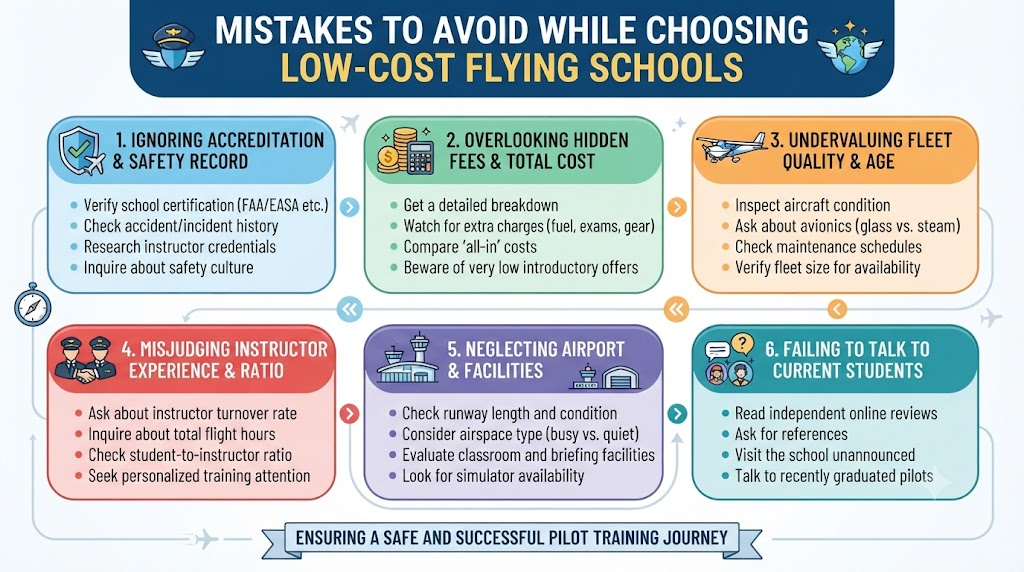
Mistakes to Avoid While Choosing Low-Cost Flying Schools
1. Choosing a School Only Because It Has the Lowest Fees
The cheapest flying school may initially appear attractive, but price alone should never determine your decision.
A very low advertised fee may cover only certain parts of the training. Additional costs for examinations, ground classes, flying hours, accommodation, equipment, administrative services, or extra training may increase the final amount.
Instead of asking only, “Which school is cheapest?” ask, “What will I actually receive for the total amount I am likely to spend?”
2. Ignoring Hidden or Additional Costs
One of the most common mistakes is failing to understand the complete fee structure.
Ask the school for a detailed breakdown of all expected expenses. Find out whether the quoted price includes flight hours, instructor fees, study materials, simulator sessions, examination preparation, registration charges, and other services.
It is also useful to ask what happens if additional flying hours are required to meet training standards.
| Cost Area | What to Check |
|---|---|
| Flight training | Number of flying hours included |
| Ground training | Whether classes are included in the package |
| Simulator | Number and type of simulator sessions |
| Examinations | Registration and examination-related charges |
| Additional hours | Cost if more training is required |
| Accommodation | Whether accommodation is included or separate |
| Equipment | Costs for books, uniforms, headsets, or other equipment |
3. Failing to Check Regulatory Approvals
A flying school should operate under the applicable aviation regulations and maintain the required approvals and certifications.
Students should independently verify the school’s current regulatory status instead of relying only on advertisements or verbal assurances.
Proper authorization is an important part of evaluating whether a school is suitable for formal flight training.
4. Not Checking the Aircraft Fleet
Aircraft are the primary training tools at a flying school, so students should carefully examine the school’s fleet.
Ask about the number of operational aircraft, aircraft types, their availability, and the school’s maintenance arrangements. A school may have a large fleet on paper but fewer aircraft available for students at a particular time.
Limited aircraft availability can contribute to scheduling problems and longer training periods.
5. Ignoring Aircraft Maintenance and Safety Practices
Safety should never be sacrificed to reduce training costs.
Students should understand how the school manages aircraft maintenance, inspections, technical issues, and operational safety. It is reasonable to ask how frequently aircraft undergo required inspections and how technical problems are handled.
A transparent school should be willing to explain its safety and maintenance procedures clearly.
6. Overlooking Instructor Experience
Flight instructors play a major role in a student’s development as a pilot.
Before enrolling, learn about the qualifications, experience, and availability of instructors. Also ask whether students can expect consistent instruction or frequently changing instructors.
An experienced instructor can help students develop sound flying habits, understand procedures, and address areas where additional practice may be required.
7. Not Asking About Aircraft Availability
Even if a school has enough aircraft, students may face difficulties if those aircraft are heavily booked.
Ask how students schedule flights, how often they typically fly, and what happens when a flight is cancelled because of maintenance, weather, or operational issues.
Regular flying opportunities can be important for maintaining continuity in training.
8. Ignoring Training Completion Time
A low-cost school may become expensive if training takes substantially longer than expected.
Delays can increase accommodation, transportation, food, administrative, and additional flying expenses. Therefore, students should ask about the typical training timeline and the factors that can cause delays.
However, students should also be careful about schools promising unrealistically fast completion. Training should progress according to safety, regulatory requirements, and individual student performance.
9. Overlooking Weather and Location
The location of a flying school can influence training opportunities.
Weather conditions, airport traffic, airspace restrictions, and local operating conditions may affect how frequently students can fly. A school in a location with frequent unfavorable weather may experience more interruptions.
Students should research the local flying environment and understand how it could affect their training schedule.
10. Not Researching Student Experiences
Reviews and student experiences can provide useful insight into the actual training environment.
Look for feedback about instructor availability, aircraft scheduling, administrative support, maintenance, communication, and overall student experience.
However, do not rely on one review alone. Compare multiple experiences and consider whether the feedback is recent and relevant.
11. Ignoring Ground School and Simulator Training
Pilot training is not limited to time spent in the aircraft.
Ground school helps students understand subjects such as aviation regulations, meteorology, navigation, aircraft systems, and flight planning. Simulator training can also provide opportunities to practice procedures in a controlled environment.
Ask what type of ground and simulator training is available and whether these services are included in the quoted fees.
12. Failing to Understand Refund and Cancellation Policies
Before paying a substantial amount, carefully read the school’s terms and conditions.
Understand its policies regarding refunds, cancellations, transfers, unused flying hours, postponed training, and other changes. Verbal promises should not replace written terms.
Keeping copies of receipts, agreements, and fee schedules can also help avoid misunderstandings later.
How to Compare Low-Cost Flying Schools Properly
A better approach is to compare several schools using the same criteria rather than selecting the first affordable option.
Consider the complete cost of training, aircraft availability, instructor experience, safety practices, facilities, location, student support, training structure, and career objectives.
| Comparison Factor | Questions to Ask |
| Total cost | What is the estimated overall cost of training? |
| Aircraft | How many training aircraft are operational? |
| Instructors | What are the instructors’ qualifications and experience? |
| Safety | How are aircraft inspections and maintenance managed? |
| Training schedule | How frequently can students expect to fly? |
| Ground school | What subjects and learning resources are provided? |
| Simulator | Is simulator training available and included? |
| Completion timeline | What factors commonly cause training delays? |
| Additional fees | What expenses are not included in the advertised price? |
| Student support | What academic and administrative support is available? |
| Career suitability | Does the training structure match the student’s long-term goals? |
Important Things to Check Before Enrolling
Before making a final decision, students should conduct their own research and ask detailed questions.
Verify the Complete Cost
Do not rely on a single headline price. Request a written fee structure and identify potential additional expenses.
Visit the Training Facility
If possible, visit the school before enrolling. Observe the aircraft, classrooms, briefing facilities, simulator setup, and general training environment.
Speak With Current Students
Current students can sometimes provide practical information about scheduling, instructors, aircraft availability, and day-to-day training conditions.
Check Documentation
Review enrollment agreements, payment terms, refund policies, training requirements, and other important documents before making a major financial commitment.
Evaluate Safety Over Price
Aviation training requires a strong safety culture. A small difference in price should not outweigh concerns about safety, maintenance, or training quality.
Consider Your Long-Term Career Goals
The right school should fit your broader aviation goals. Consider whether its training structure, aircraft, facilities, and support system are appropriate for the type of pilot career you are planning.
Benefits and Limitations of Low-Cost Flying Schools
Low-cost flying schools can provide an attractive option for students who need to manage their training budget carefully. Lower initial fees may make aviation training more accessible and allow students to compare different affordable training options.
However, low cost can sometimes be misleading when important services or expenses are excluded from the advertised price. Training delays, additional flight hours, limited aircraft availability, or unexpected charges can increase the overall cost.
The key is not to assume that every low-cost school is poor or that every expensive school is better. The right decision depends on safety, transparency, training quality, total cost, and suitability for the student’s goals.
Common Mistakes Students Should Avoid
Students can reduce the risk of making a poor decision by remembering a few basic principles:
- Do not select a school based only on the lowest advertised fee.
- Ask for a complete written cost breakdown.
- Verify applicable regulatory approvals.
- Check aircraft availability and maintenance practices.
- Research instructor qualifications and experience.
- Understand the expected training timeline.
- Investigate additional charges.
- Read refund and cancellation policies carefully.
- Compare feedback from multiple students.
- Consider the school’s suitability for your long-term aviation goals.
Frequently Asked Questions
1. Are low-cost flying schools always a bad choice?
No. A low-cost flying school can be a good option if it maintains appropriate safety standards, regulatory compliance, quality training, and transparent fees. The important point is to evaluate the school beyond its price.
2. What should I check before choosing an affordable flying school?
Check regulatory approvals, total training costs, aircraft availability, maintenance practices, instructor qualifications, training facilities, student feedback, scheduling, and refund policies.
3. Can a low advertised fee become much more expensive?
Yes. Additional flying hours, examinations, accommodation, equipment, administrative charges, and other expenses can increase the final cost. Always ask for a complete fee breakdown.
4. How important is aircraft availability?
Aircraft availability is very important because limited access to training aircraft can cause scheduling difficulties and delays. Ask how many aircraft are operational and how students schedule their flights.
5. Should I choose a flying school based only on its fees?
No. Fees are only one factor. Training quality, safety, aircraft condition, instructor experience, facilities, scheduling, and overall value should also be considered.
6. Why should I check the experience of flight instructors?
Instructors directly influence your learning and flying habits. Their qualifications, experience, teaching approach, and availability can have a significant impact on your training experience.
7. Is visiting a flying school before enrollment useful?
Yes. A visit can help you understand the training environment, inspect available facilities, ask questions, and get a better idea of how the school operates.
8. Why are hidden costs important when comparing flying schools?
Hidden or additional costs can significantly change the final training budget. Comparing only the advertised fee may give you an incomplete picture of the actual expense.
9. What role does weather play in flight training?
Weather can affect flight schedules and training opportunities. Students should consider the local climate and typical flying conditions when evaluating a school’s location and expected training timeline.
10. What is the most important factor when choosing a low-cost flying school?
There is no single factor that applies to everyone, but safety, regulatory compliance, training quality, transparent costs, aircraft availability, and suitability for your career goals should receive significant attention.
Conclusion
Choosing a low-cost flying school does not mean choosing the cheapest option available. The real objective should be to find a school that offers reliable training, appropriate safety practices, transparent costs, qualified instructors, and suitable facilities at a reasonable overall expense.
By researching schools carefully, asking the right questions, comparing total costs, and looking beyond advertisements, aspiring pilots can reduce the chances of unexpected expenses and training difficulties. A thoughtful decision at the beginning can make the flight-training journey more organized, practical, and aligned with long-term aviation goals.

