
Introduction
Planning a pilot career requires more than simply deciding to learn how to fly. Aspiring pilots need to understand eligibility, medical requirements, training, licensing, finances, flight experience, and employment preparation.
A well-structured plan can help students make better decisions and avoid unnecessary delays or unexpected expenses.
The pilot career journey can differ depending on the country, aviation authority, training pathway, and individual career goals.
This guide explains the major stages of pilot career planning in a practical and beginner-friendly way.
What Is Pilot Career Planning?
Pilot career planning is the process of creating a realistic pathway from the beginning of aviation education to professional flying and long-term career development.
For a beginner, the journey may involve several stages:
- Understanding different pilot careers
- Checking educational and age eligibility
- Understanding medical requirements
- Selecting a suitable licensing pathway
- Choosing a flight training organization
- Creating a financial plan
- Completing ground and flight training
- Passing required examinations
- Obtaining the appropriate pilot license
- Building flight experience
- Preparing for pilot employment
- Developing additional professional qualifications
Career planning is important because pilot training requires considerable time, effort, and financial commitment. Making major decisions without understanding the complete pathway can create difficulties later.
A good career plan should therefore be flexible. Training progress, finances, regulatory requirements, aircraft availability, personal circumstances, and employment conditions can all affect the timeline.
Why Career Planning Is Important for Aspiring Pilots
A clear plan helps a student understand what needs to happen at each stage of the journey.
Understanding the Complete Career Pathway
Beginners sometimes focus only on obtaining a pilot license. Professional aviation careers can require additional flight experience, qualifications, assessments, and training.
Understanding the complete pathway helps students prepare for these later stages.
Planning Training Expenses
Pilot training can involve many costs beyond basic flying lessons. A financial plan helps students account for training, examinations, licensing, accommodation, transportation, and additional flying hours.
Selecting Suitable Training
Different flight schools can have different aircraft fleets, instructor availability, training schedules, facilities, and fee structures.
Researching these factors before enrollment can help students make a more informed choice.
Setting Realistic Expectations
Aviation careers can be competitive, and completing training does not automatically guarantee employment.
Career planning encourages students to prepare for the transition from training to professional employment while maintaining realistic expectations.
Preparing for Long-Term Development
Pilots continue learning throughout their careers. Recurrent training, additional qualifications, operational experience, and professional development remain important after initial licensing.
Step-by-Step Pilot Career Pathway
Step 1: Understand the Pilot Career
Before investing in training, beginners should understand the different types of professional flying careers.
Potential career directions can include:
- Commercial airline pilot
- Charter pilot
- Corporate pilot
- Cargo pilot
- Flight instructor
- General aviation pilot
- Specialized aviation roles
Each pathway can involve different aircraft, operating environments, qualifications, experience requirements, and career expectations.
A student interested in airline operations may have different long-term goals from someone interested in flight instruction or corporate aviation.
The first step is therefore to identify the type of flying career that best matches the student’s interests, abilities, financial situation, and long-term goals.
Step 2: Check Basic Eligibility
Students should determine whether they meet the requirements for their intended training pathway before making a major financial commitment.
Depending on the country and license, requirements may involve:
- Minimum age
- Educational qualifications
- English-language proficiency
- Identity and documentation requirements
- Medical certification
- Aviation authority requirements
Requirements are not identical everywhere. Students should always verify the current rules of the aviation authority responsible for the license they intend to obtain.
Step 3: Understand Pilot Medical Requirements
Medical eligibility is an important part of pilot career planning.
Students should understand the applicable medical certification requirements before committing significant funds to training.
Depending on the license and aviation authority, medical assessments can consider areas such as:
- Vision
- Hearing
- General physical health
- Medical history
- Other applicable fitness requirements
A student should obtain the appropriate medical assessment through an authorized aviation medical process rather than making assumptions based on general health.
Medical requirements can vary depending on the license and jurisdiction, so current official requirements should be checked.
Step 4: Choose the Appropriate Pilot License Path
Pilot licenses have different privileges and requirements.
Common categories include:
Student Pilot Licence
This is generally associated with the early stage of flight training, subject to the applicable aviation authority’s rules.
Private Pilot Licence
A private pilot license generally provides privileges for private flying rather than professional commercial operations.
Commercial Pilot Licence
A commercial pilot license is an important stage for individuals pursuing professional pilot careers, subject to applicable regulatory requirements.
Airline Transport Pilot Licence
An Airline Transport Pilot Licence represents an advanced professional qualification with requirements that differ according to the relevant aviation authority.
The progression between licenses varies by country. Students should understand which license is appropriate for their intended career and what additional requirements follow each stage.
Step 5: Select a Flight Training School
Choosing a flight school is one of the most important decisions in the training journey.
Students should evaluate more than the advertised course fee.
Important factors include:
- Regulatory approval
- Aircraft fleet
- Aircraft availability
- Instructor availability
- Safety culture
- Ground-school facilities
- Simulator access
- Training schedule
- Maintenance standards
- Location
- Weather conditions
- Training cost
- Student support
- Training records and documentation
A school offering a lower price may not necessarily provide better overall value.
Students should compare the complete training environment and expected total cost before making a decision.
Step 6: Build a Financial Plan
Financial preparation should begin before flight training starts.
A pilot training budget may include:
- Enrollment fees
- Ground school
- Flight hours
- Examination fees
- Medical examinations
- Licensing expenses
- Study materials
- Simulator sessions
- Additional flying hours
- Accommodation
- Transportation
- Food and living expenses
Students should also maintain a financial reserve where possible.
Training can sometimes take longer than initially expected because of weather, aircraft availability, examination schedules, learning progress, maintenance, or other circumstances.
A financial plan should therefore include some flexibility rather than assuming that the initial estimate will always be the final cost.
Step 7: Complete Ground and Flight Training
Pilot training combines theoretical knowledge with practical flying skills.
Ground training may cover subjects such as:
- Aviation regulations
- Aircraft technical knowledge
- Navigation
- Meteorology
- Flight planning
- Radio communication
- Human factors
- Operational procedures
- Emergency procedures
Flight training develops practical skills such as aircraft handling, takeoffs, landings, navigation, communication, decision-making, and response to abnormal situations.
Students should treat both components seriously. Strong practical flying skills require a solid understanding of the theory behind aviation operations.
Step 8: Complete Licensing and Examinations
Students must complete the applicable theoretical examinations, flight training, skill tests, and documentation requirements for their intended license.
The exact process depends on the aviation authority.
Students should maintain organized records of:
- Training progress
- Flight hours
- Examination results
- Medical certification
- Required documents
- Instructor records
- Licensing paperwork
Good documentation can make the administrative side of training easier to manage.
Step 9: Build Flight Experience
Obtaining an initial commercial qualification does not necessarily represent the end of professional development.
Aspiring professional pilots often need to build additional flight experience and develop operational competence.
Depending on the career pathway, experience may be developed through appropriate roles and training opportunities, including flight instruction or other qualifying flying activities.
Students should understand the experience requirements associated with their intended career and plan accordingly.
Step 10: Prepare for Pilot Employment
Career preparation should begin before the final stage of training.
Aspiring pilots should work on:
- A professional resume
- Aviation documentation
- Technical knowledge
- Communication skills
- Interview preparation
- Aviation terminology
- Professional presentation
- Simulator assessment preparation where applicable
- Behavioral interview preparation
Employers can evaluate candidates on more than flight experience. Communication, decision-making, teamwork, professionalism, and technical understanding can also be important.
Hiring standards differ among employers, so students should research the specific requirements of the positions they intend to pursue.
Step 11: Plan Long-Term Career Development
A pilot career involves continuous learning.
Long-term development can include:
- Additional ratings
- Advanced qualifications
- Type-specific training
- Recurrent training
- Operational experience
- Leadership skills
- Continuing education
- Professional networking
- Broader aviation knowledge
Pilots should view professional development as an ongoing process rather than something that ends after receiving an initial license.
Practical Explanation: Creating a Personal Pilot Career Roadmap
A beginner can simplify the career journey into the following sequence:
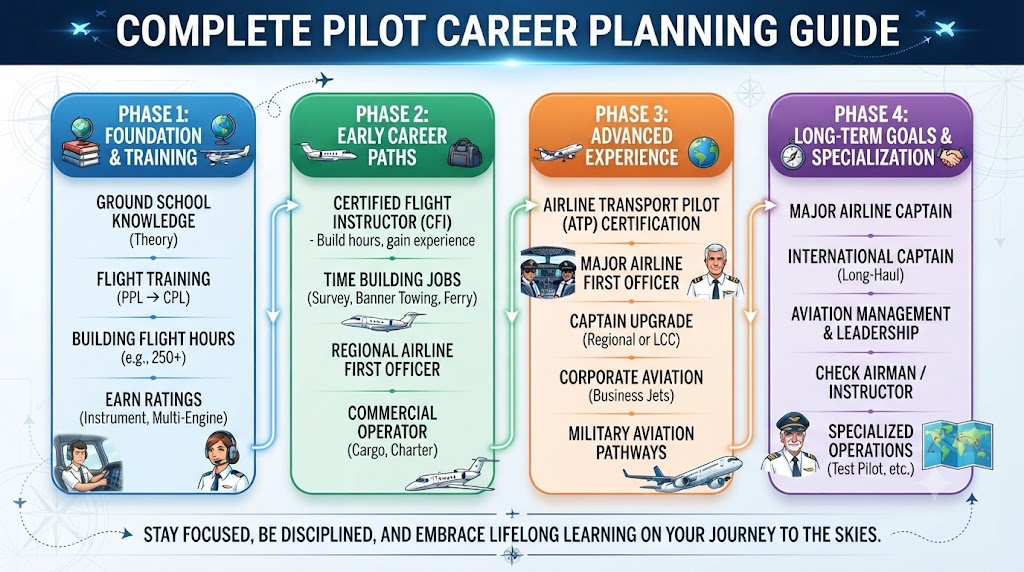
Career Goal → Eligibility → Medical → Training School → Financial Plan → License → Flight Experience → Job Preparation → Career Development
For example, a student interested in becoming a professional airline pilot could first research the applicable licensing pathway and medical requirements.
The student could then compare suitable training organizations, calculate the expected total cost, complete ground and flight training, obtain the required license, build appropriate flight experience, and prepare for airline recruitment processes.
The actual timeline can vary considerably.
Weather, aircraft availability, training progress, examination schedules, finances, regulatory requirements, and employment conditions can all influence the journey.
Therefore, a career roadmap should be treated as a planning framework rather than a guaranteed schedule.
Pilot Career Planning Stages
| Career Stage | Main Objective | Important Considerations | Common Challenge |
|---|---|---|---|
| Career Research | Identify a suitable aviation career | Career goals, interests, lifestyle, requirements | Choosing a path without enough research |
| Eligibility | Confirm basic requirements | Age, education, language, documentation | Missing an important requirement |
| Medical | Determine applicable medical eligibility | Aviation medical standards and certification | Delaying the medical assessment |
| Training Selection | Choose an appropriate training organization | Approval, aircraft, instructors, cost, facilities | Choosing only on price |
| Financial Planning | Estimate complete training expenses | Flight hours, exams, accommodation, additional costs | Underestimating total expenses |
| Flight Training | Develop theoretical and practical skills | Training quality, consistency, progress | Delays or additional training needs |
| Licensing | Meet license requirements | Exams, flight experience, documentation | Incomplete preparation |
| Experience Building | Develop professional flight experience | Career pathway and applicable requirements | Limited initial opportunities |
| Employment Preparation | Prepare for pilot recruitment | Resume, interviews, technical knowledge | Assuming licensing guarantees employment |
| Career Development | Continue professional growth | Additional qualifications and recurrent training | Becoming too dependent on an initial qualification |
Common Mistakes Aspiring Pilots Should Avoid
Starting Training Without Understanding Eligibility
Students should confirm educational, age, language, medical, and regulatory requirements before committing to training.
Ignoring Medical Requirements
Aviation medical requirements can be different from ordinary health assessments. Delaying the appropriate medical process can create unnecessary risk for a student making a major training investment.
Choosing a Flight School Only Because of Price
Price matters, but it should be evaluated alongside aircraft availability, instructor support, training quality, regulatory approval, and expected completion time.
Underestimating Total Training Costs
The initial course price may not include every expense. Additional flying hours, examinations, accommodation, licensing, and living expenses can increase the final amount.
Failing to Maintain a Financial Reserve
Unexpected training requirements can create financial pressure. Students should plan for the possibility that training may take longer than originally expected.
Assuming Training Automatically Leads to Employment
A pilot license is an important qualification, but employment depends on many factors, including experience, employer requirements, market conditions, and individual performance.
Not Researching Licensing Requirements
Students should understand the requirements of the aviation authority under which they intend to train and qualify.
Ignoring Communication Skills
Professional pilots need to communicate clearly with other pilots, air traffic services, cabin crew, dispatch personnel, and other aviation professionals.
Neglecting Theoretical Knowledge
Practical flying skills and theoretical knowledge support each other. Weak understanding of aviation subjects can affect both training and professional performance.
Failing to Maintain Training Records
Accurate records are important throughout flight training and later career stages.
Not Preparing for Interviews
Technical knowledge alone may not be sufficient during recruitment. Students should also practice communication, teamwork, decision-making, and behavioral interview questions.
Having No Financial or Career Backup Plan
Aviation careers can involve changing conditions and unexpected delays. A realistic backup plan can help students manage uncertainty.
How to Choose the Right Pilot Career Path
There is no single pilot career path that is perfect for every student.
Before choosing a direction, students should consider several factors.
Personal Interests
Someone who enjoys teaching may eventually find flight instruction attractive, while another student may prefer airline, corporate, cargo, or charter operations.
Career Goals
The intended type of flying should influence training and qualification decisions.
Financial Resources
Students should choose a pathway that is financially realistic rather than relying on optimistic assumptions about future income.
Training Requirements
Different career paths can require different qualifications and experience.
Lifestyle Expectations
Professional flying can involve irregular schedules, travel, relocation, and extended periods away from home. Students should understand the lifestyle associated with their preferred career.
Geographic Preferences
Some careers may require relocation or access to particular aviation markets.
Long-Term Goals
Students should consider where they want their career to progress after the first professional flying position.
Pilot Career Directions
| Pilot Career Direction | Typical Focus | Skills to Develop | Important Consideration |
| Airline Pilot | Scheduled passenger operations | Technical knowledge, teamwork, communication, decision-making | Recruitment standards can be competitive |
| Charter Pilot | On-demand passenger operations | Adaptability, planning, customer awareness | Operations can vary significantly |
| Corporate Pilot | Business aviation | Professionalism, flexibility, operational awareness | Schedules and operating environments can vary |
| Cargo Pilot | Freight operations | Procedures, planning, operational discipline | May involve irregular schedules |
| Flight Instructor | Teaching and flight training | Communication, instructional ability, patience | Requires appropriate qualifications |
| General Aviation Pilot | Diverse non-airline flying | Aircraft handling, planning, situational awareness | Career opportunities vary by market |
| Specialized Pilot Roles | Specific aviation operations | Role-specific technical and operational skills | Additional training may be required |
Important Considerations Before Starting Pilot Training
Medical Eligibility
Medical requirements should be investigated early. Students should use the appropriate aviation medical process for their intended license.
Educational Preparation
Strong foundations in mathematics, physics, English, and general science can be useful for understanding aviation subjects, although exact educational requirements vary.
Regulatory Requirements
Aviation rules differ between jurisdictions. Students should consult the applicable aviation authority for current licensing and training requirements.
Financial Readiness
Students should understand both direct training expenses and indirect living costs.
Training School Selection
The quality and reliability of a training organization can affect the overall experience and progress.
Career Expectations
Students should avoid making career decisions based on exaggerated salary figures or assumptions of guaranteed employment.
Family and Personal Support
Pilot training can require significant time and financial commitment. Students should understand how the training schedule may affect their personal circumstances.
Geographic Considerations
Training away from home can create additional accommodation, transportation, and living expenses.
Time Commitment
Flight training requires regular practice and theoretical study. Students should be prepared to dedicate consistent time to the process.
Backup Planning
A backup financial and career plan can help students manage unexpected delays or changes in circumstances.
Long-Term Professional Development
Students should think beyond the first license and consider how they will continue developing their qualifications and experience.
Skills Aspiring Pilots Should Develop
Communication
Clear communication is essential in aviation. Pilots must exchange information accurately and efficiently with multiple aviation professionals.
Decision-Making
Pilots regularly evaluate information, identify risks, and make operational decisions.
Situational Awareness
Understanding what is happening around the aircraft is an essential part of safe and effective flight operations.
Discipline
Aviation involves procedures, checklists, regulations, and recurrent training. Professional discipline is therefore fundamental.
Time Management
Pilots need to manage preparation, flight schedules, documentation, rest requirements, and other responsibilities effectively.
Teamwork
Modern aviation depends heavily on coordination between flight crews and other operational teams.
Technical Knowledge
Pilots need a strong understanding of aircraft systems, performance, weather, navigation, regulations, and operational procedures.
Problem-Solving
Unexpected situations require pilots to evaluate information and choose appropriate actions.
Leadership
As pilots progress in their careers, leadership and crew coordination become increasingly important.
Continuous Learning
Aviation technology, procedures, regulations, and operational practices can change. Professional pilots need to continue learning throughout their careers.
Financial Planning for a Pilot Career
Financial planning should cover the entire training journey rather than just the enrollment stage.
A student can begin by listing all expected expenses and separating them into categories.
Fixed Expenses
These may include certain enrollment, administrative, or course-related charges.
Variable Expenses
Flight hours and other training expenses can vary depending on progress and individual requirements.
Living Expenses
Accommodation, food, transportation, and other personal expenses should be included when training requires relocation.
Additional Training
Students should allow for the possibility of additional flying or simulator sessions.
Emergency Reserve
Unexpected delays or expenses can occur during training. Maintaining a reasonable financial reserve can make such situations easier to manage.
A useful approach is to calculate the expected total cost and then add a realistic contingency rather than assuming the initial estimate will never change.
Students considering financing should also understand the complete repayment obligation before accepting any loan or payment arrangement.
Pilot Career Planning Checklist
- Define the preferred pilot career direction
- Research the applicable aviation authority
- Check age and educational requirements
- Understand English-language requirements
- Investigate the appropriate medical certification
- Research the required pilot license
- Compare suitable flight training organizations
- Check aircraft and instructor availability
- Estimate complete training expenses
- Plan accommodation and living costs if required
- Maintain a financial reserve
- Complete ground training
- Complete required flight training
- Prepare for applicable examinations
- Maintain accurate training records
- Complete licensing requirements
- Build appropriate flight experience
- Prepare a professional aviation resume
- Practice pilot interview skills
- Research employer-specific requirements
- Plan long-term professional development
Benefits and Limitations of Proper Pilot Career Planning
Benefits
Proper career planning can provide several advantages.
Better Financial Preparation
Students can understand expected expenses before making major financial commitments.
Clearer Career Direction
Researching different pilot roles can help students choose a pathway that fits their goals.
Better Training Decisions
Students who understand their long-term objectives can evaluate training organizations more effectively.
Reduced Uncertainty
A structured plan can make the overall journey easier to understand.
Better Employment Preparation
Starting resume, technical, and interview preparation early can help students become more prepared for recruitment.
Stronger Professional Development
A long-term plan encourages continuous learning beyond the initial license.
Limitations
Career planning cannot eliminate every uncertainty.
Career Conditions Can Change
Employment conditions, airline recruitment, aviation activity, and economic factors can change over time.
Training Timelines Can Vary
Weather, maintenance, aircraft availability, instructor availability, examinations, and individual learning progress can affect completion time.
Costs May Increase
Additional training and unexpected expenses can increase the final cost.
Additional Training May Be Required
Not every student progresses at exactly the same rate.
Employment Is Not Guaranteed
Completing a pilot qualification does not automatically guarantee employment.
Regulations Can Change
Aviation authorities can update licensing and operational requirements.
Individual Circumstances Matter
Financial resources, location, academic preparation, medical eligibility, and personal goals can all influence career progression.
FAQs
1. What is pilot career planning?
Pilot career planning is the process of organizing the education, medical, training, licensing, financial, experience-building, employment, and professional-development stages of a pilot career.
2. What should I do before starting pilot training?
Before starting, research your intended career, verify eligibility requirements, understand the applicable medical requirements, investigate licensing pathways, compare training organizations, and create a realistic financial plan.
3. Which pilot license should a beginner pursue?
The appropriate license depends on the student’s career objective and applicable aviation authority. Beginners should understand the progression from initial training toward the qualifications required for their intended professional role.
4. How important is the pilot medical examination?
It is an important part of career planning because medical certification may be required for pilot training and licensing. Students should understand the applicable requirements and complete the appropriate aviation medical process early.
5. How should I choose a flight training school?
Consider regulatory approval, aircraft availability, instructors, training facilities, safety culture, schedule reliability, location, total cost, and student support rather than focusing only on the advertised price.
6. How can I plan the cost of pilot training?
Start by listing flight training, ground school, examinations, medicals, licensing, study materials, simulator sessions, accommodation, transportation, living expenses, and possible additional flying hours. A financial reserve should also be considered.
7. Does completing commercial pilot training guarantee an airline job?
No. A commercial pilot qualification is an important professional milestone, but employment depends on employer requirements, experience, recruitment conditions, market conditions, and individual performance.
8. What skills should aspiring pilots develop?
Important skills include communication, decision-making, situational awareness, discipline, teamwork, technical knowledge, problem-solving, time management, leadership, and continuous learning.
9. How can I prepare for a pilot interview?
Build strong aviation knowledge, understand your training history, practice technical and behavioral questions, improve communication, prepare a professional resume, and research the employer’s stated requirements.
10. How can I build a long-term pilot career plan?
Start with a clear career goal, identify the required licenses and experience, create a financial plan, complete training systematically, build relevant experience, prepare for employment, and continue developing professional qualifications throughout your career.
Conclusion
A complete pilot career plan should cover much more than flight lessons. Aspiring pilots need to consider eligibility, medical certification, education, licensing, training quality, finances, flight experience, employment preparation, and long-term professional development.
The most effective approach is to divide the journey into manageable stages and evaluate each stage carefully. Students should research current aviation requirements, compare training options based on overall value, prepare financially, and maintain realistic expectations about career progression.
Pilot careers can be rewarding, but they also require discipline, continuous learning, financial planning, and professional commitment. By creating a realistic career roadmap before and during training, beginners can make better-informed decisions and prepare themselves for the demands of professional aviation.

