
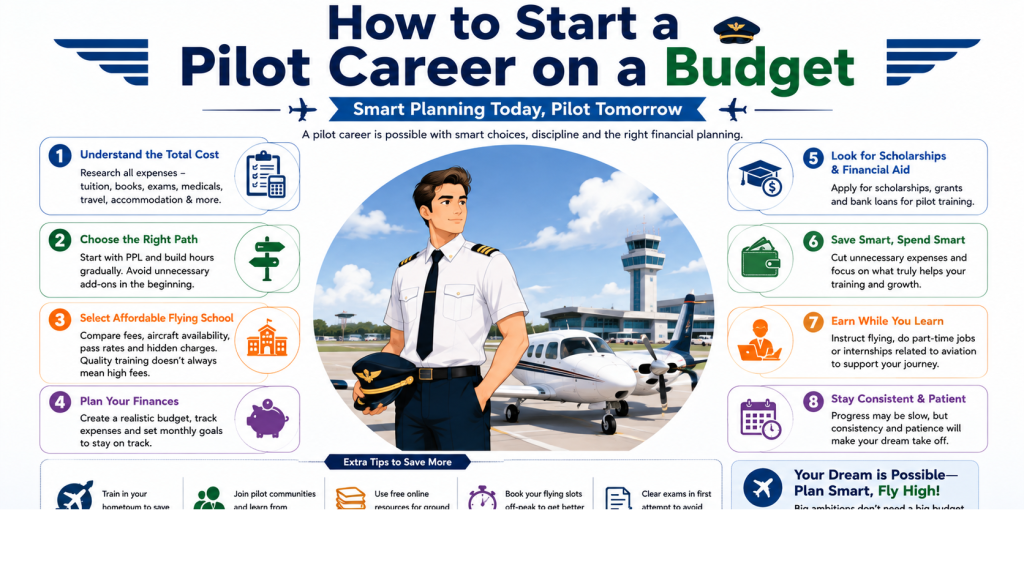
Introduction
Starting a pilot career requires careful planning because flight training can involve significant educational and practical expenses.
However, a limited budget does not necessarily mean that an aspiring pilot cannot begin working toward an aviation career.
Smart financial planning, proper research, and consistent training can help reduce unnecessary expenses along the journey.
This guide explains practical ways to start a pilot career while managing costs responsibly and realistically.
Understanding the Cost of Becoming a Pilot
Becoming a pilot involves more than paying for flying lessons. Students should understand the full range of expenses before beginning their training journey.
Common expenses may include educational preparation, aviation medical examinations, ground school, flight training, examinations, licensing requirements, accommodation, transportation, study materials, and personal living costs.
The total cost can vary significantly depending on the country, training route, aircraft type, flying school, regulatory requirements, and career goal.
One of the most important financial mistakes is focusing only on the advertised training fee. Students should instead calculate the complete expected cost of reaching their desired qualification.
A realistic financial plan helps aspiring pilots avoid unexpected interruptions during training.
Set a Realistic Career Goal
Before spending money on pilot training, students should clearly understand their career objective.
Different aviation careers have different training requirements. For example, someone interested in recreational flying may follow a different path from a student planning to become a commercial airline pilot.
Possible career directions include:
- Private pilot
- Commercial pilot
- Airline pilot
- Flight instructor
- Charter pilot
- Cargo pilot
- Agricultural pilot
- Corporate aviation pilot
Each path can require different licenses, ratings, flight hours, and additional qualifications.
Defining a realistic goal helps students avoid paying for training that may not be necessary for their intended career path.
Research Training Requirements Before Spending Money
Thorough research should happen before making a major financial commitment.
Students should understand the eligibility requirements for their chosen pilot training path. These requirements may involve educational qualifications, age limits, medical fitness, language proficiency, examinations, and minimum flight experience.
Medical eligibility is especially important. Completing the appropriate medical assessment early can help students understand whether they meet the required standards before investing heavily in training.
Students should also understand the sequence of licenses and qualifications required for their career goal.
Creating a clear training roadmap can prevent confusion and unnecessary spending later.
Major Expenses to Plan For
| Expense Category | What It May Include | Practical Cost-Control Approach |
|---|---|---|
| Medical Requirements | Aviation medical examinations and assessments | Complete required checks early and understand the standards |
| Ground Training | Aviation theory, classes, and study materials | Build strong self-study habits and prepare consistently |
| Flight Training | Aircraft rental, instructor time, and practical lessons | Train regularly and arrive well prepared for each lesson |
| Examinations | Written, practical, and licensing assessments | Study thoroughly to reduce the risk of repeated attempts |
| Accommodation | Housing during training | Compare suitable living options and manage monthly expenses |
| Transportation | Travel to the training location | Choose practical transportation and plan travel efficiently |
| Study Materials | Books, charts, equipment, and learning resources | Buy only essential and approved materials |
| Personal Expenses | Food, communication, and daily living costs | Maintain a realistic monthly budget |
Create a Detailed Budget Plan
A pilot career should be approached with a long-term financial plan.
Start by listing all expected expenses rather than focusing only on the initial enrollment cost. Divide expenses into categories such as training, examinations, accommodation, transportation, and personal costs.
It is also useful to separate essential expenses from optional purchases.
Students should consider maintaining an emergency fund because unexpected delays can occur during training. Weather conditions, aircraft maintenance, scheduling issues, and personal circumstances can sometimes affect the training timeline.
A budget should be reviewed regularly and adjusted when circumstances change.
The goal is not simply to spend as little as possible. The goal is to spend money efficiently while maintaining training quality and safety.
Compare Flying Schools Carefully
Choosing a flying school based only on the lowest advertised fee can create problems later.
A lower initial price may not include all training costs. Students should carefully understand what is included and what may require additional payment.
Important factors to compare include:
- Aircraft availability
- Aircraft maintenance standards
- Instructor availability
- Student-to-instructor ratio
- Training scheduling
- Safety culture
- Weather conditions
- Accommodation costs
- Training delays
- Additional charges
- Overall training consistency
A school with slightly higher costs but reliable aircraft and consistent scheduling may sometimes be more cost-effective than a cheaper option with frequent delays.
Students should focus on the complete training experience rather than only the initial price.
Choose a Cost-Effective Training Path
A cost-effective training path is not necessarily the cheapest option.
The best approach is one that helps students complete required training efficiently without compromising safety or quality.
Before enrolling, understand the complete sequence of training. Avoid changing plans repeatedly because switching between different training routes can sometimes create additional expenses.
Students should also avoid paying for unnecessary courses or qualifications that do not support their immediate career goal.
A structured roadmap helps maintain focus and improves financial decision-making.
Manage Living and Daily Expenses
Daily living expenses can become a significant part of the total cost, especially during long training programs.
Students can manage these costs by creating a monthly spending plan.
Practical approaches may include:
- Choosing affordable but suitable accommodation
- Preparing meals when practical
- Using economical transportation
- Avoiding unnecessary subscriptions
- Tracking monthly spending
- Sharing suitable accommodation where appropriate
- Planning purchases before spending
Small daily expenses may seem insignificant, but they can become substantial over a long training period.
Financial discipline outside the cockpit can support financial stability during flight training.
Plan Flight Training Efficiently
Consistency is one of the most important factors in controlling pilot training costs.
Long gaps between flying lessons can reduce skill retention. When students return after extended breaks, they may need additional practice to regain confidence and proficiency.
Regular training helps students build skills progressively.
Preparation before each lesson is equally important. Students should review procedures, understand the lesson objectives, and study relevant theory before arriving for practical training.
Better preparation can make flight time more productive.
Students should respect the importance of quality instruction and should never rush through training simply to reduce costs. Safety and competence must remain the highest priorities.
Explore Financial Planning Options
Aspiring pilots can explore different methods of organizing their training finances.
Possible options may include:
- Personal savings
- Family support
- Educational scholarships where available
- Education financing options
- Phased training plans
- Part-time work where compatible with training requirements
- Long-term savings strategies
Every financial option should be evaluated carefully based on personal circumstances.
Students should understand repayment responsibilities and long-term financial commitments before accepting any form of financing.
A realistic plan is generally more sustainable than relying on uncertain future income.
Build Aviation Knowledge Before Expensive Flight Hours
One practical way to improve training efficiency is to develop a strong theoretical foundation before beginning intensive flight training.
Students can study subjects such as:
- Basic aerodynamics
- Aviation meteorology
- Air navigation
- Aircraft systems
- Aviation regulations
- Flight planning
- Aviation communication principles
Strong theoretical preparation can help students understand practical lessons more effectively.
When students already understand the purpose of a maneuver or procedure, they may be able to use practical training time more efficiently.
However, theoretical preparation should complement professional instruction rather than replace it.
Avoid Unnecessary Expenses
Aspiring pilots can sometimes spend money on items that provide little value during the early stages of training.
Before making a purchase, students should ask whether the item is essential for their current stage of training.
It is important to distinguish between useful equipment and unnecessary purchases.
Students should also avoid repeatedly changing training plans without a clear reason. Frequent changes in location, school, or career direction can create additional financial pressure.
A disciplined approach to spending helps preserve resources for the most important parts of pilot development.
Smart Cost-Saving Decisions vs Risky Cost-Cutting Decisions
| Smart Cost-Saving Decision | Risky Cost-Cutting Decision |
|---|---|
| Creating a complete budget before training | Starting training without understanding total costs |
| Comparing schools based on quality and consistency | Choosing a school only because it has the lowest fee |
| Studying theory before practical lessons | Skipping important preparation |
| Training consistently to maintain skills | Taking long gaps that reduce proficiency |
| Managing accommodation and daily expenses | Ignoring regular spending and financial discipline |
| Completing medical requirements early | Investing heavily before understanding medical eligibility |
| Buying essential training materials | Purchasing expensive but unnecessary equipment |
| Planning finances for possible delays | Assuming training will always follow the shortest timeline |
| Selecting safe and reliable training | Compromising safety to save money |
Common Mistakes Students Should Avoid
Choosing a School Based Only on the Lowest Fee
A low advertised price does not always represent the complete cost of training. Students should examine training quality, aircraft availability, instructor support, and possible additional charges.
Ignoring Hidden Costs
Expenses such as examinations, accommodation, transportation, study materials, and repeated training sessions should be included in the budget.
Starting Without a Complete Financial Plan
Running out of funds during training can create long interruptions. A detailed financial plan can help students prepare for expected and unexpected expenses.
Creating Long Gaps Between Flying Lessons
Extended breaks may affect skill retention and lead to additional practice requirements when training resumes.
Ignoring Medical Eligibility
Students should understand medical requirements early. Discovering a medical limitation after making significant financial commitments can create serious difficulties.
Overspending on Unnecessary Items
Expensive accessories and non-essential equipment should not take priority over essential training expenses.
Failing to Compare Training Programs
Students should compare the complete structure and quality of different programs rather than making decisions based on advertisements or assumptions.
Important Considerations Before Choosing the Cheapest Option
Affordability is important, but the cheapest training option is not automatically the best choice.
Pilot training involves safety-critical skills. Aircraft condition, maintenance standards, instructor quality, regulatory compliance, and training consistency should never be compromised.
Students should consider whether a low-cost option may create delays or require additional spending later.
Reliable scheduling can also have financial value. If aircraft or instructors are frequently unavailable, students may face accommodation expenses while waiting for training opportunities.
The most sensible decision is usually based on overall value rather than the lowest initial price.
A good training environment should support safety, consistent learning, proper instruction, and efficient progress.
Practical Budget Planning Tips for Aspiring Pilots
Start by identifying your final career objective and understanding the training required to reach it.
Create a written financial plan that includes both major training costs and regular living expenses.
Track spending every month and compare actual expenses with your original budget.
Prepare for possible delays rather than assuming that every stage will be completed immediately.
Study aviation theory seriously before and during practical training so that flight lessons can be used effectively.
Avoid unnecessary purchases and focus financial resources on essential qualifications and training.
Review your progress regularly and adjust your financial plan when necessary.
Most importantly, never compromise safety, medical requirements, or training quality simply to reduce costs.
Developing a Long-Term Career Mindset
Starting a pilot career requires patience as well as financial discipline.
Students should avoid making decisions based only on short-term savings. A career in aviation involves continuous learning, additional qualifications, recurrent training, and professional development.
Building strong study habits and responsible financial habits from the beginning can help students manage future career requirements more effectively.
A budget should support career progress rather than become a reason to rush through important training.
The strongest approach is to combine realistic financial planning with consistent skill development.
FAQs
1. Can I start a pilot career with limited financial resources?
Yes, it is possible to begin planning and preparing for a pilot career with limited financial resources. Careful budgeting, phased planning, savings, and exploring available financial support options can help, depending on individual circumstances.
2. What is usually the biggest expense in pilot training?
Flight training is often one of the largest expenses because it involves aircraft operation, fuel, maintenance, instructor time, and practical flight hours.
3. Should I complete a medical examination before joining a flying school?
Understanding and completing the appropriate aviation medical requirements early is generally an important step before making major financial commitments.
4. Is choosing the cheapest flying school always a good idea?
No. Students should consider safety, aircraft maintenance, instructor availability, training quality, and possible delays rather than focusing only on the lowest fee.
5. How can training delays increase pilot training costs?
Delays can increase accommodation and living expenses and may also affect skill retention, potentially requiring additional practice.
6. Can scholarships help aspiring pilots?
Scholarships or educational support opportunities may be available in some locations and organizations. Students should research eligibility requirements carefully.
7. How should students prepare financially before training?
Students should calculate expected training expenses, living costs, examination fees, and possible unexpected costs before beginning their program.
8. Can studying aviation theory reduce practical training expenses?
Strong theoretical preparation can help students understand practical lessons more efficiently, although it does not replace required professional flight instruction.
9. Should students take long breaks to save money during training?
Long gaps can affect skill retention and may result in additional training requirements. A consistent schedule is often more efficient when financially possible.
10. Is it possible to reduce pilot training costs without compromising safety?
Yes. Students can control unnecessary expenses, plan training efficiently, prepare thoroughly, and manage living costs while maintaining proper safety and training standards.
Conclusion
Starting a pilot career on a budget requires realistic planning, disciplined spending, and careful decision-making. Aspiring pilots should understand the complete cost of training, define clear career goals, research requirements early, and avoid unnecessary financial commitments. Consistent flight training and strong theoretical preparation can also help students use their resources more efficiently. While reducing unnecessary costs is important, safety, medical eligibility, instructor quality, and training standards should never be compromised. With patience and a structured financial plan, aspiring pilots can take practical steps toward building a successful aviation career.

