
Introduction
Choosing aviation as a career can be exciting, but the admission process can seem confusing for students who are just starting. Different aviation courses and institutions may follow different entrance tests, eligibility rules, and selection procedures.
For students in India, understanding these requirements early can make the admission process much easier. It also helps students avoid preparing for the wrong examination or overlooking important eligibility conditions.
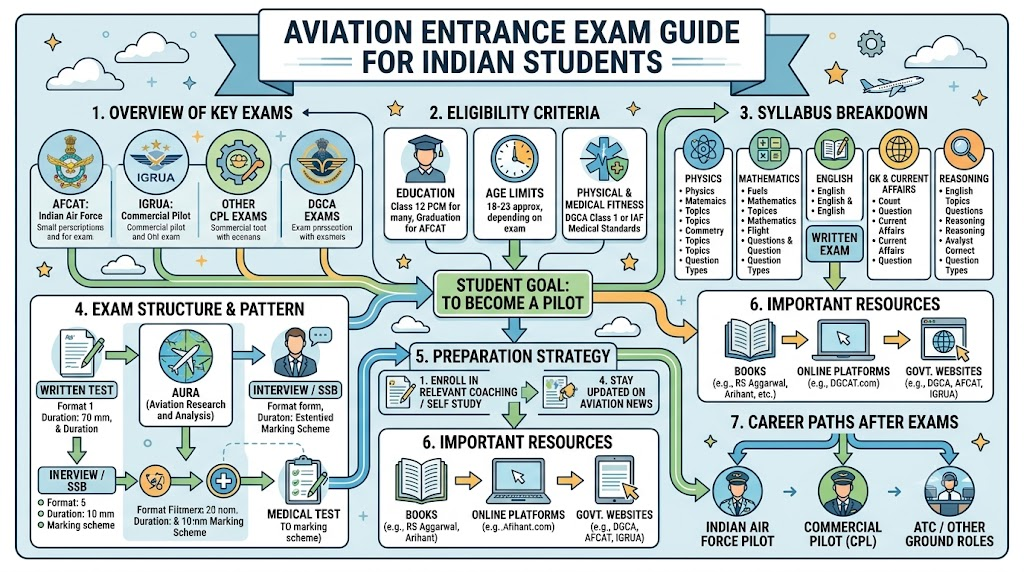
This guide explains aviation entrance exams, common subjects, eligibility, preparation methods, exam patterns, and important factors students should consider before applying.
Understanding Aviation Entrance Exams
An aviation entrance exam is a test used by some educational institutions or training organizations to assess students before admission to an aviation-related course or program.
The purpose of such an examination can vary. An institution may use it to assess academic knowledge, logical thinking, English proficiency, numerical ability, or general aptitude. Some universities may have their own admission examinations, while others may use broader university-level entrance processes.
Students should understand one important point: there is no single entrance examination that applies to every aviation course in India.
A student applying for a B.Sc. Aviation program may face a different admission process from someone applying directly for commercial pilot training. Similarly, an aviation management course can have requirements that are different from those of a flight-training program.
Entrance examinations should also not be confused with examinations associated with obtaining a pilot licence. Academic or institute-level admission tests and regulatory requirements serve different purposes.
Before preparing, students should therefore identify their exact course, institution, and career pathway.
Which Aviation Courses May Require Entrance Tests?
Entrance requirements depend on the institution and program. Students may encounter entrance tests or selection assessments when applying for several aviation-related courses.
Commercial Pilot Licence Training
Students planning to become commercial pilots may apply to flight-training organizations through an admission or selection process. Depending on the organization, this may involve written assessments, aptitude tests, interviews, or other screening procedures.
The admission test is different from the regulatory examinations and requirements involved in obtaining a pilot licence.
B.Sc. Aviation
Several institutions offer undergraduate aviation programs. Admission may involve an institutional test, a university admission process, or another recognized entrance mechanism.
Students should check whether the selected college has a separate examination and whether Class 12 subjects such as Mathematics and Physics are required.
Aviation Management
Aviation management programs focus more on airport operations, airline management, aviation business, logistics, and related areas. Their entrance requirements can differ significantly from pilot-training programs.
Aeronautical and Aerospace Programs
Students interested in aircraft design, aerospace engineering, propulsion, or related technical fields may apply through engineering or university-level admission pathways. These should not automatically be treated as pilot-training entrance examinations.
Aircraft Maintenance-Related Programs
Aircraft maintenance education also follows its own academic and regulatory framework. Students should carefully check the specific course requirements rather than assuming that the admission process is the same as pilot training.
Common Subjects Covered in Aviation Entrance Exams
The subjects included in an aviation entrance examination depend on the institution. However, students may encounter areas such as Mathematics, Physics, English, reasoning, aptitude, and general awareness.
Mathematics
Mathematics questions may test basic concepts, calculations, percentages, ratios, algebra, geometry, equations, and numerical reasoning.
A strong mathematical foundation can also help students later when studying aviation-related subjects.
Physics
Physics is particularly relevant to students interested in flight training and technical aviation education. Questions may cover areas such as motion, forces, energy, pressure, measurements, and basic mechanics.
Students should focus on understanding concepts rather than simply memorizing formulas.
English
English may be assessed through grammar, vocabulary, reading comprehension, sentence formation, and related skills.
Good English communication is valuable in aviation because students and aviation professionals regularly work with technical information, instructions, procedures, and communication systems.
Aptitude and Logical Reasoning
Aptitude sections can examine numerical ability, patterns, problem-solving, analytical thinking, and logical reasoning.
These questions often require students to reach an answer within a limited amount of time.
General Knowledge
Some entrance assessments may include general awareness or current-affairs questions. However, students should not assume that every aviation entrance examination includes this section.
The safest approach is to study the actual syllabus and examination pattern provided by the institution.
Eligibility Requirements for Indian Students
Eligibility varies according to the course and institution. Students should never rely only on a general eligibility rule when applying.
For aviation and pilot-training pathways, common areas to check include:
- Class 12 or equivalent qualification
- Required subjects
- Mathematics and Physics requirements where applicable
- Minimum qualifying marks
- Minimum or maximum age conditions, where applicable
- Medical requirements for pilot-training pathways
- Institution-specific admission conditions
- Citizenship or residency conditions, where applicable
For students interested in becoming pilots, academic eligibility is only one part of the overall pathway. Medical assessment and regulatory requirements can also be important.
A student who is planning pilot training should therefore understand the complete pathway before committing significant time or money to a course.
Entrance Exam Pattern and Question Types
There is no universal aviation entrance exam pattern. The structure can vary from one institution to another.
A typical assessment may contain multiple-choice questions, numerical problems, reasoning questions, English questions, or subject-based questions.
For example, a Mathematics section may require a student to solve a numerical problem within a short time. A Physics section may test whether the student understands a basic principle rather than whether they can reproduce a definition.
English questions may include reading comprehension or sentence-based questions, while aptitude sections may involve logical patterns or numerical relationships.
Time management can therefore be just as important as subject knowledge.
Students should obtain the latest official syllabus and examination instructions before creating their preparation plan.
How to Prepare for an Aviation Entrance Exam
Good preparation does not necessarily mean studying for long hours every day. A structured approach is usually more effective.
1. Understand the Syllabus
Start by identifying the exact subjects and topics included in the examination.
Do not prepare from a generic aviation syllabus when the institution has published its own examination pattern.
2. Check Official Admission Requirements
Review the latest information about eligibility, application procedures, examination dates, required documents, and selection stages.
Admission requirements can change, so older information found online may not always apply to the current admission cycle.
3. Strengthen Mathematics and Physics
If the examination includes these subjects, revise fundamental concepts first.
Students should understand formulas, units, basic calculations, graphs, mechanics, and other relevant topics rather than relying entirely on memorization.
4. Improve English Skills
Read English articles, practice comprehension passages, revise grammar, and build vocabulary.
Regular reading can improve both speed and understanding.
5. Practice Aptitude and Reasoning
Aptitude improves with regular practice. Solve different types of numerical and logical questions and identify the areas where you repeatedly make mistakes.
6. Take Timed Mock Tests
Mock tests help students understand how they perform under examination pressure.
After each test, review incorrect answers and identify whether the problem was caused by a lack of knowledge, careless calculation, or poor time management.
7. Create a Revision Schedule
Instead of studying every subject randomly, divide preparation into manageable sessions.
A simple weekly plan can include subject revision, practice questions, mock tests, and revision of previously difficult topics.
8. Prepare Documents Early
Admission processes may require educational certificates, identification documents, photographs, medical documentation, or other records.
Preparing these in advance can prevent last-minute problems.
Aviation Entrance Exam Preparation Timeline
Students can adjust their preparation according to the examination date, but a basic timeline can look like this:
3–6 Months Before the Exam
Build strong fundamentals in Mathematics, Physics, English, and aptitude if these subjects are part of the examination.
Use this stage to identify weak areas rather than focusing only on completing large numbers of questions.
2–3 Months Before the Exam
Increase practice and begin taking regular mock tests.
Start tracking the questions you get wrong and revise those topics systematically.
One Month Before the Exam
Focus more on revision, timed practice, and mock examinations.
Avoid constantly adding new study materials. A smaller set of reliable resources can make revision easier.
Final Week
Review important concepts, formulas, vocabulary, and commonly repeated mistakes.
Maintain a regular sleep schedule and avoid excessive last-minute studying.
Exam Day
Read the instructions carefully, manage your time, and avoid spending too long on one difficult question.
If the examination allows students to return to unanswered questions, use that option strategically.
What Students Should Prepare
| Area | What Students Should Prepare | Practical Tip |
|---|---|---|
| Mathematics | Basic calculations, algebra, ratios, percentages and relevant concepts | Practice regularly under time limits |
| Physics | Fundamental concepts, formulas and numerical applications | Focus on understanding before memorizing |
| English | Grammar, vocabulary and comprehension | Read regularly to improve speed |
| Aptitude | Numerical and analytical problem-solving | Practice different question types |
| Reasoning | Patterns, logic and analytical questions | Review mistakes after every practice session |
| General Awareness | Relevant current and general knowledge if included | Follow the actual examination syllabus |
Common Mistakes Students Should Avoid
Preparing Without Checking the Syllabus
One of the most common mistakes is preparing for an examination based on information from another institution.
Entrance examinations can differ considerably. Always start with the current requirements of the institution where you intend to apply.
Ignoring Mathematics and Physics Fundamentals
Students sometimes concentrate on aptitude questions while neglecting academic subjects.
For aviation-related pathways, a solid understanding of Mathematics and Physics can be valuable both for entrance preparation and later studies.
Depending Entirely on Memorization
Aviation education involves concepts and practical applications. Students should develop understanding rather than memorize answers without knowing how they work.
Not Practicing Under Time Limits
Knowing the answer is not enough if a student takes too long to solve every question.
Timed practice helps students improve both speed and accuracy.
Ignoring English
Students may focus heavily on technical subjects and overlook English. Strong comprehension and communication skills are important throughout aviation education.
Confusing Entrance Tests With DGCA Examinations
An institute-level entrance test is not necessarily the same as a regulatory examination associated with pilot licensing.
Understanding this distinction can prevent considerable confusion during career planning.
Failing to Check Medical Requirements
Students considering pilot training should understand applicable medical requirements early. Discovering an issue after making a major financial commitment can create unnecessary difficulties.
Choosing a Course Without Understanding the Career Path
The word “aviation” covers many different careers. Pilots, aircraft maintenance professionals, aviation managers, airport professionals, engineers, and other specialists follow different educational routes.
Students should choose the course based on their intended career rather than choosing a program simply because it has an aviation-related name.
Choosing the Right Aviation Entrance Exam and Institution
Before applying, students should compare the complete admission and training pathway rather than focusing only on the entrance examination.
Important factors include the course curriculum, eligibility requirements, entrance-test pattern, training structure, academic content, practical training, medical requirements, total expected cost, duration, location, institutional approvals or recognition, and the likely career pathway.
Students should also understand what happens after admission.
For example, a student planning to become a pilot needs to consider not only admission but also medical requirements, theoretical studies, flight training, licensing requirements, financial planning, and career development after training.
Information about fees and training duration should also be checked carefully. Published estimates may not represent the complete cost of an individual’s training.
Factors Students Should Check Before Applying
| Factor | What Students Should Check | Why It Matters |
|---|---|---|
| Course | Exact qualification and specialization | Determines the career pathway |
| Eligibility | Academic subjects, marks and age conditions | Prevents unsuitable applications |
| Entrance Test | Syllabus, pattern and selection process | Helps students prepare correctly |
| Training | Academic and practical components | Shows what the course actually provides |
| Medical | Applicable medical requirements | Particularly important for aspiring pilots |
| Cost | Tuition, training and other expected expenses | Helps with financial planning |
| Duration | Expected academic or training period | Supports realistic career planning |
| Recognition | Current approvals or recognition relevant to the course | Helps students evaluate the qualification |
| Career Path | Opportunities and further requirements after completion | Helps set realistic expectations |
Important Considerations for Pilot Aspirants
Students who specifically want to become pilots should look beyond the entrance examination.
The first step is to understand the overall pilot-training pathway. Admission to a training organization does not by itself mean that a student has completed the requirements for a pilot licence.
Academic Preparation
Mathematics, Physics, English, and basic analytical skills can support both entrance preparation and later aviation studies.
Students should develop a strong academic foundation instead of preparing only for the admission test.
Medical Assessment
Medical eligibility is an important consideration for aspiring pilots. Students should understand the applicable medical assessment requirements early and consult the appropriate authorized medical professionals or current regulatory guidance.
DGCA Requirements
Students pursuing pilot licensing in India should familiarize themselves with the current requirements of the Directorate General of Civil Aviation and the specific licence pathway they intend to follow.
Regulatory requirements can change, so students should verify the latest information before making decisions.
Financial Planning
Pilot training can involve substantial expenses. Students and families should prepare a realistic budget that considers more than the initial advertised training amount.
Possible expenses can include training fees, examinations, equipment, accommodation, travel, medical assessments, study materials, and additional training if required.
English Communication
English plays an important role in aviation education and professional communication.
Students should work continuously on comprehension, technical vocabulary, listening, and clear communication.
Discipline and Time Management
Pilot training requires consistent study, practical preparation, revision, and attention to procedures.
Developing disciplined study habits before training begins can make the transition easier.
Study Resources and Preparation Methods
Students do not always need a large collection of books and courses. The quality and relevance of preparation material matter more than the quantity.
School-level Mathematics and Physics resources can help strengthen fundamentals. Aptitude and reasoning practice books can provide additional question practice, while English reading and comprehension exercises can improve language skills.
Mock tests are particularly useful because they combine knowledge with time management.
Students should also maintain a small revision notebook containing formulas, difficult concepts, vocabulary, and mistakes from previous tests.
Most importantly, students should use the official admission information provided by their selected institution as the primary reference for the current examination pattern and eligibility requirements.
Frequently Asked Questions
1. What is an aviation entrance exam?
An aviation entrance exam is an admission or selection test used by some institutions or training organizations to assess applicants before admitting them to an aviation-related program.
2. Is an entrance exam required for every pilot-training program?
No. Admission procedures differ between training organizations. Some may conduct written tests, aptitude assessments, interviews, or other selection procedures, while others may follow a different process.
3. Which subjects should I study for an aviation entrance exam?
It depends on the examination. Mathematics, Physics, English, aptitude, reasoning, and general awareness may appear in some assessments, but students should always follow the current syllabus of their chosen institution.
4. Do I need Mathematics and Physics for pilot training?
Mathematics and Physics requirements depend on the specific licensing pathway and applicable rules. Students should verify the current eligibility requirements before enrolling.
5. Is an aviation entrance exam the same as a DGCA examination?
No. An institution’s entrance examination is generally part of its admission process, while DGCA-related examinations and requirements are associated with India’s civil aviation regulatory framework and licensing pathways.
6. How early should I start preparing?
Starting three to six months in advance can provide enough time for many students to strengthen fundamentals, practice questions, and complete mock tests. The ideal timeline depends on the student’s academic background and examination date.
7. Are coaching classes necessary?
Not necessarily. Some students can prepare effectively through self-study, textbooks, practice questions, and mock tests. Others may benefit from structured coaching, particularly if they need additional academic support.
8. What should I check before applying to an aviation institute?
Check eligibility, entrance requirements, course structure, training components, medical requirements, costs, duration, relevant approvals or recognition, and the career pathway after completion.
9. What medical requirements should aspiring pilots consider?
Pilot aspirants should understand the medical standards applicable to their intended licence and complete the appropriate medical assessment through the relevant authorized process.
10. What should I do after clearing an aviation entrance exam?
Follow the institution’s admission process and confirm all remaining requirements before joining. If you are pursuing pilot training, also ensure that you understand the applicable medical, regulatory, academic, and flight-training requirements.
Conclusion
An aviation entrance exam is only one part of the journey toward an aviation career. The exact admission process depends on the course, institution, and career pathway a student chooses.
Indian students should begin by identifying their target course, checking the latest eligibility and examination requirements, and building strong foundations in the relevant subjects. Regular practice, mock tests, English preparation, and good time management can make entrance preparation more effective.
For aspiring pilots, the planning process should go beyond admission. Medical requirements, regulatory conditions, training costs, academic preparation, and the complete licensing pathway all deserve attention before making a major career decision.
With careful research and structured preparation, students can approach aviation entrance examinations with greater confidence and make more informed choices about their future in aviation.

