
Introduction
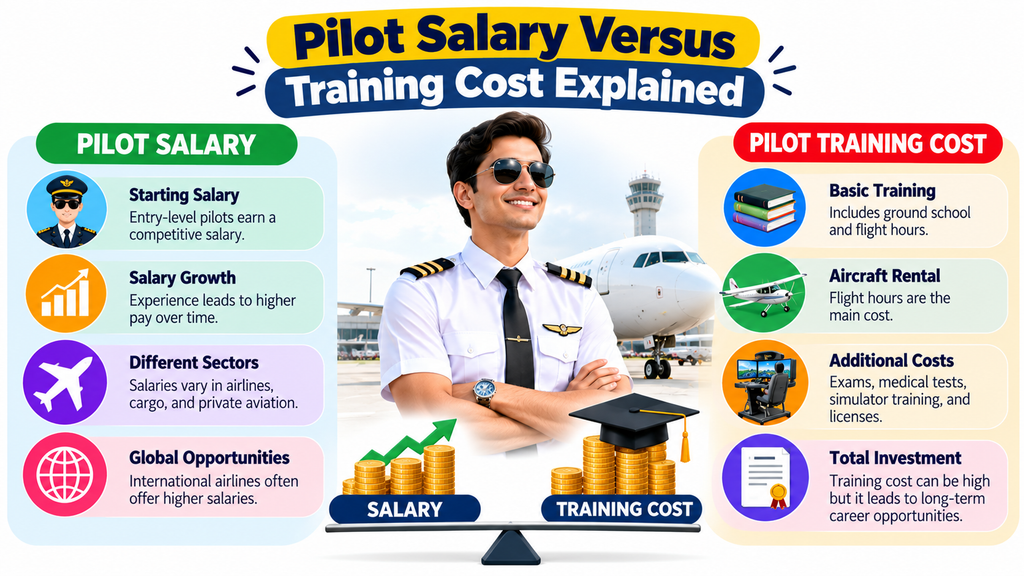
Becoming a pilot can be an exciting career choice, but flight training requires a large financial investment. Students and families often want to know how much training costs and how much pilots can earn later. However, pilot salaries vary by airline, experience, country, and job role. Understanding both sides can help students make a more informed career decision.
Understanding the Total Cost of Pilot Training
Pilot training involves more than learning to fly an aircraft. Students must complete ground classes, practical flying lessons, examinations, and medical checks. Some training paths also require simulator sessions and additional qualifications.
The total cost depends on the licence you want, the country where you train, and the school you choose. Your progress also matters. If you need extra flying hours or must repeat an examination, your expenses may increase.
Other costs can add up during training. These include accommodation, meals, travel, books, equipment, and licence processing fees. Students should also consider possible delays caused by weather, aircraft availability, or scheduling issues.
Before enrolling, ask each flight school for a complete written cost breakdown. Check which services are included in the advertised fee and which require separate payments. This step can help you avoid unexpected expenses later.
How Much Does Pilot Training Cost?
The cost of becoming a pilot depends on the licence and training route. In India, students pursuing a Commercial Pilot Licence (CPL) generally need to budget for ground training, flying hours, examinations, medical assessments, and licence-related expenses.
Training abroad can involve additional costs, such as international travel, accommodation, visa fees, and currency exchange. A lower advertised training fee does not always mean a lower total cost.
The following table explains the main expense categories. It does not give fixed prices because fees vary by school, country, and training programme.
| Expense category | What it covers | What affects the cost |
|---|---|---|
| Ground school | Aviation theory and classroom learning | Course length and training provider |
| Flying lessons | Aircraft use and practical flight instruction | Required hours, aircraft type, and hourly rates |
| Simulator sessions | Practice in approved training simulators, where applicable | Simulator type and session requirements |
| Exams and licence fees | Written tests, skill tests, and processing | Applicable authority and examination requirements |
| Medical checks | Required aviation medical assessments | Examination type and additional tests |
| Accommodation and food | Living expenses during training | City, housing, and lifestyle |
| Additional training | Extra flying hours, retests, or repeat sessions | Individual progress and training needs |
Students should compare complete programme costs rather than relying on a single advertised figure. They should also check whether the quoted fee includes taxes, examination charges, aircraft fuel surcharges, and additional flying hours.
Choosing Between Integrated and Modular Training
Integrated training follows a structured programme designed to take students through the required stages. It may offer a more organised schedule, but students should still check the total fee and what it includes.
Modular training allows students to complete different stages separately. It may offer greater flexibility in scheduling and payments. However, the total cost depends on how each stage is priced and how long the student takes to finish.
Neither route is automatically cheaper for everyone. Compare the full cost, training quality, aircraft availability, instructor access, and licensing requirements before making a decision.
Understanding Pilot Salaries
Pilot salaries depend on the type of aircraft, employer, experience, and job responsibilities. A newly hired first officer usually earns less than an experienced captain. Pay can also differ between airlines and countries.
In India, airline pilot pay may include a fixed salary and additional flying allowances. Some employers also offer benefits under their employment contracts. These may include travel benefits, insurance, or other allowances.
The figures below are broad examples from a published 2026 salary guide. They are not official salary scales, and actual offers may differ. Confirm current pay details with the relevant airline before making financial plans. Source: We One Aviation’s 2026 pilot salary guide.
| Career stage | Indicative monthly gross pay | Important consideration |
|---|---|---|
| Junior first officer | ₹1 lakh–₹1.5 lakh | Pay depends on the employer and contract |
| First officer | ₹2 lakh–₹3.5 lakh | Experience and flying allowances can affect income |
| Senior first officer | ₹3.5 lakh–₹4.5 lakh | Earnings vary by airline and roster |
| Narrow-body captain | ₹5 lakh–₹10 lakh | Requires experience and selection for command |
These amounts are illustrative market estimates, not guaranteed starting salaries. Gross pay is the amount before taxes and other deductions. Take-home pay is the amount that reaches your bank account after applicable deductions.
What Affects a Pilot’s Salary?
Several factors influence how much a pilot earns.
- Experience: Pilots may earn more as they gain experience and move into senior roles.
- Aircraft type: Pay structures can differ between aircraft fleets and operations.
- Employer: Airlines, charter operators, cargo companies, and other employers may offer different packages.
- Flying hours: Some contracts include allowances linked to flying hours.
- Career progression: Becoming a captain usually involves meeting experience, training, and assessment requirements.
- Location: Salary comparisons must account for taxes, living costs, and local employment conditions.
A high advertised salary should not be the only reason to choose this career. Students should also consider job availability, training quality, medical eligibility, and the time required to reach their preferred role.
Pilot Salary Versus Training Cost
Comparing training expenses with future earnings helps students understand the financial commitment. However, the comparison must include more than the advertised course fee and a pilot’s monthly salary.
For example, an Indian student might budget ₹60 lakh for core commercial pilot training. This is an illustrative planning figure, not a fixed price for every school. Some published training programmes quote different fees depending on the package and included services. Source: IGRUA’s 2026 course advertisement.
The student must then consider whether additional qualifications, accommodation, travel, or other expenses are separate. A type rating, which provides training for a specific aircraft type, may add a substantial amount when required for the chosen career path.
Here is a simple comparison of the investment and possible income stages.
| Financial factor | Illustrative amount | What it means |
|---|---|---|
| Core CPL training budget | ₹60 lakh | Initial planning estimate |
| Additional career training | Depends on requirements | May increase the total investment |
| Junior first officer gross pay | ₹1 lakh–₹1.5 lakh per month | Illustrative salary range from a published 2026 guide |
| Living expenses and taxes | Varies | Reduce the amount available for savings |
| Loan interest and repayments | Depends on the loan | Can increase the total amount paid |
| Career recovery period | Not fixed | Depends on employment, savings, and total costs |
The key point is that training cost and salary are different financial measures. Training cost is an upfront investment, while salary is income earned over time.
A Simple Example of Training Cost Recovery
Suppose a student spends ₹60 lakh on training and later earns ₹1.5 lakh per month before deductions. This salary is used only to explain the calculation.
If the student could save the entire ₹1.5 lakh every month, recovering ₹60 lakh would take 40 months, or about three years and four months.
But real life does not work that way. The pilot must pay for housing, food, transport, taxes, loan interest, and other needs. The student may also spend time looking for a suitable job after training.
Consider a more practical example in which the pilot saves ₹50,000 each month after expenses and loan payments.
At that savings rate, recovering ₹60 lakh would take 120 months, or 10 years. This simplified calculation excludes investment returns and any change in future savings. It also assumes that the full ₹60 lakh must be recovered from personal savings.
The example shows why a large salary does not automatically mean a quick financial recovery. Students should estimate their likely savings rather than relying only on gross income.
How Long Can It Take to Recover Pilot Training Costs?
There is no single recovery period for every pilot. It depends on the total training investment, the time taken to find work, and the amount saved each month.
A basic estimate uses this formula:
\[ \text{Recovery period} = \frac{\text{Total training investment}}{\text{Monthly savings}} \]
For example, a total investment of ₹60 lakh divided by monthly savings of ₹75,000 gives 80 months. That equals approximately six years and eight months.
This calculation is only a starting point. A realistic plan should include interest on education loans, periods without employment, additional qualifications, and changes in income.
Students should also remember that salary growth is not automatic. Promotion to a senior first officer or captain role depends on experience, assessments, employer requirements, and available opportunities.
If training takes longer than expected, living expenses may rise. If a job offer takes time to arrive, loan repayments may become difficult. A financial plan should allow for these risks instead of assuming everything will follow the ideal schedule.
Common Financial Mistakes Aspiring Pilots Should Avoid
Pilot training is a major financial decision. Small planning errors can create problems when students are already committed to a course. Understanding common mistakes can help families prepare more carefully.
1. Choosing a School Only Because It Is Cheap
A low advertised fee may not include every required expense. Check the total flying hours, aircraft availability, instructor access, and extra charges before comparing schools.
Ask for a written fee breakdown. Also, check the school’s current regulatory approval and training arrangements.
2. Ignoring Extra Flying Hours
Students may need more hours than their initial budget allows. Training progress varies, and extra lessons can increase costs.
Ask how additional flying hours are charged. Also, ask about aircraft maintenance delays and the school’s recent training schedules.
3. Assuming an Airline Job Will Come Immediately
A commercial pilot licence does not guarantee employment. Recruitment depends on airline requirements, hiring conditions, qualifications, and selection results.
Students should plan for a possible gap between completing training and receiving their first suitable job offer. Keep enough savings to cover essential expenses during this period.
4. Taking a Loan Without Checking the Full Cost
Education loans can help students pay for training. However, interest and repayment terms can increase the total amount they owe.
Before borrowing, check the interest rate, repayment start date, processing fees, collateral requirements, and any grace period. Understand how repayments will work if employment takes longer than expected.
5. Forgetting Medical and Licensing Requirements
Students must meet the applicable medical and licensing requirements. A training plan can become financially risky if eligibility issues arise after major payments.
Check the current requirements with the relevant aviation authority before committing a large amount of money.
How to Plan Your Pilot Training Budget
A clear budget helps students understand what they can afford and where they may need financial support. Start by estimating the complete cost of training, rather than focusing only on the first payment.
Follow these practical steps:
- Confirm your career goal and the licence you need.
- Review the current requirements of the relevant aviation authority.
- Compare complete fee schedules from several approved training providers.
- Ask which flying hours, examinations, simulator sessions, and other services are included.
- Estimate accommodation, food, transport, medical checks, and study materials.
- Review loan interest, repayment terms, and possible financial assistance.
- Set aside an emergency reserve for delays and unexpected costs.
- Research realistic entry-level job opportunities and salary ranges.
- Check whether further qualifications or aircraft-specific training may be needed.
- Recalculate your budget before signing a contract or paying a deposit.
It is also useful to prepare three financial scenarios.
- Best case: Training finishes on schedule, and you secure suitable employment relatively quickly.
- Expected case: Training or recruitment takes longer than planned, increasing your expenses.
- Difficult case: You face extended delays or must arrange additional funding.
Planning for all three situations provides a more realistic picture of the commitment. It also helps families decide how much they can safely invest without putting essential household needs at risk.
Important Considerations Before Investing in Pilot Training
Before spending your savings or taking a large loan, consider the following factors.
Medical Eligibility
Check the required aviation medical standards before making major financial commitments. Confirm which medical examinations apply to your intended licence and career path.
Training Quality and Duration
A school with a low fee may not always offer the best overall value. Aircraft availability, instructor access, training schedules, and student progress can affect both the experience and the final cost.
Licence Recognition
If you plan to train abroad and work in India, check the applicable licence conversion rules. Foreign training may involve additional examinations, documentation, medical checks, or flight tests.
Employment Uncertainty
Pilot hiring can change with airline expansion, economic conditions, and workforce needs. Do not base your financial plan on the assumption that a particular airline will hire you immediately after graduation.
Loan Repayment Risk
Loan payments can become difficult when income is delayed or lower than expected. Make sure you understand the repayment schedule and have a backup plan.
Long-Term Career Growth
A pilot’s income may rise with experience and career progression. However, promotions are not automatic, and salary increases should not be treated as guaranteed.
The safest approach is to make decisions using verified information, a realistic budget, and a clear understanding of the risks.
Frequently Asked Questions
1. How much does it cost to become a commercial pilot in India?
The cost varies by training provider, course structure, flying hours, and included services. Some 2026 estimates place the core CPL training budget around ₹55 lakh to ₹75 lakh, but actual fees can fall outside this range. Always obtain a current, itemised quotation.
2. What is the starting salary of a commercial pilot?
There is no single starting salary for every commercial pilot. Airline pay depends on the employer, role, contract, and flying allowances. A newly qualified CPL holder may also need to complete further requirements before securing an airline position.
3. Can a pilot recover the cost of flight training?
Yes, a pilot may recover the investment over time through earnings and savings. However, the period depends on total training expenses, employment opportunities, taxes, living costs, and loan interest. Recovery is not guaranteed within a specific number of years.
4. How many years does it take to become an airline pilot?
The timeline depends on the training route, examination progress, flying-hour availability, and licensing requirements. Some students complete their initial training in around 18–24 months, while others take longer. Securing an airline job may require additional time.
5. Does a commercial pilot licence guarantee an airline job?
No. A CPL allows a pilot to pursue eligible commercial flying work, subject to applicable requirements. Airline recruitment may require additional qualifications, assessments, medical fitness, and successful selection.
6. Can students use education loans to pay for pilot training?
Some lenders offer financing for eligible aviation training programmes. However, eligibility, loan limits, interest rates, collateral, and repayment conditions vary. Students should confirm the full terms with lenders before accepting a loan.
7. What expenses are often excluded from flight school fees?
Possible exclusions include accommodation, food, travel, medical examinations, examination fees, extra flying hours, and additional qualifications. Some schools include certain expenses in their packages, while others charge separately. Check every item in writing.
8. Is pilot training more expensive in India or abroad?
The answer depends on the training provider, exchange rates, living costs, and the services included. Overseas training may add travel and accommodation expenses, as well as possible licence conversion costs. Compare the complete cost of obtaining the licence you need.
9. Does a captain earn more than a first officer?
Captains generally earn more than first officers because they hold greater operational responsibility and usually have more experience. However, pay varies by airline, aircraft, contract, and location. Promotion to captain also depends on meeting the employer’s requirements.
10. How can students decide whether pilot training is financially practical?
Estimate the complete training investment and compare it with realistic employment and salary expectations. Include living costs, loan repayments, possible delays, and emergency savings. Discuss the figures with your family and avoid relying on guaranteed-job or guaranteed-salary claims.
Conclusion
Comparing pilot salary with training cost helps aspiring pilots make better career decisions. The real investment includes more than flight school fees, and future earnings depend on employment, experience, and career progression.
Before enrolling, compare complete training costs, verify licensing requirements, and research realistic salary ranges. If you plan to borrow money, calculate repayments using a cautious income estimate.
Most importantly, choose pilot training because it fits your career goals and financial situation. A clear budget and a backup plan can help you approach this career with greater confidence.

