
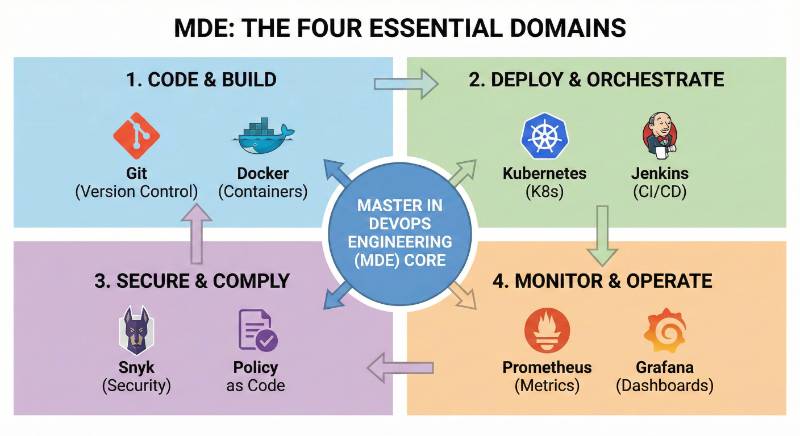
Introduction
The Master in DevOps Engineering (MDE) certification has become one of the leading qualifications for professionals looking to enhance their skills in DevOps practices. I can tell you that DevOps has rapidly evolved to become an essential practice for ensuring faster and more reliable software delivery. The MDE certification is designed to equip professionals with the necessary knowledge to implement, automate, and optimize DevOps pipelines across development and operations.
In this guide, we will explore everything you need to know about the MDE certification, from its structure to the benefits it offers. You’ll also learn about the learning paths you can follow post-certification, career opportunities, preparation plans, and the common mistakes to avoid.
What is the Master in DevOps Engineering (MDE) Certification?
The Master in DevOps Engineering (MDE) is an advanced certification aimed at providing professionals with in-depth knowledge of DevOps principles and practices. The certification focuses on building proficiency in automation, continuous integration, continuous delivery (CI/CD), containerization, cloud platforms, and infrastructure management. With a practical, hands-on approach, the MDE certification equips you with the skills to design, implement, and manage efficient DevOps workflows and pipelines.
Who Provides the Master in DevOps Engineering (MDE) Certification?
The Master in DevOps Engineering (MDE) certification is provided by DevOpsSchool — a globally recognized training and certification organization focused on DevOps, cloud computing, and modern IT practices.
DevOpsSchool specializes in industry‑aligned training programs that combine hands‑on labs, practical projects, and expert mentorship. Their courses are designed for working professionals, engineers, and managers who want to build real skills that can be immediately applied in the workplace.
Who Should Take the MDE Certification?
The MDE certification is suitable for the following professionals:
- Software Engineers: Engineers looking to integrate DevOps practices into their development workflows.
- DevOps Engineers: Professionals already working in DevOps roles who want to formalize their knowledge and tackle more complex challenges.
- Engineering Managers: Managers aiming to lead DevOps initiatives and improve team collaboration and efficiency.
- Platform Engineers: Engineers responsible for maintaining infrastructure who want to enhance their skills with automation and cloud technologies.
- Cloud Engineers: Engineers working with cloud services who want to streamline their workflows using DevOps tools and techniques.
- Security Engineers: Professionals focusing on integrating security within the DevOps lifecycle (DevSecOps).
Skills You’ll Gain from the MDE Certification
Upon completing the MDE certification, you will gain the following skills:
- CI/CD Automation: Automating the integration and delivery of software, ensuring seamless, continuous workflows.
- Containerization: Mastering Docker for containerizing applications and using Kubernetes for container orchestration and scaling.
- Infrastructure as Code (IaC): Using tools like Terraform and Ansible to automate infrastructure management and provisioning.
- Cloud Management: Proficiency in managing cloud resources and automating cloud infrastructure deployments using AWS, Azure, or GCP.
- Monitoring and Logging: Setting up monitoring systems with tools like Prometheus and Grafana to track application health and performance.
- Security Integration: Learning to integrate security practices into your DevOps workflows (DevSecOps).
Real-World Projects You Should Be Able to Do After It
After completing the MDE certification, you should be able to work on the following real-world projects:
- Designing and Deploying CI/CD Pipelines: Build and automate software delivery pipelines that include code integration, testing, and deployment.
- Cloud Infrastructure Management: Use tools like Terraform to automate the provisioning of cloud infrastructure on AWS or Azure.
- Implementing Containerization: Dockerize applications and deploy them in Kubernetes clusters for scalability and management.
- Building Monitoring and Logging Systems: Set up and configure Prometheus and Grafana to monitor system performance and create alerting systems.
- DevOps Automation for Security: Integrate security tools into the DevOps pipeline for continuous security monitoring (DevSecOps).
Preparation Plan for MDE Certification
To successfully prepare for the MDE certification, follow these recommended plans based on your availability and experience level.
7–14 Days Preparation Plan
Ideal for: Professionals with basic DevOps knowledge or experience in software development and IT operations.
Week 1: DevOps Fundamentals and CI/CD
- Days 1–3: Learn the core DevOps principles, focusing on collaboration, automation, and continuous integration.
- Days 4–7: Set up simple CI/CD pipelines using tools like Jenkins and GitLab.
Week 2: Cloud Platforms and Containers
- Days 8–10: Study cloud basics (AWS, Azure) and deploy sample applications on the cloud.
- Days 11–14: Learn Docker and Kubernetes for containerizing applications and deploying them in cloud environments.
30-Day Preparation Plan
Ideal for: Professionals who have some DevOps experience but want to go deeper into cloud management, containerization, and automation.
Week 1–2: Advanced CI/CD and Cloud Infrastructure
- Days 1–4: Set up advanced CI/CD pipelines, including automated testing, deployment, and environment management.
- Days 5–10: Study cloud automation with Terraform, focusing on infrastructure provisioning and management.
- Days 11–14: Learn advanced containerization and orchestration with Docker and Kubernetes.
Week 3–4: Infrastructure as Code and Monitoring
- Days 15–18: Dive into Infrastructure as Code (IaC) with Terraform and CloudFormation.
- Days 19–21: Study monitoring tools like Prometheus and Grafana, and practice setting up alerting systems.
- Days 22–30: Implement a full DevOps pipeline, integrating CI/CD, cloud management, containers, and monitoring.
60-Day Preparation Plan
Ideal for: Those looking to master every aspect of DevOps and gain comprehensive hands-on experience.
Week 1–2: DevOps Basics and CI/CD Pipelines
- Days 1–7: Study DevOps culture, CI/CD pipelines, and version control (Git).
- Days 8–14: Set up and manage complex CI/CD pipelines with automated testing and deployment.
Week 3–4: Cloud Platforms and Containerization
- Days 15–21: Study cloud platforms (AWS, Azure) and deploy applications using cloud resources.
- Days 22–28: Implement container orchestration with Kubernetes and scale containerized applications.
Week 5–6: Infrastructure Automation, Monitoring, and Security
- Days 29–35: Focus on infrastructure automation using Terraform and CloudFormation.
- Days 36–42: Learn monitoring and logging systems, set up monitoring solutions with Prometheus and Grafana.
- Days 43–60: Complete a real-world DevOps project integrating CI/CD, cloud management, containerization, and security.
Common Mistakes to Avoid
- Not Practicing Enough:
Hands-on practice is essential. Make sure to spend plenty of time working with the tools. - Skipping Security:
Always integrate security practices within your DevOps workflows (DevSecOps). - Overcomplicating Pipelines:
Keep your CI/CD pipelines simple and maintainable. - Not Staying Updated:
DevOps is a fast-evolving field. Stay updated with the latest tools and technologies.
Best Next Certification After MDE
- Same Track: Certified DevOps Professional (CDP)
- Cross-Track: Certified Kubernetes Administrator (CKA)
- Leadership Track: Certified DevOps Leader (CDL)
Choose Your Path: DevOps Learning Paths
After completing the MDE certification, here are six specialized learning paths you can pursue:
- DevOps:
Master DevOps tools and techniques to optimize the software delivery pipeline.
Ideal For: DevOps Engineers, Software Engineers. - DevSecOps:
Integrate security within the DevOps lifecycle to ensure secure software delivery.
Ideal For: Security Engineers, DevOps Engineers. - Site Reliability Engineering (SRE):
Enhance system reliability, availability, and scalability in production environments.
Ideal For: SREs, Cloud Engineers. - AIOps/MLOps:
Implement machine learning and AI in DevOps to optimize performance and automate issue detection.
Ideal For: Data Scientists, Machine Learning Engineers. - DataOps:
Automate data pipelines for faster, more accurate data processing and integration.
Ideal For: Data Engineers, Data Architects. - FinOps:
Optimize cloud costs and manage financial operations in DevOps environments.
Ideal For: Cloud Financial Managers, IT Finance Professionals.
These paths help you specialize further and advance your career in DevOps!
Role → Recommended Certifications
| Role | Recommended Certifications |
|---|---|
| DevOps Engineer | MDE, CDP, CKA |
| Site Reliability Engineer | MDE, SRE, CKA |
| Platform Engineer | MDE, CKA, CKAD |
| Cloud Engineer | MDE, AWS Certified Solutions Architect |
| Security Engineer | MDE, DevSecOps, CISM |
| Data Engineer | MDE, DataOps, Google Professional Data Engineer |
| FinOps Practitioner | MDE, FinOps, Certified Cloud Financial Professional |
| Engineering Manager | MDE, CDL, DevOps Leader |
Top Institutions Offering MDE Certification
- DevOpsSchool
The official provider of the MDE certification, offering expert-led training, hands-on labs, and real-world projects to ensure a comprehensive learning experience. - Cotocus
Offers comprehensive DevOps and cloud certification programs, focusing on real-world project-based learning to reinforce practical skills. - ScmGalaxy
Known for in-depth DevOps training, ScmGalaxy covers all essential DevOps tools and methodologies, preparing you for real-world challenges. - BestDevOps
Provides practical, application-focused DevOps training with hands-on labs and industry-relevant scenarios to help professionals excel. - DevSecOpsSchool.com
Specializes in integrating security within the DevOps lifecycle (DevSecOps), ensuring that security is embedded in every stage of development. - SRESchool.com
Focuses on Site Reliability Engineering (SRE) alongside core DevOps practices, ensuring highly reliable, scalable systems. - AIOpsSchool.com
Specializes in AIOps and integrating artificial intelligence into DevOps processes for smarter, automated infrastructure management. - DataOpsSchool.com
Provides training for managing and automating data pipelines, focusing on ensuring efficient and accurate data flow in DevOps environments. - FinOpsSchool.com
Specializes in cloud financial operations (FinOps), teaching professionals how to optimize cloud spending and manage financial operations in DevOps.
These institutions provide excellent training and certification programs, offering a mix of theory, hands-on learning, and real-world projects to prepare you for the MDE certification and beyond.
General DevOps FAQs
- What is the role of DevOps in modern software development?
DevOps plays a crucial role in modern software development by promoting collaboration between development and operations teams, automating workflows, and enhancing the speed and reliability of software delivery. It helps organizations shorten the development lifecycle and deliver high-quality software more frequently. - How does DevOps improve collaboration between teams?
DevOps fosters communication and collaboration by breaking down silos between development, operations, and other teams. Through shared responsibilities, automated processes, and transparency, DevOps encourages faster feedback loops and more coordinated efforts across teams. - What are the key benefits of implementing DevOps practices in an organization?
Key benefits include faster time-to-market, improved software quality, better collaboration across teams, enhanced security, and more efficient use of resources. DevOps also leads to higher customer satisfaction through frequent, reliable updates. - What is Infrastructure as Code (IaC), and why is it important?
IaC is the practice of managing and provisioning infrastructure through code instead of manual processes. It’s important because it allows for faster, more consistent, and automated infrastructure deployment, making scaling and managing infrastructure easier. - How does DevOps integrate with Agile methodologies?
DevOps complements Agile by focusing on automation, continuous integration, and continuous delivery. While Agile emphasizes iterative development, DevOps ensures that the process of deployment and operations is as fast and automated as development. - What is Continuous Testing in DevOps, and why is it important?
Continuous Testing involves running automated tests at every stage of the DevOps pipeline to ensure that code changes do not introduce defects. It’s crucial for maintaining high-quality software and for detecting issues early in the development cycle. - What are the common challenges faced during DevOps implementation?
Common challenges include resistance to change, lack of proper tooling, integrating legacy systems, ensuring security (DevSecOps), and aligning teams around a common DevOps culture. - What is the significance of monitoring and logging in DevOps?
Monitoring and logging are vital for tracking system performance, detecting issues, and ensuring high availability. They help identify bottlenecks, system failures, or security breaches in real-time, allowing teams to respond quickly and maintain system health. - How do you ensure security in a DevOps environment?
Security can be ensured by integrating security practices into every phase of the DevOps pipeline, known as DevSecOps. This includes automating security scans, vulnerability management, and ensuring secure code practices from development to deployment. - What tools are commonly used in a DevOps pipeline?
Some commonly used tools include Jenkins (CI/CD), Docker (containerization), Kubernetes (orchestration), Git (version control), Terraform (IaC), Prometheus and Grafana (monitoring), and AWS or Azure (cloud services). - What’s the difference between a DevOps Engineer and a System Administrator?
A DevOps Engineer focuses on automating and streamlining development and deployment processes through CI/CD, containerization, and cloud management, whereas a System Administrator manages and configures physical or virtual servers and networks, often focusing on infrastructure stability. - How can organizations scale DevOps practices effectively?
Organizations can scale DevOps by standardizing tools and practices, automating processes, promoting a DevOps culture, and ensuring continuous learning through training and mentorship. Collaborating with cross-functional teams is also key to scaling DevOps successfully.
MDE Certification-Specific FAQs
- What is the best way to prepare for the MDE certification exam?
Start by reviewing key DevOps concepts, tools, and best practices. Then, work through practical exercises, build sample projects, and take part in hands-on labs. Studying with real-world applications will ensure you’re well-prepared for the exam. - What is covered in the MDE certification exam?
The MDE exam covers DevOps principles, CI/CD pipelines, containerization, cloud management, automation (IaC), and monitoring. It tests your ability to apply these practices in real-world scenarios. - Who is the MDE certification intended for?
The MDE certification is for software engineers, DevOps engineers, engineering managers, platform engineers, cloud engineers, and security engineers looking to deepen their knowledge of DevOps practices and tools. - How will the MDE certification benefit my career?
The MDE certification will enhance your expertise in DevOps, making you a more competitive candidate for senior roles such as DevOps Engineer, Cloud Engineer, or Site Reliability Engineer (SRE). It also positions you for career advancement and salary increases. - Is the MDE certification recognized globally?
Yes, the MDE certification is globally recognized and respected in the industry, making you eligible for DevOps roles worldwide. It demonstrates your proficiency with industry-standard DevOps tools and practices. - What tools and technologies are emphasized in the MDE certification?
The MDE certification emphasizes tools like Jenkins (CI/CD), Docker (containerization), Kubernetes (orchestration), Terraform (IaC), AWS and Azure (cloud platforms), and monitoring tools like Prometheus and Grafana. - What kind of hands-on experience is included in the MDE certification?
The certification includes practical exercises, real-world projects, and hands-on labs where you will automate CI/CD pipelines, manage cloud infrastructure, deploy containerized applications, and monitor system performance. - How is the MDE certification exam structured?
The exam includes multiple-choice questions and practical case studies that assess your ability to apply DevOps principles in real-world scenarios. It tests both your theoretical knowledge and hands-on skills.
Conclusion
The Master in DevOps Engineering (MDE) certification is a valuable asset for professionals looking to enhance their DevOps skills and advance their careers. Whether you are an engineer looking to specialize in DevOps or a manager aiming to lead DevOps transformations in your organization, this certification provides the knowledge, tools, and hands-on experience necessary to excel in the fast-evolving IT landscape.
By completing the MDE certification, you will gain expertise in areas like continuous integration and deployment (CI/CD), containerization, cloud management, infrastructure automation, and monitoring, making you a highly sought-after candidate in the global job market. The certification also offers you an edge in securing high-level positions such as DevOps Engineer, Site Reliability Engineer (SRE), and Cloud Engineer, among others.

