
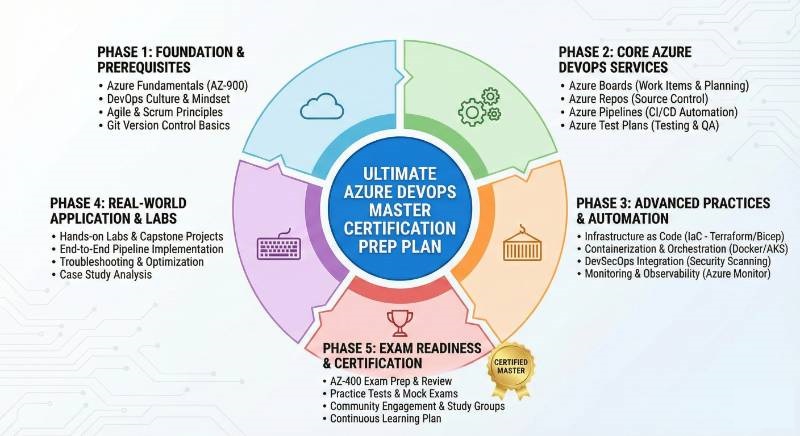
The software world moves fast. In the past, we had separate teams for writing code and managing servers. That wall is now gone. Today, companies need a unified way to plan, build, and ship software. Azure DevOps has become the standard for doing exactly that.
For engineers and managers in India and around the world, mastering this platform is no longer optional. It is the key to building reliable systems and advancing your career. This guide explores the Master in Azure DevOps program and how it helps you lead in a cloud-first world.
Why Focus on Azure DevOps?
Most large organizations trust Microsoft. Because Azure DevOps works so well with existing enterprise tools, it is the primary choice for digital transformation. Learning this platform means you can handle everything from a small startup’s code to the massive infrastructure of a global bank.
The DevOps Certification Landscape
Before looking at the Master program, it is helpful to see how different specialized tracks fit together.
| Track | Level | Who it’s for | Prerequisites | Skills Covered | Recommended Order |
| Azure DevOps | Master | Engineers & Managers | Basic Cloud knowledge | Pipelines, Boards, Repos, Artifacts | 1st |
| DevSecOps | Professional | Security Engineers | DevOps Basics | Security as Code, Scanning | 2nd |
| SRE | Expert | Reliability Engineers | Azure DevOps Master | Uptime, Monitoring, SLOs | 2nd |
| MLOps | Specialized | Data Scientists | Azure DevOps Basics | Model Serving, Pipelines | 3rd |
| DataOps | Specialized | Data Engineers | Data Basics | ETL Automation, Versioning | 3rd |
| FinOps | Strategic | Tech Leads/Managers | Cloud Experience | Cost Optimization, Savings | 4th |
Deep Dive: Master in Azure DevOps
What it is
The Master in Azure DevOps is a complete training program. It covers the full lifecycle of software development using Microsoft’s cloud-native tools. You learn to connect planning, coding, and deployment into one smooth process.
Who should take it
This is for Software Engineers, Release Managers, and Platform Engineers. If you are responsible for making sure code gets from a developer’s laptop to a production server safely, this is for you.
Skills you’ll gain
- Agile Planning: Using Azure Boards to track work and manage team sprints.
- Source Control: Managing code versions and pull requests with Azure Repos.
- CI/CD Automation: Building and releasing code automatically using Azure Pipelines.
- Testing: Organizing manual and automated tests with Azure Test Plans.
- Artifact Sharing: Managing software packages and dependencies with Azure Artifacts.
- Cloud Infrastructure: Deploying servers and services as code.
Real-world projects you should be able to do after it
- Multi-Stage Pipelines: Build a system that tests code, asks for manager approval, and then deploys to the cloud.
- Infrastructure as Code: Write scripts that automatically set up a whole data center in Azure.
- Security Integration: Add automatic tools that scan your code for bugs or security holes before it is even finished.
- Container Orchestration: Deploy and manage applications running in Docker or Kubernetes through Azure.
Preparation Plan
7–14 Days (The Fast Track)
- Spend your time in the Azure Pipelines editor. Learn the YAML syntax by heart.
- Practice setting up a private build agent on your own machine.
- Learn how to link your code repository to your deployment pipeline.
30 Days (The Professional Path)
- Week 1: Master Azure Boards and Repos. Learn how to link tasks to code changes.
- Week 2: Deep dive into Build Pipelines. Learn how to handle different programming languages.
- Week 3: Focus on Release Pipelines and deployment gates.
- Week 4: Practice Artifacts and Test Plans. Run a full mock project from start to finish.
60 Days (The Foundation Path)
- Month 1: Start with Azure cloud basics. Learn about virtual machines, networks, and storage.
- Month 2: Follow the 30-day professional path, spending extra time on hands-on labs for each tool.
Common Mistakes to Avoid
- Using the GUI only: Avoid the “Classic” editor. Professionals use YAML for pipelines because it can be version-controlled.
- Messy Branching: Don’t let your code branches get out of control. Use a simple strategy like GitHub Flow.
- Hardcoding Secrets: Never put passwords in your scripts. Always use the built-in “Library” or Azure Key Vault.
- Skipping Tests: A pipeline without tests is just a fast way to break your production environment.
Best next certification after this
After finishing the Master program, most people choose the DevSecOps Certified Professional to learn how to keep their automated systems secure.
Choose Your Path: 6 Learning Tracks
Azure DevOps connects with multiple modern engineering domains. Choose the track that matches your career goal and strengths.
1. DevOps Track
Focus: CI/CD, automation, infrastructure, cloud deployment
Learn Azure Pipelines, Git strategies, Terraform/ARM, containers, and release management.
Best for: DevOps Engineers, Cloud Engineers, Platform Engineers.
2. DevSecOps Track
Focus: Security in CI/CD pipelines
Work on SAST/DAST integration, container security, policy enforcement, and secret management.
Best for: Security Engineers and DevOps professionals moving into security.
3. SRE Track
Focus: Reliability and monitoring
Cover SLIs/SLOs, observability, incident response, and scaling strategies.
Best for: SREs and reliability-focused engineers.
4. AIOps / MLOps Track
Focus: AI-driven operations and ML deployment
Learn ML pipelines, automated retraining, intelligent monitoring, and predictive alerts.
Best for: ML Engineers and advanced DevOps professionals.
5. DataOps Track
Focus: Data pipeline automation
Implement CI/CD for ETL workflows, data testing, and monitoring in Azure environments.
Best for: Data Engineers and analytics teams.
6. FinOps Track
Focus: Cloud cost optimization
Manage Azure cost governance, budgeting automation, and resource optimization.
Best for: FinOps practitioners and Engineering Managers.
Role → Recommended Certifications Mapping
| Current Role | Recommended Certifications |
| DevOps Engineer | Master in Azure DevOps + Certified DevOps Professional |
| SRE | Master in Azure DevOps + SRE Certified Professional |
| Platform Engineer | Master in Azure DevOps + Master in DevOps Engineering |
| Cloud Engineer | Master in Azure DevOps + Azure Architect Solutions |
| Security Engineer | Master in Azure DevOps + DevSecOps Professional |
| Data Engineer | Master in Azure DevOps + DataOps Specialist |
| FinOps Practitioner | Master in Azure DevOps + FinOps Engineer |
| Engineering Manager | Master in Azure DevOps + Certified DevOps Manager |
Top Institutions for Azure DevOps Training
Choosing a training partner with real-world experience is vital. These institutions provide the best help for the Master in Azure DevOps program:
- DevOpsSchool:
A leader in professional technical education. They offer a deep Master program that focuses on 80% practical work and 20% theory, ensuring you are ready for actual job challenges. - Cotocus:
Known for their enterprise-level training. They help engineers understand how to use Azure DevOps in massive production environments, focusing on scalability and high performance. - Scmgalaxy:
A great resource for those who value community learning. They offer a huge library of tutorials and lab setups that make complex topics easy to understand. - BestDevOps:
They specialize in the latest toolsets. Their training is highly structured and updated frequently to match the newest features released by Microsoft. - devsecopsschool.com:
The best choice for engineers who want to specialize in security. They teach you how to build “Security as Code” directly into your Azure pipelines. - sreschool.com:
Focuses on reliability. They show you how to use Azure DevOps to maintain high uptime and manage incidents like a pro. - aiopsschool.com:
Ideal for data scientists. They teach you how to manage the lifecycle of AI and Machine Learning models using automated cloud workflows. - dataopsschool.com:
Perfect for data professionals. They bridge the gap between data engineering and automated cloud deployments. - finopsschool.com:
A specialized school for technical leads who need to manage cloud costs and ensure every dollar spent on Azure is optimized.
Next Certifications to Take
Once you have finished the Master program, consider these three paths for growth:
- Option 1: Same Track (Advanced Tech)Master in DevOps Engineering (MDE): This takes you beyond just Microsoft tools and into the broader world of Terraform, Ansible, and Multi-Cloud strategies.
- Option 2: Cross-Track (Specialization)DevSecOps Certified Professional (DSOCP): Security is the fastest-growing part of the cloud. This certification makes you a highly valuable “Security Champion” in any team.
- Option 3: Leadership (Management)Certified DevOps Manager (CDM): For those moving into leadership, this focuses on how to change company culture and lead technical teams to success.
General FAQs (Career & Value)
1. How difficult is the Master in Azure DevOps?
It is a professional-level course. It is not “easy,” but if you follow the hands-on labs, it is very manageable.
2. How long does it take to prepare?
Most working professionals can finish the core learning and clear the certification in about 30 days of consistent study.
3. Are there any prerequisites?
You should have a basic understanding of how the cloud works and be comfortable using a computer for technical tasks.
4. How does this certification help my salary?
Azure DevOps is in high demand. Certified professionals often see a significant jump in their pay because they can handle complex automation tasks.
5. Is the certification valid globally?
Yes. Azure DevOps is used by companies everywhere, from India to Europe to North America.
6. Do I need to be a programmer?
You don’t need to be an expert coder, but you should be able to read and write simple scripts and YAML files.
7. Can I take the exam online?
Yes, most modern certifications and training programs are fully available online for your convenience.
8. Is it better than Jenkins?
Azure DevOps is an all-in-one suite, whereas Jenkins is just for pipelines. Many companies are switching to Azure for its ease of use.
9. What if I fail the first time?
Most training providers offer support and a path to retake the exam once you have practiced more.
10. Is it good for managers?
Yes. Managers need to understand these tools to set realistic deadlines and manage their team’s technical debt.
11. How much of the course is practical?
In a good Master program, at least 70-80% of your time should be spent doing hands-on labs in a real environment.
12. Can I use the skills on other clouds?
Yes. The principles of CI/CD and automation you learn here will apply to AWS and Google Cloud as well.
Specific FAQs: Master in Azure DevOps
1. What is the main focus of this Master program?
It focuses on mastering the five core services: Boards, Repos, Pipelines, Test Plans, and Artifacts.
2. Where can I find the official registration?
You can sign up and see all the details at DevOpsSchool.
3. Do I need an Azure account?
Yes, but you can use the free tier provided by Microsoft to do almost all of your practice.
4. Does the course cover Terraform?
Yes, a true Master program shows you how to use Infrastructure as Code tools like Terraform within your Azure pipelines.
5. What is the passing score?
Usually, you need to score around 70% to prove you have mastered the material.
6. Is there a community for help?
Yes, places like Scmgalaxy and DevOpsSchool have large communities where you can ask questions.
7. How often is the content updated?
The content is updated regularly to stay in line with Microsoft’s latest cloud releases.
8. Can I get a job as a DevOps Engineer after this?
This certification is a very strong signal to employers that you have the skills needed for a professional DevOps role.
Conclusion
The world of software is moving toward total automation. By becoming a Master in Azure DevOps, you are placing yourself at the center of that movement. Whether you are an engineer looking to build better systems or a manager looking to help your team succeed, this certification provides the roadmap you need.
Success in the cloud comes down to one thing: the ability to deliver quality software quickly. Azure DevOps is the tool that makes that possible. Start your journey today, and build the future of your career.

