
1. Introduction
Becoming a pilot is a dream career for many aviation aspirants, but the cost of pilot training often becomes a major challenge. From ground school education to flying hours, simulator sessions, licensing exams, and medical certifications, the total investment required can be very high.
This is where pilot training scholarships play an important role. These scholarships help deserving students reduce financial burden and make aviation careers more accessible. However, simply finding a scholarship is not enough—knowing how to apply correctly is equally important.
In this guide, we will walk you through the complete process of how to apply for pilot training scholarships, including eligibility criteria, required documents, step-by-step application process, selection stages, and expert tips to improve your chances of success.
2. What Are Pilot Training Scholarships?
Pilot training scholarships are financial assistance programs designed to support aspiring pilots in completing their aviation education. These scholarships are offered by different organizations to encourage talent in the aviation industry.
Types of Pilot Training Scholarships:
- Government Scholarships: Offered by national aviation authorities or education boards
- Airline Cadet Programs: Sponsored or partially funded training programs by airlines
- Private Aviation Institute Scholarships: Provided by flight schools and academies
- Defense Scholarships: Sponsored by air force or military aviation programs
- Aviation Foundation Grants: Support from aviation organizations and NGOs
Each type of scholarship has its own eligibility criteria, benefits, and selection process.
3. Eligibility Criteria for Pilot Scholarships
Before applying, candidates must ensure they meet the basic eligibility requirements.
Academic Requirements:
- Completion of 10+2 or equivalent education
- Strong background in Physics and Mathematics
- Good overall academic performance
Age Requirements:
- Typically between 17 to 26 years
- Some programs may have flexible age limits
Medical Fitness:
- Must hold a Class 1 Medical Certificate
- Good vision and physical fitness
- Mental and psychological stability
Additional Requirements:
- English language proficiency
- Aptitude and reasoning test performance
- Clean background record (for airline and defense programs)
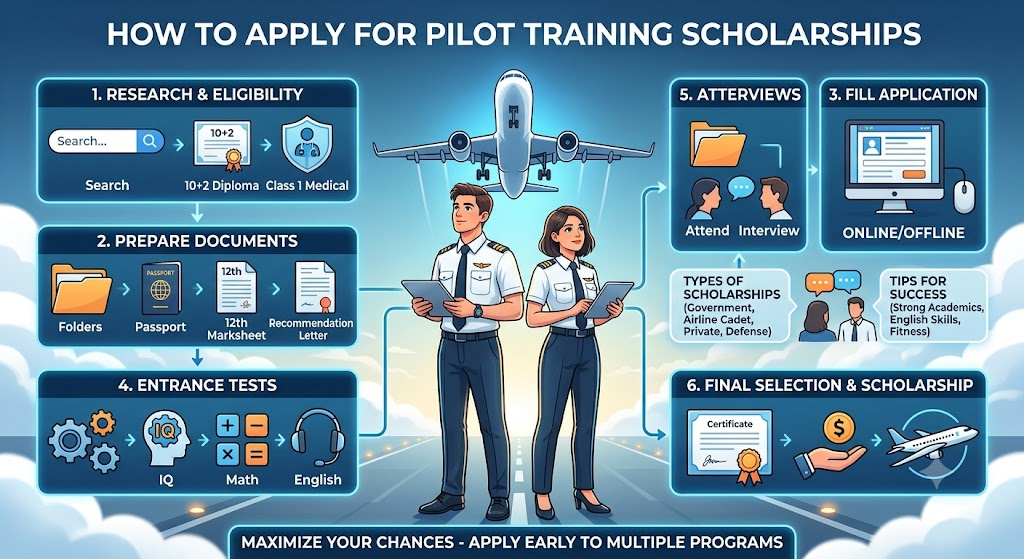
4. Step-by-Step Process to Apply for Pilot Training Scholarships
Applying for a pilot scholarship requires careful planning and proper documentation.
Step 1: Research Available Scholarships
Start by identifying government schemes, airline cadet programs, and aviation academy scholarships.
Step 2: Check Eligibility
Carefully review academic, medical, and age requirements before applying.
Step 3: Prepare Required Documents
Gather all necessary documents in advance to avoid last-minute issues.
Step 4: Fill Application Form
- Complete online or offline application forms accurately
- Ensure all details are correct and match official documents
Step 5: Submit Application Before Deadline
Late applications are usually not accepted, so apply early.
Step 6: Appear for Entrance Tests
- Aptitude tests (logical reasoning, math, physics)
- English communication tests
- Aviation knowledge assessments
Step 7: Attend Interviews
Shortlisted candidates may be called for personal or panel interviews.
Step 8: Final Selection
Selection is based on merit, test scores, interview performance, and medical fitness.
5. Required Documents for Application
Candidates must prepare the following documents before applying:
- Educational certificates (10th & 12th marksheets)
- Valid identity proof (Aadhar card, passport, etc.)
- Passport-size photographs
- Medical fitness certificate (Class 1)
- Duly filled application form
- Recommendation letters (if required by program)
6. Selection Process Explained
The selection process for pilot training scholarships is highly competitive.
Common Selection Stages:
- Written Examination: Tests aptitude, reasoning, and basic science knowledge
- Psychometric Test: Evaluates decision-making and mental ability
- Interview Round: Assesses communication skills and motivation
- Medical Examination: Ensures fitness for aviation standards
Only candidates who perform well in all stages are awarded scholarships.
7. Tips to Successfully Get a Pilot Scholarship
Winning a pilot training scholarship requires preparation and discipline.
- Maintain strong academic performance, especially in Physics and Mathematics
- Practice aptitude and reasoning tests regularly
- Improve English communication skills
- Start basic aviation knowledge early
- Apply for multiple scholarship programs
- Stay updated with deadlines and announcements
- Focus on physical fitness and medical standards
Consistency and early preparation significantly increase your chances of selection.
8. Common Mistakes to Avoid
Many applicants lose opportunities due to avoidable errors:
- Missing application deadlines
- Submitting incomplete or incorrect forms
- Ignoring eligibility requirements
- Poor preparation for aptitude tests
- Lack of proper medical certification
- Applying to only one scholarship program
Avoiding these mistakes can greatly improve your success rate.
9. Career Path After Scholarship Selection
Once selected and trained, multiple aviation career paths open up:
Airline Pilot Career
- Start as First Officer
- Progress to Captain
- Work with domestic and international airlines
Cargo Aviation
- Fly freight and logistics aircraft
- Work with global cargo operators
Charter Aviation
- Fly private jets and corporate aircraft
- Flexible and high-paying opportunities
Defense Aviation
- Serve in air force aviation roles
- Specialized training and responsibilities
10. FAQs
1. Can I apply for pilot scholarships after 12th grade?
Yes, most scholarships are available after completing 10+2 with Physics and Mathematics as core subjects.
2. Do all pilot scholarships cover full training costs?
No, some are fully funded while others offer partial financial assistance.
3. Is medical fitness mandatory for scholarship applications?
Yes, a Class 1 Medical Certificate is required for most pilot training scholarships.
4. Are scholarships based on merit or financial need?
They can be merit-based, need-based, or a combination of both depending on the program.
5. Can I apply for multiple scholarships at once?
Yes, applying to multiple programs increases your chances of selection.
6. What is the most important part of selection?
Aptitude test performance, academic background, and medical fitness are critical factors.
7. Is English fluency required for pilot scholarships?
Yes, basic to advanced English communication skills are essential for most programs.
11. Conclusion
Applying for pilot training scholarships requires careful planning, proper documentation, and strong preparation. While the aviation field is competitive, scholarships provide a valuable opportunity for deserving students to pursue their dream career without financial stress.
By understanding eligibility criteria, following the correct application process, and avoiding common mistakes, you can significantly improve your chances of success. Stay consistent, prepare early, and apply to multiple programs to maximize opportunities.
With dedication and the right approach, your journey to becoming a professional pilot can begin with the support of a scholarship.

