
Introduction
A pilot logbook is more than a record of flying hours. It is an important aviation document that shows your training progress, flight experience, instructor verification, and readiness for future license steps.
For student pilots, logbook accuracy is very important from the first day of training. A small mistake in date, aircraft number, flight duration, or instructor signature may look minor today, but it can create confusion later during license verification, training review, or career documentation.
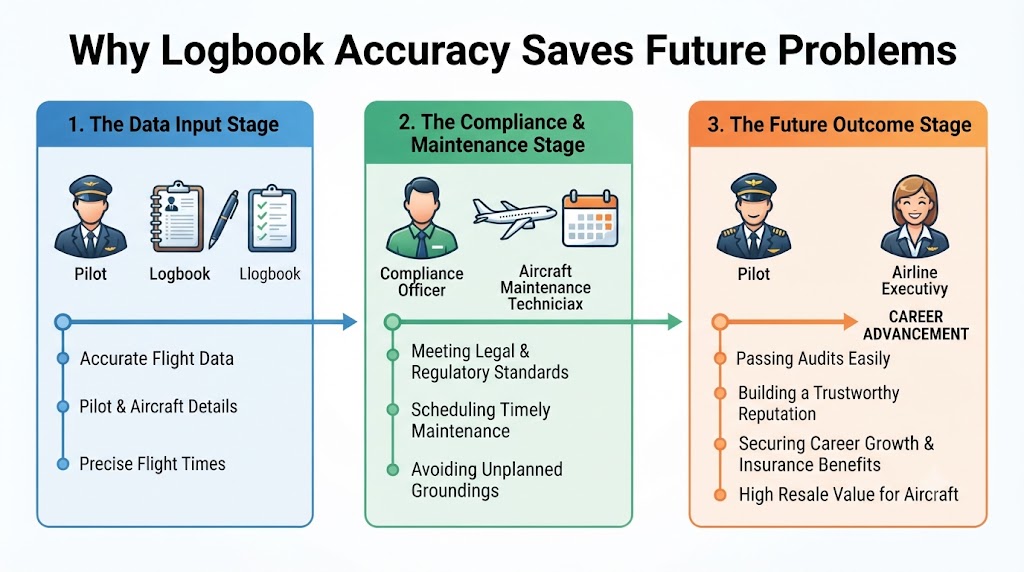
This is why every student pilot should understand why logbook accuracy saves future problems.
What Is Logbook Accuracy?
Logbook accuracy means writing correct, complete, and clear flight details in your pilot logbook.
It includes recording the right:
- Flight date
- Aircraft type
- Aircraft registration number
- Departure and arrival airport
- Flight duration
- Solo or dual flight status
- Day or night flying details
- Simulator time
- Instructor name
- Instructor signature
- Training remarks
An accurate logbook should be easy to read, easy to verify, and match your flight school records.
Why Accurate Logbook Records Matter
Accurate logbook records help student pilots track their real training progress. They show how many hours you have completed and what type of flying experience you have gained.
A clean logbook helps with:
- License applications
- Flying hour verification
- Instructor reviews
- Training progress checks
- Advanced course admission
- Future job documentation
- Personal confidence as a pilot
In aviation, documentation matters. If your records are unclear, incomplete, or incorrect, it can create unnecessary delays.
Future Problems Caused by Wrong Logbook Entries
Wrong logbook entries can create several problems later in training.
License Application Delays
When applying for a pilot license, your flying hours may be checked. If entries are missing or incorrect, the application process may take longer.
Flying Hour Mismatch
Your logbook hours should match flight school records. If there is a difference, you may need extra verification or correction.
Missing Instructor Verification
Some training flights require instructor signatures. Missing signatures can make it difficult to prove that a lesson was completed.
Training Record Confusion
If solo, dual, night, simulator, or cross-country hours are not marked correctly, your progress may become confusing.
Problems During Advanced Training
When moving to advanced training, your previous flight records may be reviewed. A poorly maintained logbook can create doubts or delays.
Career Documentation Issues
In the future, aviation employers or training organizations may review your flying experience. A neat and accurate logbook supports your professional image.
Common Logbook Mistakes Student Pilots Make
Many student pilots make simple mistakes because they update the logbook late or depend on memory.
Common mistakes include:
- Forgetting to update entries after flight
- Writing the wrong aircraft registration number
- Recording incorrect flight duration
- Missing instructor signatures
- Forgetting simulator hours
- Not marking solo or dual flight correctly
- Poor handwriting
- Leaving blank columns
- Not checking total hours regularly
- Mixing rough notes with official entries
These mistakes can be avoided with regular checking and instructor support.
How Accurate Logbooks Help During License Verification
During license verification, flight schools or aviation authorities may review your logbook to confirm your training record.
They may check:
- Total flying hours
- Dual instruction hours
- Solo flying hours
- Cross-country hours
- Night flying hours
- Simulator hours
- Instructor signatures
- Training completion details
If your logbook is accurate, the verification process becomes smoother. If there are mistakes, you may need to correct entries, collect missing signatures, or explain mismatched records.
Paper Logbook vs Digital Backup
Both paper and digital records can help student pilots stay organized.
| Feature | Paper Logbook | Digital Backup |
|---|---|---|
| Main use | Official record | Extra safety copy |
| Signature | Easy for instructor to sign | Depends on app or system |
| Risk | Can be lost or damaged | Can be stored safely online |
| Calculation | Manual total needed | Automatic totals possible |
| Access | Must carry physically | Can access from phone or laptop |
| Best use | Official training proof | Backup and quick review |
The best habit is to maintain your official logbook carefully and also keep a digital backup through scans, photos, or a spreadsheet.
Step-by-Step Method to Keep Logbook Accurate
1. Fill Entries Immediately
Do not wait for many days. Update your logbook after every flight while details are fresh.
2. Confirm Flight Time
Check flight duration with your instructor or flight school record before writing it.
3. Check Aircraft Details
Make sure the aircraft type and registration number are correct.
4. Record Flight Type Clearly
Mark whether the flight was dual, solo, simulator, cross-country, night, or instrument training.
5. Get Instructor Signature
For instructor-led flights, get the required signature as soon as possible.
6. Review Weekly Totals
Review total flying hours every week. This helps catch small errors early.
7. Keep a Digital Copy
Take clear photos or scans of important logbook pages. You can also maintain a simple spreadsheet backup.
Real Example
Imagine a student pilot completes several cross-country flights but forgets to mark them correctly in the logbook. Later, during license preparation, the school checks the records and finds that the required cross-country hours are unclear.
Now the student must go back through old schedules, instructor notes, and flight records to prove the training was completed. This creates stress and delays.
If the logbook had been updated correctly after every flight, the problem could have been avoided.
Tips to Avoid Future Logbook Problems
To keep your logbook clean and reliable:
- Update it after every flight
- Use clear handwriting
- Do not depend on memory
- Check details before writing
- Review entries with your instructor
- Keep training receipts separately
- Scan or photograph important pages
- Maintain a spreadsheet backup
- Avoid overwriting or messy corrections
- Follow your flight school’s format
Good logbook habits show discipline, responsibility, and professionalism.
How pilotsdeal.com Can Help Student Pilots
pilotsdeal.com can be a useful platform for aviation learners who want simple guidance about pilot training, flying hours, logbook accuracy, training expenses, and student pilot planning.
For beginners, aviation documents can feel confusing. Platforms like pilotsdeal.com can help students understand practical topics in simple language and prepare better for their training journey.
FAQs
1. Why is logbook accuracy important for student pilots?
Logbook accuracy is important because it proves flying hours, training progress, and instructor verification. It helps avoid problems during license applications.
2. What happens if my pilot logbook has mistakes?
Mistakes may cause confusion during training review or license verification. You may need to correct entries with instructor or flight school support.
3. Should I update my logbook after every flight?
Yes, it is best to update your logbook immediately after every flight. This helps avoid forgotten details and incorrect entries.
4. Why are instructor signatures important?
Instructor signatures verify that a training flight was completed under supervision. Missing signatures can create problems during record checking.
5. Can I use a digital logbook only?
A digital logbook is useful, but you should follow your flight school and aviation authority rules. Many students keep both paper and digital records.
6. Should simulator hours be recorded?
Yes, simulator hours should be recorded separately if they are part of your training program.
7. How can I avoid flying hour mismatches?
Confirm flight time with your instructor or flight school record before entering it in your logbook.
8. What details should I check before writing an entry?
Check the date, aircraft type, registration number, flight time, route, flight type, instructor name, and remarks.
9. Is poor handwriting a problem in a pilot logbook?
Yes, unclear handwriting can create confusion during verification. Entries should be neat and readable.
10. How often should I review my logbook totals?
Review your totals weekly. This helps catch mistakes early and keeps your training records accurate.
Final Thoughts
Logbook accuracy protects student pilots from future problems. A clean and correct logbook helps during license verification, training reviews, advanced course admission, and career documentation.
Every flight entry should be treated seriously. Write correct details, check them with your instructor, and keep a backup copy. A pilot who maintains accurate records from the beginning builds a strong professional habit.
In aviation, accuracy is not only important in flying. It is also important in documentation.

