
Introduction
The Certified Site Reliability Architect is a professional milestone designed for those who want to bridge the gap between high-level system design and day-to-day operational excellence. This guide is crafted for engineers and managers who are navigating the complexities of modern cloud-native environments and need a structured path to validate their architectural expertise. By pursuing this through sreschool, professionals can ensure they are learning from a curriculum that is grounded in the actual needs of global enterprise systems and distributed platforms.
As organizations move away from traditional monolithic architectures toward microservices and serverless environments, the role of a reliability architect has become indispensable. This guide clarifies the certification landscape, helping you understand how these credentials align with modern career paths like Platform Engineering and DevOps. It serves as a decision-making tool to help you invest your time in skills that offer the highest career impact. Professionals who master these concepts are better equipped to lead digital transformation projects and ensure that business-critical services remain available under any conditions.
What is the Certified Site Reliability Architect?
The Certified Site Reliability Architect represents a rigorous standard for engineers who design and maintain large-scale, distributed systems. It is not merely a theoretical exercise but a validation of a professional’s ability to apply Site Reliability Engineering principles to real-world production environments. This designation exists because the industry needs leaders who can look beyond individual tools and focus on the holistic health of the ecosystem.
This program emphasizes production-focused learning, where the primary objective is to reduce toil and increase system resilience. It aligns perfectly with modern enterprise practices by focusing on the quantitative measurement of reliability through service level objectives. By achieving this status, an engineer demonstrates they can navigate the tension between feature velocity and system stability. It is a benchmark for excellence in the modern software development lifecycle.
Who Should Pursue Certified Site Reliability Architect?
This path is intended for experienced software engineers, system administrators, and DevOps professionals who want to transition into high-level architectural roles. It is also highly beneficial for current Site Reliability Engineers who wish to formalize their experience and demonstrate their ability to handle enterprise-grade complexity. Managers and technical leaders who oversee infrastructure teams will find the curriculum essential for setting strategic technical directions.
The certification is relevant for both the global market and the rapidly expanding tech ecosystem in India, where the demand for reliability at scale is peaking. Professionals in security, data engineering, and cloud operations should also consider this track to understand how reliability affects their specific domains. Beginners who are serious about a career in infrastructure can use the foundational levels as a roadmap for their long-term professional development.
Why Certified Site Reliability Architect is Valuable and Beyond
The value of the Certified Site Reliability Architect lies in its focus on longevity and fundamental principles rather than fleeting tool sets. As enterprises move deeper into cloud-native territory, the complexity of their systems increases exponentially, creating a permanent demand for reliability experts. Holding this certification signals to the market that you possess the foresight to prevent outages before they occur.
This credential helps professionals stay relevant by teaching them how to build self-healing systems and automated recovery workflows. The investment in this certification yields a high return because it prepares you for the strategic challenges of the future, such as scaling globally and managing multi-cloud architectures. It provides a distinct competitive advantage, positioning you as a premium talent in a crowded market of generalist engineers.
Certified Site Reliability Architect Certification Overview
This program is delivered via the official portal at Certified Site Reliability Architect and is hosted on sreschool. It utilizes a multi-tiered assessment approach that combines theoretical knowledge with practical, lab-based challenges. This ensures that every certified individual has been tested against scenarios they will actually encounter in a production environment.
The structure of the certification is owned and updated by industry veterans who understand the shift toward automated operations. It is organized into progressive levels that allow a professional to grow from a functional understanding to strategic mastery. Each level is designed to provide practical utility immediately, allowing engineers to apply what they learn to their current jobs while preparing for future roles.
Certified Site Reliability Architect Certification Tracks & Levels
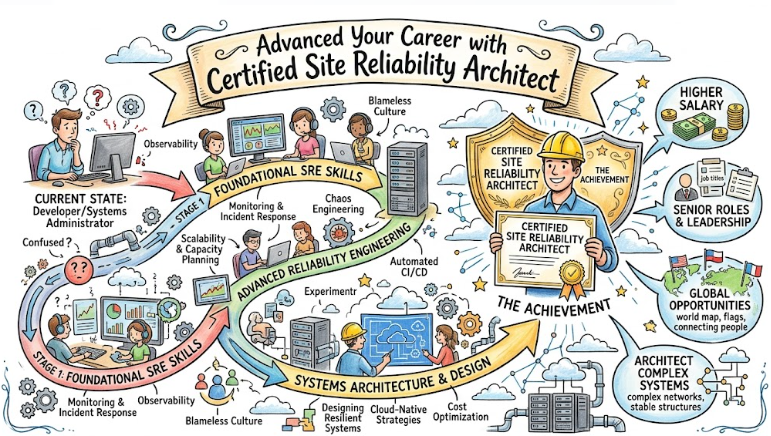
The certification is organized into Foundation, Professional, and Advanced levels to mirror the natural progression of an engineering career. The Foundation level focuses on the vocabulary and core concepts of reliability, while the Professional level dives deep into the implementation of automation and observability. The Advanced level is purely architectural, focusing on the design of global-scale resilient systems.
Beyond the core levels, there are specialization tracks that allow professionals to map their reliability skills to specific domains like FinOps, DevOps, or DataOps. This flexibility ensures that the certification remains relevant whether you are managing a small startup’s infrastructure or a massive enterprise data lake. Each level serves as a prerequisite or a building block, creating a clear and logical path toward technical leadership.
Complete Certified Site Reliability Architect Certification Table
| Track | Level | Who it’s for | Prerequisites | Skills Covered | Recommended Order |
| Core SRE | Foundation | Developers, Juniors | Basic Linux | SLOs, SLIs, Toil | 1 |
| Engineering | Professional | SREs, DevOps Engineers | Foundation | Automation, Monitoring | 2 |
| Architecture | Advanced | Senior SREs, Leads | Professional | System Design, DR | 3 |
| Specialized | Expert | Principal Architects | Advanced | Global Scale, Strategy | 4 |
Detailed Guide for Each Certified Site Reliability Architect Certification
Certified Site Reliability Architect – Foundation
What it is
This certification validates a candidate’s understanding of the core SRE mindset and the fundamental metrics used to define system health. It is the mandatory entry point for those entering the world of reliability engineering.
Who should take it
It is suitable for software developers, junior system admins, and traditional operations staff who want to understand the modern approach to infrastructure. It is also perfect for managers needing a high-level overview of reliability principles.
Skills you’ll gain
- Mastery of Service Level Objectives and Indicators.
- Understanding the concept of Error Budgets.
- Identifying and eliminating operational toil.
- Basic understanding of monitoring versus observability.
Real-world projects you should be able to do
- Define a reliability roadmap for a simple web application.
- Calculate error budgets for a tiered service architecture.
- Design a basic incident response communication plan.
Preparation plan
- 7–14 days: Focus on reading the core SRE handbooks and understanding the vocabulary of reliability engineering.
- 30 days: Engage with online modules and take practice quizzes to solidify the concepts of SLIs and SLOs.
- 60 days: Apply foundation principles to a small-scale internal project and document the impact on operational workload.
Common mistakes
- Treating SRE as just another word for system administration.
- Failing to understand the mathematical relationship between availability and downtime.
- Over-complicating the initial set of monitoring metrics.
Best next certification after this
- Same-track option: Certified Site Reliability Architect – Professional
- Cross-track option: Certified DevOps Professional
- Leadership option: Team Lead Foundation
Certified Site Reliability Architect – Professional
What it is
The professional level validates the technical execution skills required to build and maintain reliable systems. It focuses on the automation of routine tasks and the implementation of robust observability stacks.
Who should take it
This is designed for practicing DevOps engineers and SREs who have at least two years of experience. It is for those who are responsible for the uptime of production environments and want to improve their technical depth.
Skills you’ll gain
- Advanced automation using configuration management and scripting.
- Implementation of distributed tracing and log aggregation.
- Managing complex incident response and blameless post-mortems.
- Designing automated canary deployments and rollbacks.
Real-world projects you should be able to do
- Automate the recovery of a failed microservice without human intervention.
- Build a comprehensive observability dashboard for a distributed system.
- Lead a technical post-mortem for a major production outage.
Preparation plan
- 7–14 days: Review advanced scripting and automation patterns specifically focused on error handling and recovery.
- 30 days: Work through lab environments to practice setting up observability tools and simulating system failures.
- 60 days: Execute a full automation project in a staging environment to demonstrate skills in toil reduction.
Common mistakes
- Automating a broken process instead of fixing the underlying architecture.
- Ignoring the cultural aspect of blamelessness during incident reviews.
- Setting up too many alerts, leading to alert fatigue for the team.
Best next certification after this
- Same-track option: Certified Site Reliability Architect – Advanced
- Cross-track option: Certified DevSecOps Specialist
- Leadership option: Technical Project Management
Certified Site Reliability Architect – Advanced
What it is
This is the pinnacle of the program, validating the ability to design massive, resilient architectures. It focuses on high-level strategy, capacity planning, and the structural integrity of global platforms.
Who should take it
Senior engineers, principal architects, and infrastructure directors should pursue this level. It is for those who are making the “big picture” decisions that affect the entire organization’s technical viability.
Skills you’ll gain
- Designing multi-region, multi-cloud architectures for high availability.
- Long-term capacity planning and resource forecasting.
- Architectural patterns for disaster recovery and business continuity.
- Strategic leadership of SRE organizations and culture.
Real-world projects you should be able to do
- Design a global traffic management system for a low-latency application.
- Create a multi-year infrastructure scaling strategy for an enterprise.
- Architect a zero-downtime migration for a legacy data system.
Preparation plan
- 7–14 days: Deep dive into white papers regarding distributed system design and global networking patterns.
- 30 days: Analyze case studies of major cloud outages and design theoretical architectural fixes for them.
- 60 days: Prepare a comprehensive architectural proposal for a complex system and present it for peer review.
Common mistakes
- Designing complex systems that are impossible for smaller teams to operate.
- Failing to account for the cost implications of high-availability designs.
- Over-engineering solutions for problems that do not yet exist.
Best next certification after this
- Same-track option: Distinguished Architect Fellowship
- Cross-track option: Certified FinOps Practitioner
- Leadership option: CTO / Engineering Director Track
Choose Your Learning Path
DevOps Path
The DevOps path within this certification framework is designed for those who want to integrate reliability into the continuous delivery pipeline. It focuses on the technical aspects of deployment automation, quality gates, and automated testing to ensure that every release is stable. This path is ideal for engineers who want to remain close to the development lifecycle while maintaining a focus on operational excellence. It creates a bridge between the agility of development and the stability of operations.
DevSecOps Path
The DevSecOps path emphasizes that reliability is impossible without security. This track teaches you how to integrate automated security scanning, compliance checks, and vulnerability management into the SRE framework. You will learn to treat security incidents as reliability incidents, using the same response and post-mortem methodologies. It is a vital path for professionals working in highly regulated industries like banking or government services.
SRE Path
The SRE path is the core journey for those who want to specialize exclusively in system health and performance. It follows the traditional Google-pioneered model of using software engineering to solve operations problems. You will spend your time mastering observability, incident management, and toil reduction. This path is for the “purist” who wants to be at the forefront of the reliability engineering movement.
AIOps Path
The AIOps path focuses on the application of machine learning and data science to IT operations. You will learn how to design systems that can predict outages before they happen and automate root cause analysis. This path is for the forward-thinking architect who wants to use data-driven insights to manage massive infrastructure. It requires a balance of traditional infrastructure knowledge and modern data analysis skills.
MLOps Path
The MLOps path is a specialized track for those managing the reliability of machine learning models in production. It addresses the unique challenges of model drift, data versioning, and the computational demands of AI inference. You will learn how to build pipelines that ensure ML models are delivered and monitored with the same rigor as traditional software. This path is essential as AI becomes a core component of enterprise applications.
DataOps Path
The DataOps path applies reliability principles to the data lifecycle. This involves designing resilient data pipelines, ensuring data quality through automated checks, and managing the uptime of big data platforms. As organizations become more data-centric, the reliability of the data itself becomes a critical business requirement. This path is perfect for data engineers who want to adopt a more architectural and operational mindset.
FinOps Path
The FinOps path teaches architects how to balance system reliability with financial efficiency. In a world of elastic cloud spending, an architect must understand how to design for cost as a primary constraint. You will learn about cloud billing structures, resource rightsizing, and how to communicate the value of infrastructure investments to business stakeholders. This path is critical for senior leaders who have budget responsibility.
Role → Recommended Certified Site Reliability Architect Certifications
| Role | Recommended Certifications |
| DevOps Engineer | Foundation, Professional |
| SRE | Professional, Advanced |
| Platform Engineer | Professional, Advanced, DevOps |
| Cloud Engineer | Foundation, Professional, FinOps |
| Security Engineer | Foundation, DevSecOps |
| Data Engineer | Foundation, DataOps, MLOps |
| FinOps Practitioner | Foundation, FinOps |
| Engineering Manager | Foundation, Advanced, Leadership |
Next Certifications to Take After Certified Site Reliability Architect
Same Track Progression
Once you have mastered the architectural levels, the journey continues with deep specialization. This might involve becoming a subject matter expert in specific cloud providers or mastering niche technologies like service meshes and complex container orchestration. The goal is to move from being an architect to becoming a thought leader within your organization, capable of mentoring others and setting global standards.
Cross-Track Expansion
The most effective architects are those with a broad range of knowledge across multiple domains. After completing the reliability track, expanding into DevSecOps or FinOps provides a more holistic view of the business. Understanding how security and cost impact reliability allows you to make better-informed architectural decisions. This cross-pollination of skills makes you a more versatile leader and increases your market value significantly.
Leadership & Management Track
For those who wish to move away from the keyboard and into strategic planning, the leadership track is the natural evolution. This path focuses on organizational culture, budgeting, and long-term technical vision. You will use your architectural background to build high-performing teams and foster an environment where reliability is a core value. This transition is ideal for those who want to have a broad impact on how a company uses technology.
Training & Certification Support Providers for Certified Site Reliability Architect
DevOpsSchool
DevOpsSchool provides a massive ecosystem for learning modern engineering practices, offering everything from short workshops to long-term intensive programs. They have built a reputation for having a practical approach that helps students transition from theory to practice quickly. Their courses are designed to handle the fast-paced changes in the industry, ensuring that the curriculum is always updated with the latest tools. For professionals looking to start their journey toward becoming an architect, this provider offers the foundational support needed to clear the initial certification levels. They are particularly known for their strong community presence in the Asian markets.
Cotocus
Cotocus is a high-end training provider that focuses on niche skills within the cloud-native and SRE domains. They often work with enterprise teams to provide customized training that addresses specific organizational challenges. Their trainers are usually active practitioners who bring real-world case studies into every session. This makes their training highly effective for those aiming for the Professional or Advanced levels of the architecture track. By focusing on deep technical mastery rather than just exam passing, they help engineers develop a deep-seated competence that lasts throughout their careers. Their mentorship-driven model is highly valued by senior professionals.
Scmgalaxy
Scmgalaxy has been a cornerstone of the configuration management and DevOps community for over a decade. They offer a vast repository of free and paid learning materials that cover the entire spectrum of software delivery. Their training programs are often praised for being highly detailed and for providing students with a wealth of documentation and lab guides. For someone pursuing the Certified Site Reliability Architect, Scmgalaxy provides the technical depth required to master the “under the hood” aspects of infrastructure. Their community forums are also a great place for candidates to discuss complex topics and share preparation tips.
BestDevOps
BestDevOps focuses on delivering high-impact, results-oriented training for individuals and corporate teams. They understand that time is a premium for working professionals, so their courses are designed to be concise and focused on high-value skills. They provide a clear roadmap for certification preparation, including mock exams and lab environments that simulate real production issues. Their support team is highly responsive, helping students navigate the complexities of the certification process. For those looking for a balanced approach between cost and quality, BestDevOps represents a very strong option in the market.
devsecopsschool
devsecopsschool is the primary resource for engineers who want to master the intersection of security and operations. As security becomes an inseparable part of reliability, the training provided here becomes essential for any aspiring architect. They offer specialized tracks that teach you how to automate security at every stage of the development lifecycle. Their curriculum covers modern topics like supply chain security and cloud-native protection. By learning from this provider, a reliability architect ensures that the systems they design are not just resilient to failures, but also to malicious attacks, making them a more complete professional.
sreschool
sreschool is the specialized hub for all things related to Site Reliability Engineering and is the direct host of the architect certification. Their programs are uniquely aligned with the certification requirements, offering the most direct path to success. Because they focus exclusively on SRE, their depth of knowledge in this area is unmatched. They provide a structured learning journey that covers the cultural, technical, and architectural aspects of the role. For anyone serious about the Certified Site Reliability Architect designation, sreschool is the most logical starting point for their education and assessment needs.
aiopsschool
aiopsschool caters to the elite group of engineers who are looking to integrate machine learning into their operational workflows. They provide cutting-edge training on how to use AI for anomaly detection, predictive maintenance, and automated incident management. This training is vital for architects who are managing systems at such a scale that manual intervention is no longer feasible. By learning the principles of AIOps, you can design systems that are proactive rather than reactive. This provider is at the forefront of the next wave of operational evolution, making them a key partner for future-focused architects.
dataopsschool
dataopsschool addresses the specific needs of data professionals who want to adopt an SRE mindset. They teach you how to apply reliability principles to complex data architectures, ensuring that data pipelines are as robust as application pipelines. This involves learning about data observability, automated testing for data quality, and managing large-scale distributed databases. For a reliability architect, understanding the data layer is often the most challenging part of the job, and the specialized training here helps bridge that gap. Their focus on the practicalities of big data operations makes them a unique and valuable training provider.
finopsschool
finopsschool is dedicated to the financial management of cloud resources, a critical skill for any modern architect. They provide the training needed to implement a successful FinOps practice within an organization, focusing on accountability and optimization. You will learn how to read cloud bills, identify waste, and design systems that are inherently cost-effective. For senior architects and managers, the ability to show the financial impact of their technical decisions is key to gaining executive buy-in. Finopsschool provides the tools and the vocabulary needed to bridge the gap between the engineering team and the finance department.
Frequently Asked Questions (General)
- How difficult is the Certified Site Reliability Architect exam?
The difficulty increases with each level, starting with foundational concepts and moving toward complex, practical architectural scenarios that require significant experience.
- How much time does it take to get certified?
While the foundational level can be completed in a few weeks, reaching the advanced architectural level typically takes several months of dedicated study and practice.
- What are the prerequisites for the advanced level?
You generally need to have passed the professional level and demonstrate several years of experience managing production-grade distributed systems in a lead role.
- Is there a high demand for reliability architects in India?
Yes, as Indian tech hubs continue to grow, companies are looking for senior talent who can manage the massive scale and complexity of global services.
- Can I pursue this certification if I am currently a developer?
Absolutely, the foundation level is designed to help developers transition into a reliability mindset, providing a clear path for career pivoting into SRE.
- What is the typical salary impact of this certification?
Certified architects often command significantly higher salaries because they fill a critical gap in the market for senior-level infrastructure and reliability expertise.
- Does the certification expire after a certain period?
Like most high-level technical certifications, there is usually a renewal process every two to three years to ensure your skills remain current with technology.
- Is the exam conducted online or at a center?
The program is designed to be accessible globally, typically offering online proctored exams that allow you to take the assessment from your own location.
- Are there any lab-based components in the professional exam?
Yes, the professional and advanced levels emphasize practical application, often requiring you to solve real problems in a simulated production environment.
- How does this certification help an Engineering Manager?
It provides managers with a standardized framework for evaluating their team’s operational health and helps them make better strategic decisions regarding infrastructure.
- Do I need to know specific tools like Kubernetes or Terraform?
While the principles are tool-agnostic, you will need a working knowledge of common industry tools to complete the practical assessments at the higher levels.
- Is there community support for students during the preparation phase?
Yes, sreschool and other providers often host forums and community groups where students can interact, ask questions, and share their learning experiences.
FAQs on Certified Site Reliability Architect
- What makes the architect level different from a senior SRE?
The architect level focuses on the structural design and long-term strategy of systems, whereas a senior SRE often focuses more on implementation and response.
- How does this certification handle the concept of Error Budgets?
It treats Error Budgets as a primary architectural constraint that dictates the balance between new feature releases and the need for system stability.
- Can this certification help me in a multi-cloud environment?
Yes, the core principles of reliability architecture are designed to be applicable across any cloud provider or hybrid infrastructure setup you may encounter.
- Is the culture of blamelessness covered in the curriculum?
Culture is a major pillar of the program, as technical reliability cannot exist without a supportive organizational culture that values learning from failures.
- How does the certification address the reduction of toil?
It teaches a quantitative approach to identifying manual, repetitive tasks and provides the architectural framework for building automated, long-term solutions to eliminate them.
- What role does observability play in the architectural track?
Observability is considered the foundation of reliability; the track covers how to design systems that are inherently transparent and easy to debug.
- Are there specific tracks for different industry verticals?
While the core is universal, the specialization tracks allow you to apply reliability principles to specific domains like Finance, Data, or Security.
- Is the Certified Site Reliability Architect recognized by major tech companies?
The program is built on industry-standard principles developed at top tech firms, making it highly recognizable and respected by hiring managers globally.
Final Thoughts: Is Certified Site Reliability Architect Worth It?
From the perspective of a mentor who has seen the industry evolve over two decades, I can tell you that the shift toward reliability is permanent. We are past the era where “keeping the lights on” was enough; today, infrastructure is a competitive advantage. The Certified Site Reliability Architect is worth the investment because it forces you to think about systems in a way that few other programs do. It moves you away from being a consumer of tools and turns you into a designer of resilient ecosystems.
If you are a professional who enjoys the challenge of solving complex problems and wants to lead at the highest levels of technology, this is your path. There is no hype here—just the hard reality that systems will fail, and the world needs architects who know how to build them to survive those failures. Take the first step by mastering the foundations and then continue to build your expertise level by level. Your future self, and the companies you will build for, will thank you for the foresight.

