
Introduction
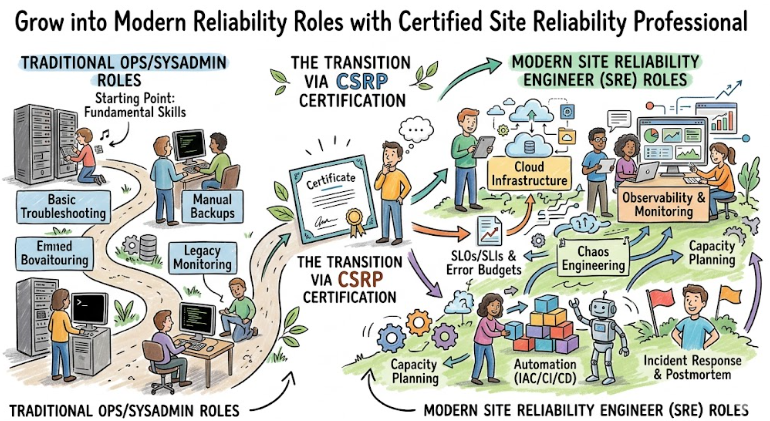
The Certified Site Reliability Professional is a comprehensive validation for engineers looking to bridge the gap between traditional operations and modern software engineering. This guide is designed for professionals navigating the complexities of cloud-native ecosystems, platform engineering, and automated infrastructure. As the industry moves toward autonomous systems and highly resilient architectures, understanding the principles hosted at sreschool becomes a career-defining move. This manual provides a clear roadmap to help you evaluate the certification’s impact and make informed decisions about your professional growth.
What is the Certified Site Reliability Professional?
The Certified Site Reliability Professional represents a shift from theoretical knowledge to production-grade competency in modern infrastructure management. It exists to standardize the multidisciplinary skills required to maintain high availability, scalability, and performance in distributed systems. Unlike academic courses, this program emphasizes hands-on application, focusing on how to manage toil, implement Service Level Objectives, and handle incident response. It aligns perfectly with modern enterprise workflows where the boundary between development and operations has blurred into a single, cohesive engineering discipline.
Who Should Pursue Certified Site Reliability Professional?
This certification is built for software engineers who want to specialize in reliability and DevOps engineers looking to formalize their expertise in systems architecture. It is equally valuable for Cloud Architects and Security professionals who need to understand the operational impact of their designs. In the global market, including the rapidly expanding tech hubs in India, there is a massive demand for professionals who can handle large-scale migrations and maintain uptime. Even engineering managers find value here, as it provides the technical vocabulary and strategic framework needed to lead high-performing platform teams.
Why Certified Site Reliability Professional is Valuable and Beyond
The demand for reliability engineering is driven by the universal move toward digital-first business models where downtime equals significant revenue loss. This certification ensures longevity in a career by teaching foundational principles that remain relevant even as specific tools and cloud providers evolve. It offers a high return on time investment because it focuses on solving systemic problems rather than just learning syntax. By mastering these concepts, professionals stay competitive and become indispensable assets to organizations that prioritize stable and scalable digital services.
Certified Site Reliability Professional Certification Overview
The program is delivered via the Certified Site Reliability Professional and is hosted on the sreschool. It utilizes a structured assessment approach that combines conceptual testing with practical scenarios to ensure a candidate can perform under real-world pressure. The ownership of the curriculum lies with industry veterans who ensure the content reflects current enterprise practices and challenges. The structure is modular, allowing learners to progress through different stages of complexity while maintaining a focus on actionable engineering skills.
Certified Site Reliability Professional Certification Tracks & Levels
The certification is categorized into foundation, professional, and advanced levels to cater to different career stages. The foundation level introduces core concepts like error budgets and monitoring, while the professional level dives deep into automation and incident management. Advanced levels focus on architectural patterns, multi-cloud reliability, and leadership within the SRE domain. These levels are designed to align with career progression, moving from individual contributor roles to senior technical leadership and specialized track mastery.
Complete Certified Site Reliability Professional Certification Table
| Track | Level | Who it’s for | Prerequisites | Skills Covered | Recommended Order |
| Core SRE | Foundation | Junior Engineers | Basic Linux/Cloud | SLIs, SLOs, Toil Reduction | 1 |
| Engineering | Professional | Mid-level DevOps | 2+ Years Experience | CI/CD, Error Budgets, IaC | 2 |
| Architecture | Advanced | Senior/Principal | 5+ Years Experience | Distributed Systems, Scalability | 3 |
| Management | Leadership | Leads/Managers | Management Exp | Team SLOs, Budgeting, Culture | 4 |
Detailed Guide for Each Certified Site Reliability Professional Certification
Certified Site Reliability Professional – Foundation
What it is
This entry-level certification validates a fundamental understanding of site reliability principles and the cultural shift required for successful SRE implementation.
Who should take it
It is suitable for recent graduates, junior system administrators, and software developers who are new to the concepts of production operations and reliability.
Skills you’ll gain
- Understanding the difference between SRE and traditional DevOps.
- Defining Service Level Indicators and Service Level Objectives.
- Identifying and measuring operational toil in daily workflows.
Real-world projects you should be able to do
- Draft a basic SLO document for a simple web application.
- Set up basic monitoring and alerting for a microservice.
Preparation plan
- 7–14 Days: Focus on reading core documentation and understanding the terminology of error budgets and uptime.
- 30 Days: Practice defining metrics for small projects and participate in community forums to discuss reliability scenarios.
- 60 Days: Deep dive into case studies of system failures to understand how fundamental principles apply to recovery.
Common mistakes
Candidates often confuse SRE with general cloud administration or fail to understand the mathematical aspects of error budgets.
Best next certification after this
- Same-track option: Professional SRE Level
- Cross-track option: Cloud Practitioner
- Leadership option: Team Lead Fundamentals
Certified Site Reliability Professional – Professional
What it is
This certification validates the ability to implement and manage SRE practices in a production environment using automation and standardized frameworks.
Who should take it
Experienced DevOps engineers and mid-level software developers who are responsible for the uptime and performance of live applications should pursue this level.
Skills you’ll gain
- Implementing Infrastructure as Code for resilient deployments.
- Managing complex incident response and conducting blameless post-mortems.
- Automating repetitive operational tasks to eliminate toil.
Real-world projects you should be able to do
- Automate the recovery process for a failed database cluster.
- Build a dashboard that visualizes error budget consumption in real-time.
Preparation plan
- 7–14 Days: Review advanced automation scripts and study incident management life cycles.
- 30 Days: Set up a sandbox environment to practice chaos engineering and failure injection.
- 60 Days: Work on optimizing CI/CD pipelines for reliability rather than just speed.
Common mistakes
Focusing too much on specific tools (like Terraform or Jenkins) instead of the underlying reliability patterns is a frequent pitfall.
Best next certification after this
- Same-track option: Advanced SRE Architect
- Cross-track option: DevSecOps Specialist
- Leadership option: Engineering Manager Track
Choose Your Learning Path
DevOps Path
This path focuses on the integration of development and operations with a heavy emphasis on delivery speed and reliability. Professionals here learn to build robust pipelines that allow for frequent code changes without compromising system stability. It is the ideal starting point for those who want to master the full software delivery lifecycle.
DevSecOps Path
In this track, security is integrated into every stage of the SRE and DevOps process. Candidates learn how to automate security checks and maintain compliance without slowing down the deployment process. It is designed for those who want to ensure that high-speed releases are also highly secure and resilient against threats.
SRE Path
The pure SRE path is dedicated to the science of reliability, focusing on scaling systems and managing production environments. It emphasizes the use of software engineering to solve operational problems and improve system longevity. This is perfect for engineers who enjoy deep-diving into system internals and performance tuning.
AIOps Path
This specialization explores the use of artificial intelligence to enhance operational efficiency. It covers automated anomaly detection, predictive maintenance, and intelligent alerting systems. Professionals in this path work on the cutting edge of autonomous infrastructure management.
MLOps Path
MLOps focuses on the reliability and deployment of machine learning models in production. It bridges the gap between data science and production engineering, ensuring that models remain performant and scalable. It is essential for organizations that rely on live data and complex algorithmic decision-making.
DataOps Path
DataOps applies SRE and DevOps principles to data pipelines and big data infrastructure. It ensures that data delivery is consistent, high-quality, and reliable across the organization. This path is vital for data engineers who need to manage massive datasets with the same rigor as application code.
FinOps Path
The FinOps path introduces financial accountability to the cloud and SRE world. It focuses on optimizing cloud spend while maintaining the performance and reliability of services. This is a critical role for professionals who need to balance technical excellence with business cost-efficiency.
Role → Recommended Certified Site Reliability Professional Certifications
| Role | Recommended Certifications |
| DevOps Engineer | Professional Track + DevSecOps |
| SRE | Full Core Track (Foundation to Advanced) |
| Platform Engineer | Professional Track + DataOps |
| Cloud Engineer | Foundation + Advanced Architecture |
| Security Engineer | Professional Track + DevSecOps |
| Data Engineer | Foundation + DataOps Track |
| FinOps Practitioner | Foundation + FinOps Specialist |
| Engineering Manager | Foundation + Leadership Track |
Next Certifications to Take After Certified Site Reliability Professional
Same Track Progression
Once you have mastered the professional level, the logical step is to pursue advanced architectural certifications. These focus on global-scale systems, multi-region failover strategies, and the design of self-healing infrastructures. Deep specialization ensures you are prepared for roles like Principal Reliability Engineer or Chief Architect.
Cross-Track Expansion
To become a well-rounded engineer, expanding into security (DevSecOps) or data (DataOps) is highly recommended. Understanding how reliability interacts with other domains allows you to solve complex, cross-functional problems. This broadening of skills makes you a versatile asset in any high-growth technology organization.
Leadership & Management Track
For those looking to move away from day-to-day coding, the leadership track focuses on building SRE cultures. This includes hiring strategies, managing team SLOs, and aligning technical goals with business objectives. It prepares you for roles such as Director of Platform Engineering or VP of Infrastructure.
Training & Certification Support Providers for Certified Site Reliability Professional
DevOpsSchool
Provides intensive training programs focused on practical DevOps and SRE skills. Their curriculum is designed to help professionals master automation tools and cloud infrastructure through hands-on labs and expert mentorship.
Cotocus
A specialized provider known for its deep-dive workshops into containerization and orchestration. They offer customized training paths that align with the certification requirements of modern engineering roles.
Scmgalaxy
A comprehensive resource hub and training center for configuration management and software supply chain security. They provide extensive documentation and tutorials for candidates preparing for reliability exams.
BestDevOps
Focuses on delivering high-quality educational content and certification prep for engineering professionals. Their approach emphasizes real-world scenarios and production-level troubleshooting.
devsecopsschool
Dedicated to the integration of security into the DevOps lifecycle. They provide specialized courses that help SREs understand and implement automated security protocols within their reliability frameworks.
sreschool
The primary hosting body for the certification, offering direct access to the official curriculum and assessment tools. It serves as the central point for professionals seeking to validate their reliability engineering expertise.
aiopsschool
Specializes in the intersection of artificial intelligence and operations. Their training covers how to implement machine learning for proactive system monitoring and automated incident resolution.
dataopsschool
Focuses on the operational aspects of data management. Their programs teach engineers how to apply SRE principles to data pipelines, ensuring high availability and quality of business intelligence.
finopsschool
Provides the necessary training for managing cloud financials. Their courses help technical professionals understand cost optimization strategies without sacrificing system performance or reliability.
Frequently Asked Questions (General)
- How difficult is the certification exam?The exam is moderately challenging as it requires a mix of theoretical knowledge and the ability to solve practical, scenario-based problems.
- What is the recommended preparation time for a working professional?Most professionals find that 30 to 60 days of consistent study is sufficient to cover the material and practice the required skills.
- Are there any mandatory prerequisites?While there are no strict blockers, having a basic understanding of Linux, networking, and at least one cloud provider is highly recommended.
- Does this certification help in getting a salary hike?Yes, validating your skills as a reliability professional often leads to higher-paying roles, as SRE is one of the highest-paid specializations in tech.
- Is the certification recognized globally?The principles taught are industry-standard, making the certification valuable across different countries and various technology sectors.
- How long is the certification valid?Typically, the certification remains valid for two to three years, after which a refresher or higher-level exam is recommended to stay current.
- Can a developer transition to SRE using this program?Absolutely, the curriculum is designed to help developers understand the operational side of the software they build.
- What kind of support is available if I get stuck?The training providers mentioned above offer forums, mentorship, and lab access to help you through difficult concepts.
- How does this differ from a standard DevOps certification?This program focuses more on the software engineering approach to operations and the specific metrics of system reliability.
- Is there a focus on specific tools like Kubernetes?While tools are used in labs, the focus is on the concepts of orchestration and management rather than just a single platform.
- Are the exams remote or at a center?The exams are generally conducted online through proctored platforms, allowing you to take them from your home or office.
- Is it worth it for an Engineering Manager?Yes, it provides the framework needed to build and manage a reliability-focused team and understand technical debt.
FAQs on Certified Site Reliability Professional
- What makes this specific certification unique compared to others? It focuses heavily on the practical application of SRE in diverse enterprise environments rather than just theoretical concepts.
- How does the assessment process work? The assessment involves a series of questions that test your ability to handle real-world production outages and design resilient systems.
- Can I skip the Foundation level? If you have significant industry experience, you may be eligible to start at the Professional level, though Foundation is recommended for a complete base.
- Is the course material updated regularly? Yes, the hosting site ensures that the curriculum reflects the latest trends in cloud-native technologies and site reliability practices.
- What is the pass percentage for the professional exam? The passing score is designed to ensure that only those with a solid grasp of the material can achieve the certification.
- Are there hands-on labs included in the training? Most supported training providers include virtual labs where you can practice failure scenarios in a safe, sandboxed environment.
- How does this certification impact my career in India? With the massive growth of cloud services in India, this certification puts you at the forefront of the most in-demand tech roles.
- Is there a community for certified professionals? Yes, becoming certified gives you access to a network of professionals who share best practices and job opportunities in the field.
Final Thoughts: Is Certified Site Reliability Professional Worth It?
If you are looking for a way to stand out in a crowded market of generalist engineers, specializing in site reliability is one of the smartest moves you can make. This certification provides more than just a badge; it offers a structured way to think about systems, failures, and the business value of uptime. It bridges the gap between writing code and ensuring that code actually works for the end-user under high-load conditions. In my experience mentoring engineers, those who embrace these principles move faster into senior leadership roles because they understand the “big picture” of production. It is a solid investment for anyone serious about a long-term career in modern technology infrastructure.

