
Introduction
Modern IT environments are no longer simple, static systems. They are dynamic, distributed, cloud-native ecosystems made up of microservices, containers, APIs, and multi-cloud infrastructure. As complexity grows, traditional monitoring and manual operations struggle to keep up with the volume of alerts, incidents, and performance issues.
This is where AIOps Training becomes essential.
AIOps (Artificial Intelligence for IT Operations) combines machine learning, big data analytics, and automation to transform how IT teams detect issues, analyze root causes, and resolve incidents. Instead of reacting to problems after they occur, AIOps enables predictive and intelligent operations that reduce downtime and improve service reliability.
For DevOps engineers, SREs, cloud professionals, and IT operations teams, AIOps skills are becoming a core requirement. Organizations are actively investing in professionals who understand AIOps tools, observability, event correlation, anomaly detection, and automation frameworks.
This blog provides a complete guide to AIOps Training and Certification, covering concepts, tools, career paths, use cases, and step-by-step learning roadmaps.
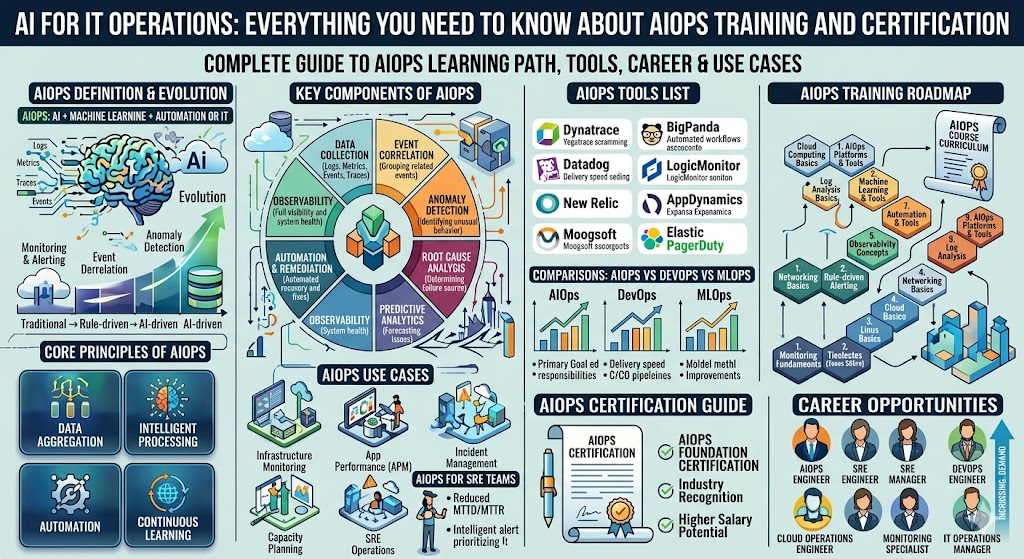
What is AIOps?
AIOps stands for Artificial Intelligence for IT Operations. It refers to the use of AI and machine learning techniques to enhance IT operations by automating and improving:
- Monitoring and alerting
- Event correlation
- Anomaly detection
- Root cause analysis
- Predictive operations
- Incident response automation
Evolution of AIOps
AIOps evolved from traditional IT monitoring systems and big data analytics platforms. Earlier systems focused on collecting logs and metrics. However, they lacked intelligence to interpret patterns or predict failures.
With the rise of cloud computing and distributed systems, AIOps emerged as a solution to:
- Handle massive volumes of telemetry data
- Reduce alert noise and duplication
- Automate operational workflows
- Improve system reliability
Core Principles of AIOps
AIOps is built on four foundational principles:
- Data Aggregation – Collect logs, metrics, traces, and events
- Intelligent Processing – Use AI/ML models to analyze patterns
- Automation – Trigger automated responses and remediation
- Continuous Learning – Improve accuracy over time using feedback loops
Why Organizations Need AIOps
Enterprises today face unprecedented operational complexity. Without AIOps, IT teams struggle with inefficiency and delayed incident resolution.
1. Growing Infrastructure Complexity
Cloud-native applications, Kubernetes clusters, and hybrid environments generate massive telemetry data. Manual analysis becomes impossible at scale.
2. Alert Fatigue
Teams often receive thousands of alerts daily, many of which are redundant or low priority. AIOps helps filter and correlate alerts into meaningful insights.
3. Faster Incident Resolution
AIOps reduces Mean Time to Detect (MTTD) and Mean Time to Resolve (MTTR) by identifying root causes automatically.
4. Cost Optimization
By automating operations and reducing downtime, organizations significantly reduce operational costs.
5. Improved Customer Experience
Faster resolution and proactive monitoring ensure better application performance and user satisfaction.
Key Components of AIOps
AIOps platforms are built around several core capabilities:
Data Collection
Collects data from:
- Logs
- Metrics
- Events
- Traces
- Application telemetry
Event Correlation
Groups related alerts into a single incident to reduce noise and duplication.
Anomaly Detection
Identifies unusual patterns in system behavior using machine learning models.
Root Cause Analysis
Automatically identifies the underlying cause of system failures.
Predictive Analytics
Forecasts potential system issues before they occur.
Automation and Remediation
Triggers automated workflows to resolve incidents without human intervention.
Observability
Provides full visibility into system health across distributed environments.
AIOps Use Cases
AIOps is widely used across IT operations and enterprise environments.
Infrastructure Monitoring
Tracks server health, CPU usage, memory consumption, and system performance.
Application Performance Monitoring
Ensures applications run smoothly and identifies bottlenecks.
Incident Management
Automates incident detection, prioritization, and resolution.
Capacity Planning
Predicts infrastructure requirements based on usage trends.
Security Operations
Detects anomalies that may indicate security threats.
Network Operations
Monitors network traffic and identifies failures or latency issues.
Cloud Operations
Optimizes cloud resource usage and cost efficiency.
SRE Operations
Supports reliability engineering teams in maintaining system uptime.
AIOps for SRE Teams
Site Reliability Engineering (SRE) teams benefit significantly from AIOps adoption.
Key Benefits
- Reduced Mean Time to Detect (MTTD)
- Reduced Mean Time to Resolve (MTTR)
- Intelligent alert prioritization
- Automated incident response
- Improved system reliability
AIOps enables SRE teams to focus on engineering improvements instead of repetitive firefighting tasks.
AIOps Tools List
Here are some widely used AIOps platforms and observability tools:
Dynatrace
Provides AI-driven observability, automatic root cause analysis, and full-stack monitoring.
Datadog
Offers monitoring, logging, and AIOps capabilities for cloud-scale applications.
Splunk
Known for log analytics, event correlation, and ITSI-based AIOps workflows.
New Relic
Provides observability with AI-assisted incident detection and diagnostics.
Moogsoft
Specialized in event correlation and noise reduction for IT operations.
BigPanda
Focuses on alert correlation and incident automation.
PagerDuty
Helps automate incident response and operational workflows.
LogicMonitor
Provides hybrid infrastructure monitoring with automation capabilities.
AppDynamics
Delivers application performance insights and business transaction monitoring.
Elastic
Enables log analytics, observability, and AI-powered search insights.
AIOps vs DevOps
| Aspect | AIOps | DevOps |
|---|---|---|
| Primary Goal | Intelligent operations using AI | Faster software delivery |
| Focus Area | Monitoring and automation | Development and deployment |
| Approach | AI-driven insights | CI/CD pipelines |
| Incident Handling | Automated root cause analysis | Manual + scripted response |
| Tooling | AIOps platforms | DevOps toolchains |
AIOps complements DevOps by improving operational intelligence.
AIOps vs MLOps
| Aspect | AIOps | MLOps |
|---|---|---|
| Purpose | IT operations optimization | ML model lifecycle management |
| Users | IT Ops, SRE teams | Data scientists, ML engineers |
| Focus | Infrastructure and incidents | Model training and deployment |
| Outcome | System reliability | Model performance |
AIOps uses ML models, while MLOps manages those models.
AIOps Training Roadmap
A structured AIOps Training journey includes:
- Monitoring Fundamentals
- Linux Basics
- Cloud Computing Basics
- Networking Fundamentals
- Observability Concepts
- Log Analysis Techniques
- Automation Tools (scripts, APIs)
- Machine Learning Basics
- AIOps Platforms and Tools
AIOps Course Curriculum
A complete AIOps course typically includes:
- Foundations of AIOps
- Event correlation techniques
- Root cause analysis methods
- Observability frameworks
- Incident response workflows
- Predictive analytics
- Hands-on labs
- Enterprise case studies
AIOps Certification Guide
Why Certification Matters
AIOps certification validates your ability to work with modern IT operations systems and tools.
Benefits
- Industry recognition
- Better job opportunities
- Higher salary potential
- Practical skill validation
- Career growth in DevOps and SRE roles
Career Opportunities
- AIOps Engineer
- SRE Engineer
- DevOps Engineer
- Cloud Operations Engineer
- Monitoring Specialist
AIOps Foundation Certification
The AIOps Foundation Certification focuses on:
- Core AIOps concepts
- Event correlation and analytics
- Observability principles
- Automation workflows
- Incident management
It is ideal for beginners entering AIOps training programs.
Skills Required to Become an AIOps Engineer
To succeed in AIOps roles, professionals should develop:
- Linux fundamentals
- Cloud platforms (AWS, Azure, GCP)
- Networking basics
- Python scripting
- Monitoring tools
- Observability concepts
- Machine learning basics
- Automation frameworks
Career Opportunities in AIOps
AIOps creates multiple high-demand career paths:
- AIOps Engineer
- Site Reliability Engineer
- DevOps Engineer
- Cloud Operations Engineer
- Platform Engineer
- Monitoring Specialist
- IT Operations Manager
Future of AIOps
The future of AIOps is driven by advanced AI capabilities:
- Generative AI for operations insights
- Self-healing infrastructure
- Autonomous IT operations
- Predictive incident prevention
- Intelligent automation at scale
AIOps will become the backbone of enterprise IT operations.
Why Learn AIOps from AIOpsSchool
AIOpsSchool provides structured learning designed for modern IT professionals.
Key Benefits
- Structured learning path
- Industry-focused curriculum
- Hands-on practical training
- Real-world case studies
- Certification preparation
- Expert-led sessions
Frequently Asked Questions
1. What is AIOps?
AIOps is the use of artificial intelligence and machine learning to automate IT operations and improve system reliability.
2. Is AIOps a good career option?
Yes, AIOps is a high-demand career path with strong growth in cloud and DevOps domains.
3. How long does it take to learn AIOps?
Typically 2–6 months depending on prior DevOps and cloud experience.
4. What are the best AIOps tools?
Tools include Dynatrace, Datadog, Splunk, New Relic, and PagerDuty.
5. What is the difference between AIOps and DevOps?
DevOps focuses on delivery pipelines, while AIOps focuses on intelligent operations.
6. What is AIOps used for?
It is used for monitoring, anomaly detection, root cause analysis, and incident management.
7. Is AIOps difficult for beginners?
No, beginners can start with monitoring and cloud basics before advancing.
8. What is AIOps certification?
It validates skills in AI-driven IT operations and automation techniques.
9. Does AIOps require coding?
Basic Python or scripting knowledge is helpful but not always mandatory.
10. What is anomaly detection in AIOps?
It identifies unusual system behavior using AI models.
11. What is event correlation?
It groups related alerts into a single meaningful incident.
12. What is predictive operations?
It forecasts potential system failures before they occur.
13. What industries use AIOps?
IT, banking, telecom, healthcare, and cloud service providers.
14. What is observability in AIOps?
It refers to monitoring system health using logs, metrics, and traces.
15. What is the salary of an AIOps engineer?
It varies by region and experience but is generally higher than traditional IT operations roles.
Conclusion: Why AIOps Training Matters Today
AIOps Training is becoming essential for modern IT professionals as enterprises move toward automation, cloud-native architectures, and AI-driven operations. It helps organizations reduce downtime, improve efficiency, and build more reliable systems.
AIOps certification further strengthens career opportunities by validating skills in observability, event correlation, anomaly detection, and predictive operations.
As IT environments continue to grow in complexity, professionals who master AIOps will play a critical role in shaping the future of digital operations. Starting your journey with structured training is the first step toward becoming a highly skilled AIOps engineer.

