
Introduction
Becoming a pilot is one of the most exciting and prestigious career goals in aviation. However, pilot training is also one of the most expensive professional education paths in the world. From ground school theory to flight hours and simulator training, the overall cost can be a major barrier for many aspiring aviators.
This is where scholarships play a crucial role. Scholarships for pilot training help talented students reduce financial pressure and make aviation careers more accessible. Whether offered by governments, airlines, private aviation academies, or defense organizations, these funding opportunities can significantly support your journey toward becoming a professional pilot.
In this blog, we will explore the different scholarship options for pilot training aspirants, eligibility requirements, application processes, and practical tips to improve your chances of selection.
Why Scholarships Are Important for Pilot Training
Pilot training requires substantial financial investment, often ranging from moderate to very high depending on the country and flying school. Scholarships help bridge this gap and provide equal opportunities for deserving candidates.
Key reasons scholarships are important:
- High Training Costs: Flight hours, simulators, and licensing exams are expensive.
- Equal Opportunity Access: Students from all financial backgrounds can pursue aviation.
- Merit-Based Support: Rewards talented and disciplined candidates.
- Encourages Diversity in Aviation: More inclusive pilot community.
- Reduces Education Loans: Minimizes long-term financial burden.
Scholarships ensure that financial limitations do not stop passionate students from achieving their dream of flying.
Types of Pilot Training Scholarships
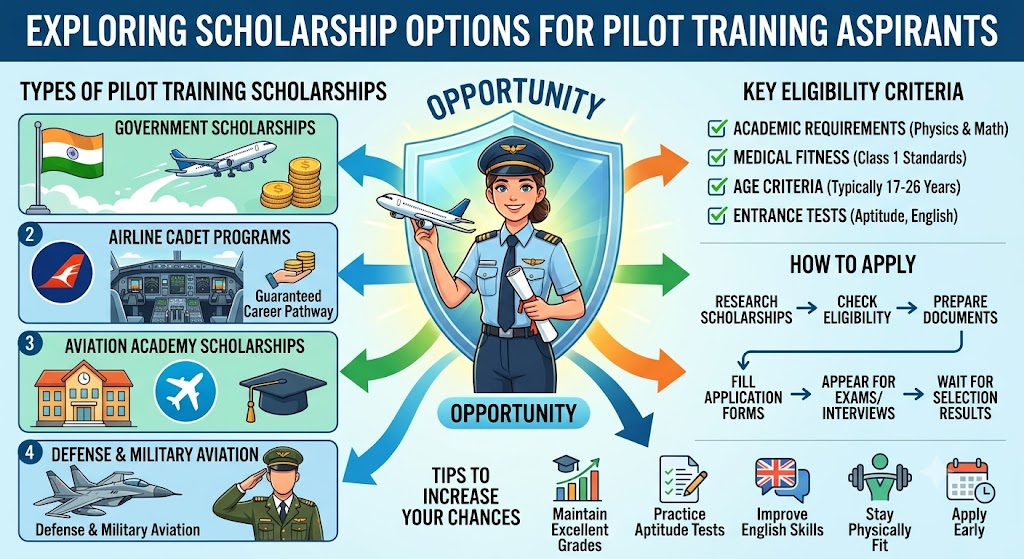
There are several categories of scholarships available for aspiring pilots. Each type serves different needs and career paths.
3.1 Government Scholarships
Many governments offer financial aid programs for aviation education through national scholarship schemes or aviation authorities. These are often merit-based or need-based.
- Support for ground school training
- Partial funding for flight training
- Reserved for national citizens
3.2 Airline Cadet Programs
Airlines often sponsor cadet pilot programs where selected candidates receive structured training.
- Sponsored or partially funded pilot training
- Guaranteed career pathway after completion (in some cases)
- Competitive selection process
3.3 Aviation Academy Scholarships
Flight schools and aviation institutes provide scholarships to attract top-performing students.
- Merit-based discounts or fee reductions
- Entrance exam-based selection
- Performance-based renewal
3.4 Private Aviation Foundation Scholarships
Various aviation organizations and foundations offer grants and scholarships.
- Focus on promoting aviation careers
- May support underrepresented groups
- Often competitive and limited seats
3.5 Defense and Military Aviation Scholarships
Air force and defense training programs often cover full or partial training costs.
- Fully sponsored pilot training
- Includes discipline-based selection tests
- Requires commitment to service
Eligibility Criteria for Aviation Scholarships
Although each scholarship has its own requirements, some common eligibility criteria apply across most programs.
Academic Requirements
- Minimum qualification: 10+2 or equivalent
- Strong background in Physics and Mathematics
- Good academic performance increases selection chances
Medical Fitness
- Must meet Class 1 Medical Standards
- Good vision (with or without correction depending on program)
- Overall physical and mental fitness
Age Criteria
- Usually between 17 to 26 years
- Some programs have flexible age limits
Entrance Tests and Interviews
- Aptitude tests (logical reasoning, math, physics)
- English proficiency assessments
- Personal interviews and group discussions
How to Apply for Pilot Training Scholarships
Applying for pilot scholarships requires careful preparation and attention to detail.
Step-by-step process:
- Step 1: Research Available Scholarships
Identify government, airline, and institute-based options. - Step 2: Check Eligibility
Ensure you meet academic, medical, and age requirements. - Step 3: Prepare Documents
Common documents include:- Academic certificates
- Identity proof
- Medical fitness report
- Passport-size photographs
- Step 4: Fill Application Forms
Complete online or offline applications accurately. - Step 5: Appear for Exams/Interviews
Clear aptitude tests and selection rounds. - Step 6: Wait for Selection Results
Shortlisted candidates are notified through official channels.
Tips to Increase Your Chances of Getting a Scholarship
Competition for pilot training scholarships is extremely high. These tips can help you stand out:
- Maintain excellent academic performance, especially in Physics and Mathematics
- Practice aptitude and reasoning tests regularly
- Improve English communication skills
- Stay physically fit and meet medical standards
- Research multiple scholarship programs
- Apply early and avoid last-minute submissions
- Build basic aviation knowledge before applying
Preparation and consistency are key to securing a scholarship in aviation.
Common Mistakes to Avoid
Many candidates miss opportunities due to simple errors. Avoid these mistakes:
- Missing application deadlines
- Submitting incomplete forms
- Ignoring eligibility criteria
- Poor preparation for aptitude tests
- Lack of required medical certification
- Applying for only one scholarship program
Careful planning can significantly improve your success rate.
Future Career Opportunities After Sponsored Training
Once you complete pilot training through a scholarship or sponsored program, several career paths open up.
Airline Pilot
- Join domestic or international airlines
- Fly commercial passenger aircraft
- Work as First Officer or Captain over time
Cargo and Freight Aviation
- Operate cargo aircraft for logistics companies
- Focus on freight transportation
Charter and Private Aviation
- Fly private jets for individuals and corporations
- Flexible and high-paying opportunities
Defense Aviation Careers
- Serve in air force or military aviation
- Specialized training and responsibilities
Pilot training opens doors to a globally respected and high-growth career.
FAQs
1. Are there fully funded scholarships for pilot training?
Yes, some defense programs and airline cadet programs offer fully funded training, but they are highly competitive and limited in number.
2. Can I get a scholarship after completing 12th grade?
Yes, many scholarships are available for students who have completed 10+2 with Physics and Mathematics.
3. Do I need medical fitness for pilot scholarships?
Yes, most scholarships require Class 1 Medical fitness certification before final selection.
4. Is there an age limit for pilot scholarships?
Yes, most programs accept candidates between 17 to 26 years, but it may vary depending on the program.
5. Are scholarships based on merit or financial need?
They can be either merit-based, need-based, or both depending on the sponsoring organization.
6. Can international students apply for aviation scholarships?
Some global aviation academies and airline programs allow international applicants.
7. What is the most important factor in selection?
Strong academic background, aptitude test performance, and medical fitness are key selection factors.
Conclusion
Pilot training scholarships are a powerful opportunity for aspiring aviators who dream of building a career in aviation but face financial challenges. From government schemes to airline cadet programs and private aviation institute scholarships, there are multiple pathways available for deserving candidates.
Success in securing a scholarship depends on preparation, discipline, and consistent effort. If you are serious about becoming a pilot, start early, build strong fundamentals in science and aptitude, and explore all available funding options.
With the right preparation and determination, your dream of flying can become a reality without being limited by financial barriers.

