
Introduction
Pilot training is a high-investment career path that requires structured financial planning from the beginning. The cost of completing a Commercial Pilot License (CPL), including ground school, flight hours, simulator training, and living expenses, can be substantial for most students. This is where pilot training loans become essential.
A pilot training loan is a specialized education loan designed to fund aviation training programs, particularly CPL courses at approved flying schools. These loans help students bridge the financial gap and focus on training without immediate financial pressure.
For aviation students, understanding loan structure, repayment plans, and eligibility is critical because aviation careers take time to generate income after training completion.
Real-World Use Cases
Pilot training loans are widely used in different scenarios:
- A middle-class student enrolling in a DGCA-approved flying school using bank financing
- Parents funding their child’s aviation education through structured EMI plans
- Career changers transitioning from IT, engineering, or other industries into aviation
- Students comparing different financial institutions for lower interest rates and better repayment terms
- Learners combining partial savings with education loans to complete CPL training
These scenarios show how financial planning plays a key role in making aviation careers accessible.
What Students Should Evaluate Before Taking a Loan
Before applying for a pilot training loan, students should carefully evaluate several factors:
- Total cost of training and hidden expenses
- Interest rates and EMI burden after training
- Loan repayment duration and flexibility
- Requirement of collateral or guarantor
- Reputation and approval status of flying school
- Moratorium period (time before repayment starts)
- Processing fees and additional bank charges
- Future salary expectations and job placement chances
Proper evaluation ensures students avoid long-term financial stress.
What Is a Pilot Training Loan?
A pilot training loan is an education loan specifically designed to finance aviation training programs such as CPL, PPL, and ground school courses. These loans are offered by banks and financial institutions to help students cover the cost of training at recognized flying academies.
The loan typically covers:
- Tuition fees
- Flight training hours
- Simulator sessions
- Exam and licensing fees
- Accommodation and living expenses (in some cases)
Repayment usually begins after course completion or after a moratorium period.
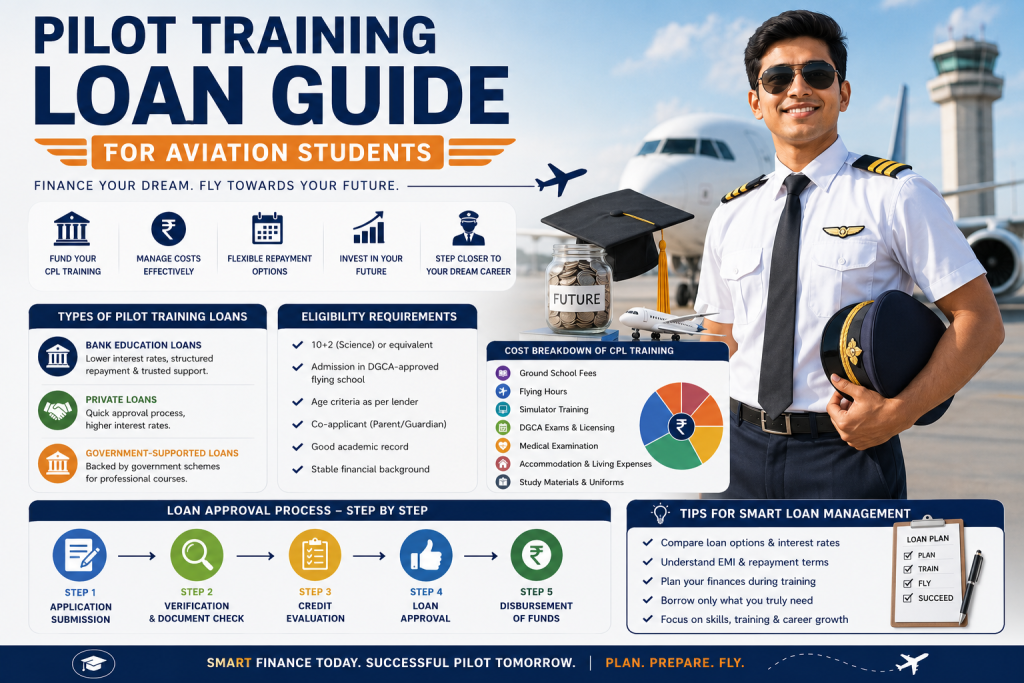
Types of Pilot Training Loans
There are different types of loans available for aviation students:
1. Bank Education Loans
These are standard loans offered by national and private banks. They are generally preferred due to lower interest rates and structured repayment plans.
2. Private Financial Institution Loans
Private lenders may offer faster approval processes but often come with higher interest rates.
3. Government-Supported Education Loans
Some government-backed schemes may support higher education funding, including professional aviation courses under certain conditions.
Each type has different eligibility rules and repayment structures.
Eligibility Requirements
To apply for a pilot training loan, students usually need to meet the following criteria:
- Minimum educational qualification (typically 10+2 with science subjects)
- Admission in a recognized flying school
- Age requirements as per lending institution policies
- Good academic record
- Co-applicant such as parent or guardian
- Stable financial background of co-applicant
Eligibility may vary depending on the bank or financial institution.
Documents Required
Students must prepare essential documents before applying:
- Identity proof (Aadhar, passport, etc.)
- Address proof
- Academic certificates
- Admission letter from flying school
- Fee structure from training institute
- Co-applicant income proof
- Bank statements
- Collateral documents (if required)
Proper documentation speeds up loan approval.
Loan Approval Process
The loan approval process generally follows these steps:
Step 1: Application Submission
Student applies through bank or financial institution with required documents.
Step 2: Verification
Bank verifies academic background, co-applicant income, and training institute credibility.
Step 3: Credit Evaluation
Financial capacity and repayment ability are assessed.
Step 4: Loan Approval
If eligible, the loan is sanctioned with defined terms.
Step 5: Disbursement
Funds are released directly to the flying school or in phases based on training progress.
Cost Breakdown of Pilot Training
Understanding training costs helps in planning loan amounts effectively:
- Ground school training fees
- Flying hours (major cost component)
- Simulator training charges
- DGCA examination fees
- Medical examination costs
- Accommodation and living expenses
- Study materials and uniforms
Flight hours typically represent the largest portion of overall training costs.
Repayment Strategy for Aviation Students
A strong repayment strategy is essential after completing training:
- Start EMI planning during training itself
- Choose repayment tenure based on expected salary growth
- Maintain emergency savings for initial job phase
- Consider interest-only repayment during training (if available)
- Avoid over-borrowing beyond actual training needs
Most pilots begin repayment after securing their first aviation job, so financial discipline is important.
Common Mistakes Students Make
Many aviation students face financial stress due to avoidable mistakes:
- Taking maximum loan without cost planning
- Ignoring hidden charges and processing fees
- Choosing non-approved or low-quality flying schools
- Not understanding EMI burden after training
- Relying only on optimistic salary expectations
- Not comparing multiple loan options
Avoiding these mistakes improves long-term financial stability.
Evaluation Criteria for Pilot Training Loans
Before finalizing a loan, students should evaluate:
Loan Affordability
Check if EMI fits within expected future income range.
Training Institute Credibility
Ensure the flying school is properly approved and recognized.
Return on Investment (ROI)
Compare total investment with expected career earnings.
EMI Feasibility
Assess whether repayment is manageable in early career stages.
Financial Backup Plan
Always have savings or support for initial job search period.
Frequently Asked Questions (FAQs)
1. Are pilot training loans easy to get?
They are available, but approval depends on academic record, co-applicant income, and training institute approval. Strong documentation improves chances significantly.
2. What is the maximum loan amount available?
Loan amounts vary based on institution and training cost. Some banks may cover full CPL training expenses, while others set upper limits.
3. Do banks finance full CPL training?
Yes, many banks finance full CPL training if the flying school is recognized and the applicant meets eligibility requirements.
4. What is the repayment period?
Repayment periods usually range from several years after course completion, depending on the lender’s policy.
5. Can international students apply for pilot training loans?
Eligibility for international students depends on the country and lending institution policies.
6. Is collateral always required?
Not always. Smaller loans may be unsecured, while larger amounts often require collateral or guarantors.
7. When does repayment start?
Repayment typically starts after a moratorium period, often after course completion.
8. Can loan cover living expenses?
Some loans include partial coverage for accommodation and living costs, depending on the lender.
9. What happens if I don’t get a flying job quickly?
Students may need to start repayment regardless of employment status, so financial planning is essential.
10. Which is better: bank loan or private loan?
Bank loans are generally preferred due to lower interest rates and structured repayment terms.
Conclusion
Pilot training loans play a crucial role in making aviation careers accessible to students from different financial backgrounds. With proper planning, these loans can help bridge the gap between ambition and opportunity. However, students must approach borrowing responsibly by understanding repayment obligations, training costs, and future earning potential.
Aviation is a long-term career investment, and financial discipline is just as important as flying skills. Choosing the right loan, evaluating training institutes, and planning repayment early can significantly reduce financial stress after graduation. For aspiring pilots, smart financial planning today leads to a stable and successful aviation career tomorrow.

