
Introduction
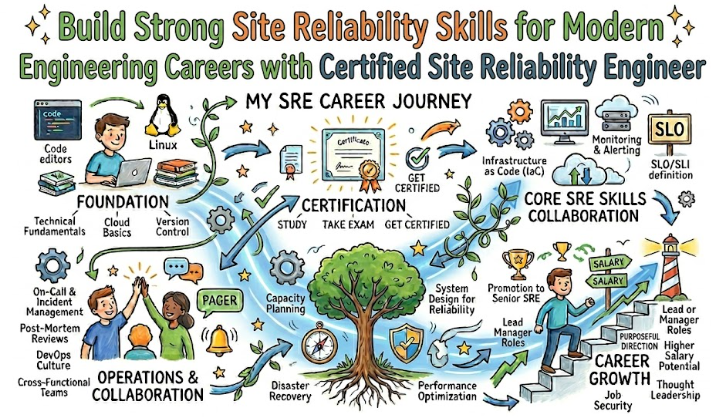
The Certified Site Reliability Engineer certification is designed for professionals who want to build reliable, scalable, and production-ready systems in modern cloud environments. If you are working in DevOps, cloud, or platform engineering, this guide will help you understand where this certification fits in your career path. It connects deeply with real-world engineering challenges like uptime, automation, monitoring, and incident response.
This guide is especially useful for engineers and managers who want clarity before investing time and effort into certification. It explains what the certification offers, how it aligns with real-world roles, and how it helps you make better career decisions. The certification is delivered through sreschool, which focuses on practical, enterprise-grade learning.
What is the Certified Site Reliability Engineer?
The Certified Site Reliability Engineer certification represents a structured way to learn how modern systems are built, operated, and scaled reliably. It focuses on real production systems rather than theoretical concepts. You learn how to manage availability, reduce incidents, and automate operations using proven SRE practices.
This certification exists because companies today rely heavily on always-on digital systems. Any downtime directly impacts revenue and user trust. The certification prepares you to handle such responsibilities with confidence. It aligns closely with real enterprise workflows where monitoring, alerting, and automation are daily activities.
Who Should Pursue Certified Site Reliability Engineer?
This certification is valuable for a wide range of professionals across different experience levels. If you are a DevOps engineer or platform engineer, it helps you strengthen your reliability and scalability skills. For cloud engineers, it adds depth in operational excellence and system design.
Beginners can use it to build a strong foundation in modern infrastructure operations. Experienced engineers can use it to formalize their knowledge and move into senior roles. Engineering managers can also benefit by understanding how reliability engineering impacts team performance and system stability.
It is equally relevant for professionals in India and globally because SRE practices are now widely adopted across industries.
Why Certified Site Reliability Engineer is Valuable and Beyond
The demand for reliability engineering continues to grow as systems become more complex and distributed. Organizations are moving toward microservices, cloud-native architectures, and global-scale systems. This makes SRE skills critical for maintaining performance and uptime.
This certification helps you stay relevant even as tools change. Instead of focusing only on specific tools, it teaches principles like error budgets, SLIs, SLOs, and automation strategies. These concepts remain constant across technologies.
From a career perspective, the return on investment is strong. It opens opportunities in high-demand roles like SRE, platform engineer, and cloud reliability specialist.
Certified Site Reliability Engineer Certification Overview
The program is delivered via the Certified Site Reliability Engineer and hosted on sreschool. It focuses on hands-on learning and real-world scenarios rather than academic theory. The certification structure is designed to validate practical skills used in production environments.
The certification typically includes multiple levels and assessments based on real-world scenarios. Candidates are evaluated on their ability to design, monitor, and maintain reliable systems. The program ownership lies with sreschool, ensuring consistency in training quality and assessment standards.
Certified Site Reliability Engineer Certification Tracks & Levels
The certification is structured into different levels to match career progression. The foundation level introduces core concepts such as monitoring, alerting, and system reliability basics. It is ideal for beginners and those transitioning into SRE roles.
The professional level focuses on deeper technical skills such as incident management, automation, and scalability. This level is suitable for working engineers who want to advance their careers.
Advanced levels cover specialization tracks such as DevOps, FinOps, and platform engineering. These levels align with senior roles where decision-making and system design are critical.
Complete Certified Site Reliability Engineer Certification Table
| Track | Level | Who it’s for | Prerequisites | Skills Covered | Recommended Order |
|---|---|---|---|---|---|
| SRE | Foundation | Beginners, junior engineers | Basic Linux, cloud basics | Monitoring, logging, reliability basics | Start here |
| SRE | Professional | Working engineers | Foundation knowledge | Incident response, automation, scaling | After foundation |
| DevOps | Professional | DevOps engineers | CI/CD knowledge | Deployment reliability, pipelines | Parallel track |
| FinOps | Advanced | Cost-focused engineers | Cloud basics | Cost optimization, efficiency | After professional |
| Platform Engineering | Advanced | Senior engineers | System design knowledge | Infrastructure design, resilience | Final stage |
Detailed Guide for Each Certified Site Reliability Engineer Certification
Certified Site Reliability Engineer – Foundation
What it is
This certification validates your understanding of core SRE concepts such as monitoring, logging, and basic reliability practices. It focuses on building a strong foundation for modern system operations.
Who should take it
Beginners, junior engineers, and professionals transitioning into SRE roles should start here. It is also useful for developers who want to understand production systems.
Skills you’ll gain
- Monitoring and alerting basics
- Understanding SLIs and SLOs
- Logging and observability fundamentals
- Incident awareness
Real-world projects you should be able to do
- Set up monitoring dashboards
- Configure alerts for production systems
- Analyze system logs for issues
Preparation plan
- 7–14 days: Focus on basics and terminology
- 30 days: Practice monitoring tools and scenarios
- 60 days: Work on real-world mini projects
Common mistakes
- Ignoring hands-on practice
- Focusing only on theory
- Not understanding real incidents
Best next certification after this
- Same-track: Professional SRE
- Cross-track: DevOps certification
- Leadership: Engineering management basics
Certified Site Reliability Engineer – Professional
What it is
This certification validates your ability to manage production systems, handle incidents, and automate operations. It is more practical and scenario-based.
Who should take it
Mid-level engineers, DevOps professionals, and SREs looking to grow into senior roles should pursue this level.
Skills you’ll gain
- Incident management
- Automation strategies
- Scalability design
- Performance tuning
Real-world projects you should be able to do
- Handle production incidents
- Automate deployment pipelines
- Optimize system performance
Preparation plan
- 7–14 days: Review core concepts
- 30 days: Practice real scenarios
- 60 days: Build and test systems
Common mistakes
- Lack of real-world exposure
- Ignoring automation
- Weak understanding of scaling
Best next certification after this
- Same-track: Advanced SRE
- Cross-track: FinOps or DevSecOps
- Leadership: Architecture roles
Choose Your Learning Path
DevOps Path
This path focuses on integrating development and operations with reliability. You learn automation, CI/CD, and deployment strategies. It is ideal for engineers working on delivery pipelines and system operations.
DevSecOps Path
This path combines security with reliability. You learn how to secure systems while maintaining uptime. It is useful for professionals handling compliance and security risks.
SRE Path
This is the core path focused on reliability engineering. It includes monitoring, incident management, and system performance. It is best suited for engineers aiming to specialize in SRE roles.
AIOps / MLOps Path
This path introduces automation using AI and machine learning. It helps in predictive monitoring and intelligent alerting. It is useful for advanced automation scenarios.
DataOps Path
This path focuses on data pipeline reliability and performance. It ensures data systems are consistent and scalable. It is relevant for data engineers and analytics teams.
FinOps Path
This path focuses on cost optimization in cloud environments. It helps balance performance and cost efficiency. It is valuable for organizations managing large cloud budgets.
Role → Recommended Certified Site Reliability Engineer Certifications
| Role | Recommended Certifications |
|---|---|
| DevOps Engineer | Foundation + Professional |
| SRE | Professional + Advanced |
| Platform Engineer | Professional + Platform track |
| Cloud Engineer | Foundation + Professional |
| Security Engineer | DevSecOps + SRE |
| Data Engineer | DataOps + SRE |
| FinOps Practitioner | FinOps + SRE |
| Engineering Manager | Professional + Leadership track |
Next Certifications to Take After Certified Site Reliability Engineer
Same Track Progression
You can deepen your expertise by moving into advanced SRE certifications. This helps you specialize in reliability, scalability, and performance engineering.
Cross-Track Expansion
Expanding into DevOps, FinOps, or DevSecOps allows you to build a broader skill set. This makes you more versatile and valuable in cross-functional teams.
Leadership & Management Track
Transitioning into leadership roles requires understanding system design and team management. Certifications in architecture and management can help in this shift.
Training & Certification Support Providers for Certified Site Reliability Engineer
DevOpsSchool
DevOpsSchool provides structured training programs focused on real-world DevOps and SRE practices. The learning approach includes live sessions, practical labs, and real project exposure. It is designed for professionals who want to gain hands-on experience. The training emphasizes automation, CI/CD pipelines, and cloud-native practices. Learners benefit from guided mentorship and industry-aligned content. It helps build strong foundational and advanced skills required in modern engineering roles.
Cotocus
Cotocus offers consulting-driven training programs that focus on solving real business problems. The certification support includes practical case studies and implementation strategies. It is useful for professionals who want to understand enterprise-level challenges. The programs emphasize real-time problem-solving and production environments. Learners gain insights into how systems are managed at scale.
Scmgalaxy
Scmgalaxy focuses on tools and technologies used in DevOps and SRE ecosystems. The training includes detailed coverage of CI/CD, monitoring, and automation tools. It is suitable for professionals looking to strengthen technical skills. The approach is practical and tool-oriented. Learners gain hands-on experience through guided exercises and projects.
BestDevOps
BestDevOps provides certification-oriented training with a focus on career growth. The programs are designed to align with industry demands and job roles. Training includes real-world scenarios and hands-on labs. It is suitable for both beginners and experienced professionals. The goal is to help learners transition into advanced roles.
devsecopsschool
devsecopsschool specializes in integrating security into DevOps and SRE workflows. The training focuses on secure system design and compliance practices. It is useful for professionals working in regulated environments. The programs emphasize practical security implementation. Learners gain knowledge of risk management and security automation.
sreschool
sreschool focuses specifically on Site Reliability Engineering and production systems. The programs are designed to provide deep expertise in reliability, monitoring, and scalability. Training includes real-world case studies and incident simulations. It helps professionals understand how large-scale systems operate. The approach is practical and aligned with enterprise needs.
aiopsschool
aiopsschool focuses on using AI and machine learning for operations. The training includes predictive monitoring and automation techniques. It is useful for advanced professionals exploring intelligent systems. The programs emphasize real-world applications of AI in operations. Learners gain skills in automation and data-driven decision-making.
dataopsschool
dataopsschool focuses on data pipeline reliability and management. The training includes data integration, monitoring, and performance optimization. It is suitable for data engineers and analytics professionals. The approach emphasizes real-world data challenges. Learners gain practical experience in managing large-scale data systems.
finopsschool
finopsschool focuses on cost management and optimization in cloud environments. The training helps professionals understand how to balance cost and performance. It is useful for organizations managing large cloud budgets. The programs emphasize real-world financial operations. Learners gain insights into cost control strategies.
Frequently Asked Questions (General)
1. Is Certified Site Reliability Engineer difficult?
It depends on your background. If you have experience in cloud or DevOps, it becomes easier. Beginners may need more time to understand core concepts.
2. How long does it take to prepare?
Preparation time varies from 2 weeks to 2 months depending on your experience level and consistency.
3. Do I need coding skills?
Basic scripting knowledge is helpful but not mandatory for the foundation level.
4. Is this certification worth it?
Yes, it provides practical skills that are highly valued in modern engineering roles.
5. Can beginners start with this certification?
Yes, the foundation level is designed for beginners.
6. Does it help in job roles?
Yes, it improves your chances for roles like SRE, DevOps engineer, and platform engineer.
7. Is it globally recognized?
Yes, SRE practices are widely adopted across industries worldwide.
8. What tools will I learn?
You will learn monitoring, logging, and automation tools used in real environments.
9. Do I need cloud experience?
Basic cloud knowledge is helpful but not mandatory for beginners.
10. How is the exam structured?
It is usually scenario-based and tests practical understanding.
11. Can I switch careers using this certification?
Yes, it helps in transitioning into DevOps and SRE roles.
12. What is the ROI of this certification?
The return is high due to strong demand for reliability engineers.
FAQs on Certified Site Reliability Engineer
1. What is the main focus of Certified Site Reliability Engineer?
It focuses on building reliable, scalable, and production-ready systems using real-world practices.
2. Is this certification tool-specific?
No, it focuses on principles rather than specific tools.
3. How is it different from DevOps certification?
SRE focuses more on reliability, monitoring, and system performance.
4. Can developers benefit from this certification?
Yes, it helps developers understand production systems better.
5. Does it include automation?
Yes, automation is a core part of the certification.
6. Is hands-on practice required?
Yes, practical experience is essential for success.
7. Can I take it without experience?
Yes, but beginners should start with the foundation level.
8. What roles can I target after this?
You can target SRE, DevOps, and platform engineering roles.
Final Thoughts: Is Certified Site Reliability Engineer Worth It?
If you are serious about building a career in modern infrastructure and cloud systems, the Certified Site Reliability Engineer certification is a strong choice. It does not just teach tools but focuses on how systems behave in real-world environments. This makes it highly practical and relevant.
The certification is especially useful if you want to move into roles that demand responsibility for uptime, performance, and scalability. It also helps you think like a system owner rather than just a tool user.
However, the real value comes only if you apply the concepts in practice. Treat it as a learning journey rather than just a certification goal. If you do that, it can significantly elevate your career.

