
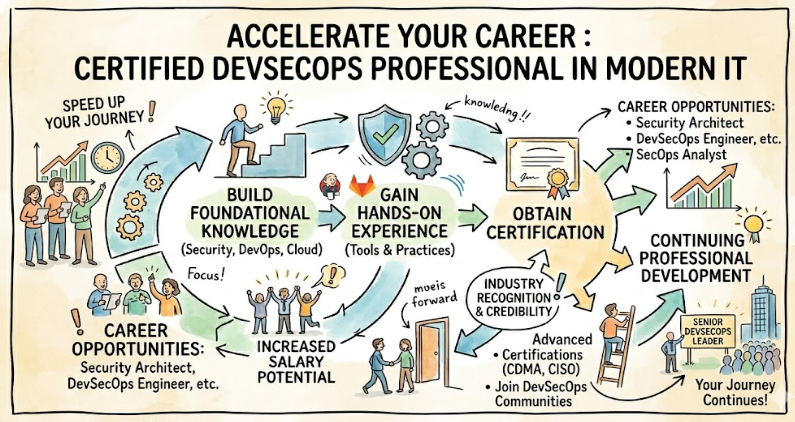
Introduction
Choosing to become a Certified DevSecOps Professional is a significant step for anyone working in modern software delivery. This guide is designed for engineers and managers who want to understand how security fits into the fast-paced world of cloud-native engineering. It provides a clear roadmap for those looking to move beyond basic automation and into the critical area of secure infrastructure.
As companies move more workloads to the cloud, the need for security that moves at the speed of code has never been higher. By following this guide, you will learn how to integrate security into every stage of the pipeline rather than treating it as an afterthought. This resource helps professionals at DevSecOpsschool and across the global IT industry make informed decisions about their career growth and technical focus.
Modern engineering roles now require a deep understanding of how to protect data and systems without slowing down the development process. Whether you are a developer, an SRE, or a technical leader, understanding the path to certification will help you stay competitive in a changing market. This guide simplifies the process and highlights the most effective ways to build a secure career in the DevOps ecosystem.
What is the Certified DevSecOps Professional?
The Certified DevSecOps Professional is a program designed to bridge the gap between traditional security practices and modern automated workflows. It focuses on the “Shift Left” philosophy, where security checks are moved earlier in the software development lifecycle. This ensures that vulnerabilities are caught before they reach a production environment.
Rather than focusing solely on theoretical knowledge, this certification emphasizes practical, hands-on skills that are used in real-world engineering teams. It covers how to use automated tools to scan code, manage secrets, and monitor infrastructure for threats. The goal is to create engineers who can build resilient systems that are secure by design.
This program aligns perfectly with enterprise practices where speed and security must coexist. It moves away from the old model of having a separate security team that blocks releases. Instead, it teaches engineers how to build security directly into the tools and platforms they use every day, making security a shared responsibility across the whole team.
Who Should Pursue Certified DevSecOps Professional?
This certification is ideal for software engineers and DevOps practitioners who want to specialize in security automation. System administrators and SREs who are responsible for maintaining high-availability systems will find great value in learning how to defend those systems against modern cyber threats. It provides a structured path for moving into a specialized security role.
Cloud professionals and data engineers also benefit because security is now a fundamental requirement for all cloud-based services. If you are handling sensitive data or managing large-scale infrastructure, you need to know how to implement robust security controls. Even beginners with a strong foundation in Linux and networking can use this as a way to enter a high-demand field.
For engineering managers and technical leaders in India and global markets, this certification provides the context needed to lead secure teams. It helps managers understand the tools and processes their engineers use, allowing them to make better strategic decisions. Anyone looking to increase their market value in a security-conscious industry should consider this path.
Why Certified DevSecOps Professional is Valuable and Beyond
The demand for security expertise is growing every day as cyber-attacks become more sophisticated and frequent. Enterprises are no longer looking for just “DevOps engineers”; they are looking for professionals who can ensure that the delivery pipeline is secure from start to finish. This certification provides long-term career stability in an evolving tech landscape.
As tools change and new platforms emerge, the core principles of DevSecOps remain the same. This certification teaches you the logic and strategy behind secure automation, which helps you stay relevant even as specific technologies come and go. It is a long-term investment in your ability to solve complex architectural problems.
Professionals who hold this certification often see a high return on their time and career investment. It opens doors to senior roles and specialized positions that command higher salaries. In a competitive job market, having a verified credential that proves you can handle security at scale is a significant advantage for both individual growth and organizational trust.
Certified DevSecOps Professional Certification Overview
The program is delivered via Certified DevSecOps Professionaland is hosted on DevSecOpsschool . It is built to be a comprehensive learning journey that covers everything from basic security concepts to advanced automation techniques. The assessment approach is practical, ensuring that candidates can actually perform the tasks required in a professional environment.
The certification is structured into different modules that focus on specific areas like container security, CI/CD pipeline protection, and compliance as code. It is owned and maintained by industry experts who understand the current challenges faced by large-scale enterprises. This ensures that the content is always relevant to what is happening in the industry.
Candidates are tested on their ability to configure tools, write security scripts, and analyze system logs for potential issues. The structure is designed to be accessible yet challenging, pushing engineers to think critically about security at every level. By completing this program, you demonstrate a clear mastery of the DevSecOps methodology.
Certified DevSecOps Professional Certification Tracks & Levels
The certification is organized into three distinct levels: Foundation, Professional, and Advanced. The Foundation level is for those new to security who need to understand the basic concepts and terminology. It provides the groundwork for more complex topics like automated scanning and vulnerability management.
The Professional level is where the focus shifts to implementation. Here, engineers learn how to integrate security tools into existing Jenkins, GitLab, or GitHub pipelines. It covers the practical application of security in a DevOps context, making it the most popular track for working engineers who need to apply these skills immediately.
The Advanced level is for those who want to reach a leadership or architectural role. It covers complex topics like threat modeling, regulatory compliance at scale, and building custom security tools. These tracks allow professionals to align their learning with their specific career goals, whether they want to be a deep technical expert or a security architect.
Complete Certified DevSecOps Professional Certification Table
| Track | Level | Who it’s for | Prerequisites | Skills Covered | Recommended Order |
| Security Operations | Foundation | Junior Engineers | Basic Linux | Security Basics, CI/CD intro | 1st |
| DevSecOps Engineer | Professional | DevOps Engineers | CI/CD knowledge | Pipeline Security, Scanning | 2nd |
| Security Architect | Advanced | Senior Lead SREs | Proficient scripting | Threat Modeling, Compliance | 3rd |
| Cloud Security | Professional | Cloud Engineers | AWS/Azure/GCP | IAM, Network Security, VPC | 2nd |
| Compliance Expert | Advanced | Managers/Leads | Governance basics | Policy as Code, Auditing | 3rd |
Detailed Guide for Each Certified DevSecOps Professional Certification
Certified DevSecOps Professional – Foundation Level
What it is
This level validates your basic understanding of security within a DevOps environment. It ensures you know the core terminology and why “shifting left” is important for modern software teams.
Who should take it
It is suitable for junior developers, system admins, or students who want to enter the world of DevOps. It is also good for project managers who need to speak the language of technical teams.
Skills you’ll gain
- Understanding the DevSecOps lifecycle.
- Basics of vulnerability management.
- Introduction to static and dynamic analysis.
- Awareness of common security threats in pipelines.
Real-world projects you should be able to do
- Setting up a basic secure code repository.
- Identifying common vulnerabilities in a sample application.
- Explaining the difference between SAST and DAST to a team.
Preparation plan
- 7-14 Days: Focus on reading documentation and understanding core definitions.
- 30 Days: Take a basic course and experiment with one open-source security tool.
- 60 Days: Review all modules and take a practice exam to ensure broad landscape understanding.
Common mistakes
- Ignoring the cultural aspect of DevSecOps.
- Focusing too much on tools and not enough on the process.
Best next certification after this
- Same-track option: Certified DevSecOps Professional – Professional Level
- Cross-track option: Cloud Security Essentials
- Leadership option: Technical Project Management
Certified DevSecOps Professional – Professional Level
What it is
This certification validates your ability to implement security tools in a live production pipeline. It proves you have the technical hands-on skills to secure a company’s software delivery process.
Who should take it
This is for working DevOps engineers, SREs, and security analysts. You should have at least some experience with CI/CD tools and scripting languages like Bash or Python.
Skills you’ll gain
- Implementing SAST, DAST, and SCA tools.
- Managing secrets in automated environments.
- Configuring container security and image scanning.
- Automating compliance checks in the pipeline.
Real-world projects you should be able to do
- Building a full Jenkins pipeline with integrated security gates.
- Automating Docker image scanning before deployment.
- Setting up a centralized secrets management system.
Preparation plan
- 7-14 Days: Set up a lab environment and install various security scanners.
- 30 Days: Practice integrating these scanners into different CI/CD platforms.
- 60 Days: Focus on troubleshooting failed security scans and optimizing pipeline speed.
Common mistakes
- Allowing security scans to slow down the developer experience too much.
- Failing to update scanner rules regularly.
Best next certification after this
- Same-track option: Certified DevSecOps Professional – Advanced Level
- Cross-track option: Kubernetes Security Specialist (CKS)
- Leadership option: DevSecOps Team Lead
Choose Your Learning Path
DevOps Path
This path is for those who want to remain generalists but with a strong security focus. You will focus on how to make security a standard part of the delivery process without causing friction for developers. It is perfect for engineers who love automation and want to ensure their work is robust.
DevSecOps Path
This is the specialized route for those who want to be the primary security experts on a platform team. You will spend your time researching new vulnerabilities and finding automated ways to block them. This path leads directly to roles like Security Engineer or DevSecOps Architect.
SRE Path
Site Reliability Engineers use this certification to ensure that their systems are not only available but also secure from attack. You will focus on how security affects system performance and how to recover quickly from a security-related outage. It is about building resilient systems that can withstand both load and malicious intent.
AIOps Path
In this path, you look at how artificial intelligence can be used to improve security operations. You will learn how to use machine learning models to detect unusual patterns in system logs that might indicate a breach. It is a forward-looking path for those interested in the intersection of data science and operations.
MLOps Path
This path focuses on securing the machine learning pipeline itself. You will learn how to protect training data, secure model endpoints, and ensure that the AI systems you build are not tampered with. It is critical for companies that rely on data-driven decision-making.
DataOps Path
Data security is the core focus here. You will learn how to automate the protection of data at rest and in transit throughout the data pipeline. This path is essential for those working in regulated industries like finance or healthcare where data privacy is a legal requirement.
FinOps Path
This path looks at the security of financial operations in the cloud. You will learn how to prevent unauthorized spending and ensure that cost-management tools are secure. It combines cloud economics with security to protect the organization’s bottom line.
Role → Recommended Certified DevSecOps Professional Certifications
| Role | Recommended Certifications |
| DevOps Engineer | Certified DevSecOps Professional – Professional |
| SRE | Certified DevSecOps Professional – Professional |
| Platform Engineer | Certified DevSecOps Professional – Advanced |
| Cloud Engineer | Certified DevSecOps Professional – Professional |
| Security Engineer | Certified DevSecOps Professional – Advanced |
| Data Engineer | Certified DevSecOps Professional – Professional |
| FinOps Practitioner | Certified DevSecOps Professional – Foundation |
| Engineering Manager | Certified DevSecOps Professional – Foundation |
Next Certifications to Take After Certified DevSecOps Professional
Same Track Progression
Once you have mastered the professional level, moving to the advanced or architect level is the natural next step. This allows you to deepen your knowledge of specific tools and complex architectural patterns. Deep specialization makes you the primary authority for the most difficult security challenges in your company.
Cross-Track Expansion
Many professionals choose to branch out into related fields like Kubernetes security or cloud-specific security certifications. Broadening your skills ensures that you understand how security applies to different layers of the technology stack. It makes you a more versatile engineer who can handle a wider variety of projects.
Leadership & Management Track
For those who want to move away from hands-on keyboard work, a leadership track is a great option. You can move into roles like DevSecOps Manager or Director of Security Engineering. These roles focus on strategy, team building, and aligning technical security goals with business objectives.
Training & Certification Support Providers for Certified DevSecOps Professional
DevOpsSchool
This provider offers extensive resources for engineers looking to master security automation. They focus on providing a structured environment where students can learn at their own pace while getting support from experts. Their curriculum is updated frequently to reflect the latest changes in the industry, making it a reliable choice for long-term career planning.
Cotocus
This organization is known for its high-quality training programs that help professionals transition into specialized technical roles. They emphasize practical learning and real-world scenarios, which helps students build confidence in their skills. Their support system is designed to guide learners through the entire certification process.
Scmgalaxy
This is a community-driven platform that provides a wealth of information on DevOps and security practices. It is a great place to find tutorials, articles, and discussion forums where you can learn from other professionals. They offer a variety of learning paths that cater to different skill levels and career goals.
BestDevOps
This provider focuses on delivering top-tier educational content for the modern engineering market. They offer specialized courses that cover the most in-demand tools and methodologies in the industry. Their goal is to empower engineers with the knowledge they need to excel in a competitive job market.
devsecopsschool
As the primary hub for the Certified DevSecOps Professional program, this site provides everything you need to succeed. From official course materials to exam registration, it is the central point for your certification journey. It offers a clear and direct path for anyone looking to specialize in secure automation.
sreschool
This site focuses specifically on the needs of Site Reliability Engineers. It provides training that bridges the gap between traditional operations and modern software engineering. Their courses are designed to help SREs build more reliable and secure systems using automated tools.
aiopsschool
For those interested in the future of operations, this site offers training on how to use AI and machine learning in IT environments. It covers how to automate the analysis of large datasets to improve system performance and security. It is an excellent resource for staying ahead of the curve.
dataopsschool
This provider focuses on the unique challenges of managing and securing data pipelines. They offer training that helps data professionals implement DevOps principles in their work. This ensures that data is delivered quickly and securely to the people who need it.
finopsschool
This site provides specialized training on cloud financial management. It helps professionals understand how to optimize cloud costs while maintaining a secure and efficient infrastructure. It is a vital resource for anyone responsible for the financial health of their organization’s cloud presence.
Frequently Asked Questions (General)
1. How difficult is it to get certified?
The difficulty depends on your background, but the professional level requires a good grasp of CI/CD and security tools. It is designed to be a fair test of your actual ability to perform DevSecOps tasks in a real environment.
2. How much time does it take to prepare?
Most working professionals spend about 4 to 8 weeks preparing, depending on their existing experience. It is best to set aside a few hours each week for consistent study and hands-on practice.
3. Are there any prerequisites for the foundation level?
There are no strict prerequisites, but a basic understanding of Linux and how software is developed is very helpful. It is meant to be an entry point for those new to the field.
4. Will this certification help me get a higher salary?
Yes, security-focused roles generally offer higher compensation because the skills are in high demand and short supply. Many companies are willing to pay a premium for verified expertise.
5. Should I take the DevOps or DevSecOps track first?
If you are already a developer or sysadmin, the DevSecOps track is a great way to add a specialized skill to your resume. If you are totally new to automation, start with the DevOps foundation first.
6. How long does the certification last?
Most technical certifications are valid for two to three years. After that, you may need to renew or move to a higher level to show that your skills stay current.
7. Is the exam theoretical or practical?
The exam focuses heavily on practical application. You will be expected to know how to use tools and solve problems rather than just memorizing facts and definitions.
8. Can I take the exam online?
Yes, most modern certification programs offer online proctoring so you can take the test from the comfort of your home or office. Ensure you have a stable internet connection.
9. What tools should I practice with?
Focus on popular open-source tools like Jenkins, SonarQube, Snyk, and Trivy. Knowing how to use these will give you a great foundation for the certification and your career.
10. Is this certification recognized globally?
Yes, the principles taught are universal and are used by large enterprises and startups all over the world. It is highly respected in major tech hubs.
11. Do I need to know how to code?
You don’t need to be a professional software developer, but you should be comfortable reading code and writing basic scripts in Bash or Python. Automation requires some level of scripting.
12. What is the return on investment for this program?
The ROI is typically very high. The cost of the certification is often covered by the first salary increase or the new job opportunities that become available once you are certified.
FAQs on Certified DevSecOps Professional
1. What is the primary focus of this program?
The main goal is to teach you how to integrate security into the automated software delivery pipeline effectively.
2. Does it cover cloud-specific security?
Yes, it includes sections on securing cloud infrastructure and using cloud-native security tools across major providers like AWS and Azure.
3. How does this differ from traditional security certifications?
Traditional security often focuses on audits and manual checks, while this program focuses on automation and integration within the DevOps cycle.
4. Is there a community for certified professionals?
Yes, once you are certified, you can join various alumni groups and forums to continue learning and networking with other experts.
5. Are labs provided during the training?
Most training paths for this certification include hands-on labs where you can practice in a safe, controlled environment.
6. Can I move directly to the Advanced level?
It is highly recommended to complete the Professional level first to ensure you have the foundational hands-on skills required for the advanced topics.
7. How often is the course content updated?
The content is reviewed regularly to ensure it includes the latest tools and addresses the most recent security threats in the industry.
8. Is there a focus on container security?
Yes, container and Kubernetes security are major components of the curriculum, as they are central to modern cloud-native engineering.
Final Thoughts: Is Certified DevSecOps Professional Worth It?
From a mentor’s perspective, this certification is one of the most practical investments you can make in your career today. Security is no longer an optional skill for engineers; it is a core requirement for building and maintaining modern systems. By earning this credential, you prove that you understand how to protect an organization’s most valuable assets while still maintaining a high speed of delivery.
The most important thing to remember is that the certification is a starting point, not the finish line. The real value comes from the hours you spend in the lab, breaking and fixing things, and understanding why a specific security check is necessary. If you are willing to put in the work to truly understand the logic behind the process, this path will lead to a very rewarding and stable career.
Don’t just collect badges; focus on building a deep understanding of the principles. A secure pipeline is a reliable pipeline, and a reliable pipeline is what every business needs to succeed. If you are ready to take your technical skills to the next level and become a leader in the security space, then the answer is a clear yes—it is absolutely worth it.

