
Introduction
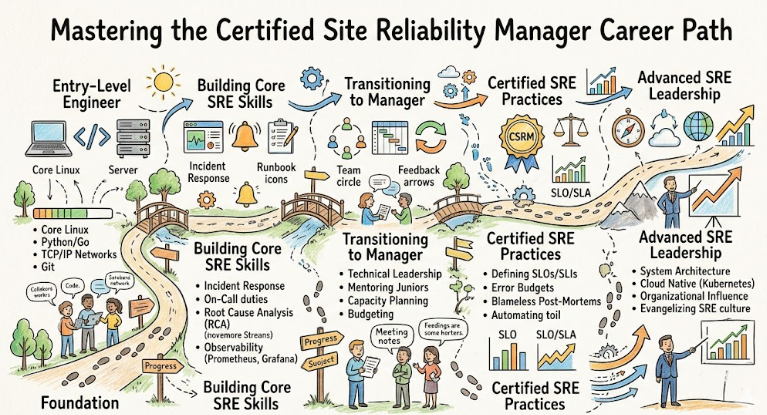
The role of a Site Reliability Manager has become a cornerstone of modern digital infrastructure, bridging the gap between high-level business objectives and granular technical execution. As organizations transition toward cloud-native architectures and complex platform engineering models, the need for leadership that understands both the cultural and technical facets of reliability is paramount. This guide is designed for professionals looking to transition into leadership or for current managers aiming to formalize their expertise through the Certified Site Reliability Manager program. By following this roadmap, you will gain a clear understanding of how this certification from sreschool can influence your career trajectory in the global DevOps and SRE ecosystem.
What is the Certified Site Reliability Manager?
The Certified Site Reliability Manager is a professional designation that validates an individual’s ability to lead SRE teams and manage the reliability of large-scale production environments. Unlike purely technical certifications, this program focuses on the strategic implementation of SRE principles such as Service Level Objectives (SLOs), error budgets, and incident response management. It represents a shift from reactive firefighting to proactive, data-driven reliability leadership within modern enterprise environments. This certification exists to ensure that those in management roles can effectively balance the speed of feature delivery with the absolute necessity of system stability.
Who Should Pursue Certified Site Reliability Manager?
This certification is primarily intended for engineering managers, technical leads, and aspiring SRE directors who are responsible for the uptime and performance of critical services. Senior DevOps engineers and SREs looking to move into people or project management will find the curriculum particularly relevant to their career progression. It is equally valuable for cloud architects and security leaders who need to integrate reliability into the broader software development lifecycle. In the context of both the Indian and global markets, this credential signals a professional’s readiness to handle the complexities of distributed systems at scale.
Why Certified Site Reliability Manager is Valuable and Beyond
The demand for reliability leadership is growing as enterprises realize that downtime is not just a technical failure but a significant business risk. Obtaining this certification demonstrates a commitment to a discipline that remains relevant regardless of the specific tools or cloud providers an organization uses. It provides a long-term career advantage by focusing on sustainable engineering practices and cultural transformation, which are harder to automate than basic scripting. Professionals who hold this title are often seen as the architects of operational excellence, ensuring a high return on investment for their organizations’ digital initiatives.
Certified Site Reliability Manager Certification Overview
The program is delivered via the Certified Site Reliability Manager and hosted on the sreschool platform, which is dedicated to site reliability education. It offers a structured assessment approach that evaluates a candidate’s understanding of SRE frameworks, team dynamics, and operational metrics. The ownership of the certification lies with a body of experts who emphasize practical application over rote memorization. The structure is designed to be modular, allowing professionals to grasp complex management concepts through real-world scenarios and enterprise-grade case studies.
Certified Site Reliability Manager Certification Tracks & Levels
The certification is categorized into distinct levels—Foundation, Professional, and Advanced—to cater to different stages of a professional’s career. The Foundation level introduces core reliability concepts, while the Professional level dives into team management and technical strategy. The Advanced level is reserved for those directing multi-team SRE organizations and setting global reliability standards. These levels are strategically aligned with various tracks including DevOps, SRE, and FinOps, allowing for a tailored approach to professional development.
Complete Certified Site Reliability Manager Certification Table
| Track | Level | Who it’s for | Prerequisites | Skills Covered | Recommended Order |
| Management | Foundation | Aspiring Leads | Basic SRE Knowledge | SLOs, Error Budgets | 1 |
| Strategy | Professional | Current Managers | 3+ Years Experience | Incident Command, Risk | 2 |
| Leadership | Advanced | Directors/VPs | 5+ Years Management | Org Design, SRE Culture | 3 |
Detailed Guide for Each Certified Site Reliability Manager Certification
Certified Site Reliability Manager – Foundation
What it is
This certification validates the fundamental understanding of SRE principles from a managerial perspective. It ensures the candidate can speak the language of reliability and understand the metrics that drive SRE teams.
Who should take it
It is suitable for junior managers, project coordinators, or senior engineers who are beginning their journey into reliability leadership. No extensive prior management experience is required.
Skills you’ll gain
- Defining Service Level Indicators (SLIs) and Objectives (SLOs).
- Understanding the concept of error budgets and their impact on releases.
- Grasping the basics of incident management and post-mortem culture.
Real-world projects you should be able to do
- Creating a basic reliability dashboard for a microservice.
- Drafting a standard operating procedure for a small-scale incident response.
Preparation plan
- 7-14 Days: Focus on reading the Google SRE Book and understanding core definitions of reliability metrics.
- 30 Days: Participate in online workshops and practice defining SLOs for hypothetical applications.
- 60 Days: Conduct a mock audit of an existing system’s reliability and prepare a gap analysis report.
Common mistakes
- Focusing too much on specific tools rather than the underlying management principles.
- Underestimating the cultural shift required to implement SRE.
Best next certification after this
- Same-track: Professional SRE Manager
- Cross-track: Certified DevOps Professional
- Leadership: Technical Project Management
Certified Site Reliability Manager – Professional
What it is
This level focuses on the tactical execution of SRE strategies within a department. It confirms the manager’s ability to handle complex incidents and optimize team performance.
Who should take it
This is designed for active managers and team leads who have a minimum of three years of experience in technical environments.
Skills you’ll gain
- Strategic resource allocation for SRE tasks.
- Leading high-pressure incident response as an Incident Commander.
- Managing toil and automating operational tasks at a team level.
Real-world projects you should be able to do
- Implementing a full-scale incident management framework for a department.
- Developing a toil reduction roadmap that increases engineering efficiency by 20%.
Preparation plan
- 7-14 Days: Review advanced case studies on large-scale system failures and resolutions.
- 30 Days: Focus on the financial aspects of reliability, including cost-benefit analysis of uptime.
- 60 Days: Lead a simulated “Game Day” to test team readiness and infrastructure resilience.
Common mistakes
- Failing to align SRE goals with broader business outcomes.
- Neglecting the psychological safety of the team during high-stress incidents.
Best next certification after this
- Same-track: Advanced SRE Director
- Cross-track: Certified FinOps Practitioner
- Leadership: Engineering Leadership Program
Choose Your Learning Path
DevOps Path
This path focuses on integrating reliability into the continuous integration and continuous delivery pipeline. It is ideal for managers who want to ensure that speed does not compromise stability. Professionals here learn to manage the “shift-left” approach where reliability is a day-one concern in development.
DevSecOps Path
In this path, the focus extends to including security as a primary component of site reliability. Managers learn to treat security vulnerabilities as reliability risks, ensuring that the system is not only up but also safe. This is critical for organizations handling sensitive data and strict compliance requirements.
SRE Path
The pure SRE path is dedicated to the deep technical management of production systems. It involves mastering the art of balancing feature development with the stability of the platform. Managers on this path are experts in metrics, monitoring, and automated remediation of system issues.
AIOps Path
This specialized track explores the use of artificial intelligence and machine learning to enhance operational efficiency. Managers learn how to oversee systems that use predictive analytics to identify potential failures before they occur. It is the frontier of modern, high-scale infrastructure management.
MLOps Path
Focusing on the reliability of machine learning pipelines, this path addresses the unique challenges of model deployment and data drift. Managers ensure that AI models in production remain reliable and performant over time. It bridges the gap between data science and traditional site reliability engineering.
DataOps Path
DataOps is centered on the reliability and quality of data pipelines and large-scale data storage. Managers in this track focus on ensuring that data is available, accurate, and delivered with low latency to downstream consumers. It is essential for data-driven enterprises.
FinOps Path
This path manages the intersection of cloud reliability and cloud cost. Managers learn how to optimize infrastructure for performance while keeping cloud spend within budget. It is a critical skill set as organizations look to maximize the value of their cloud investments.
Role → Recommended Certified Site Reliability Manager Certifications
| Role | Recommended Certifications |
| DevOps Engineer | Foundation Manager, DevOps Specialist |
| SRE | Professional Manager, Advanced SRE |
| Platform Engineer | Foundation Manager, Cloud Architect |
| Cloud Engineer | Foundation Manager, FinOps Specialist |
| Security Engineer | Professional Manager, DevSecOps Specialist |
| Data Engineer | Foundation Manager, DataOps Specialist |
| FinOps Practitioner | Professional Manager, FinOps Specialist |
| Engineering Manager | Advanced SRE Manager, Leadership Track |
Next Certifications to Take After Certified Site Reliability Manager
Same Track Progression
Deepening your specialization in SRE management involves moving toward executive leadership. After mastering the professional levels, one should look toward certifications that focus on organizational design and global infrastructure strategy. This ensures you remain at the cutting edge of how large-scale companies manage their digital presence.
Cross-Track Expansion
Broadening your skills often means moving into adjacent fields like FinOps or DevSecOps. By understanding the financial or security implications of reliability, a manager becomes more versatile and valuable to the C-suite. This expansion allows for a more holistic view of the software delivery lifecycle and business operations.
Leadership & Management Track
Transitioning into broader engineering leadership requires a focus on people management, budgeting, and corporate strategy. Certifications in these areas complement the technical grounding of SRE. This path is for those who aim to become CTOs or VPs of Engineering in technology-first organizations.
Training & Certification Support Providers for Certified Site Reliability Manager
DevOpsSchool
This provider offers extensive training programs focused on the entire DevOps ecosystem, providing hands-on labs and expert-led sessions. They are known for their comprehensive curriculum that covers both basic and advanced infrastructure management topics for global professionals.
Cotocus
A specialized training entity that focuses on cloud-native technologies and modern engineering practices. They provide tailored coaching for teams looking to adopt SRE and DevOps methodologies, ensuring that the learning is applicable to specific corporate environments and needs.
Scmgalaxy
As a long-standing community and training platform, they provide a wealth of resources for configuration management and continuous integration. Their trainers are industry veterans who bring years of practical experience to the classroom, helping students navigate real-world challenges.
BestDevOps
This organization prides itself on delivering high-quality, practical training that is updated frequently to match the changing tech landscape. They offer various certification prep courses that focus on the skills most in demand by top-tier technology employers.
devsecopsschool
Dedicated to the intersection of development, security, and operations, this provider helps managers integrate security into the SRE mindset. Their courses are essential for those looking to build resilient and secure systems in highly regulated industries.
sreschool
The primary host and provider for site reliability education, offering specialized tracks for managers and engineers alike. Their focus is exclusively on the SRE discipline, making them the go-to resource for deep expertise in reliability engineering and management.
aiopsschool
This provider focuses on the future of operations, teaching managers how to leverage artificial intelligence for better system monitoring. Their curriculum covers the integration of machine learning models into standard operational workflows to achieve predictive reliability.
dataopsschool
Specializing in the reliability of data systems, this provider offers training on managing complex data pipelines and storage solutions. They help professionals understand how to apply SRE principles to the unique world of big data and real-time analytics.
finopsschool
Focusing on the financial management of the cloud, this provider teaches how to balance performance with cost-efficiency. Their training is vital for SRE managers who need to justify infrastructure spend and optimize cloud resource utilization.
Frequently Asked Questions (General)
- How difficult is it to achieve the Certified Site Reliability Manager designation?The difficulty depends on your background; those with a strong technical foundation and some leadership experience find it manageable, though it requires dedicated study of SRE-specific management frameworks.
- What is the typical time commitment required for preparation?Most professionals spend between 30 to 60 days preparing, depending on their existing familiarity with SRE concepts and the level of certification they are pursuing.
- Are there any mandatory prerequisites before taking the exam?While some levels are open to all, the Professional and Advanced certifications usually recommend a certain number of years of experience in an engineering or management role.
- What is the Return on Investment (ROI) for this certification?The ROI is significant, often leading to higher salary brackets, better job titles, and the ability to lead high-impact projects in top-tier technology companies.
- In what sequence should I take these certifications?It is highly recommended to start with the Foundation level to build a strong theoretical base before moving to the Professional and Advanced leadership levels.
- How does this certification differ from a standard DevOps certification?While DevOps focuses on the entire lifecycle, this certification focuses specifically on the management and reliability of production systems after deployment.
- Is the certification recognized globally?Yes, the principles taught are based on industry-standard frameworks used by major global tech firms, making the credential valuable in any market.
- Do I need to be an expert coder to pass the manager certification?You do not need to be a daily coder, but you must understand technical architectures, automation scripts, and how code affects system behavior.
- How often do I need to renew my certification?Most certifications in this field require renewal every two to three years to ensure your skills remain current with evolving technology and practices.
- Does the certification provide hands-on practice?The program emphasizes real-world application, often including scenarios or projects that require you to apply SRE principles to practical problems.
- Can this certification help me move from a developer role to a manager role?Absolutely, it provides the bridge between individual contributor tasks and the strategic oversight required for successful team leadership.
- Is there a community or alumni network I can join?Yes, most providers offer access to forums and groups where you can network with other certified professionals and industry leaders.
FAQs on Certified Site Reliability Manager
- What specific management frameworks are covered in the curriculum?The course covers the Google SRE framework, incident command systems, and various agile management methodologies tailored for high-availability environments.
- Does this cover the financial aspects of running an SRE team?Yes, it includes modules on budgeting for reliability, managing cloud costs, and calculating the cost of downtime for a business.
- How does the course handle “toil” management?It provides strategies for identifying, measuring, and systematically reducing repetitive manual tasks through automation and process improvement.
- Are post-mortems a major part of the assessment?Yes, the ability to lead and write effective, blameless post-mortems is a core competency tested at the professional and advanced levels.
- Is there a focus on specific cloud providers like AWS or Azure?The certification is vendor-neutral, focusing on principles that apply across all cloud environments and on-premises infrastructure.
- How does the certification address team culture?A significant portion of the leadership track is dedicated to building a culture of reliability, psychological safety, and continuous learning.
- What is the format of the final assessment?The assessment typically involves a combination of multiple-choice questions and scenario-based evaluations that test practical decision-making.
- Can I take the training and exam entirely online?Yes, the program is designed to be accessible globally through the digital platforms provided by sreschool and its partners.
Final Thoughts: Is Certified Site Reliability Manager Worth It?
In my experience mentoring hundreds of engineers, the transition from “doing” to “leading” is often the most difficult hurdle in a career. The Certified Site Reliability Manager credential serves as more than just a line on a resume; it is a signal that you have mastered the balance between technical excellence and strategic oversight. In an era where system complexity is exploding, the industry is desperate for leaders who can maintain composure during crises and build systems that fail gracefully. If you are looking to secure your future in a leadership role within DevOps or SRE, this path offers a clear, structured, and highly relevant way to do so. It is an investment in a discipline that will only grow in importance as the world becomes increasingly digital.

