
Introduction
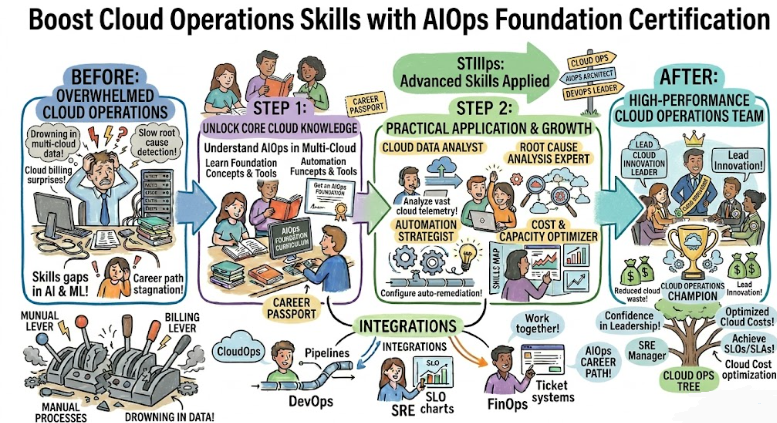
The AIOps Foundation Certification has emerged as a critical milestone for IT professionals navigating the complexities of modern, distributed systems. This guide is designed for engineers, site reliability experts, and technical leaders who need to move beyond manual intervention and embrace intelligent, automated operations. By integrating artificial intelligence into the DevOps and platform engineering lifecycle, this certification helps you transition from reactive troubleshooting to proactive system management. This detailed walkthrough will help you understand the landscape of the AIOps Foundation Certification and how the resources at aiopsschool can help you make a strategic decision for your career trajectory.
What is the AIOps Foundation Certification?
The AIOps Foundation Certification represents a paradigm shift in IT operations, moving from traditional rule-based monitoring to data-driven, intelligent automation. It exists to provide engineers with a structured framework for applying machine learning and big data analytics to operational telemetry like logs, metrics, and traces. Rather than focusing on abstract theory, this certification emphasizes real-world, production-focused learning that aligns with the speed of modern CI/CD pipelines. It ensures that engineering workflows remain efficient by using AI to handle the massive volume of data generated by cloud-native enterprise environments.
Who Should Pursue AIOps Foundation Certification?
This certification is specifically designed for working software engineers, SREs, and cloud professionals who manage large-scale infrastructure. Engineering managers and technical leaders also benefit greatly, as it provides them with the vocabulary and strategic insight needed to implement AI-driven cultures within their teams. Beginners in the “Ops” spectrum use it to build a future-proof foundation, while experienced veterans use it to modernize their existing skill sets. Given the rapid digital expansion in India and global markets, professionals with this certification are becoming essential for maintaining competitive, high-availability service levels.
Why AIOps Foundation Certification is Valuable and Beyond
The value of the AIOps Foundation Certification lies in its focus on longevity and enterprise adoption, ensuring professionals stay relevant even as specific monitoring tools change. As organizations move toward autonomous operations, the demand for individuals who can architect and manage AIOps platforms is skyrocketing. It provides a massive return on time investment by teaching engineers how to reduce Mean Time to Repair (MTTR) and eliminate operational noise. This expertise ensures that your career remains on an upward trajectory by aligning your skills with the core needs of modern, data-centric enterprises.
AIOps Foundation Certification Overview
The program is delivered via the AIOps Foundation Certification and is hosted on the aiopsschool platform. This certification provides a comprehensive assessment of a candidate’s ability to implement AIOps strategies, covering everything from data ingestion to automated remediation. It is owned and structured by industry practitioners who ensure the content remains practical and applicable to current engineering challenges. The structure typically includes a mix of conceptual validation and practical scenarios to ensure that the certified individual is ready for production-grade responsibilities.
AIOps Foundation Certification Tracks & Levels
The certification is structured into three distinct levels: Foundation, Professional, and Advanced. The Foundation level provides the essential knowledge of AI in operations, while the Professional level focuses on implementation and track-specific specializations like DevOps or SRE. The Advanced level is designed for architects and leads who are responsible for designing end-to-end autonomous systems across the organization. This tiered approach allows professionals to progress naturally as they gain more experience and take on more complex roles within their engineering teams.
Complete AIOps Foundation Certification Table
| Track | Level | Who it’s for | Prerequisites | Skills Covered | Recommended Order |
| Core Operations | Foundation | New Ops Engineers | Basic IT Knowledge | AI Basics, Data Types | 1 |
| SRE & Reliability | Professional | SREs / Cloud Eng | Foundation Level | Anomaly Detection | 2 |
| Platform Eng | Professional | DevOps / Platform Eng | Foundation Level | Automated Remediation | 2 |
| Architecture | Advanced | Principal Eng / Leads | Professional Level | Autonomous Design | 3 |
Detailed Guide for Each AIOps Foundation Certification
AIOps Foundation Certification – Foundation Level
What it is
This certification validates a professional’s understanding of the basic pillars of AIOps, including data collection, pattern discovery, and noise reduction. It serves as the baseline for all intelligent operations tracks.
Who should take it
This is suitable for junior engineers, IT managers, and traditional system administrators who want to understand how AI is transforming the operational landscape and why it is necessary for scale.
Skills you’ll gain
- Understanding the difference between traditional monitoring and AIOps.
- Knowledge of the AIOps lifecycle: Observe, Engage, Act.
- Ability to identify key data sources for machine learning models.
- Understanding how to reduce alert fatigue in a production environment.
Real-world projects you should be able to do
- Designing a basic data ingestion pipeline for system logs and metrics.
- Identifying redundant alerts in a legacy monitoring system.
- Mapping out an AIOps adoption roadmap for a small engineering team.
Preparation plan
- 7-14 days: Focus on core vocabulary and the high-level architecture of AIOps platforms. Read industry whitepapers and case studies.
- 30 days: Spend time understanding the math behind basic anomaly detection and how data scientists and operations teams collaborate.
- 60 days: Perform hands-on labs with open-source AIOps tools to visualize how machine learning identifies outliers in real-time data.
Common mistakes
- Assuming that AIOps is a “magic box” that solves all problems without clean data input.
- Neglecting the cultural change required for teams to trust automated insights.
Best next certification after this
- Same-track option: AIOps Professional Certification
- Cross-track option: SRE Practitioner Certification
- Leadership option: Digital Transformation Manager
Choose Your Learning Path
DevOps Path
In the DevOps path, the focus is on integrating AI into the CI/CD pipeline to predict deployment failures and optimize resource allocation during builds. Engineers learn to use AIOps to analyze historical deployment data and provide feedback to developers before code reaches production. This creates a highly efficient feedback loop where AI acts as a guardrail for rapid delivery. It ensures that velocity does not come at the expense of system stability or performance.
DevSecOps Path
The DevSecOps path emphasizes the use of AI for automated threat detection and vulnerability management across the lifecycle. Professionals learn to apply AIOps to security logs to identify subtle patterns that indicate a sophisticated breach attempt that traditional rules might miss. This path is crucial for engineers who want to build self-healing, secure infrastructures. It bridges the gap between proactive security monitoring and automated incident response.
SRE Path
For SREs, this path is about using AI to manage error budgets and automate root cause analysis for complex incidents. The focus is on reducing toil by letting machine learning models handle repetitive diagnostic tasks while humans focus on architectural improvements. It empowers SRE teams to manage thousands of microservices without a linear increase in headcount. This path turns data into a strategic asset for maintaining high availability.
AIOps Path
The pure AIOps path is for those who want to become domain experts in the architecture of intelligent systems. It covers the deep integration of machine learning models into every aspect of IT service management. Professionals in this path design the data lakes and training pipelines that power an organization’s operational intelligence. It is the definitive track for those who see themselves as the “brain” behind the modern operations center.
MLOps Path
The MLOps path focuses on the specialized task of managing the lifecycle of machine learning models used in production. It addresses the unique challenges of model drift, retraining, and deployment in an operational context. Professionals learn how to treat ML models with the same rigor as software code within a DevOps framework. This path is essential for ensuring that the AI driving your AIOps remains accurate and reliable over time.
DataOps Path
DataOps is the foundational track that ensures the quality and flow of data used by AIOps engines. This path focuses on data engineering for operations, including data cleaning, transformation, and governance. Without a solid DataOps practice, AI models will produce inaccurate results based on poor data quality. It is a critical path for ensuring that the “intelligence” in intelligent operations is based on a trustworthy data source.
FinOps Path
The FinOps path leverages AIOps to provide intelligent cloud cost optimization and predictive spending analysis. Engineers learn to use machine learning to identify wasted resources and suggest automated rightsizing or spot instance usage. This path connects technical operations with business value by ensuring cloud spend is always optimized. It is a high-demand track as organizations look to scale their cloud presence while controlling costs.
Role → Recommended AIOps Foundation Certification
| Role | Recommended Certifications |
| DevOps Engineer | Foundation, Professional (DevOps Track) |
| SRE | Foundation, Professional (SRE Track) |
| Platform Engineer | Foundation, Professional (AIOps Track) |
| Cloud Engineer | Foundation, Professional (DataOps Track) |
| Security Engineer | Foundation, DevSecOps Specialist |
| Data Engineer | Foundation, DataOps Specialist |
| FinOps Practitioner | Foundation, FinOps Specialist |
| Engineering Manager | Foundation, Leadership Track |
Next Certifications to Take After AIOps Foundation Certification
Same Track Progression
Deep specialization within the AIOps track involves moving toward Professional and Architect levels. This allows you to master advanced concepts like autonomous remediation and custom ML model development for specific infrastructure needs. By staying on this track, you become the go-to expert for designing the next generation of “NoOps” environments within an enterprise.
Cross-Track Expansion
Skill broadening is achieved by taking certifications in adjacent fields like SRE or FinOps. For example, an AIOps expert with FinOps certification can build systems that automatically scale down infrastructure based on cost-efficiency models. This makes you a versatile “T-shaped” professional who can solve problems across different business and technical domains.
Leadership & Management Track
For those transitioning to leadership, the focus shifts to organizational strategy and the cultural aspects of AI adoption. Certifications in digital transformation or technical management help you lead large engineering departments through the transition to automated operations. It prepares you to manage the budget, people, and processes required to make AIOps a core business capability.
Training & Certification Support Providers for AIOps Foundation Certification
DevOpsSchool
This provider is well-known for its deep technical dives and practical approach to DevOps and AIOps training. They offer extensive laboratory environments and real-world case studies that help professionals understand the practical application of AI in operational settings.
Cotocus
Cotocus focuses on high-end consulting and training for elite engineering teams. Their AIOps curriculum is designed for those who need to implement production-grade solutions in complex, large-scale environments, emphasizing architectural integrity and modern best practices.
Scmgalaxy
As a community-driven platform, Scmgalaxy offers a wealth of resources, including blogs, tutorials, and structured courses on software configuration and operations. They provide a supportive environment for engineers looking to broaden their skills in the automation space.
BestDevOps
BestDevOps provides curated training paths that are optimized for busy professionals who need to gain high-impact skills quickly. Their courses on AIOps are designed to be concise yet comprehensive, focusing on the most relevant skills for modern job markets.
devsecopsschool
This school is the primary authority on integrating security into the automated operational lifecycle. Their AIOps modules focus heavily on using machine learning for threat detection and automated security responses, which is a critical need for modern enterprises.
sreschool
sreschool is dedicated to the principles of site reliability and high availability. Their training integrates AIOps as a core methodology for achieving the performance and reliability goals required by today’s digital businesses.
aiopsschool
As the primary host for the AIOps Foundation Certification, this school provides the most direct and structured path to certification. Their curriculum is strictly aligned with the exam objectives and is developed by leading practitioners in the field of intelligent operations.
dataopsschool
This provider focuses on the data engineering aspect of the operational lifecycle. They ensure that professionals understand how to build and maintain the high-quality data pipelines that are necessary for any AIOps engine to function correctly.
finopsschool
finopsschool specializes in the intersection of cloud engineering and financial management. Their courses show how AIOps can be used to drive financial accountability and ensure that cloud growth remains sustainable and cost-effective.
Frequently Asked Questions (General)
- How difficult is the AIOps Foundation Certification exam?
The exam is moderately challenging as it requires a mix of operational knowledge and a new understanding of AI and ML concepts tailored for infrastructure. - How much time do I need to prepare for this certification?
Most working professionals find that 4 to 6 weeks of consistent study is sufficient to cover the materials and feel confident for the assessment. - Are there any prerequisites for taking the foundation level?
While there are no formal prerequisites, a basic understanding of IT operations, cloud computing, and monitoring tools will be extremely helpful. - Is this certification recognized by major tech companies?
Yes, as more enterprises adopt AIOps to manage their cloud-native stacks, this certification is becoming a recognized standard for hiring managers and recruiters. - Does the certification focus on specific tools?
The foundation level is largely tool-agnostic, focusing on the concepts and frameworks that apply to any AIOps platform or suite of tools. - How much does the certification cost?
Pricing can vary depending on the region and the training provider, so it is best to check the official website for the most current information. - Is there a renewal process for the certification?
Yes, most technical certifications require renewal every two to three years to ensure your skills remain current with the latest industry developments. - Can this certification help me get a salary hike?
Professionals with specialized skills in AI and automation often see a significant increase in their market value and salary potential compared to generalists. - Is there a community for certified AIOps professionals?
Yes, there are several online forums and social media groups where certified individuals can share knowledge and find job opportunities. - How does AIOps differ from traditional automation?
Traditional automation uses fixed scripts for known problems, whereas AIOps uses machine learning to identify and respond to new or complex patterns in data. - Do I need to know how to code to pass the exam?
A basic understanding of scripting or programming logic is beneficial, but the foundation level focuses more on the conceptual and architectural side of AIOps. - Is this certification suitable for project managers?
Absolutely, as it provides the technical context necessary for managers to lead AI-driven operational projects and communicate effectively with engineering teams.
FAQs on AIOps Foundation Certification
- What is the primary goal of the AIOps Foundation Certification?
The goal is to ensure that professionals can effectively use AI to manage the complexity and data volume of modern IT environments. - How does the certification address root cause analysis?
It teaches candidates how machine learning models can correlate events across different layers of the stack to identify the source of a problem automatically. - Is there a focus on data privacy in the exam?
Yes, the certification covers the ethical and security considerations of handling large amounts of operational and potentially sensitive data. - Does the curriculum cover both on-premise and cloud environments?
Yes, the AIOps framework is designed to be applicable to hybrid and multi-cloud architectures, which is a major focus of the certification. - How does AIOps support Site Reliability Engineering?
It provides the SRE with the intelligent tools needed to manage error budgets and perform “toil reduction” at scale through automated insights. - Is machine learning theory a large part of the assessment?
The exam focuses on the practical application of ML—such as clustering and anomaly detection—rather than deep mathematical theory. - What kind of data sources are discussed in the certification?
The certification covers structured and unstructured data, including logs, metrics, traces, and historical incident tickets. - Can I take the exam online?
Yes, the certification is typically delivered through an online platform, allowing candidates from all over the world to participate.
Final Thoughts: Is AIOps Foundation Certification Worth It?
As a mentor who has seen many technical shifts, I believe the AIOps Foundation Certification is one of the most practical investments an engineer can make today. We have reached a point where systems are too complex for humans to manage with manual scripts and basic alerts. This certification gives you the “intelligent edge” required to handle the data-heavy reality of modern production environments. It is not just about passing an exam; it is about adopting a new mindset where data drives every operational decision. If you want to move into high-level architecture or senior SRE roles, mastering these principles is no longer optional—it is a baseline requirement for success.

