
Introduction
Modern software is fast, cloud‑native, and highly automated—but also constantly under attack. Traditional security, added at the end of the pipeline, simply cannot keep up with weekly or even daily releases. Teams ship code quickly, but security reviews, approvals, and audits often remain slow and manual, creating friction between developers, operations, and security.
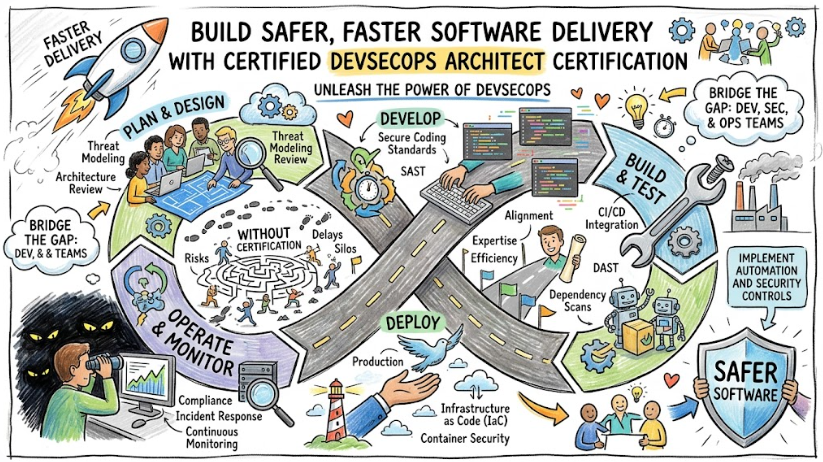
A Certified DevSecOps Architect is the person who solves this problem at the design level. Instead of treating security as a late‑stage gate, they bake security into every layer of the system: architecture, CI/CD, infrastructure, containers, and runtime operations. Their job is to ensure that security controls are automated, repeatable, and developer‑friendly, so teams can move fast without increasing risk.
What Is a Certified DevSecOps Architect?
A Certified DevSecOps Architect is a senior professional who designs secure‑by‑default DevOps ecosystems across applications, pipelines, platforms, and clouds. Instead of adding security at the end, they embed it from design to production, using automation, guardrails, and clear architecture patterns.
This role sits at the intersection of DevOps, cloud architecture, and application security. It balances speed, safety, and compliance so teams can ship fast without increasing risk.
Certified DevSecOps Architect
What it is
Certified DevSecOps Architect is an advanced, architecture‑level certification focused on designing and governing secure DevOps and cloud environments. It blends secure SDLC, cloud‑native security, CI/CD security, threat modeling, and compliance into one structured program.
Who should take it
- DevOps and Cloud Architects
- Senior DevOps / Platform / SRE engineers
- Security engineers and security architects moving into DevSecOps
- Engineering managers leading DevOps/SRE/security initiatives
Skills you’ll gain
- Designing security‑first CI/CD pipelines across hybrid and multi‑cloud environments
- Applying shift‑left security in architecture and SDLC
- Architecting container and Kubernetes security (RBAC, policies, admission controllers)
- Building security as code and compliance as code (policy engines, CIS, PCI, GDPR etc.)
- Doing advanced threat modeling and risk‑based architecture decisions
- Aligning DevSecOps architectures with standards like NIST, OWASP SAMM, SLSA
Real‑world projects you should be able to do
- Design an end‑to‑end secure CI/CD pipeline for a microservices application, including SAST, DAST, SCA, and secrets management.
- Architect secure Kubernetes clusters with network policies, RBAC, admission policies, and image scanning.
- Define a multi‑cloud security reference architecture with CSPM, IaC scanning, and guardrails.
- Implement security and compliance as code using policy‑as‑code tools.
- Create DevSecOps blueprints and playbooks for an enterprise migration or transformation program.
Preparation plan
7–14 days (intensive / fast track)
Best for experienced DevOps, cloud, or security engineers.
- Day 1–3: Quick revision of DevOps, CI/CD, cloud basics, and container fundamentals.
- Day 4–6: Focus on DevSecOps concepts – secure SDLC, threat modeling, pipeline security, secrets, and scanners.
- Day 7–10: Deep dive into architecture patterns: multi‑cloud security, Kubernetes security, policy‑as‑code, and reference diagrams.
- Day 11–14: Case studies, mock designs, and practice questions focusing on architectural decisions.
30 days (standard working‑professional track)
- Week 1: DevOps + cloud refresh, CI/CD concepts, and container basics.
- Week 2: Security fundamentals for DevOps – AppSec, identity, secrets, vulnerability management.
- Week 3: DevSecOps architectures, SDLC security, pipeline scanners, and policy‑as‑code.
- Week 4: Kubernetes and cloud‑native security, compliance‑as‑code, and one capstone design project.
60 days (foundation plus architecture)
- Month 1: Build strong foundations in DevOps, cloud, CI/CD, containers, and basic security tooling.
- Month 2: Move into architecture, cloud hardening, risk frameworks, and complex scenario designs.
Common mistakes
- Treating DevSecOps as “add some scanners” instead of full architecture and process change.
- Over‑focusing on tools without understanding threat modeling and risk trade‑offs.
- Ignoring cloud and Kubernetes architecture, and only securing application code.
- Not defining clear policies, SLAs, and ownership for security in pipelines.
- Forgetting culture: trying to “push security” without enabling developers and SREs.
Best next certification after this
- Same track (deep security): A more practitioner‑level DevSecOps or security cert (e.g., Certified DevSecOps Professional‑style programs, cloud security specialist, or advanced AppSec).
- Cross‑track: SRE / observability, or cloud architect–type certifications to strengthen reliability and platform side.
- Leadership: DevOps / engineering management programs that focus on scaling DevSecOps and governance across large organizations.
Choose Your Path: 6 Learning Paths
1. DevOps path
- Start: DevOps fundamentals / DevOps Certified Professional‑style training.
- Add: Cloud and container certifications (AWS/Azure/GCP, Docker/Kubernetes).
- Then: Certified DevSecOps Architect to make your pipelines and platforms secure by design.
- Grow: Move into DevOps architect, platform architect, or cloud security architect roles.
2. DevSecOps path
- Start: DevOps + basic security (AppSec, OWASP Top 10, vulnerability management).
- Add: Practitioner‑level DevSecOps certifications focused on hands‑on pipelines.
- Then: Certified DevSecOps Architect as the architecture‑level capstone.
- Grow: Lead DevSecOps architect, DevSecOps transformation lead, or platform security lead.
3. SRE path
- Start: SRE‑oriented training (SLOs, error budgets, incident management).
- Add: Observability and reliability programs (metrics, tracing, chaos, post‑mortems).
- Then: Certified DevSecOps Architect to integrate security into SRE practices and production platforms.
- Grow: Security‑aware SRE lead or reliability and security architect.
4. AIOps / MLOps path
- Start: DevOps + basic ML/MLOps pipeline skills.
- Add: AIOps/MLOps training for monitoring and automating ML workloads.
- Then: Certified DevSecOps Architect to secure those pipelines and data flows end‑to‑end.
- Grow: AIOps/MLOps architect with strong security and compliance grounding.
5. DataOps path
- Start: Data engineering / DataOps training (ETL, streaming, orchestration).
- Add: Cloud data platform certifications and observability concepts.
- Then: Certified DevSecOps Architect to secure data pipelines, metadata systems, and data platforms.
- Grow: Data security architect or DataOps engineer with DevSecOps capability.
6. FinOps path
- Start: Cloud cost and governance / FinOps fundamentals.
- Add: Cloud architect / operations certifications.
- Then: Certified DevSecOps Architect to design guardrails that balance cost, security, and speed.
- Grow: FinOps practitioner who can influence secure and cost‑efficient architectures.
Role → Recommended Certifications Mapping
| Role | Recommended sequence (simplified) |
|---|---|
| DevOps Engineer | DevOps foundation → Cloud / containers → Certified DevSecOps Architect → advanced cloud/security certs |
| SRE | SRE training → observability/reliability certs → Certified DevSecOps Architect (for secure reliability and incident readiness) |
| Platform Engineer | Kubernetes / platform certs → cloud architect cert → Certified DevSecOps Architect (for secure platforms) |
| Cloud Engineer | Cloud associate/architect certs → container security basics → Certified DevSecOps Architect → specialized cloud security |
| Security Engineer | Security+ / AppSec / DevSecOps practitioner → Certified DevSecOps Architect → advanced cloud or enterprise security |
| Data Engineer | Data engineering / DataOps → cloud data certs → Certified DevSecOps Architect (for secure data pipelines) |
| FinOps Practitioner | Cloud / FinOps training → governance and policy tools → Certified DevSecOps Architect (for secure guardrails) |
| Engineering Manager | DevOps/Agile leadership programs → Certified DevSecOps Architect → SRE / platform leadership training |
Training Institutions for Certified DevSecOps Architect
DevSecOpsSchool.com
DevSecOpsSchool is the main provider of the Certified DevSecOps Architect program. It focuses on security‑driven DevOps training with practical architectures, security as code, and real‑world patterns. The curriculum is built by practitioners and includes case studies, capstone projects, and global alumni from Fortune 500 companies.
DevOpsSchool
DevOpsSchool has 15+ years of experience in DevOps and security training, including CI/CD, cloud, and container programs that form the foundation for DevSecOps Architect. Their hands‑on labs and project‑oriented style help working engineers connect architecture concepts to daily work.
Cotocus
Cotocus focuses on consulting‑aligned DevOps and security enablement for enterprises. For aspiring DevSecOps architects, it adds real project flavor, multi‑team coordination, and exposure to complex, regulated environments.
ScmGalaxy
ScmGalaxy is known for practical training on DevOps tools, configuration management, and CI/CD pipelines. This provides a strong pipeline and tooling base that Certified DevSecOps Architect then builds into secure architectures.
BestDevOps
BestDevOps curates DevOps‑centric content, training, and community resources for working engineers. It is useful for staying current on tools and patterns that you will integrate into secure architectures as a DevSecOps architect.
SRESchool.com
SRESchool specializes in Site Reliability Engineering, SLOs, and production operations. When combined with DevSecOps Architect, it helps you design platforms that are both reliable and secure by design.
AIOpsSchool.com
AIOpsSchool focuses on AI‑driven operations and analytics. Pairing it with DevSecOps Architect lets you secure telemetry pipelines and AIOps workflows, ensuring that your automation is trustworthy and compliant.
DataOpsSchool.com
DataOpsSchool is oriented around DataOps and data pipelines. When combined with DevSecOps Architect, you can secure data flows, ETL processes, and analytics platforms end‑to‑end.
FinOpsSchool.com
FinOpsSchool trains practitioners in cloud cost management and financial operations. With DevSecOps Architect, you can design architectures that balance cost, performance, and security through automated guardrails.
Next Certifications to Take After Certified DevSecOps Architect
Drawing from common software‑engineering certification trends and DevSecOps career paths:
1. Same track (security / DevSecOps depth)
- Practitioner‑level DevSecOps certifications focused on building and operating secure pipelines hands‑on (e.g., Certified DevSecOps Professional‑style programs).
- Advanced cloud security or secure software lifecycle certifications to deepen AppSec and cloud hardening.
2. Cross‑track (breadth)
- Cloud Architect or Developer certifications (AWS, Azure, GCP) to increase your influence on platform and application design.
- SRE / observability certifications to complement security architecture with reliability and performance expertise.
3. Leadership track
- DevOps leadership / engineering management programs that focus on scaling DevSecOps culture, governance, and org‑wide transformation.
- These help you move into roles like DevSecOps transformation lead or head of platform security.
FAQs – Certified DevSecOps Architect
1. What exactly is the Certified DevSecOps Architect certification?
It is an advanced architecture‑focused certification from DevSecOpsSchool that proves you can design and guide secure DevOps ecosystems across applications, pipelines, platforms, and clouds. It emphasizes security as code, compliance as code, and strategic decision‑making.
2. How long does it take to prepare?
Most working engineers need 30–60 days with consistent study and hands‑on labs. Very experienced DevOps, cloud, or security professionals can fast‑track preparation in 7–14 intensive days.
3. What background do I need before enrolling?
You should have strong DevOps and cloud fundamentals, experience with CI/CD pipelines, basic application security knowledge, and familiarity with containers. Experience in an architecture or senior engineering role is very helpful but not mandatory.
4. Is this certification more theoretical or hands‑on?
It is architecture‑oriented but grounded in real tools and practices, with case studies, scenarios, and capstone design projects. You will be expected to understand both diagrams and how they map to real tools and workflows.
5. How is it different from a practitioner DevSecOps certification?
Practitioner programs usually focus on implementing tools and pipelines. Certified DevSecOps Architect focuses on designing the overall system, choosing patterns, balancing risks, and guiding teams at scale.
6. Does the certification help with career growth and salary?
Yes, DevSecOps architects are in demand for roles like cloud security architect, platform security lead, and DevSecOps transformation lead, which typically command senior‑level compensation. The certification signals architecture‑level thinking rather than just tool usage.
7. Is it useful for non‑security engineers like DevOps or SRE?
Definitely. DevOps, SRE, and platform engineers are often responsible for the pipelines and platforms where security must live. This certification helps them design those systems securely instead of relying only on separate security teams.
8. Is the program suitable for managers?
Yes, it is well suited for engineering managers, DevOps leaders, and security managers who must make architecture decisions, approve designs, and lead secure‑by‑design transformations. It gives them a structured vocabulary and framework to guide their teams.
Broader FAQs – Difficulty, Time, Prerequisites, Sequence, Value, Outcomes
9. How difficult is the Certified DevSecOps Architect exam?
The difficulty is moderate to high because it spans DevOps, cloud, security, and architecture decision‑making. With a good foundation and structured plan, it is very achievable for working engineers and managers.
10. How many hours per week should I plan for?
A typical working engineer should target 6–8 hours per week over 4–8 weeks. Fast‑track learners may invest 2–3 hours per day over 10–14 days.
11. What are the essential prerequisites I must have?
- Solid understanding of DevOps concepts and CI/CD workflows
- Basic to intermediate knowledge of at least one cloud platform
- Familiarity with containers and Kubernetes concepts
- Awareness of application security basics and vulnerability management
12. In what sequence should I combine this with other certifications?
A common sequence is: DevOps/Cloud foundation → security practitioner (or AppSec basics) → Certified DevSecOps Architect → advanced cloud/security or leadership programs. For managers, it often comes after leadership or DevOps management training.
13. How does this certification compare with a generic cloud or security cert?
Cloud certifications validate platform skills; traditional security certs validate security knowledge. Certified DevSecOps Architect explicitly validates your ability to integrate security into DevOps and cloud architectures and pipelines.
14. What kind of job roles does it unlock?
It supports roles such as DevSecOps architect, cloud security architect, platform security lead, DevOps security lead, and DevSecOps transformation lead. It also strengthens your profile as a senior DevOps, SRE, or platform architect.
15. Is it relevant only for large enterprises?
No. While the program addresses enterprise‑grade architectures, the principles apply to startups and mid‑size companies adopting cloud and DevOps. Smaller organizations often rely on one architect who can balance speed and security, which fits this role well.
16. Do I need hands‑on coding to succeed?
You should be comfortable reading and writing configuration, scripts, and pipeline definitions, but you do not need to be a full‑time developer. The emphasis is on architecture, patterns, and integration, not on complex algorithms.
17. How much of the course is tools‑specific?
Tools are used as examples (CI servers, scanners, cloud services, policy engines), but the focus is on architecture, integration, and principles. This means your knowledge stays relevant even as tools change.
18. Does the certification cover compliance and audits?
Yes, compliance and governance (such as ISO, PCI, GDPR, HIPAA) and policy‑as‑code are key themes. You learn to design architectures that make audits easier and compliance more automated.
19. How does this help with remote or global roles?
DevSecOps and security‑aware architecture are global needs, especially in cloud‑native and SaaS companies. Having a focused DevSecOps Architect certification signals that you can add value to distributed, global teams.
20. Is it suitable if I am mainly a software developer?
Yes, if you already understand DevOps basics and want to move into architecture or DevSecOps leadership. You may need extra time for cloud and platform topics, but the payoff is strong career leverage.
Conclusion
Certified DevSecOps Architect is a powerful certification if you want to be the person who designs how security, speed, and reliability come together in modern software delivery. It helps DevOps engineers, SREs, security professionals, architects, and managers move from “running tools” to making architecture‑level decisions that protect real systems at scale.
Combined with strong DevOps and cloud foundations, this certification can accelerate your path into senior architecture and leadership roles in India and globally. If you tell me your current role (for example, 4‑year DevOps engineer, 8‑year security engineer, or engineering manager), I can propose a concrete 30‑ or 60‑day study plan tailored to you.

