
Introduction
Becoming a pilot needs time, training, and money. Flight training can cost a large amount. So, students should plan their finances before they begin.
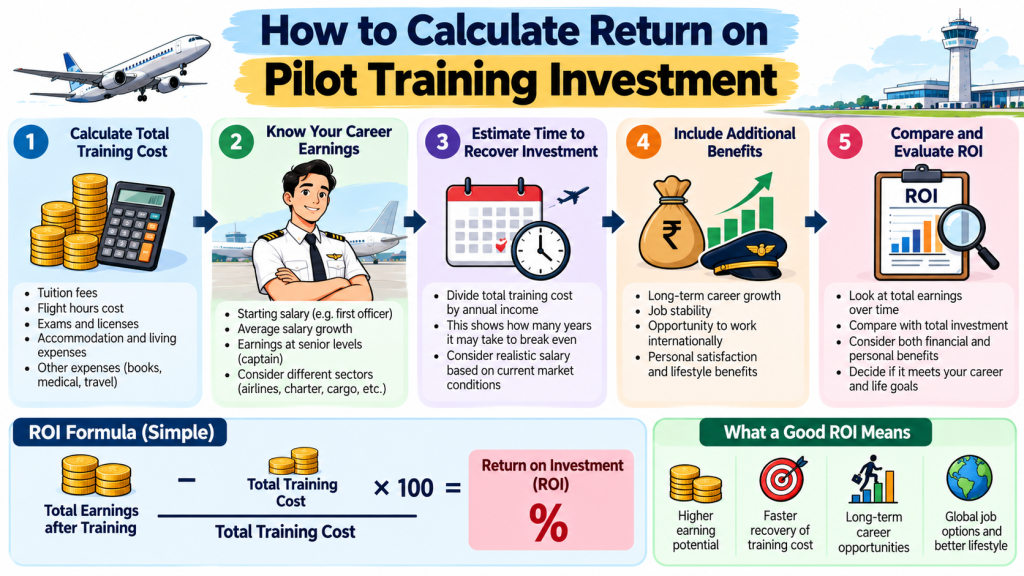
One useful step involves calculating the return on pilot training investment. This helps students compare training costs with future income.
A return on investment does not promise a certain career result. Pilot salaries and job opportunities can change over time. Still, a careful calculation can help students plan better.
What Does Return on Investment Mean?
Return on investment, or ROI, shows how an investment may provide financial value over time.
For pilot training, the investment includes the money spent to prepare for a flying career. This can include training fees, living costs, exams, licenses, and other expenses.
Students can then compare this investment with their future income.
For example, imagine a student spends ₹60 lakh on training and related costs. The student later earns a regular income as a pilot.
The student can use these figures to estimate how long it may take to recover the original investment.
This calculation needs realistic numbers. It should not rely on the highest salary shown in an advertisement.
Calculate the Full Cost of Pilot Training
The first step involves finding the total investment.
Many students look only at the flight school fee. That approach can leave out several important expenses.
Your calculation may include:
- Flight training fees
- Ground school fees
- Simulator training
- Medical examinations
- License and exam fees
- Study materials
- Uniform and equipment
- Accommodation
- Food and daily expenses
- Travel costs
- Extra flying hours
- License conversion costs
- Additional training
- Type rating costs, when required
- Loan interest
- Other unexpected costs
Your final figure should cover the full training journey.
Use This Simple Cost Formula
You can use a basic formula to estimate your investment:
Total Investment = Training Costs + Living Costs + Other Career Costs
Suppose a student has these costs:
- Flight and ground training: ₹45 lakh
- Accommodation and food: ₹7 lakh
- Exams and medical costs: ₹2 lakh
- Equipment and travel: ₹2 lakh
- Other training costs: ₹4 lakh
The estimated total becomes ₹60 lakh.
This is only a sample calculation. Actual costs can differ greatly.
Students should collect current fees before creating their own estimate.
Understand Your Future Income
The next step involves estimating future income.
Pilot income can vary for many reasons. These include airline, country, aircraft type, rank, experience, and market conditions.
A new pilot may also earn less than an experienced first officer or captain.
Some pilots may need additional training before they enter an airline job. Others may face a gap between completing training and finding employment.
So, students should avoid using one fixed salary for the entire career.
Instead, create separate estimates for different career stages.
For example, you can estimate:
- Possible starting income
- Possible income after gaining experience
- Possible income after career progression
These figures should remain estimates, not guarantees.
Calculate the Amount Available for Recovery
Gross salary does not equal the amount available to recover your training investment.
A pilot may have several regular expenses after starting work.
These can include:
- Rent or housing costs
- Food
- Transport
- Taxes
- Loan payments
- Insurance
- Family expenses
- Professional costs
- Additional training
Suppose a pilot earns ₹12 lakh per year.
The pilot may spend ₹5 lakh on taxes and personal expenses. The remaining ₹7 lakh could then help toward recovering the training investment.
This gives a more useful picture than simply using the full salary.
Estimate the Payback Period
The payback period shows how long it may take to recover the initial investment.
A simple formula is:
Payback Period = Total Investment ÷ Annual Amount Available for Recovery
Suppose the total investment is ₹60 lakh.
Now assume the pilot can use ₹7 lakh each year toward recovering that investment.
The calculation becomes:
₹60 lakh ÷ ₹7 lakh = about 8.6 years
This example suggests a payback period of about nine years.
However, real results can differ.
Salary changes, job delays, loan costs, and personal expenses can change the actual period.
A Simple Hypothetical Example
Consider a student who spends ₹50 lakh on pilot training and related costs.
After training, the student finds a pilot job. Suppose the student earns ₹10 lakh per year.
Now assume yearly taxes and personal costs total ₹4 lakh.
That leaves around ₹6 lakh for savings and investment recovery.
The basic calculation becomes:
₹50 lakh ÷ ₹6 lakh = about 8.3 years
This does not mean the student will recover the money in exactly 8.3 years.
The example ignores many real-world changes.
Salary may increase over time. Personal expenses may also increase. Employment gaps may delay income.
Loan interest can also change the total amount that needs recovery.
Why Gross Salary Can Give a Wrong Picture
Students often make one simple mistake.
They compare total training costs with gross salary.
This can make the payback period look shorter than it really is.
For example, a ₹12 lakh annual salary does not mean ₹12 lakh becomes available for investment recovery.
Taxes and living expenses reduce the amount available.
Loan payments can reduce it further.
Therefore, students should work with realistic take-home income and actual expenses.
Factors That Can Change Pilot Training ROI
Many factors can change the financial outcome.
Training Location
Training costs vary between countries and flight schools.
Currency exchange rates can also affect the final cost for international students.
Training Duration
A longer training period can increase living and accommodation costs.
Extra flight hours can also increase the total investment.
Extra Flying Hours
Some students complete training within the planned hours. Others need additional hours.
Extra flying can add a significant amount to the final cost.
Airline Hiring Conditions
Completing pilot training does not automatically lead to an airline job.
Hiring conditions can change with the aviation market.
A delay in employment can increase the time needed to recover the investment.
Type Rating Costs
Some airline roles may require additional aircraft-specific training.
Students should understand whether such costs form part of their planned career path.
Education Loans
Loans can help students finance training.
However, interest adds to the total financial burden.
Students should include loan interest when calculating the actual investment.
Career Progression
Pilot income can change with experience and career progression.
A calculation should account for possible income changes instead of using one salary forever.
Create Three Financial Scenarios
A single ROI calculation may not show the full picture.
Students can create three scenarios instead.
Conservative Scenario
Use lower income and higher expenses.
This scenario helps students understand a difficult financial situation.
Moderate Scenario
Use reasonable income and expense estimates.
This can provide a more balanced planning example.
Higher-Income Scenario
Use higher income assumptions based on a realistic career path.
Do not use unusually high salaries simply to make the calculation look attractive.
These scenarios can help students understand financial uncertainty.
A Step-by-Step ROI Method
Students can follow these steps to create their own calculation.
Step 1: List Every Training Cost
Write down every known training expense.
Include fees, exams, medical costs, equipment, and extra flying.
Step 2: Add Living Expenses
Estimate accommodation, food, travel, and other daily costs.
Step 3: Add Financing Costs
If you use a loan, include interest and other related charges.
Step 4: Estimate Starting Income
Use realistic salary information for the career path you plan to follow.
Step 5: Estimate Annual Expenses
Calculate taxes, living costs, loan payments, and other regular expenses.
Step 6: Find the Recovery Amount
Subtract annual expenses from expected income.
This gives you a rough amount available for savings or investment recovery.
Step 7: Calculate the Payback Period
Divide the total investment by the annual recovery amount.
Step 8: Add Possible Delays
Consider possible gaps between training completion and employment.
Step 9: Review Different Scenarios
Create conservative, moderate, and higher-income estimates.
Step 10: Update the Calculation
Review your numbers when training costs or career conditions change.
Common Mistakes Students Should Avoid
Students can make several mistakes when calculating pilot training ROI.
Looking Only at Flight School Fees
The training fee may not include living costs or extra flying.
Always calculate the full training journey.
Using the Highest Salary
The highest pilot salary may not apply to a new pilot.
Use realistic figures for your expected career stage.
Ignoring Loan Interest
A loan can increase the total cost of training.
Include interest when calculating the investment.
Assuming Immediate Employment
Students may need time to find their first flying job.
Include a possible employment gap in your planning.
Forgetting Extra Training
Additional flying, simulator sessions, or aircraft training can increase costs.
Keep some financial room for unexpected expenses.
Ignoring Currency Changes
International training can involve currency exchange risk.
Changes in exchange rates can affect the final cost.
Treating ROI as Guaranteed
An ROI calculation is only an estimate.
It cannot guarantee income, employment, or career growth.
Important Considerations Before Investing in Pilot Training
Financial planning matters, but ROI should not become the only decision factor.
Students should also check their medical eligibility.
They should understand the required licenses and training hours.
They should research the safety record and training setup of a flight school.
Aircraft availability also matters.
Frequent aircraft shortages can affect training time.
Instructor availability can also affect progress.
Students should understand the complete fee structure before joining.
They should also keep a financial backup for unexpected costs.
If they plan to use a loan, they should understand the repayment terms.
Most importantly, students should understand the current aviation job market before making large financial commitments.
Frequently Asked Questions
1. What does ROI mean in pilot training?
ROI means return on investment. It compares the money spent on training with the financial return from future work.
2. How do I calculate the total cost of becoming a pilot?
Add training fees, living costs, exams, medical costs, equipment, travel, extra flying, and other career-related expenses.
3. How do I calculate the payback period?
Divide your total investment by the amount you can realistically use each year toward recovering that investment.
4. Should accommodation be included in pilot training ROI?
Yes. Accommodation can form a large part of total training costs, especially during long training periods.
5. Should loan interest be included?
Yes. Loan interest increases the total amount you need to repay.
6. Does pilot salary affect training ROI?
Yes. Future income directly affects the estimated time needed to recover your training investment.
7. How long can it take to recover pilot training costs?
The period varies widely. Training costs, salary, expenses, loan interest, and employment delays all affect it.
8. Should I use gross or take-home salary?
Take-home income provides a more practical starting point. You should also subtract regular living and career expenses.
9. Can pilot training ROI change over time?
Yes. Training costs, salaries, exchange rates, hiring conditions, and personal expenses can all change.
10. Is pilot training ROI guaranteed?
No. ROI calculations are estimates. They cannot guarantee employment, salary, or career progression.
Conclusion
Pilot training requires careful financial planning.
Students should calculate more than the flight school fee. They should include living costs, exams, medical expenses, extra flying, loan interest, and other career costs.
Next, they should compare the total investment with realistic future income.
A simple payback calculation can help show how long recovery may take. But students should also consider employment delays and changing expenses.
Using several financial scenarios can make planning more useful.
A careful calculation cannot predict the future. However, it can help students understand the financial commitment before starting their pilot training journey.

