
Introduction
While many organizations have adopted DevOps tools like CI/CD pipelines, containers, and cloud services, the real challenge still lies in the delivery process itself. Teams continue to face problems like delayed releases, recurring failures, incidents, and bottlenecks due to manual approvals or unclear ownership. The issue is not the technology—it’s the lack of a coherent, repeatable process for managing delivery, ensuring stability, and improving continuously.
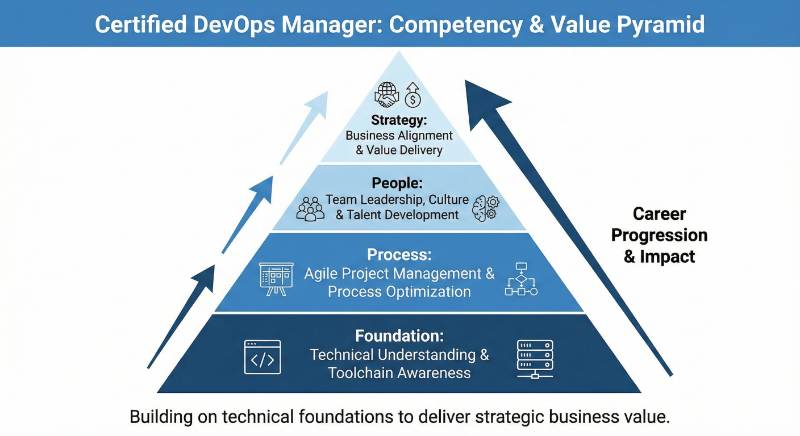
Certified DevOps Manager (CDM) is a leadership-focused certification that teaches professionals how to manage DevOps across teams effectively. It provides the skills needed to design clear operating models, define ownership, create governance frameworks, and use metrics to drive continuous improvement. CDM is perfect for those looking to lead stable, predictable software delivery at scale while managing complex systems across teams.
What Is Certified DevOps Manager (CDM)?
Certified DevOps Manager (CDM) is a certification aimed at professionals who want to manage and scale DevOps practices across teams. It focuses on the key aspects of ownership, governance, and continuous improvement, ensuring that delivery is both fast and reliable. CDM emphasizes leadership skills that can align teams and drive positive change, ensuring long-term success.
Why CDM matters
In larger organizations, DevOps often becomes fragmented, with teams working in silos, leading to inconsistent delivery speeds and stability issues. CDM helps solve this problem by providing a framework to manage cross-team delivery with consistent ownership, clear governance, and actionable metrics. It’s essential for scaling DevOps practices to ensure reliability and speed, especially as production systems grow more complex.
Who This Guide Is For
This guide is for professionals who are already involved in software delivery processes but want to move into a leadership role. Whether you’re a senior engineer, platform lead, or engineering manager, if you are responsible for improving the speed, stability, and predictability of software releases, CDM is designed for you. This guide will help you understand how CDM can enhance your career and make your work more impactful.
What You Will Get From This Guide
In this guide, you’ll get an in-depth understanding of the Certified DevOps Manager (CDM) certification, including the following:
- A clear overview of what CDM covers and what it is testing.
- A practical learning path and timeline for preparation.
- An explanation of the skills you’ll gain from the certification.
- A roadmap for your career progression, including next certifications after CDM.
- A mapping of roles and certifications based on your career aspirations.
- Frequently asked questions (FAQs) to clarify your doubts and help you plan your preparation.
About Provider
DevOpsSchool offers the Certified DevOps Manager (CDM) certification, a comprehensive program that teaches you how to lead and manage DevOps at scale. The course is designed to enhance your leadership skills in managing the complex task of DevOps delivery across multiple teams while ensuring stability and operational excellence.
Who Should Take CDM
Certified DevOps Manager (CDM) is ideal for professionals who are responsible for overseeing the stability, speed, and quality of delivery processes. This includes:
- Senior DevOps engineers looking to move into leadership roles.
- Engineering managers who want to improve cross-team collaboration and delivery outcomes.
- Platform leads who need to scale delivery processes across multiple teams.
- Cloud and platform architects who want to implement repeatable, reliable delivery pipelines.
- Professionals in regulated environments who need to balance speed with compliance.
Skills You’ll Gain
Upon completing the CDM certification, you will gain the following skills:
- Ownership models: Defining clear responsibilities across teams.
- Release governance: Designing risk-based release processes and readiness checks.
- Improvement metrics: Using data-driven decisions to improve delivery and stability.
- Incident management: Leading teams through incidents and preventing recurrences.
- Continuous improvement: Creating actionable feedback loops to refine delivery processes.
- Leadership alignment: Guiding teams through adoption, scaling, and change management.
Real-World Projects You Should Be Able to Do After CDM
After completing CDM, you should be capable of tackling real-world challenges that affect delivery and stability. You will be able to:
- Design and implement an operating model for multiple teams to ensure clear ownership and smooth workflows.
- Create risk-based release governance to define when releases are ready for production and how to manage rollback plans.
- Improve CI/CD pipelines by reducing flaky tests and ensuring stable and reliable deployments.
- Implement safe deployment strategies such as blue-green or canary deployments to minimize production risks.
- Set up an incident management framework that includes severity classification, escalation paths, and postmortems for continuous improvement.
- Use metrics to track and improve performance in delivery speed, stability, and recovery.
Preparation Plan (7–14 Days / 30 Days / 60 Days)
Preparing for CDM can vary depending on your existing knowledge. Here’s a suggested preparation plan:
7–14 Days
- Focus on scenarios: Practice real-world decision-making.
- Understand ownership models: Review how roles and responsibilities should be structured across teams.
- Learn release governance: Study how to manage safe deployments and mitigate risks.
30 Days
- Week 1: Delivery flow, ownership, and cross-team collaboration.
- Week 2: Governance, risk management, and continuous improvement.
- Week 3: Reliability leadership, incident management, and recovery.
- Week 4: Planning for platform adoption and stakeholder alignment.
60 Days
- Month 1: Build strong foundations by reading case studies and applying real-world examples.
- Month 2: Start an improvement project (e.g., streamline a release pipeline or incident response process).
- Revise and document results: Use these improvements as examples to showcase your leadership ability.
Common Mistakes
Here are some common mistakes to avoid while preparing for CDM:
- Overlooking real-world scenarios: CDM focuses on practical decision-making. Make sure to practice scenario-based questions.
- Focusing only on speed: Speed is important, but stability and recovery are just as critical.
- Adding approvals instead of guardrails: Learn to set up automated controls that ensure safety without slowing delivery.
- Ignoring postmortems: Running retrospectives is essential. Make sure to use insights from failures to improve.
- Treating metrics as numbers only: Use metrics as actionable insights for improvement, not just as something to report.
Best Next Certification After This
After completing CDM, consider the following next certifications depending on your career goals:
Same Track Option
Move toward DevOps Architect if you want to design platform-wide systems and solutions for multiple teams.
Cross-Track Options
Choose one based on your organization’s needs:
- DevSecOps for security-driven delivery
- SRE for reliability and operations maturity
- DataOps for data delivery governance
- FinOps for cost governance and optimization culture
- AIOps/MLOps for intelligent automation and insights
Leadership Option
Expand your leadership scope by integrating CDM thinking with cost, reliability, or data governance depending on what you are managing next.
Choose Your Path
Pick the track that matches your next responsibility area:
DevOps Path
Best for: DevOps leads managing delivery speed and stability.
Suggested sequence: Foundation → Engineer → Professional → Manager → Architect
DevSecOps Path
Best for: Leaders building secure-by-default delivery pipelines.
Suggested sequence: DevOps baseline → DevSecOps specialization → CDM governance
SRE Path
Best for: Reliability owners managing incidents and SLO maturity.
Suggested sequence: DevOps baseline → SRE specialization → CDM governance
AIOps/MLOps Path
Best for: Leaders driving automation and intelligent operations.
Suggested sequence: DevOps baseline → AIOps/MLOps specialization → leadership adoption
DataOps Path
Best for: Data engineering leads improving pipeline quality and delivery.
Suggested sequence: DataOps specialization → governance + flow + adoption leadership
FinOps Path
Best for: Cloud cost owners working with engineering leadership.
Suggested sequence: DevOps baseline → FinOps practices → CDM-style governance
Role → Recommended Certifications Mapping
| Role | Suggested progression |
|---|---|
| DevOps Engineer | DCP → CDE → CDP → CDM |
| SRE | DevOps baseline → SRE specialization → CDM |
| Platform Engineer | CDP → CDM → DevOps Architect direction |
| Cloud Engineer | DevOps baseline → DevOps engineer/pro path → CDM for leadership |
| Security Engineer | DevOps baseline → DevSecOps specialization → CDM |
| Data Engineer | DevOps baseline → DataOps specialization → CDM |
| FinOps Practitioner | Cloud basics → FinOps track → CDM for governance leadership |
| Engineering Manager | CDM first → cross-track specialization based on org needs |
Training and Certification Support Institutions
These platforms provide specialized tracks that can support your career after CDM, helping you focus on areas like security, reliability, operations automation, data management, and cloud cost governance.
DevSecOpsSchool
Focused on securing pipelines and ensuring delivery with built-in security.
SRESchool
Focused on improving service reliability, managing incidents, and defining SLOs.
AIOpsSchool
Focused on leveraging AI and machine learning to automate and optimize operations.
DataOpsSchool
Focused on improving data pipeline quality, governance, and orchestration.
FinOpsSchool
Focused on optimizing cloud costs and establishing effective cost governance models.
DevOpsSchool
Supports structured learning aligned to real DevOps outcomes. It helps professionals strengthen leadership thinking, governance clarity, and measurable improvement planning.
Cotocus
Focuses on practical, enterprise-level implementation thinking and scalability in DevOps practices.
ScmGalaxy
Supports CI/CD and automation learning journeys with structured guidance.
BestDevOps
Offers guided preparation for DevOps roles, ensuring readiness for job-specific requirements.
Frequently Asked Questions
- Is CDM only for managers?
No. CDM is useful for senior engineers, leads, and managers who influence delivery, release stability, governance, or cross-team execution. - Is CDM hard for someone new to DevOps?
It can be challenging if you have never worked with CI/CD, releases, or production support. With basic DevOps understanding, it becomes manageable. - How much time should working professionals keep for CDM?
Most people do well with 30 days. Experienced leads may need 7–14 days, and deep learners can take 60 days for stronger application. - Do I need coding skills for CDM?
No. CDM is more about leadership thinking, operating model design, governance, and improvement planning than writing code. - What background helps the most for CDM?
Experience with releases, deployments, incident handling, and cross-team coordination helps the most. - What is the biggest shift CDM expects from you?
Moving from “doing tasks” to “owning outcomes”—predictable releases, stable operations, clear ownership, and measurable improvement. - How is CDM different from engineer-level DevOps certifications?
Engineer-level certifications focus on hands-on tools and automation. CDM focuses on scaling DevOps practices through governance, ownership, and metrics. - Is CDM valuable for careers in India and global markets?
Yes. DevOps leadership, governance, and reliability outcomes are needed in every market and industry. - Will CDM help with promotions?
Yes—especially if you apply it to real problems and show measurable outcomes like fewer failures, faster recovery, or smoother releases. - What kind of preparation works best for CDM?
Scenario-based preparation works best—practice how you would solve delivery bottlenecks, repeat incidents, and approval overload. - What outcomes should I be able to show after CDM?
Better release predictability, fewer repeat incidents, clearer ownership, reduced manual approvals, and stronger cross-team alignment. - What should I do after passing CDM to keep it useful?
Create a simple “DevOps Manager Playbook,” apply it to one improvement program, and review it quarterly using real results.
FAQs – Certified DevOps Manager (CDM)
- What does CDM mainly teach?
How to manage DevOps across teams using clear ownership, governance models, and metrics-driven continuous improvement. - Does CDM focus on specific tools like Kubernetes or Jenkins?
No. Tools are context. CDM is about operating model, leadership decisions, governance, and scaling DevOps across teams. - What type of questions should I expect in CDM learning?
Mostly scenario-based questions—release failures, incident overload, unclear ownership, slow approvals, and compliance needs. - What real-world work should I be able to do after CDM?
Run a delivery improvement program: define roles, reduce bottlenecks, improve release governance, strengthen incident routines, and measure outcomes. - What is the most common mistake during CDM preparation?
Studying definitions only and ignoring scenario practice. CDM needs decision-making practice, not memorization. - How do I prepare CDM in 7–14 days?
Focus on scenarios, governance patterns, ownership models, and short structured answers: problem → decision → steps → expected outcome. - What should I prepare in 30 days for best results?
Work week-by-week: delivery flow, governance, reliability practices, and adoption planning—then revise using scenario answers. - What is the best next step after CDM inside a learning journey?
Choose based on your goal: DevOps Architect direction (same track), or cross-track focus like SRE/DevSecOps/DataOps/FinOps/AIOps-MLOps (based on your org needs).
Conclusion
Certified DevOps Manager (CDM) helps you transition from technical tasks to leadership, enabling you to manage DevOps as a repeatable, scalable operating model. It empowers you to reduce failures, improve delivery speed, and ensure stable production across teams. Applying CDM thinking to real-world problems makes you a leader who can align teams and influence the overall delivery system, positioning you for bigger roles and long-term career growth.

