
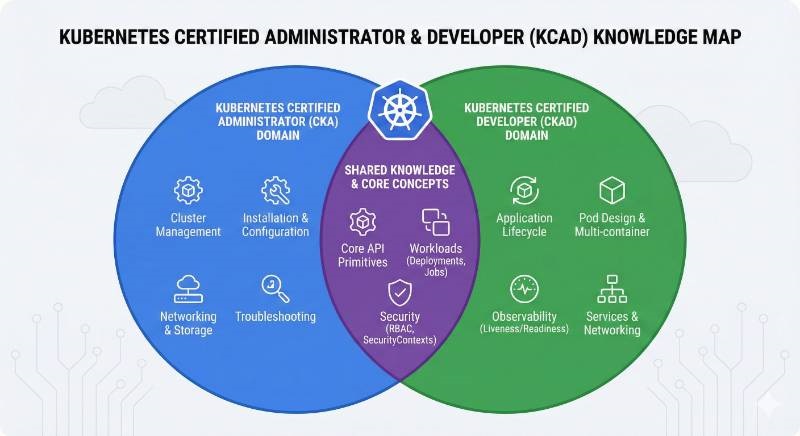
In the current era of cloud-native engineering, Kubernetes has transitioned from a specialized tool to the foundational operating system of the modern data center. For software engineers and managers across India and the global market, mastery of orchestration is no longer a luxury—it is a baseline requirement for building scalable, resilient systems.
The Kubernetes Certified Administrator & Developer (KCAD) program is designed to bridge the critical gap between infrastructure management and application deployment. This guide provides a comprehensive roadmap for navigating this certification and understanding its impact on a high-velocity technical career.
The Landscape of Cloud-Native Certifications
Choosing the right certification requires understanding where a specific credential sits within the broader ecosystem of DevOps, Security, and Reliability.
Master Certification Table
| Track | Level | Who it’s for | Prerequisites | Skills Covered | Recommended Order |
| Kubernetes | Intermediate/Advanced | DevOps, SRE, Developers | Linux, Docker basics | Cluster setup, Networking, Deployments, RBAC | Start with KCAD |
| DevOps | Professional | Engineers, Leads | Scripting, Cloud basics | CI/CD, GitOps, Infrastructure as Code | After KCAD |
| DevSecOps | Professional | Security Engineers | DevOps Fundamentals | SCA, SAST/DAST, Policy as Code | After DevOps Core |
| SRE | Professional | SREs, Ops Leads | Linux, Monitoring | SLOs, Error Budgets, Reliability | Parallel to KCAD |
| AIOps | Advanced | Data/Ops Engineers | Python, ML basics | Predictive Monitoring, Log Analysis | After SRE Path |
| FinOps | Management/Ops | Managers, Cloud Ops | Cloud Billing concepts | Cost Allocation, Unit Economics | After Platform Path |
Deep Dive: Kubernetes Certified Administrator & Developer (KCAD)
What it is
The KCAD is a performance-based certification program that validates the dual competencies of cluster administration and cloud-native application development. Unlike theoretical exams, it requires candidates to solve real-world problems in a live CLI environment, ensuring they can both build the “house” (the cluster) and live in it (deploy the apps).
Who should take it
- Software Engineers aiming to understand the lifecycle of their code beyond the local IDE.
- DevOps & Platform Engineers responsible for automating infrastructure and CI/CD pipelines.
- System Administrators migrating legacy workloads to containerized environments.
- Engineering Managers who need to oversee technical architecture and resource allocation effectively.
Skills you’ll gain
- Provisioning: Installing and configuring production-ready Kubernetes clusters.
- Workload Orchestration: Managing Pods, Deployments, and StatefulSets.
- Networking: Implementing Ingress, Services, and sophisticated Network Policies.
- Storage: Handling Persistent Volumes and Claims for stateful applications.
- Security: Implementing RBAC, Service Accounts, and Secrets management.
- Observability: Troubleshooting cluster components and application logs in real-time.
Real-world projects you should be able to do
- Multi-Node Setup: Build a high-availability cluster using
kubeadm. - Traffic Management: Configure an Ingress Controller to route traffic to multiple microservices.
- Self-Healing Apps: Set up Liveness and Readiness probes to ensure zero-downtime.
- Dynamic Scaling: Implement Horizontal Pod Autoscaling based on CPU/Memory metrics.
- Cluster Hardening: Restrict inter-pod communication using Network Policies.
Preparation Plan
7–14 Days (Fast Track)
- Days 1–5: Intensive focus on
kubectlimperatives. Learn to generate YAML manifests without a browser. - Days 6–10: Master cluster maintenance (upgrades, backup/restore of
etcd). - Days 11–14: Full-length mock exams focusing purely on speed and troubleshooting.
30 Days (Standard Plan)
- Week 1: Core Architecture. Understand the Control Plane and Worker Node components.
- Week 2: Application Deployment. Practice ConfigMaps, Secrets, and Rollouts.
- Week 3: Networking & Storage. Deep dive into CoreDNS, Services, and PV/PVC.
- Week 4: Practice & Refine. Target weak areas discovered during practice labs.
60 Days (Comprehensive Plan)
- Month 1: Foundational Linux and Containerization (Docker/Containerd) basics.
- Month 2: Follow the 30-day standard plan with additional time for “The Hard Way” installations and complex networking scenarios.
Common mistakes
- Manual YAML Editing: Spending too much time fixing indentation instead of using dry-run flags.
- Context Switching: Forgetting to switch between clusters or namespaces during multi-tasking.
- Ignoring Base OS: Failing to troubleshoot the underlying Linux node when the cluster is healthy but the app is not.
- Neglecting Documentation: Not knowing how to quickly search the official
kubernetes.iodocs during timed tasks.
Best next certification after this
The Certified Kubernetes Security Specialist (CKS) is the logical progression, focusing on securing the entire container supply chain.
Choose Your Path: 6 Specialized Learning Tracks
1. The DevOps Path
Focuses on the integration of development and operations through automation.
- Goal: Seamless delivery and CI/CD excellence.
2. The DevSecOps Path
Integrates security at every stage of the software development lifecycle.
- Goal: Shifting security “left” to prevent vulnerabilities early.
3. The SRE Path
Applies software engineering principles to infrastructure and operations.
- Goal: Maximizing reliability, scalability, and uptime.
4. The AIOps / MLOps Path
Combines big data and machine learning to automate IT operations and model deployment.
- Goal: Proactive incident management and streamlined AI lifecycles.
5. The DataOps Path
An agile, process-oriented methodology for developing and delivering analytics.
- Goal: Ensuring data quality and rapid integration across pipelines.
6. The FinOps Path
Brings financial accountability to the variable spend model of the cloud.
- Goal: Optimizing cloud costs while maintaining performance.
Role → Recommended Certifications
| Role | Recommended Sequence |
| DevOps Engineer | KCAD → Certified DevOps Professional → CKS |
| SRE | KCAD → SRECP → Observability Specialist |
| Platform Engineer | KCAD → Infrastructure as Code (Terraform) → Certified DevOps Architect |
| Cloud Engineer | KCAD → AWS/Azure/GCP Architect Professional |
| Security Engineer | KCAD → DSOCP → CKS |
| Data Engineer | KCAD → DataOps Certified Professional |
| FinOps Practitioner | KCAD → Certified FinOps Engineer |
| Engineering Manager | KCAD (Awareness) → Certified DevOps Manager |
Next Certifications to Take
To maintain a competitive edge, consider these three distinct directions after achieving the KCAD:
- Same Track (Specialization): Certified Kubernetes Security Specialist (CKS). Focuses on hardening the cluster and secure supply chain.
- Cross-Track (Broadening): Certified FinOps Architect. Essential for understanding the economic impact of cloud-native scaling.
- Leadership (Career Growth): Certified DevOps Manager (CDM). Designed for those moving into strategic leadership and team management.
Top Institutions for KCAD Training & Certification
- DevOpsSchool:
A premier training provider specializing in hands-on, instructor-led sessions. Their curriculum is heavily weighted toward real-world scenarios, making it ideal for those needing practical experience alongside certification. - Cotocus:
Offers enterprise-level training programs that focus on industrial use cases. They are known for deep-dive technical workshops that cater to both individual engineers and corporate teams. - Scmgalaxy:
A robust platform providing extensive resources, community support, and specialized training in configuration management and orchestration tools. - BestDevOps:
Focuses on career transformation, offering structured pathways for engineers looking to transition into the DevOps and Kubernetes space with high-quality study materials. - devsecopsschool.com:
The go-to destination for security-first engineering. Their courses ensure that Kubernetes administration is taught through a lens of risk mitigation and compliance. - sreschool.com:
Specifically designed for reliability professionals, focusing on how to keep Kubernetes clusters running at peak performance under heavy load. - aiopsschool.com:
Tailored for the next generation of operations, teaching how to integrate artificial intelligence into standard Kubernetes and DevOps workflows. - dataopsschool.com:
Provides specialized training for data professionals who need to manage data pipelines and stateful workloads within containerized environments. - finopsschool.com:
Focuses on the financial side of the cloud, providing the frameworks needed to manage and optimize Kubernetes spending effectively.
Career FAQs: The Big Picture
1. How difficult is the KCAD?
It is considered moderately difficult because it is 100% lab-based. You cannot guess your way through it; you must be able to perform.
2. How much time is required for preparation?
Typically, 40–60 hours of dedicated hands-on practice is sufficient for most engineers with a basic background.
3. Are there prerequisites?
No formal prerequisites exist, but a strong grasp of Linux and basic container concepts is vital for success.
4. What is the value of this certification in India?
India is a global hub for cloud services; the demand for certified Kubernetes professionals is among the highest in the world, often commanding significant salary premiums.
5. How does this help an Engineering Manager?
It provides the technical vocabulary and architectural understanding required to make data-driven decisions regarding cloud spend and team velocity.
6. Can I skip the Administrator part and just do Developer?
The KCAD combines both. Understanding how the cluster is built (Admin) makes you a significantly better Developer, and vice versa.
7. Does the exam use a specific cloud provider?
No, the exam uses standard Kubernetes (upstream), making your skills applicable to AWS (EKS), Azure (AKS), and GCP (GKE).
8. Is the certification recognized globally?
Yes, it is the industry standard for Kubernetes expertise worldwide.
9. What happens if I fail the first time?
Most exam registrations include one free retake, allowing you to learn from the first attempt.
10. How long is the certification valid?
It is valid for 3 years, after which you can recertify to stay current with the latest Kubernetes versions.
11. Is the exam proctored?
Yes, it is a remote-proctored exam that you can take from any quiet location with a stable internet connection.
12. Can I use notes during the exam?
You cannot use personal notes, but you are allowed to access official Kubernetes documentation in a separate browser tab.
Specific FAQs: Kubernetes Certified Administrator & Developer (KCAD)
1. What is the primary focus of the KCAD?
The program focuses on the ability to install, configure, and manage production-grade Kubernetes clusters while deploying and troubleshooting applications.
2. Does the training include Helm?
Standard KCAD training includes application packaging and deployment strategies, which often involve Helm for manifest management.
3. Is a lab environment provided during training?
Institutions like DevOpsSchool provide dedicated, cloud-based lab environments to ensure candidates can practice without local hardware limitations.
4. Who is the provider of the KCAD certification?
The certification is offered through professional training organizations and is supported by global training partners like DevOpsSchool.
5. What is the format of the exam?
The exam consists of a series of performance-based tasks (problems) to be solved in a command-line interface.
6. What is the passing score?
The passing score for most Kubernetes performance-based exams is 66%.
7. How quickly are results delivered?
Candidates typically receive their scores via email within 24 hours of completing the exam.
8. Is there a project-based component?
The certification itself is one large project-based assessment, as you must solve real-time infrastructure and deployment challenges.
Conclusion
The transition to a cloud-native architecture is a fundamental shift in how modern software is engineered. The Kubernetes Certified Administrator & Developer (KCAD) certification serves as a critical benchmark, validating that an engineer possesses the practical, hands-on skills required to navigate this landscape.
For Software Engineers, it offers a deep understanding of the environment where their code lives. For Managers, it provides the technical clarity needed to lead teams toward efficient, scalable, and reliable infrastructure. Whether you are aiming for a role in DevOps, SRE, or FinOps, mastering Kubernetes is the most significant investment you can make in your professional growth.

