
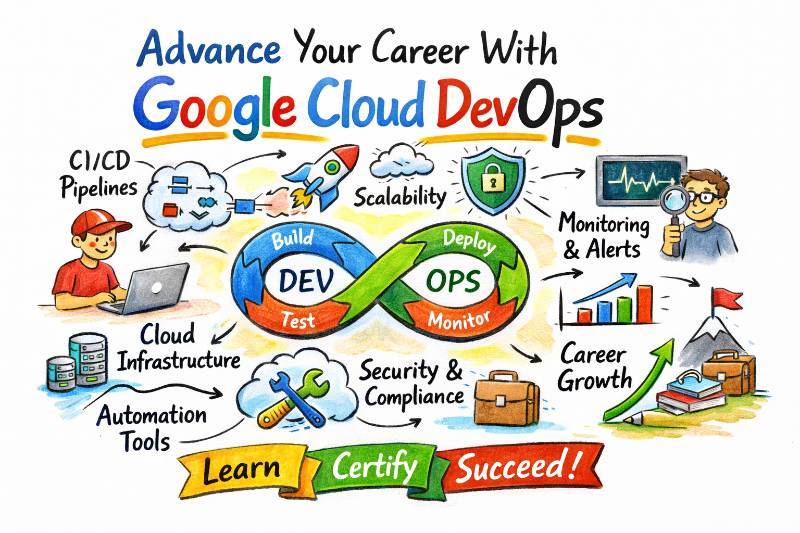
Introduction
Google Cloud is now a serious option for companies that want fast delivery, strong reliability, and smart use of data and AI. To support this, teams need people who can build and run systems on Google Cloud in a disciplined way, not just write code or click in the console. The Google Cloud Professional Engineer certification proves that you can balance delivery speed with stability using DevOps and Site Reliability Engineering (SRE) practices on Google Cloud.
This guide is for working engineers, software developers, SREs, and managers in India and around the world who want a clear view of the Google Cloud Professional Engineer space, with Professional Cloud Engineer as the core focus. You will see what the certification covers, who it suits, what skills you will build, how to prepare in 7–14, 30, or 60 days, and how to connect it with DevOps, DevSecOps, SRE, AIOps/MLOps, DataOps, and FinOps paths.
What Is Google Cloud Professional Engineer?
A Google Cloud Professional Engineer implements processes and capabilities throughout the system lifecycle using Google Cloud tools and recommended methods. They set up software delivery pipelines, deploy and monitor services, apply SRE principles like SLOs and error budgets, and tune systems for performance and cost.
This certification checks that you:
- Can build and run CI/CD pipelines on Google Cloud.
- Know how to watch systems using logs, metrics, and traces.
- Can handle incidents and continuously improve services.
- Understand how to keep systems both fast and reliable over time.
Who Should Take This Certification?
You should consider this certification if you:
- Work as a DevOps Engineer, SRE, Platform Engineer, or Cloud Engineer on Google Cloud, or want to move into these roles.
- Are a software engineer who owns deployments, on-call, or production health for your services.
- Are an engineering manager or tech lead who wants a practical view of how modern cloud operations should run on GCP.
Recommended background:
- Comfortable with Linux, scripting, and at least one programming language.
- Experience with basic CI/CD concepts and tools, even if not yet on GCP.
- Understanding of core Google Cloud services like Compute Engine, GKE, Cloud Run, Storage, networking, and IAM.
Skills You Will Gain
The certification builds a very practical skill set that you can apply directly on the job.
- SRE principles
- Define and work with SLIs, SLOs, and error budgets.
- Make trade-offs between new features and reliability.
- CI/CD pipelines
- Design and implement pipelines with tools like Cloud Build, Cloud Deploy, and Artifact Registry.
- Automate testing and deployment for apps, infrastructure, and ML workloads.
- Observability and troubleshooting
- Use Cloud Monitoring and Logging to track health, performance, and errors.
- Build dashboards and alerts that map to SLOs and business needs.
- Incident management and reliability
- Organise on-call actions, escalation, and incident workflows.
- Run blameless post-mortems and improve systems based on learnings.
- Performance and cost optimisation
- Use autoscaling, caching, and resource tuning to improve performance.
- Optimise cost while keeping reliability targets intact.
Real-World Projects You Should Handle After This
After this certification, you should be able to:
- Build a CI/CD pipeline that takes code from commit to production on GKE or Cloud Run, including tests and safe rollbacks.
- Design SLOs for a key service, track them in Cloud Monitoring, and wire them to alerts that matter.
- Turn a fragile, manually deployed GCP workload into an automated, observable, and resilient service with canary or blue–green deployments.
- Set up an incident response process including runbooks, on-call rotation basics, and post-mortem templates.
- Work with developers and security engineers to add tests, checks, and policies into the delivery pipeline.
Google Cloud Professional Engineer – Certification Table
Here is a high-level view of key Google Cloud Professional-level engineer certifications, with DevOps Engineer as the main focus.
Google Cloud Professional Engineer
What it is
The Google Cloud Professional Engineer certification proves that you can design, build, and run delivery and operations on GCP using DevOps and SRE best practices. It focuses on how you keep services running reliably while releasing changes quickly and safely.
Who should take it
- DevOps Engineers, SREs, and Platform Engineers working with or moving to GCP.
- Software Engineers who are responsible for deployment, monitoring, and production incidents.
- Engineering Managers who guide teams across delivery, reliability, and operations on cloud.
Skills you’ll gain
- Understand and apply core SRE ideas like SLIs, SLOs, and error budgets.
- Design and manage CI/CD pipelines on GCP for applications, infrastructure, and ML workloads.
- Implement observability with Cloud Monitoring, Logging, and tracing, plus alerting and dashboards.
- Plan and run incident response, including post-mortems and continuous improvement.
- Optimise services for performance and cost, with smart use of autoscaling and resource sizing.
Real-world projects you should be able to do after it
- Build a pipeline that packages a service into containers, runs tests, and deploys it to GKE or Cloud Run with rollback options.
- Define SLOs for a major API, set alerts based on error budget burn, and tune the system based on data.
- Convert manual, ticket-driven deployments into an automated, auditable, and observable release process.
- Design an incident response process for a small or medium team, including playbooks and review steps.
Preparation plan (7–14 / 30 / 60 days)
7–14 days (fast track) – For engineers already working with GCP and SRE/DevOps:
- Map the exam objectives from Google to your current skills and find gaps.
- Do focused labs on Cloud Build, Cloud Deploy, Cloud Operations, and deployment patterns you are weak in.
- Take 2–3 timed practice exams, then review each wrong answer in detail.
30 days (balanced plan) – For typical working professionals:
- Week 1: SRE basics, SLIs/SLOs/error budgets, and incident management concepts.
- Week 2: Hands-on CI/CD on GCP; create pipelines for at least one sample app.
- Week 3: Observability labs (Monitoring, Logging, traces) and performance tuning.
- Week 4: Full project where you apply all pieces, then 2+ mock exams with review.
60 days (deep-dive) – For people new to GCP or DevOps:
- Weeks 1–2: Learn GCP basics (Compute, Storage, networking, IAM) and simple deployments.
- Weeks 3–4: Study DevOps and SRE fundamentals; build first simple pipeline and monitoring setup.
- Weeks 5–6: Build a realistic project environment, practise incidents, and take spaced mock exams.
Common mistakes
- Focusing only on tools and commands but ignoring SRE principles and trade-offs.
- Underestimating observability and incident response content.
- Practising only in theory without real deployments or production-like problems.
- Ignoring performance and cost optimisation; treating them as minor topics.
Best next certification after this
Based on current software engineer certification trends and stack choices:
- Same track: move to Google Cloud Professional Cloud Architect to add end-to-end design and leadership of solutions on top of DevOps skills.
- Cross-track: add Professional Data Engineer or Professional Cloud Security Engineer if you work closely with data or security teams.
- Leadership: aim for architecture/management-focused certifications such as architect or manager-level DevOps credentials from recognised providers.
Choose Your Path: 6 Learning Paths
DevOps path
Use Professional Cloud DevOps Engineer as your core badge. Combine it with Cloud Developer or Architect skills so you can both design and operate systems on GCP. This suits people responsible for CI/CD, environments, and production reliability.
DevSecOps path
Pair DevOps Engineer with security-focused skills or certifications. You will design pipelines that include security scanning, policy checks, and compliance gates while still moving fast. This is ideal if you collaborate deeply with security or compliance teams.
SRE path
Focus on DevOps Engineer plus deeper SRE learning and practice on GCP. You will own SLOs, error budgets, incident response, and reliability automation for critical services. This suits people who enjoy both coding and operations.
AIOps/MLOps path
Combine DevOps Engineer with data and ML credentials. You work on automating data and ML pipelines, managing model deployments, and using telemetry for smarter operations.
DataOps path
Mix DevOps Engineer with Data Engineer skills. You will design and run reliable, monitored data pipelines that deliver fresh, correct data to analytics and ML systems.
FinOps path
Blend DevOps Engineer with cloud cost and governance knowledge. You help teams design and run systems that meet reliability goals without over-spending, using metrics and automation to control cost.
Role → Recommended Certifications
| Role | Recommended certification flow (including DevOps Engineer) |
|---|---|
| DevOps Engineer | GCP fundamentals → Professional Cloud DevOps Engineer → Professional Cloud Architect |
| SRE | GCP fundamentals → Professional Cloud DevOps Engineer, plus deep SRE practice and training |
| Platform Engineer | GCP fundamentals → Professional Cloud Architect → DevOps or Network Engineer |
| Cloud Engineer | Fundamentals/Associate skills → DevOps Engineer or Architect depending on job focus |
| Security Engineer | Fundamentals → Cloud Security Engineer → DevOps Engineer for secure delivery and operations |
| Data Engineer | Fundamentals → Data Engineer → DevOps Engineer or ML Engineer for production pipelines |
| FinOps Practitioner | Fundamentals → any main Professional (Architect/DevOps) plus structured FinOps and cost training |
| Engineering Manager | Fundamentals → Cloud Architect → DevOps Engineer or Data/Security paths relevant to your teams |
Training Institutions for Google Cloud Professional Engineer
- DevOpsSchool:
Offers guided training for Google Cloud Professional Cloud DevOps Engineer with deep hands-on labs, scenario-based exercises, and exam preparation support, helping engineers and managers connect exam topics to daily work. - Cotocus:
Provides structured cloud and DevOps learning paths, where Google Cloud DevOps skills are combined with SRE, automation, and architecture for long-term career growth. - Scmgalaxy:
Focuses on practical DevOps implementation, CI/CD, and containerisation, showing how to apply Google Cloud DevOps concepts in real delivery pipelines. - BestDevOps:
Curates DevOps and cloud courses aimed at working professionals who want to upgrade their profile with Google Cloud and related certifications. - devsecopsschool.com:
Specialises in DevSecOps training; integrates security testing, policy-as-code, and governance into pipelines that may run on Google Cloud. - sreschool.com:
Targets SRE and reliability roles, including SLO design, incident management, and observability patterns suitable for GCP environments. - aiopsschool.com:
Focuses on AIOps, using data from logs and metrics to automate operations; Google Cloud observability and DevOps skills fit directly into this. - dataopsschool.com:
Dedicated to DataOps and analytics; Google Cloud data and pipeline tooling is combined with DevOps practices for stable data platforms. - finopsschool.com:
Teaches cloud cost management and governance; DevOps and architecture skills from GCP complement its FinOps-focused content.
FAQs – Google Cloud Professional Cloud DevOps Engineer
- Is the Google Cloud Professional Cloud DevOps Engineer exam very difficult?
It is an advanced exam and can feel demanding if you are new to GCP or SRE, but with real hands-on practice and a clear plan, most working engineers can clear it. - How much time do I need to prepare?
Many professionals need between one and three months, depending on starting experience and study time per week. If you already work with GCP and SRE ideas, 4–6 focused weeks can be enough. - Do I need an Associate Cloud Engineer certification before this?
It is not required by Google, but having Associate-level skills or similar experience makes the Professional DevOps exam easier and more comfortable. - Can beginners attempt this exam directly?
A complete beginner can try but will likely struggle. It is better to first build GCP fundamentals and work on at least one small project before attempting this certification. - What is the main advantage of this certification for my career?
It shows employers that you can run real production systems on GCP using modern DevOps and SRE practices, not just write code or know theory. This is a strong differentiator for senior DevOps, SRE, and platform roles. - Is this certification more relevant for DevOps or SRE roles?
It is built on SRE principles but framed in a DevOps context, so it is highly relevant for both groups of roles that manage and improve production systems. - How does this compare with other cloud certifications?
Many cloud exams focus on architecture or basic administration, while this one focuses deeply on how you deliver, monitor, and improve services over time using pipelines, SLOs, and observability. - Will this certification guarantee me a job or promotion?
No certification can guarantee that, but this credential strongly supports your profile when combined with good project experience, communication skills, and clear career stories in interviews. - What mistakes should I avoid in preparation?
Common issues include ignoring SLO/error budget content, not practising real CI/CD and monitoring on GCP, and focusing only on reading instead of labs and scenarios. - In what order should I do Google Cloud certifications?
A common sequence is GCP fundamentals → Associate-level skills → Professional Cloud DevOps Engineer → Professional Cloud Architect or Data/Security Engineer, depending on your direction. - Are the skills from this certification useful outside Google Cloud?
Yes, because DevOps, SRE, observability, and incident management concepts apply across all major clouds and even on-prem; you would just change specific tools. - Is this certification useful for engineering managers?
It helps managers understand what good pipelines, SLOs, and incident processes look like on GCP, so they can set better expectations, review designs, and support their teams.
Conclusion
The Google Cloud Professional Cloud DevOps Engineer certification is one of the most practical credentials you can choose if you care about delivering software quickly and running it reliably on Google Cloud. It brings together DevOps automation, SRE discipline, observability, and cost awareness, which are exactly the mix modern organisations expect from senior engineers and technical leaders.
When you position this certification inside a clear path—DevOps, DevSecOps, SRE, AIOps/MLOps, DataOps, or FinOps—you create a strong, future-ready career story that works in India and globally.

