
Introduction
Kubernetes is the main platform many companies use to run containers in production. It helps teams run many services together in a stable way.
Because of this, companies need people who can install, run, fix, and secure Kubernetes clusters in real life, not only write example files.
The Certified Kubernetes Administrator (CKA) Certification Training Course is built to teach you these real cluster skills and also prepare you for the CKA exam. This guide will explain the course, who should join, what you will learn, how to study, what to avoid, possible next certifications, learning paths, role mapping, and common questions.
What Is the Certified Kubernetes Administrator (CKA) Training Course?
The Certified Kubernetes Administrator (CKA) Training Course from DevOpsSchool follows this idea. You learn Kubernetes by doing labs, solving problems, and working with real‑looking clusters. The course covers cluster basics, installation, configuration, workloads, networking, storage, and troubleshooting.
Who Should Take the CKA Certification Training Course?
This course is a good fit if you work with containers or plan to work with Kubernetes soon. It is useful for:
- DevOps Engineers handling deployments and CI/CD with containers
- Platform and Cloud Engineers who manage shared Kubernetes clusters
- SREs responsible for uptime and reliability of services on Kubernetes
- System Administrators moving from VMs to container platforms
- Software Engineers who want to own deployment and runtime of their apps
- Engineering Managers who want to understand what their teams are doing on Kubernetes
If your company uses Kubernetes now, or is planning to, CKA helps you become one of the key people for cluster operations.
Skills You Will Learn in the CKA Training Course
The course and exam cover these main areas:
- Cluster architecture, install, and setup
- Plan and create Kubernetes clusters (for example with kubeadm)
- Configure control plane and worker nodes, networking, and add‑ons
- Upgrade clusters and back up and restore etcd
- Workloads and scheduling
- Deploy and manage apps using Deployments, ReplicaSets, and DaemonSets
- Perform rollouts, rollbacks, and scale applications
- Use ConfigMaps, Secrets, and set resource requests and limits
- Services and networking
- Understand Pod networking and how CNI plugins work at a basic level
- Expose apps using ClusterIP, NodePort, and LoadBalancer services
- Configure Ingress controllers, Ingress rules, and CoreDNS
- Storage
- Work with StorageClasses, PersistentVolumes, and PersistentVolumeClaims
- Set correct access modes and reclaim policies
- Attach persistent storage to stateful applications
- Troubleshooting
- Find and fix issues in Pods, nodes, services, networking, and control plane
- Use kubectl, events, and logs to understand problems
- Solve deployment failures, configuration mistakes, and resource issues
Real‑World Projects You Should Handle After CKA
After this training and proper practice, you should be able to:
- Install and configure a Kubernetes cluster ready for real applications
- Move existing applications into Kubernetes using deployments, services, and storage
- Set up basic monitoring and logging for apps and nodes in the cluster
- Perform safe rolling updates and rollbacks for important services
- Troubleshoot and fix common cluster problems under time pressure
Preparation Plan (7–14 Days / 30 Days / 60 Days)
7–14 Days (Fast Plan, if You Already Use Kubernetes)
- Days 1–3: Review basics: Pods, Deployments, Services, ConfigMaps, Secrets, simple storage.
- Days 4–6: Practice cluster tasks: install with kubeadm, upgrade, configure RBAC, do etcd backup and restore.
- Days 7–10: Focus only on troubleshooting labs: broken Pods, failing services, node issues.
- Days 11–14: Do full mock exams with a timer and then review every mistake.
30 Days (Balanced Plan for Busy Engineers)
- Week 1: Learn or revise Kubernetes basics and do small labs for workloads and services.
- Week 2: Study cluster architecture, install and upgrade clusters, and work with RBAC and control plane tasks.
- Week 3: Focus on networking (services, Ingress) and storage (PV, PVC, StorageClasses).
- Week 4: Spend most time on troubleshooting, mixed‑topic labs, and 2–3 practice exams.
60 Days (Deep Plan, if You Are New to Kubernetes)
- Month 1: Learn containers and Kubernetes from scratch with simple labs. Get comfortable with kubectl, YAML, and core objects.
- Month 2: Follow the full CKA syllabus topic by topic with labs, then do multiple mock exams and review weak areas.
Common Mistakes While Preparing for CKA
- Starting CKA without basic Linux and networking knowledge.
- Just reading or watching videos without touching a real cluster.
- Not checking the official CKA exam topics and their weight.
- Not learning kubectl shortcuts and efficient ways to search and edit objects.
- Ignoring storage or networking, assuming they are “low priority” topics.
Best Next Certification After CKA
You can move in three directions after CKA:
- Same track (Kubernetes and containers):
- Go deeper into Kubernetes with more advanced or security‑focused Kubernetes certifications.
- Cross‑track (cloud / DevOps / platform):
- Add a cloud provider or DevOps certification to show you can run Kubernetes as part of wider cloud and CI/CD systems.
- Leadership (architecture / strategy):
- Choose architecture‑oriented certifications so you can design large systems and guide teams that use Kubernetes heavily.
Choose Your Path: 6 Learning Paths Around CKA
DevOps Path
Here you use CKA to become strong in container platforms. You know how to run Kubernetes clusters that support CI/CD, GitOps, and automation, so your deployments are repeatable and safe.
DevSecOps Path
Here you mix CKA skills with security practices. You care about network rules, secrets, policies, and secure images, and you make sure security is built into the cluster and pipelines, not added at the end.
SRE Path
Here you combine CKA with SRE ideas like SLIs, SLOs, and error budgets. You use Kubernetes as the base where you manage reliability, monitoring, alerts, and incident response for microservices.
AIOps / MLOps Path
Here you use Kubernetes to run ML and data‑heavy workloads. With CKA, you can handle batch jobs, model training, and inference services with autoscaling and rolling updates.
DataOps Path
Here you run data pipelines and analytics workloads on Kubernetes. CKA helps you manage stateful sets, storage, and network paths so your data flows are reliable and observable.
FinOps Path
Here you focus on cost and value. After CKA, you understand how CPU and memory requests, node sizes, and scaling choices affect cloud bills, and you can help your team design clusters that use money wisely.
Role → Recommended Certifications Mapping
| Role | How CKA helps | Recommended direction after CKA |
|---|---|---|
| DevOps Engineer | Gives strong control over Kubernetes clusters and deployments | Add cloud/DevOps or advanced Kubernetes certifications |
| SRE | Helps you understand cluster behavior, failures, and fixes | Add reliability or architecture‑focused certifications |
| Platform Engineer | Lets you design and run shared Kubernetes platforms | Add architecture, security, or networking certifications |
| Cloud Engineer | Connects cloud infra with Kubernetes workloads | Move towards cloud architect or DevOps certifications |
| Security Engineer | Gives a base for cluster and workload security | Add cloud/Kubernetes security certifications |
| Data Engineer | Helps run data services and pipelines on Kubernetes | Add data or cloud‑data certifications |
| FinOps Practitioner | Shows where and how Kubernetes uses resources and money | Add architecture or FinOps‑focused certifications |
| Engineering Manager | Gives real understanding of how teams run workloads on Kubernetes | Add architecture‑oriented certifications to support leadership decisions |
Top Institutions for CKA Training and Support
DevOpsSchool
DevOpsSchool offers a full CKA Certification Training Course with live classes, labs, and exam‑style practice. The content maps to official CKA topics and also includes real project examples so you can use skills at work, not only in the exam.
Cotocus
Cotocus provides DevOps and Kubernetes training and consulting. They help you link CKA topics to real migration and platform stories, so you can see how clusters are used in full environments.
Scmgalaxy
Scmgalaxy focuses on DevOps tools and CI/CD. This is useful when you want to connect CKA skills to pipelines, configuration management, and automation in your company.
BestDevOps
BestDevOps builds community and content around DevOps and cloud. For CKA students, this gives you extra learning material and shared experience from people using Kubernetes in different setups.
devsecopsschool.com
devsecopsschool.com helps you bring security into development and operations. Combined with CKA, you learn how to apply secure practices directly inside Kubernetes clusters and CI/CD flows.
sreschool.com
sreschool.com teaches SRE concepts and tools. Together with CKA, this lets you manage Kubernetes with a strong focus on reliability, SLIs, SLOs, and better incident handling.
aiopsschool.com
aiopsschool.com focuses on AIOps and smart operations. With CKA, you can feed Kubernetes metrics and logs into smart automation and monitoring systems to react faster to problems.
dataopsschool.com
dataopsschool.com focuses on DataOps. When you mix their approach with CKA, you can run data pipelines and platforms on Kubernetes with better control over reliability and changes.
finopsschool.com
finopsschool.com teaches FinOps and cloud cost control. With CKA skills, you understand how cluster design affects cost and can work with finance and engineering to keep spending under control.
FAQs on Certified Kubernetes Administrator (CKA) Certification Training Course
1. Is the CKA exam very hard?
CKA is not easy because it is practical and timed. You need to be fast and accurate in a real Kubernetes cluster, but with enough practice it is absolutely possible to clear.
2. How long should I study for CKA?
Most working people need from a few weeks up to two months, depending on how new they are to Kubernetes and how many hours they can give each week.
3. What should I know before starting the CKA course?
You should know basic Linux commands, simple networking ideas, how containers work, and how to read and write simple YAML. Some basic Kubernetes use is a big plus.
4. In what order should I learn topics?
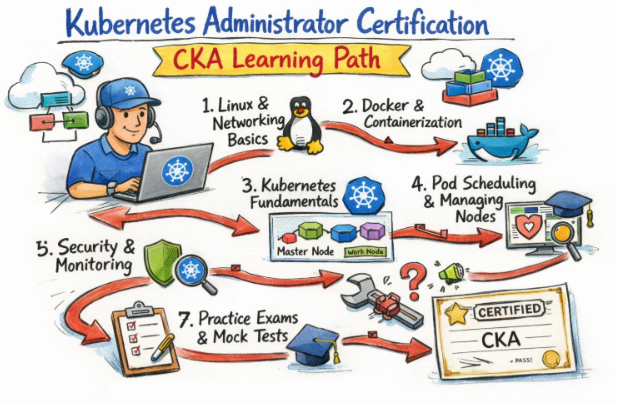
A simple order is: containers → basic Kubernetes objects → deployments and services → cluster install and admin → networking and storage → troubleshooting → full mock exams.
5. Is CKA helpful for software developers?
Yes. It helps developers understand exactly how their applications run in Kubernetes, how they scale, and how failures are handled. This supports DevOps and SRE‑style work.
6. What career value does CKA give?
CKA is well known in the industry. It shows that you can manage Kubernetes clusters, which is a key skill for many DevOps, SRE, Platform, and Cloud roles.
7. Can I prepare for CKA while working full‑time?
Yes. Many people study in the evenings and weekends, using a 30‑ or 60‑day plan with regular labs and a few full mock exams near the end.
8. What happens if I only watch videos and don’t do labs?
You will likely find the exam very hard. CKA requires real commands and problem solving. Without hands‑on practice, you will struggle under time pressure.
9. Do I need CKA if my company is not using Kubernetes yet?
If your company plans to move to Kubernetes or you want to join a company that already uses it, CKA can give you a clear advantage during hiring and role changes.
10. Will CKA stay important in the future?
As long as Kubernetes stays a main platform for containers, CKA will remain valuable. It gives you strong base skills that you can reuse and extend for years.
11. Does CKA support growth into leadership roles?
Yes. If you understand Kubernetes administration, you can make better decisions about architecture, risk, cost, and team structure, which is important for tech leads and managers.
12. How is CKA different from other tech certifications?
Many exams are theory‑based. CKA is fully hands‑on, so it tests what you can actually do in a cluster. This makes it very practical and respected in container and cloud teams.
Conclusion
The Certified Kubernetes Administrator (CKA) Certification Training Course gives you real, practical skills to run Kubernetes clusters and prove them in a hands‑on exam. For engineers, developers, and managers in modern cloud and DevOps teams, it is one of the strongest foundations you can build.
With a clear plan, steady practice in real labs, and support from training providers like DevOpsSchool and related platforms, CKA can become a key milestone in your journey toward stronger DevOps, SRE, platform, cloud, and technical leadership roles.

