
Introduction
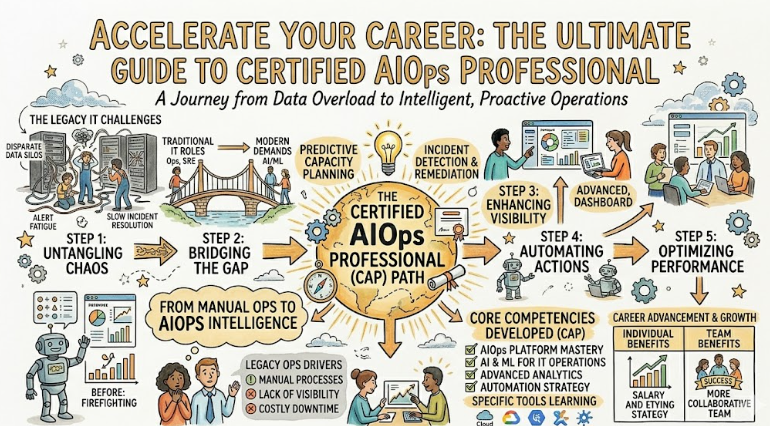
The Certified AIOps Professional is a specialized credential designed for engineers who want to lead the next wave of infrastructure automation. As systems grow more complex, manual monitoring is becoming a bottleneck for high-performing teams. This guide explores how aiopsschool provides a roadmap for professionals to master machine learning applications within IT operations.
Whether you are managing massive cloud clusters or overseeing global DevOps teams, understanding how to apply algorithmic intelligence is no longer optional. This resource is built to help you navigate the various certification tiers and understand their real-world impact. By the end of this guide, you will have a clear strategy for advancing your technical standing in the modern engineering landscape.
What is the Certified AIOps Professional?
The Certified AIOps Professional is a standard for verifying an engineer’s ability to use artificial intelligence to enhance IT operations. It exists because the sheer volume of telemetry data produced by modern microservices has exceeded the capacity of traditional human-led monitoring. This program bridges the gap between pure data science and practical systems reliability engineering.
The curriculum is designed to move beyond theoretical concepts and focus on production-grade implementations. It teaches professionals how to build systems that can identify patterns, predict failures, and automate responses without constant manual oversight. It aligns with the shift toward autonomous infrastructure where the environment itself learns to maintain its own health.
Who Should Pursue Certified AIOps Professional?
This certification is ideal for senior DevOps engineers, SREs, and cloud architects who are looking to move into high-level platform engineering roles. It also provides significant value to data engineers and security professionals who need to apply anomaly detection to their specific domains. Managers and technical leads also benefit by gaining the vocabulary and strategic insight needed to drive digital transformation.
In the global market, and particularly within the tech corridors of India, companies are actively seeking professionals who can reduce operational noise. Beginners with a strong foundation in systems administration can use this as a differentiator in a crowded job market. Experienced veterans find it useful for validating their skills in the most current operational methodologies.
Why Certified AIOps Professional is Valuable in the Future and Beyond
The demand for intelligent operations is driven by the move toward serverless and highly distributed cloud architectures. As manual tasks are increasingly automated, the role of the engineer shifts toward designing the logic that governs these automated systems. This certification ensures that your skills remain relevant as the industry moves away from reactive troubleshooting and toward proactive system management.
Investing in this program offers a high return because it addresses the most significant pain point in enterprise IT: operational complexity. Professionals who can demonstrate mastery in reducing downtime through AI-driven insights are consistently among the most highly compensated in the field. This credential signals that you are prepared to handle the scale and speed of modern technology environments.
Certified AIOps Professional Certification Overview
The program is offered through the official curriculum at Certified AIOps Professional and is hosted on the AIOpsSchool platform. It is structured to provide a logical progression from basic data literacy to advanced algorithmic design for infrastructure. The assessment process is rigorous, focusing on the candidate’s ability to solve real-world problems rather than just memorizing definitions.
The program is owned and updated by industry practitioners who manage some of the largest digital infrastructures in the world. This ensures that the content is always reflective of the current challenges faced by enterprise engineering teams. The modular structure allows candidates to focus on specific tracks that align with their current job functions or future career goals.
Certified AIOps Professional Certification Tracks & Levels
The certification is divided into Foundation, Professional, and Advanced levels to cater to different career stages. The Foundation level covers the core principles of data ingestion and basic monitoring logic. The Professional level focuses on hands-on implementation and integration with existing DevOps toolchains. The Advanced level is geared toward architects who need to design entire AIOps ecosystems.
Candidates can also choose specialization tracks that align with specific disciplines like SRE or FinOps. For instance, an SRE might focus on tracks that emphasize predictive maintenance and automated incident response. This tiered approach ensures that there is a clear growth path for every professional, regardless of their starting point.
Complete Certified AIOps Professional Certification Table
| Track | Level | Who it’s for | Prerequisites | Skills Covered | Recommended Order |
|---|---|---|---|---|---|
| Operations | Foundation | Junior Admins | Basic Networking | Data collection, UI basics | 1 |
| Engineering | Professional | SRE / DevOps | 2+ Years Exp | Anomaly detection, automation | 2 |
| Strategy | Advanced | Architects | 5+ Years Exp | ML Governance, Strategy | 3 |
| Optimization | Specialization | FinOps Leads | Cloud Basics | Cost forecasting, AI models | 4 |
Export to Sheets
Detailed Guide for Each Certified AIOps Professional Certification
Certified AIOps Professional – Foundation
What it is
This level validates a basic understanding of how machine learning interacts with IT operations. It ensures the professional understands the terminology and the data architecture required to support an AIOps environment.
Who should take it
This is suitable for entry-level engineers, IT students, and managers who need to understand the fundamental concepts of data-driven operations. It provides a solid base for anyone looking to enter the field of observability.
Skills you’ll gain
- Understanding the lifecycle of operational data.
- Differentiating between traditional monitoring and AIOps.
- Knowledge of basic data visualization for infrastructure.
- Familiarity with the common use cases for AI in operations.
Real-world projects you should be able to do
- Setting up a basic data collection pipeline.
- Creating simple dashboards that highlight system trends.
- Documenting the operational flow of an existing monitoring setup.
Preparation plan
- 7-14 Days: Focus on the history of ITOps and the core definitions of machine learning.
- 30 Days: Practice with basic data types and explore common monitoring tools.
- 60 Days: Review official study guides and take mock assessments to ensure readiness.
Common mistakes
- Focusing too much on coding and ignoring the underlying operational principles.
- Underestimating the importance of data quality and consistency.
Best next certification after this
- Same-track option: Certified AIOps Professional – Professional
- Cross-track option: Cloud Practitioner
- Leadership option: ITIL Foundation
Certified AIOps Professional – Professional
What it is
The Professional level validates the technical ability to implement AIOps solutions within a live environment. It focuses on integrating AI models with common tools like Kubernetes, Prometheus, and Jenkins to create intelligent workflows.
Who should take it
Intermediate to senior DevOps and SRE professionals who are responsible for maintaining system uptime. This is for the hands-on engineer who wants to build automated, self-healing systems.
Skills you’ll gain
- Implementing real-time event correlation and suppression.
- Building automated root cause analysis engines.
- Configuring predictive scaling for cloud resources.
- Integrating AI insights into communication tools like Slack.
Real-world projects you should be able to do
- Building a system that automatically groups related alerts into a single incident.
- Implementing a predictive auto-scaling policy for a high-traffic application.
- Creating an automated remediation workflow that resolves common server errors.
Preparation plan
- 7-14 Days: Deep dive into time-series analysis and regression models.
- 30 Days: Practice integrating monitoring APIs with automation scripts.
- 60 Days: Focus on complex architectural scenarios and multi-tool integration.
Common mistakes
- Creating “black box” automations that the rest of the team cannot troubleshoot.
- Failing to monitor the accuracy of the AI models over time.
Best next certification after this
- Same-track option: Certified AIOps Professional – Advanced
- Cross-track option: MLOps Specialist
- Leadership option: Engineering Manager Roadmap
Choose Your Learning Path
DevOps Path
The DevOps path focuses on using AIOps to accelerate the software development lifecycle. Engineers learn how to use AI to analyze code deployment patterns and predict potential failures in the CI/CD pipeline. By automating the feedback loop between production and development, teams can release software faster and with greater confidence. This path is essential for organizations striving for high-velocity delivery.
DevSecOps Path
In this path, the focus is on applying artificial intelligence to security monitoring and vulnerability management. Professionals learn how to use machine learning to identify unusual access patterns and potential security breaches in real-time. By automating the detection of security anomalies, teams can respond to threats much faster than traditional methods allow. This path is vital for maintaining compliance and protecting sensitive data.
SRE Path
The SRE path is deeply centered on maintaining service reliability through intelligent observability. It teaches engineers how to use AI to manage error budgets and perform automated incident response. SREs learn to build systems that not only alert on failures but also predict when a service is trending toward a threshold violation. This is the ultimate path for those responsible for global-scale application uptime.
AIOps Path
This is the core technical track for specialists who want to manage the AIOps platform itself. It covers the end-to-end architecture of data ingestion, model management, and algorithmic decision-making. Specialists in this track are responsible for designing the intelligence layer that supports all other operational teams. They ensure that the AI strategy is scalable and provides accurate insights across the entire infrastructure.
MLOps Path
The MLOps path focuses on the lifecycle of the machine learning models used within IT operations. It involves managing versioning, training data, and the deployment of models into production environments. This path bridges the gap between data science and systems engineering, ensuring that the AI itself is performing as expected. It is a critical role for maintaining the long-term reliability of an AIOps strategy.
DataOps Path
DataOps focuses on the quality and availability of the data that feeds the AIOps engine. This path teaches engineers how to build resilient data pipelines that can handle the massive scale of modern telemetry. By applying automation to data management, teams can ensure that their AI models are always working with high-quality information. This is the foundation upon which all successful AIOps implementations are built.
FinOps Path
The FinOps path leverages AI to optimize cloud spending and improve financial accountability. Professionals learn how to use machine learning to forecast future costs and identify areas of resource waste. By providing intelligent insights into cloud usage, FinOps practitioners help organizations balance technical performance with budgetary goals. This path is increasingly important as cloud budgets become a major corporate expense.
Role → Recommended Certified AIOps Professional Certifications
| Role | Recommended Certifications |
|---|---|
| DevOps Engineer | Professional Level + DevOps Track |
| SRE | Professional Level + SRE Track |
| Platform Engineer | Advanced Level + Core AIOps |
| Cloud Engineer | Foundation Level + Professional Level |
| Security Engineer | Professional Level + DevSecOps Track |
| Data Engineer | Professional Level + DataOps Track |
| FinOps Practitioner | Professional Level + FinOps Track |
| Engineering Manager | Foundation Level + Strategy Track |
Export to Sheets
Next Certifications to Take After Certified AIOps Professional
Same Track Progression
Advancing within the same track involves moving toward the Advanced and Architect levels. This focus is on organizational leadership, AI governance, and the design of complex multi-cloud strategies. It also involves staying current with emerging trends such as Generative AI and how it can be used to automate technical documentation and incident summaries. Architects at this level are the primary visionaries for the company’s operational platform.
Cross-Track Expansion
Expanding your skills across different tracks like MLOps or DevSecOps creates a more versatile professional profile. By understanding how different domains interact with the AIOps layer, you can lead cross-functional projects that solve complex business problems. This expansion allows you to become a comprehensive engineering leader who understands the entire technical ecosystem of a modern organization.
Leadership & Management Track
For those interested in management, the leadership track focuses on technical strategy and people management. This involves understanding how to build AIOps teams, manage budgets, and align technical goals with business outcomes. Technical managers who understand AIOps are better equipped to lead their organizations through the challenges of digital transformation and operational efficiency.
Training & Certification Support Providers for Certified AIOps Professional
DevOpsSchool
DevOpsSchool is a leading provider of technical training with a strong emphasis on hands-on labs and project-based learning. They offer comprehensive courses that prepare engineers for all levels of AIOps certification. Their curriculum is designed to be practical, ensuring that students can apply what they learn directly to their daily work.
Cotocus
Cotocus specializes in corporate training and high-end technical certifications for cloud-native engineering. They provide tailored learning paths that help teams upskill in specific areas like SRE and AIOps. Their focus on the latest industry trends makes them a reliable choice for professionals looking to stay at the cutting edge.
Scmgalaxy
Scmgalaxy is a large community platform that provides a wealth of free and paid resources, including tutorials, blogs, and forums. It is an excellent resource for self-paced learners who need additional support and community interaction during their certification journey. They host a wide range of content on various automation tools.
BestDevOps
BestDevOps offers intensive bootcamps designed to get engineers certified quickly without sacrificing depth. Their teaching style is focused on the core skills needed to succeed in modern engineering roles. They provide a mix of theoretical knowledge and practical exercises that reflect the realities of the job market.
devsecopsschool
devsecopsschool focuses on the intersection of security and operations, providing specialized training in DevSecOps and AI-driven security. Their courses are essential for professionals who need to maintain a high security posture while adopting automated operational practices. They emphasize the proactive detection of threats using machine learning.
sreschool
sreschool is dedicated entirely to the discipline of Site Reliability Engineering and its integration with AI. They provide deep-dive courses on observability, incident management, and automated remediation. This provider is the go-to for SREs looking to modernize their skills and lead high-reliability engineering teams.
aiopsschool
aiopsschool is the official authority and hosting platform for the Certified AIOps Professional credential. They provide the most direct and accurate training materials designed specifically to meet the certification standards. Learning from the primary source ensures that you are studying the most relevant and up-to-date content.
dataopsschool
dataopsschool provides the foundational data engineering training required to support an AIOps ecosystem. They focus on the principles of data quality, automation, and pipeline management. This training is critical for ensuring that the data feeding your AI models is accurate, timely, and reliable.
finopsschool
finopsschool specializes in the financial management of cloud resources using AI and data analytics. They provide the skills needed to bridge the gap between finance and engineering teams. Their curriculum is essential for anyone looking to manage cloud costs in a large-scale, automated environment.
Frequently Asked Questions (General)
- How long does it take to get certified?
Preparation usually takes between 30 to 60 days, depending on your current experience level with systems and automation. Candidates with a strong background in monitoring and Linux often move through the curriculum much faster. - Is there a retake policy if I fail the exam?
Yes, most programs allow for a retake after a brief waiting period, during which you are encouraged to review the areas where you need improvement. It is important to focus on the feedback provided in your exam report. - What is the format of the professional exam?
The exam is typically a combination of multiple-choice questions and practical, hands-on scenarios in a lab environment. This ensures that you have both the theoretical knowledge and the practical skills to do the job. - Do I need to be a programmer to pass the exam?
While you don’t need to be a software developer, having a working knowledge of scripting in Python or Bash is highly recommended for the Professional level. You will need to write scripts that interact with monitoring APIs. - Is the certification valid globally?
Yes, the certification is designed to meet international industry standards and is recognized by major technology firms around the world. It is highly valued in the global tech market for its practical focus. - Are there any prerequisites for the Professional level?
While not strictly required, it is highly recommended to have passed the Foundation level or have at least two years of experience in an IT operations or DevOps role. This provides the necessary context for the technical modules. - How does this certification help my career?
It positions you at the intersection of AI and Infrastructure, two of the most critical fields in technology today. It makes you a prime candidate for senior engineering and architecture roles in enterprise organizations. - Is the training available online?
Yes, most authorized providers offer the training in a variety of online formats, including self-paced video modules and live, instructor-led virtual sessions. This allows you to learn at your own pace from anywhere. - How often is the certification renewed?
The certification is generally valid for three years, after which you will need to recertify. This ensures that your skills remain current with the rapid advancements in AI and infrastructure management. - Does the certification focus on a specific cloud provider?
No, the program is designed to be cloud-agnostic, focusing on principles that apply to AWS, Azure, Google Cloud, and on-premises environments. This makes the skills you gain highly portable. - Are there hands-on labs included in the training?
Yes, hands-on labs are a core part of the Professional and Advanced training tracks. You will have access to virtual environments where you can practice implementing the AIOps workflows covered in the course. - Can I take the exam from home?
Yes, the exams are typically proctored online, allowing you to take them from your home or office as long as you meet the technical requirements for the proctoring software.
FAQs on Certified AIOps Professional
- What is the main benefit of AIOps for an SRE?
The primary benefit is the reduction of toil through automated incident suppression and faster root cause analysis. It allows SREs to focus on improving system design rather than constantly reacting to repetitive alerts. - How does this program address alert fatigue?
The curriculum includes specific training on event correlation and noise reduction algorithms. You will learn how to group thousands of raw alerts into a handful of actionable incidents, significantly reducing the pressure on on-call engineers. - Is machine learning theory a large part of the exam?
While you need to understand the logic behind the algorithms, the focus is on the application of ML within an operations context. You are tested on your ability to use models to solve infrastructure problems, not on the deep math behind them. - Does the certification cover open-source tools?
Yes, the program often uses popular open-source tools like Prometheus, Grafana, and ELK to demonstrate AIOps concepts. This ensures that you have practical experience with the tools most commonly used in the industry today. - How does AIOps impact Mean Time To Resolution (MTTR)?
By automating the initial correlation and diagnostic phases of an incident, AIOps can significantly reduce MTTR. It provides engineers with the most relevant data immediately, allowing them to fix the problem faster. - Can I use this certification to transition from a sysadmin role?
Absolutely. This is one of the best ways to transition from traditional systems administration to modern platform engineering or SRE roles. it provides you with the cutting-edge skills that are currently in highest demand. - Are there corporate discounts for team training?
Most training providers offer corporate packages for teams and organizations looking to certify multiple employees. This is a great way for companies to standardize their operational practices and upskill their workforce. - How does the certification stay current with AI trends?
The curriculum is reviewed annually by a board of industry experts to ensure it incorporates the latest advancements in AI, including Generative AI and its applications in automated incident management.
Final Thoughts: Is Certified AIOps Professional Worth It?
From the perspective of a technical mentor, I can tell you that the era of manual monitoring is quickly coming to an end. The sheer scale of modern technology requires a smarter approach to operations. If you want to remain a leader in this field, you must learn to leverage the power of AI to manage the complexity of the cloud.
The Certified AIOps Professional program offers a clear, practical roadmap for mastering these essential skills. It is not just about getting a certificate; it is about fundamentally changing the way you approach system reliability and infrastructure management. If you are serious about your career in engineering, this is one of the most sound investments you can make for your future.

