
Introduction
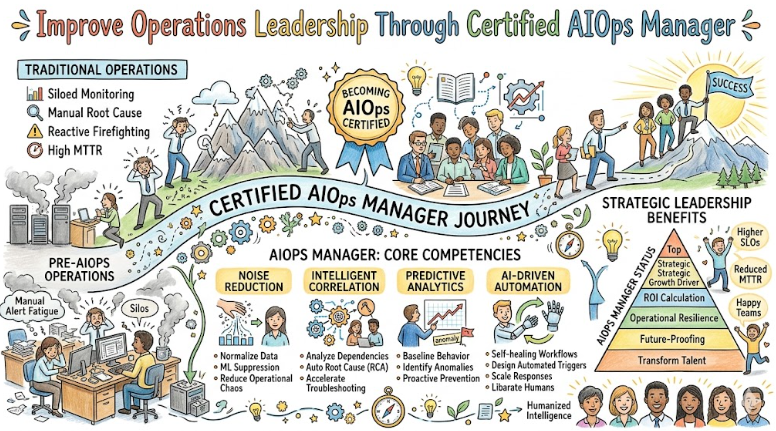
The landscape of modern IT operations is shifting from manual intervention to automated intelligence. This guide explores the Certified AIOps Manager program, a specialized credential designed for professionals navigating the intersection of artificial intelligence and systems engineering. Whether you are a DevOps engineer or a technical lead, understanding how to manage AI-driven operations is no longer optional; it is the new standard for enterprise stability. This resource helps you evaluate the curriculum and strategic value of the certification offered by aiopsschool to ensure your career trajectory aligns with the future of autonomous infrastructure.
What is the Certified AIOps Manager?
The Certified AIOps Manager designation represents a professional benchmark for those tasked with overseeing the integration of machine learning and big data into IT operations. It exists to bridge the gap between traditional monitoring and proactive, algorithmic problem-solving. Unlike theoretical academic courses, this program focuses on the practical application of AIOps platforms to reduce mean time to resolution and eliminate alert fatigue in production environments. It aligns directly with the needs of modern global enterprises that require high availability and automated incident response across complex cloud-native architectures.
Who Should Pursue Certified AIOps Manager?
This certification is tailored for SREs, DevOps architects, and Cloud engineers who are seeing their manual workflows overwhelmed by the sheer volume of telemetry data. Engineering managers and technical leaders who need to justify AIOps investments and oversee the digital transformation of their Operations Centers will find the strategic modules invaluable. It serves both seasoned professionals looking to modernize their skill set and mid-level engineers aiming for leadership roles in platform engineering. In both the Indian tech hubs and the global market, the demand for managers who can navigate AI-driven observability is growing rapidly as companies move away from legacy reactive models.
Why Certified AIOps Manager is Valuable and Beyond
As infrastructure scales beyond human capacity to manage, AIOps provides the only sustainable path forward for large-scale enterprise adoption. This certification ensures that a professional’s expertise remains relevant even as specific monitoring tools evolve or go obsolete, by focusing on the underlying logic of algorithmic operations. The longevity of this credential is rooted in its focus on architectural patterns rather than just specific software syntax, providing a high return on time investment. Organizations are increasingly prioritizing hires who can demonstrate a structured approach to reducing operational noise and predicting outages before they impact the end-user.
Certified AIOps Manager Certification Overview
The program is delivered via the Certified AIOps Manager and hosted on the aiopsschool in the introduction. The assessment approach is designed to be rigorous, utilizing a mix of conceptual examinations and practical scenario-based evaluations to ensure competency. The structure is broken down into manageable modules that cover the lifecycle of data ingestion, pattern recognition, and automated remediation. It provides a clear roadmap for professionals to demonstrate their ownership of the AIOps strategy within their respective organizations.
Certified AIOps Manager Certification Tracks & Levels
The certification is structured to support growth from foundational understanding to advanced strategic management. The foundation level introduces the core pillars of big data and machine learning in an operational context, while the professional level deepens technical implementation skills. Advanced levels are specifically designed for those moving into organizational leadership, focusing on FinOps integration and cross-departmental AIOps governance. This tiered approach allows a practitioner to align their learning with their current job responsibilities while preparing for the next step in their career progression.
Complete Certified AIOps Manager Certification Table
| Track | Level | Who it’s for | Prerequisites | Skills Covered | Recommended Order |
| Operations | Foundation | Associate Engineers | Basic Linux/Cloud | Data Ingestion, Basic ML | 1 |
| Engineering | Professional | SREs/DevOps | 2+ Years Experience | Anomaly Detection, Root Cause | 2 |
| Management | Advanced | Team Leads/Managers | Professional Cert | Strategy, ROI, Governance | 3 |
| Analytics | Specialization | Data Ops Engineers | Python Knowledge | Predictive Analytics, Modeling | Optional |
Detailed Guide for Each Certified AIOps Manager Certification
Certified AIOps Manager – Foundation
What it is
This level validates a candidate’s grasp of the core concepts of AI-driven operations and the terminology used in modern observability stacks. It confirms that the individual understands how data flows from infrastructure to insights.
Who should take it
This is suitable for junior engineers, fresh graduates entering the DevOps space, or traditional IT admins looking to understand the shift toward automated operations.
Skills you’ll gain
- Understanding telemetry data types (Metrics, Logs, Traces).
- Basic knowledge of noise reduction and event correlation.
- Familiarity with the AIOps market landscape and tool categories.
Real-world projects you should be able to do
- Configure basic data collectors for a distributed application.
- Create dashboards that visualize correlated events across different services.
Preparation plan
- 7–14 days: Focus on terminology and the theoretical differences between monitoring and AIOps.
- 30 days: Engage with lab environments to see how different data sources are aggregated into a single pane of glass.
- 60 days: Not typically required for foundation unless the candidate is entirely new to IT operations.
Common mistakes
- Overlooking the importance of data quality before applying AI models.
- Confusing standard automation scripts with true AI-driven insights.
Best next certification after this
- Same-track option: Certified AIOps Manager – Professional
- Cross-track option: Certified SRE Practitioner
- Leadership option: Technical Team Lead Certification
Certified AIOps Manager – Professional
What it is
This certification validates the ability to implement and tune AIOps platforms in a production setting. It focuses on the technical nuances of anomaly detection and automated incident management.
Who should take it
Experienced SREs, DevOps Engineers, and Platform Engineers who are actively managing cloud-native infrastructure and want to automate their response layers.
Skills you’ll gain
- Implementing supervised and unsupervised learning for anomaly detection.
- Building automated remediation workflows triggered by AI insights.
- Fine-tuning alert thresholds to eliminate false positives.
Real-world projects you should be able to do
- Design an automated self-healing system for a microservices architecture.
- Implement a predictive scaling model based on historical traffic patterns.
Preparation plan
- 7–14 days: Review ML algorithms specifically used in time-series data analysis.
- 30 days: Build a pilot AIOps project using open-source or enterprise trial tools.
- 60 days: Perform deep-dive analysis into case studies regarding failed AIOps implementations to understand pitfalls.
Common mistakes
- Attempting to automate complex tasks before achieving a baseline of stable observability.
- Neglecting the “Human in the Loop” aspect of AI operations.
Best next certification after this
- Same-track option: Certified AIOps Manager – Advanced
- Cross-track option: MLOps Specialist
- Leadership option: Certified Engineering Manager
Choose Your Learning Path
DevOps Path
The DevOps path focuses on integrating AIOps into the CI/CD pipeline and deployment cycles. It emphasizes how AI can be used to predict the impact of code changes on production stability before they occur. Engineers on this path will learn to use data-driven insights to optimize delivery speed without compromising system reliability. This path is ideal for those who want to build “smarter” pipelines that can automatically roll back based on anomalous performance signatures.
DevSecOps Path
In this path, the focus shifts toward using AI for threat detection and automated security responses. It bridges the gap between operations and security by using AIOps to identify patterns that signify a breach or a vulnerability exploit. Professionals will learn how to integrate security telemetry into the broader AIOps framework for a unified defense strategy. This is essential for organizations operating in highly regulated environments with massive attack surfaces.
SRE Path
The Site Reliability Engineering path centers on using AIOps to maintain Service Level Objectives (SLOs) and manage error budgets more effectively. It prioritizes automated root cause analysis and the reduction of toil through intelligent incident management. SREs will learn how to move from “firefighting” to a proactive stance where the system identifies potential failures before they result in downtime. This path is the most technically demanding regarding data analysis and system architecture.
AIOps Path
The pure AIOps path is dedicated to mastering the algorithms and data structures that power autonomous operations. It focuses heavily on the selection of the right machine learning models for specific operational use cases, such as capacity planning or log clustering. Practitioners become experts in the AIOps platform itself, acting as the internal specialists who configure and maintain the intelligence layer. This is a specialized role that serves as a bridge between the data science team and the operations team.
MLOps Path
The MLOps path addresses the operational challenges of deploying and maintaining machine learning models at scale. While AIOps uses AI to help operations, MLOps uses operational best practices to help AI. Professionals learn how to manage model versioning, monitoring for data drift, and ensuring the reliability of the ML pipeline. This path is crucial for organizations where the product itself is heavily reliant on AI/ML features.
DataOps Path
DataOps focuses on the orchestration of data flow and quality, which is the foundational requirement for any successful AIOps implementation. This path teaches how to ensure that the data being fed into AI models is clean, consistent, and timely. Without a solid DataOps foundation, AIOps models will provide inaccurate or “hallucinated” insights. It is a vital path for those who want to specialize in the “Big Data” side of modern IT operations.
FinOps Path
The FinOps path leverages AIOps to provide intelligent cloud cost management and optimization. By applying machine learning to usage patterns, professionals can predict cloud spend and identify waste that manual audits would miss. It focuses on the intersection of finance, engineering, and business strategy. This path is increasingly popular as cloud budgets become a primary concern for executive leadership.
Role → Recommended Certified AIOps Manager Certifications
| Role | Recommended Certifications |
| DevOps Engineer | Certified AIOps Manager (Foundation + Professional) |
| SRE | Certified AIOps Manager (Professional) |
| Platform Engineer | Certified AIOps Manager (Professional + Advanced) |
| Cloud Engineer | Certified AIOps Manager (Professional) |
| Security Engineer | Certified AIOps Manager (Specialization in DevSecOps) |
| Data Engineer | Certified AIOps Manager (Foundation + DataOps Focus) |
| FinOps Practitioner | Certified AIOps Manager (FinOps Specialization) |
| Engineering Manager | Certified AIOps Manager (Advanced / Management Track) |
Next Certifications to Take After Certified AIOps Manager
Same Track Progression
Deepening your specialization within AIOps involves moving into high-level architectural roles. This often means pursuing expert-level certifications that focus on multi-cloud AI orchestration and bespoke model development for unique enterprise needs. The goal here is to become the primary architect responsible for the organization’s entire autonomous operations roadmap.
Cross-Track Expansion
Broadening your skills involves looking at adjacent fields like MLOps or specialized Cloud Architecture. Since AIOps gives you a high-level view of system health, expanding into security (DevSecOps) or cost management (FinOps) allows you to apply those algorithmic insights to different business problems. This makes you a more versatile asset to the leadership team.
Leadership & Management Track
For those looking to move away from hands-on keyboard work, the next step is focusing on executive leadership and digital transformation strategy. This involves certifications in business management, organizational change, and strategic technology planning. Here, the AIOps background serves as a technical foundation to help you lead large-scale engineering departments with a data-driven mindset.
Training & Certification Support Providers for Certified AIOps Manager
DevOpsSchool
This provider offers extensive resources for those looking to integrate AIOps into a wider DevOps framework. Their trainers are industry veterans who focus on the practical integration of tools and culture. They provide a robust environment for hands-on learning and real-world project simulations.
Cotocus
This organization is known for its deep technical dives and specialized training modules. They cater to engineers who want to understand the “under the hood” mechanics of cloud-native technologies. Their approach to AIOps is highly analytical and geared toward complex enterprise environments.
Scmgalaxy
As a long-standing community and training portal, they provide a wealth of knowledge on configuration management and operational workflows. Their support for AIOps candidates includes comprehensive study guides and community-driven insights. They are a reliable source for staying updated on industry trends.
BestDevOps
This provider focuses on curated learning paths that prioritize career ROI. Their AIOps training is designed to be concise and impactful, stripping away the fluff to focus on what actually matters in a production environment. They are excellent for busy professionals who need efficient upskilling.
devsecopsschool
This is the premier destination for those wanting to blend security with operations. Their training ensures that AIOps practitioners don’t forget the critical security layer. They offer specialized courses that cover automated threat hunting and AI-driven compliance.
sreschool
Dedicated to the art of reliability, this provider offers deep insights into maintaining system uptime. Their AIOps curriculum is heavily weighted toward incident response and proactive maintenance. It is a perfect fit for engineers who live and breathe availability.
aiopsschool
This is the primary authority for the Certified AIOps Manager program. They provide the most direct and comprehensive curriculum aligned with the certification standards. Their focus is exclusively on the evolution of AI in operations, ensuring the most up-to-date content.
dataopsschool
Understanding that data is the fuel for AI, this provider specializes in the data engineering side of operations. Their training covers everything from data pipelines to quality assurance. They are essential for anyone wanting to master the “Data” in AIOps.
finopsschool
This provider focuses on the financial side of cloud operations. Their training teaches how to use AIOps to drive business value and reduce unnecessary cloud expenditure. It is the go-to resource for professionals looking to marry engineering with financial accountability.
Frequently Asked Questions (General)
1. How difficult is the Certified AIOps Manager exam?
The difficulty is moderate to high, as it requires a solid understanding of both IT operations and basic machine learning concepts. It is not just about memorization but about applying logic to complex scenarios.
2. How much time should I dedicate to studying?
Most professionals find that 30 to 60 days of consistent study is sufficient. This allows for a balance of reading the theoretical materials and practicing with AIOps tools.
3. Are there any strict prerequisites for the foundation level?
No strict technical prerequisites exist for the foundation level, but a basic understanding of Linux, networking, and cloud services is highly recommended.
4. What is the ROI of getting this certification?
The return on investment is significant, as it positions you for high-demand roles that command premium salaries. Organizations value the ability to reduce operational overhead through AI.
5. In what order should I take the certifications?
It is best to follow a linear path: start with Foundation, move to Professional, and then choose a Specialization or the Advanced Management track.
6. Does this certification cover specific tools like Splunk or Dynatrace?
The program is designed to be vendor-neutral, focusing on the principles of AIOps. However, it often uses popular enterprise tools for practical examples.
7. Is the exam conducted online or at a center?
The exam is typically available online through proctored platforms, making it accessible to professionals globally.
8. How long is the certification valid?
Most professional certifications in this space are valid for two to three years, after which recertification or continuing education credits are required.
9. Can this certification help me move into Data Science?
While it provides a foundation in ML applications, it is focused on operations. It is a great bridge, but a full Data Science career would require additional math and statistics study.
10. Is this certification recognized in India?
Yes, it is highly recognized by major IT service providers and captive units in India’s major tech hubs like Bangalore, Pune, and Hyderabad.
11. Does the course include hands-on labs?
Yes, the curriculum emphasizes practical application, providing virtual lab environments to test AIOps configurations.
12. How does AIOps differ from standard DevOps?
DevOps focuses on the collaboration between development and operations, while AIOps provides the intelligent tools and data analysis to make those operations autonomous.
FAQs on Certified AIOps Manager
What is the primary focus of the Certified AIOps Manager curriculum?
The curriculum focuses on transforming traditional reactive IT operations into proactive, intelligent systems using big data and machine learning.
Does this certification cover the financial aspects of AI operations?
Yes, especially at the advanced levels, where the integration of FinOps and AIOps is explored to optimize cloud costs through intelligent forecasting.
Is there a focus on automated remediation?
Absolutely. A key pillar of the certification is learning how to design and implement self-healing systems that respond to AI-detected anomalies.
How does this certification address “Alert Fatigue”?
It teaches candidates how to use event correlation and noise reduction algorithms to ensure that only actionable alerts reach the engineering teams.
Are management skills part of the certification?
The “Manager” aspect of the title refers to the ability to oversee the strategy, selection, and implementation of AIOps across an organization.
Does the course require deep programming knowledge?
While deep coding isn’t always required, familiarity with Python or similar scripting languages is very helpful for the technical tracks and automation modules.
How is the certification updated for new AI trends?
The certification body regularly reviews the curriculum to include advancements in generative AI and new algorithmic patterns in the operations space.
What kind of support is available for students?
Students have access to comprehensive documentation, community forums, and often live mentorship sessions depending on the training provider chosen.
Final Thoughts: Is Certified AIOps Manager Worth It?
From a mentor’s perspective, the transition to AIOps is an inevitable evolution of the industry. Systems have become too complex for humans to manage with manual scripts and basic dashboards alone. The Certified AIOps Manager credential provides a structured, professional way to validate that you are ready for this shift. It moves you away from being a “operator” and toward being an “architect of intelligence.” If you are looking to future-proof your career and lead high-performance teams in the next decade of cloud engineering, this path is a sound and practical investment. It isn’t about the hype of AI; it’s about the reality of modern scale.

