
Introduction
In today’s fast-paced software development landscape, security cannot be an afterthought. As organizations increasingly adopt DevOps practices to accelerate development cycles, the need for integrating security into every stage of the DevOps pipeline has become essential. This is where DevSecOps comes in, integrating security practices directly into DevOps workflows to ensure secure software delivery at speed. The DevSecOps Certified Professional (DSOCP) certification, offered by DevOpsSchool, is specifically designed to help professionals gain expertise in building secure applications and managing secure operations in a DevOps environment.
I have seen firsthand how DevSecOps is transforming the way organizations approach security. This certification is essential for anyone looking to build secure, scalable, and resilient systems while maintaining the agility that DevOps offers. In this guide, I will walk you through the DSOCP certification, its importance, who should pursue it, and how it can benefit your career.
What is the DevSecOps Certified Professional (DSOCP)?
The DevSecOps Certified Professional (DSOCP) certification is an advanced qualification designed for professionals who want to integrate security practices into the DevOps lifecycle. Unlike traditional security approaches that focus on securing applications only after development, DevSecOps integrates security at every stage—from development through deployment and operations. The DSOCP certification provides professionals with the knowledge and hands-on experience to automate security testing, vulnerability management, and compliance checks within the CI/CD pipeline, ensuring secure and compliant applications at all times.
Who Should Take the DSOCP Certification?
The DSOCP certification is ideal for a wide range of professionals, including:
1. DevOps Engineers
- Professionals working in DevOps who want to deepen their knowledge of security automation within CI/CD pipelines.
2. Security Engineers
- Security professionals looking to expand their expertise by automating security in DevOps pipelines, ensuring security is embedded at every stage of development.
3. Software Engineers
- Developers interested in learning secure coding practices and understanding how to integrate security into their development workflows.
4. Cloud Engineers
- Cloud professionals who manage cloud infrastructures and want to secure cloud resources and applications while automating security practices.
5. Engineering Managers
- Managers overseeing DevOps and security teams who want to integrate DevSecOps principles into their organization’s software delivery lifecycle.
6. Aspiring DevSecOps Practitioners
- Individuals looking to enter or specialize in DevSecOps roles and enhance their skills in securing the development process.
Skills You’ll Gain from the DSOCP Certification
By completing the DSOCP certification, you will gain a strong understanding of DevSecOps principles and become proficient in using the following tools and techniques:
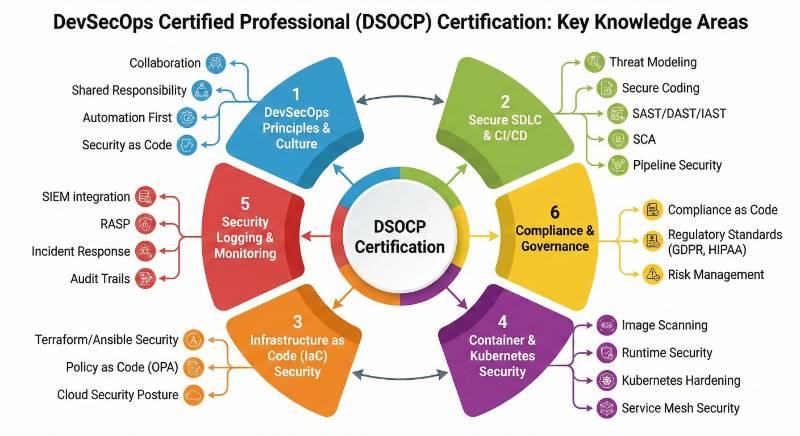
- CI/CD Security: Learn to integrate automated security checks and vulnerability scans into continuous integration and delivery pipelines.
- Cloud Security: Understand how to secure cloud environments (AWS, Azure, GCP), manage access controls, and automate security in cloud-based applications.
- Container Security: Gain hands-on experience securing containerized applications with Docker and Kubernetes, ensuring security throughout the container lifecycle.
- Security Automation: Automate security practices such as vulnerability scanning, code analysis, and compliance monitoring within the DevOps pipeline.
- Compliance Management: Automate compliance checks, ensuring that applications meet industry regulations such as GDPR, HIPAA, and SOC 2.
- Incident Response: Build and manage incident response systems for detecting and mitigating security breaches in real time.
Real-World Projects You Should Be Able to Do After It
After completing the DSOCP certification, you will be equipped to work on the following real-world projects:
- Building Secure CI/CD Pipelines: Automating security testing, vulnerability scanning, and compliance checks within CI/CD pipelines using tools like Jenkins, GitLab, and Snyk.
- Securing Cloud Infrastructure: Implementing security best practices in cloud environments like AWS, Azure, and GCP, including IAM policies, encryption, and vulnerability management.
- Securing Containers and Microservices: Containerizing applications securely with Docker, Kubernetes, and ensuring that security practices are integrated from development to production.
- Automating Vulnerability Scanning and Compliance: Using tools such as OWASP ZAP, Burp Suite, and Terraform to automate security testing and compliance in the DevOps pipeline.
- Setting up Incident Response Systems: Building and configuring automated incident response systems to detect and mitigate security threats in real time.
Preparation Plan for DSOCP Certification
The preparation for the DSOCP certification can be approached in stages based on your available study time and prior experience. Below are preparation plans for 7-14 days, 30 days, and 60 days.
7–14 Days Preparation Plan
Ideal for: Professionals with some experience in DevOps and security practices.
Week 1: DevSecOps Basics & CI/CD Security
- Day 1–3: Understand the fundamental principles of DevSecOps and why security must be integrated into the DevOps lifecycle.
- Day 4–7: Learn about CI/CD security, integrating automated security tests and vulnerability scanning within tools like Jenkins or GitLab CI.
Week 2: Cloud & Container Security
- Day 8–10: Focus on securing cloud platforms like AWS, Azure, or GCP, covering access control, IAM, and encryption.
- Day 11–14: Study container security, learning how to secure Docker containers and manage Kubernetes clusters securely.
30-Day Preparation Plan
Ideal for: Professionals who have a solid understanding of DevOps and security practices but want to go deeper into cloud and container security.
Week 1–2: CI/CD Security & Automation
- Day 1–7: Dive deeper into CI/CD security, implementing security automation using tools like OWASP ZAP and Burp Suite.
- Day 8–14: Automate security testing, vulnerability scanning, and policy enforcement within your CI/CD pipelines.
Week 3–4: Cloud Security & Container Security
- Day 15–21: Focus on cloud security, learning best practices for securing AWS, GCP, and Azure environments.
- Day 22–30: Master container security practices, including securing Docker and Kubernetes clusters, and integrating security into the container lifecycle.
60-Day Preparation Plan
Ideal for: Professionals seeking comprehensive expertise in DevSecOps, including advanced cloud and container security.
Week 1–2: DevSecOps Fundamentals & CI/CD Security
- Day 1–7: Understand the core principles of DevSecOps and learn about its importance in software delivery.
- Day 8–14: Set up automated security testing, vulnerability scanning, and compliance checks within CI/CD pipelines.
Week 3–4: Cloud Security & Vulnerability Management
- Day 15–21: Study cloud security best practices, including how to secure infrastructure as code (IaC) and cloud environments.
- Day 22–28: Automate vulnerability management using tools like Snyk and OWASP ZAP.
Week 5–6: Container Security & Real-World Projects
- Day 29–35: Learn advanced container security practices, including managing secrets and vulnerabilities in Docker and Kubernetes.
- Day 36–42: Build and deploy real-world DevSecOps projects with automated security checks and continuous compliance monitoring.
- Day 43–60: Complete hands-on projects integrating security into DevOps pipelines using the tools and techniques learned during the preparation.
Common Mistakes to Avoid
- Neglecting Automated Security: Always automate security within CI/CD pipelines to ensure vulnerabilities are identified and addressed early in the process.
- Overlooking Cloud Security: Ensure that cloud environments are securely configured, and always implement proper IAM policies and data encryption.
- Skipping Container Security: Containers need to be secured from development to deployment. Never overlook securing container images and orchestrators like Kubernetes.
- Failing to Maintain Continuous Compliance: Compliance should not be a one-time task. Integrate automated compliance checks into your DevSecOps pipeline.
Best Next Certification After DSOCP
- Same Track: Certified DevSecOps Professional (CDP)
- Cross-Track: Certified Kubernetes Administrator (CKA)
- Leadership Track: Certified DevOps Leader (CDL)
Choose Your Path: DevOps Learning Paths
After completing the DSOCP certification, you can specialize further by exploring one of the following six learning paths to advance your expertise and tailor your career in DevOps:
1. DevOps
Master the tools, techniques, and practices that streamline software delivery, automate infrastructure management, and enhance collaboration between development and operations teams to optimize the entire development lifecycle.
2. DevSecOps
Specialize in integrating security practices within the DevOps lifecycle, ensuring that security is built into every stage of the pipeline. Learn to automate security testing, vulnerability scanning, and compliance monitoring to ensure continuous, proactive security.
3. Site Reliability Engineering (SRE)
Focus on enhancing system reliability, availability, and scalability. Learn how to build and manage highly available systems, optimize performance, and minimize downtime through automation and continuous monitoring.
4. AIOps/MLOps
Implement artificial intelligence (AI) and machine learning (ML) in the DevOps pipeline to enable smarter automation, proactive monitoring, predictive analytics, and real-time anomaly detection to improve the efficiency of operations.
5. DataOps
Specialize in automating and managing data pipelines, ensuring that data flows seamlessly between systems. Learn to integrate DevOps principles into data processing to streamline data operations, enhance collaboration, and ensure high-quality data delivery.
6. FinOps
Focus on optimizing cloud costs and managing financial operations within the DevOps workflow. Learn how to balance cost management with performance, helping organizations manage their cloud resources effectively while ensuring financial accountability.
Role → Recommended Certifications
| Role | Recommended Certifications |
|---|---|
| DevOps Engineer | DSOCP, CDP, CKA |
| SRE | DSOCP, SRE, CKA |
| Platform Engineer | DSOCP, CKA, CKAD |
| Cloud Engineer | DSOCP, AWS Certified Solutions Architect |
| Security Engineer | DSOCP, DevSecOps, CISM |
| Data Engineer | DSOCP, DataOps, Google Data Engineer |
| FinOps Practitioner | DSOCP, FinOps, Certified Cloud Financial Professional |
| Engineering Manager | DSOCP, CDL, DevOps Leader |
Certifications Table
| Track | Level | Who it’s for | Prerequisites | Skills Covered | Recommended Order | Link |
|---|---|---|---|---|---|---|
| DSOCP | Advanced | Security Engineers, DevOps Professionals | Experience in DevOps, Security Basics | CI/CD Security, Cloud Security, Automation | DSOCP → CDP → CKA | DSOCP Certification |
FAQs on DevSecOps Certified Professional (DSOCP)
- How difficult is the DSOCP certification?
The DSOCP certification is advanced and requires hands-on experience with DevOps tools, security practices, and automation. - What are the prerequisites for the DSOCP certification?
Basic knowledge of DevOps practices, security concepts, and cloud technologies is recommended. - How long does it take to complete the DSOCP certification?
Typically, it takes 1–2 months depending on your prior knowledge and study time. - Can I take the DSOCP certification exam online?
Yes, the DSOCP certification exam is available online, providing flexibility for candidates around the world to take the exam remotely. - What skills will I gain from the DSOCP certification?
Skills in CI/CD security, cloud security, container security, vulnerability management, and security automation. - What are the career benefits after completing DSOCP?
Completing the DSOCP certification opens up roles such as DevSecOps Engineer, Security Engineer, Cloud Security Specialist, and more. - What tools are covered in the DSOCP certification?
Tools like OWASP ZAP, Snyk, Burp Suite, Jenkins, Terraform, Docker, Kubernetes are covered in the certification. - Is DSOCP certification globally recognized?
Yes, the DSOCP certification is widely recognized in the cybersecurity and DevOps fields.
Top Institutions Offering DSOCP Certification
Here are some of the top institutions that offer training and certifications for the DevSecOps Certified Professional (DSOCP) certification:
- DevOpsSchool
As the official provider of the DSOCP certification, DevOpsSchool offers comprehensive, hands-on training with expert-led sessions and live projects. Their courses are designed to give you practical experience in integrating security within the DevOps pipeline. - Cotocus
Cotocus specializes in DevSecOps and security training, focusing on real-world application and project-based learning. Their courses help learners implement security automation and integrate security best practices into DevOps workflows. - ScmGalaxy
ScmGalaxy is renowned for its in-depth training programs on DevOps and security practices, covering the essential tools and methodologies. Their training ensures that professionals can apply security practices in a fast-paced DevOps environment. - BestDevOps
BestDevOps offers practical training with a strong focus on integrating security within DevOps workflows. Their certifications equip learners with the knowledge needed to secure the DevOps pipeline from start to finish. - DevSecOpsSchool
Specializing in DevSecOps training, DevSecOpsSchool emphasizes securing the DevOps pipeline and practices. Their program is ideal for those who want to focus on security while adopting DevOps methodologies. - SRESchool
SRESchool focuses on Site Reliability Engineering (SRE) with a security angle, complementing DevSecOps knowledge. They offer training on how to manage secure, reliable, and scalable services while ensuring system reliability. - AIOpsSchool
AIOpsSchool offers specialized training on integrating AI and machine learning into DevOps workflows. Their courses teach you how to use AI/ML for automation, monitoring, and improving system performance and security. - DataOpsSchool
DataOpsSchool specializes in automating and managing data pipelines within a DevOps environment. Their training provides insights into secure data processing and how DevOps practices can be applied to data management and analysis. - FinOpsSchool
FinOpsSchool focuses on optimizing cloud costs and managing financial operations within DevOps workflows. They offer specialized courses on how to manage and optimize cloud costs while maintaining performance, security, and scalability.
Conclusion
The DevSecOps Certified Professional (DSOCP) certification is a must-have for professionals who want to integrate security throughout the DevOps pipeline. With the increasing importance of security in every aspect of modern software development, this certification helps professionals gain the knowledge and skills necessary to secure applications and infrastructure while maintaining the speed and efficiency of DevOps practices. Whether you’re a DevOps engineer, security professional, or engineering manager, the DSOCP certification opens doors to new career opportunities and ensures you’re equipped to tackle the challenges of modern secure software delivery.

